


Traveling around the United States by train is no longer just a niche choice for rail buffs. Between flexible rail passes, curated multi-city packages and fully escorted tours, it has become one of the most comfortable and scenic ways to see the country. The challenge for many travelers is deciding which option offers the best value for their route, time frame and budget. This guide looks at the main types of rail passes and tours now available across the U.S., with concrete examples of when each is worth booking and how to use them in real itineraries.
Get the latest updates straight to your inbox!
How U.S. Rail Passes and Multi City Packages Work
In the United States, long distance and most intercity passenger services are operated by Amtrak, while a small but growing number of private or regional operators offer additional routes or premium tourist trains. The key products that help travelers string together multi city trips are national or regional rail passes, flexible multi-ride tickets on specific corridors, and bundled vacation packages that combine rail, hotels and sightseeing. Understanding the basic mechanics of each will make it much easier to compare costs with booking individual tickets.
Rail passes usually give you a set number of segments within a fixed time window, such as ten train rides within thirty days. Each segment is one boarding of a train, regardless of distance, which means an overnight ride from Chicago to Denver counts the same as a short daytime hop between Boston and New York. Most passes are valid only in coach; upgrading to private sleeper rooms, if allowed, costs extra and is often subject to availability.
Multi city packages sit at the other end of the spectrum. These are pre-built or semi-custom itineraries that might include rail travel between cities plus several hotel nights, local tours and sometimes park shuttles. Companies such as Amtrak Vacations design itineraries like “Grand National Parks” or “New York to New Orleans” that package rail with lodging and sightseeing, while specialist operators like America by Rail focus on fully escorted group tours where a tour director manages logistics and accompanies guests throughout the journey.
Between those two options are multi-ride or monthly passes for specific routes. These are especially useful if you are basing yourself in one region and making repeated trips on the same line, like shuttling between Boston and New York for a week of city-hopping, or riding repeatedly along California’s coast. They do not give the freedom to roam the entire national network, but they can significantly reduce per-trip costs on busy corridors.
Amtrak USA Rail Pass: The Flexible Cross Country Workhorse
For most independent travelers aiming to see multiple regions in one trip, Amtrak’s USA Rail Pass is the most important product to understand. As of mid 2026, the pass gives you ten segments of coach travel within a thirty day period, on most Amtrak routes in the continental United States. It is designed as a flexible, hop-on hop-off style pass so you can build an itinerary such as Chicago to Denver on the California Zephyr, Denver to Salt Lake City, Salt Lake City to the Bay Area, and then continue up the Pacific Northwest or back across the country, all using a single pass as long as you plan your connections carefully.
The pass is best value on longer segments and on routes where last-minute one-way fares can be high. A typical example is the California Zephyr, which runs between Chicago and the San Francisco Bay Area via Denver, Salt Lake City and Reno. On busy summer dates, a one-way coach fare for Chicago to Emeryville can run into the low hundreds of dollars if booked close to departure. Replicating a series of long legs like Chicago to Denver, Denver to Salt Lake City and Salt Lake City to the Bay Area individually can easily exceed the cost of the pass, whereas using three of your ten segments covers the same ground at a fixed price.
There are important restrictions. The pass is not valid on Acela services in the Northeast Corridor, on the Auto Train, or on certain international portions of cross-border routes, and space for pass holders can be limited on popular long-distance trains. Tickets using the pass must be reserved in advance, and you cannot simply board any train without a reservation. Upgrading to a roomette or bedroom on overnight trains, when permitted, requires paying the full sleeper accommodation charge on top of using a segment, which can significantly increase the overall cost and should be factored into your budget.
In practical terms, travelers who get the most from the USA Rail Pass usually craft a one-way or loop itinerary that strings together several long runs with a few shorter hops. A classic example for first-timers might be starting in Boston or New York, traveling to Chicago, continuing to Denver on the California Zephyr, then onward to Salt Lake City and the Bay Area, and finally up the coast on the Coast Starlight to Seattle. With careful planning and flexible dates, that sort of coast-to-coast plus West Coast itinerary can be covered with a single pass, leaving one or two spare segments for side trips such as Seattle to Vancouver, Washington state, or a detour to New Orleans.
Regional Rail Passes and Multi Ride Options Worth Considering
Not every traveler needs a national pass. If you are focusing on a single region, Amtrak’s regional passes and multi-ride tickets can offer better value and a simpler set of choices. The California Rail Pass is one standout. It allows seven days of travel within a twenty one day period on most state supported Amtrak services within California, such as the Pacific Surfliner between San Luis Obispo and San Diego, the Capitol Corridor between San Jose and Sacramento, and the San Joaquins in the Central Valley. You can combine these with dedicated bus connections to reach places like Yosemite Valley or the central coast, making it a convenient backbone for a three-week California itinerary that hops between cities and national parks.
Multi-ride passes on specific routes are another useful tool, especially if you are planning multiple trips between the same two cities. In the Northeast, for example, Amtrak sells ten-ride and monthly passes on routes like the Northeast Regional between Boston, New York and Washington, the Keystone Service between New York and Harrisburg via Philadelphia, and the Downeaster between Boston and Brunswick, Maine. On busy business travel days, a last minute one-way Northeast Regional ticket between New York and Washington can approach or exceed one hundred dollars. A ten-ride pass, while a significant upfront purchase, can lower the per-ride cost substantially if you are traveling frequently within a set period.
Similar multi-ride products exist in the Midwest on routes such as the Hiawatha and Borealis between Chicago and Milwaukee, and on various Illinois and Michigan corridor trains, as well as on several West Coast routes including the Amtrak Cascades between Eugene, Portland, Seattle and the Canadian border. These are particularly attractive if you are planning a base-and-spoke trip, staying in a city like Chicago or Seattle and making repeated regional excursions instead of an extended one-way journey across the country.
Outside the Amtrak system, private operators are beginning to introduce their own passes on limited networks. In Florida, Brightline has rolled out multi-ride passes that bundle a set number of trips across its South Florida corridor and the newer extension to Orlando. While these are primarily aimed at commuters and frequent leisure travelers, they can also make sense if you are spending several weeks in Florida and expect to ride regularly between Miami, Fort Lauderdale, West Palm Beach and Orlando without renting a car.
Escorted Rail Tours: America by Rail and Similar Operators
For travelers who prefer not to manage the details of bookings, hotel changes and transfers, fully escorted rail tours can be an excellent alternative to do-it-yourself passes. Companies such as America by Rail specialize in these itineraries, combining segments on regular Amtrak services or heritage railways with coach transfers, hotel stays and guiding. Guests typically travel in a group with a dedicated tour director who handles check-ins, baggage logistics and on-the-ground problem solving, which can be especially appealing for older travelers or those new to independent travel in the United States.
Typical America by Rail itineraries focus on classic scenic routes and national parks. A Western national parks tour might, for instance, use scheduled Amtrak services to reach gateway cities like Denver, Salt Lake City or Flagstaff, then switch to motorcoach to access parks such as Rocky Mountain, Arches, Zion, Bryce Canyon or the South Rim of the Grand Canyon. Along the way, the tour might include rides on historic excursion lines like Colorado’s Cumbres and Toltec Scenic Railroad or Arizona’s Verde Canyon Railroad, which provide short but spectacular heritage experiences not available on standard intercity trains.
The cost structure for these tours is different from simply adding up rail fares. A ten to fourteen day escorted package that includes several train segments, most hotel nights, some meals and sightseeing can run into the several-thousand-dollar range per person, especially in peak summer or during fall foliage season in New England. However, when you factor in the convenience of having every transfer and hotel arranged, as well as the guidance of a tour director, many travelers find the all-in pricing comparable to what they would spend piecing everything together independently, especially in popular national park regions where rooms can be expensive or hard to find.
Escorted tours also tend to include special experiences that would be challenging to replicate exactly on your own, such as private coach charters on certain sightseeing lines or group access to local guides and museums. The trade-off is less flexibility. Itineraries are set months in advance, and while you can often add pre- or post-tour nights in gateway cities like Chicago, Los Angeles or Seattle, the core route and schedule are fixed. These tours are best suited to travelers who want to see a lot of territory with minimal logistical stress and who value traveling with a small group.
Premium Scenic Rail Journeys and Multi City Packages
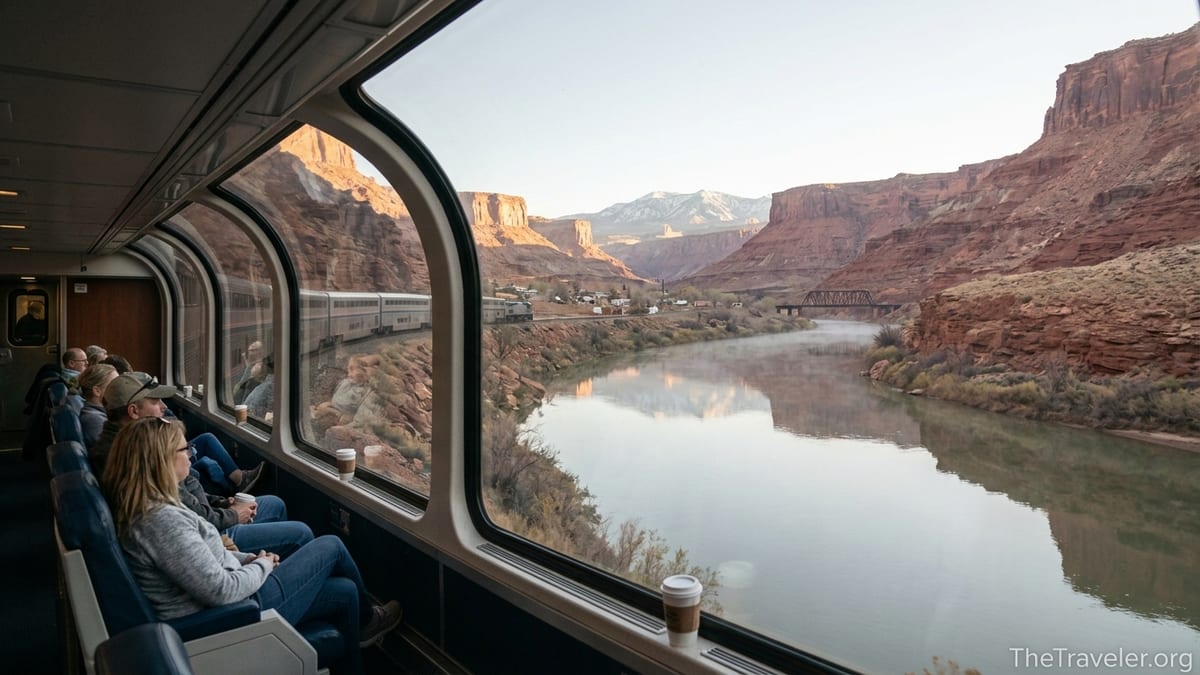
Beyond regular intercity trains and escorted tours, a growing number of premium scenic rail products operate in the American West. One of the best known is Rocky Mountaineer’s “Rockies to the Red Rocks” service between Denver and Moab, with an overnight stop in Glenwood Springs. This is a daylight-only, two-day rail journey that focuses on scenery and onboard service rather than transportation efficiency. There are no sleeper cars; instead, guests overnight in a hotel in Glenwood Springs and continue the following day through desert canyons toward Utah.
Rocky Mountaineer packages this core route into multi city itineraries that can include additional hotel nights in Denver, Moab or Salt Lake City, guided excursions in Colorado’s high country or Utah’s canyonlands, and transfers to nearby national parks. A traveler might book a package that includes the two-day train journey, two nights in Denver, two nights in Moab, and guided visits to Arches and Canyonlands National Parks, all bundled at a fixed price. The onboard experience typically includes at-seat dining, large panoramic windows, commentary and wine or beer service, so it feels more like a land cruise than conventional train travel.
These premium scenic journeys are generally more expensive on a per-mile basis than Amtrak, and they serve a relatively limited geography. However, they can be very attractive as centerpieces of a broader trip through the Rockies or the Southwest, particularly for travelers who are willing to spend extra for comfort and curated experiences. Because departures are often seasonal, usually concentrated between spring and fall, and capacity is limited, booking several months ahead is advisable, especially for September and October departures that coincide with fall colors and cooler desert temperatures.
Other premium options include short but spectacular tourist lines tied to specific destinations. For instance, travelers visiting the Grand Canyon’s South Rim can ride the Grand Canyon Railway from Williams, Arizona, as a day trip with classic rolling stock and entertainment along the way. In Colorado, lines such as the Durango and Silverton Narrow Gauge Railroad and the Royal Gorge Route Railroad offer scenic excursions through mountain passes and river gorges. While these do not offer passes in the same sense as intercity rail, many regional tour companies weave them into multi city packages that also include bus segments and hotel stays in gateway towns.
Amtrak Vacations and Customizable Multi City Rail Itineraries
Amtrak Vacations occupies a middle ground between independent pass travel and fully escorted tours. It is a tour operator that builds rail-based vacation packages using regular Amtrak services, pairing them with hotels, optional sightseeing and sometimes car rentals. Unlike escorted tours, most Amtrak Vacations packages are independent; you receive tickets, vouchers and an itinerary, but you do not travel with a tour director or group. This makes them appealing for travelers who want logistical support and bundled pricing but still prefer to explore on their own.
Examples range from city-to-city trips like “New York to Washington D.C. by Rail,” which might include rail tickets, two or three nights of hotel accommodation in each city and a guided city tour, to more elaborate “Grand National Parks” itineraries that string together overnight trains and hotel stays near parks such as Glacier, Yosemite, Yellowstone or the Grand Canyon. A traveler could, for instance, book a loop that starts in Chicago, visits Glacier National Park via the Empire Builder, continues to Seattle and then returns on the California Zephyr through the Rockies. The package price would include rail segments, specified hotel nights and pre-arranged sightseeing components.
Amtrak Vacations also offers a high level of customization. Many itineraries are labeled as “suggested” rather than fixed; travelers can add extra nights in gateway cities like San Francisco or New Orleans, upgrade hotel categories, or modify the routing to include side trips. This flexibility makes it easier to incorporate personal interests, such as spending additional days in wine country, booking a separate rental car excursion to a national park not directly served by rail, or adding time in coastal towns reached via Amtrak Thruway bus connections.
From a value perspective, these packages can sometimes cost more than buying rail segments, hotels and tours separately, particularly if you are comfortable searching for deals on your own accommodation. However, the simplicity of having a single point of contact, one set of terms and a consolidated payment schedule can appeal to many travelers. It can also be reassuring to know that if a train is significantly delayed or disrupted, the operator will help rework hotel and sightseeing arrangements rather than leaving you to renegotiate multiple separate bookings.
When a Pass or Package Is Actually Worth Booking
Deciding whether to book a rail pass, escorted tour or multi city package instead of individual tickets comes down to a few practical questions. First, how many long distance segments do you plan to take within a set period, and what are the current point to point fares on those routes for your travel dates? Since prices can fluctuate, it is worth using a fare search tool to price out each leg separately, then comparing the total with the current cost of a pass. If the pass cost is significantly lower and the restrictions fit your plans, it likely offers good value. If the point to point fares are similar or cheaper, there may be little financial benefit to a pass, and you may prefer the flexibility of separate tickets.
Second, how much do you value flexibility versus structure? Passes like the USA Rail Pass and regional multi-ride tickets give you room to adjust your plans within the validity period, as long as there is space on the trains you want. Escorted tours and many multi city packages offer less day-to-day flexibility but reduce the mental load of planning and the risk of running into sold out hotels or tours at popular destinations. Travelers who are comfortable with last minute changes and enjoy researching logistics often prefer passes and independent itineraries, while those who prioritize a smooth, predictable experience may be happier with a package or tour.
Third, consider the style of trip you want. If your primary goal is to experience iconic long distance trains like the California Zephyr, Empire Builder or Southwest Chief and you enjoy watching the landscape change over full days on board, a rail pass used on coach can be a very economical way to travel. If instead you are interested in comfort, gourmet meals and curated sightseeing but less focused on the train itself, a premium scenic train like Rocky Mountaineer or an escorted tour with heritage rail segments may align better with your expectations, even if it costs more per mile. For city hoppers and remote workers splitting time between urban hubs, corridor multi-ride passes or Brightline-style passes can function as flexible commuter tools that double as leisure travel enablers.
Finally, factor in non-financial considerations like change and refund policies, blackout dates and the need to reserve seats in advance. Some passes are refundable up to a certain point before first use, while others are only partially refundable or non-refundable once purchased. Multi-ride tickets may have strict usage windows, such as being valid for sixty or ninety days after first use. Premium scenic trains and tours generally require higher deposits and longer lead times for changes. Reading the fine print before committing can prevent surprises and help you choose the option that matches your tolerance for risk and your preferred planning style.
The Takeaway
The current landscape of U.S. rail travel offers more choice than ever for travelers who want to stitch together multi city journeys without driving. From the nationwide reach of Amtrak’s USA Rail Pass to region-specific products like the California Rail Pass and corridor multi-ride tickets, there are solid options for independent travelers looking to balance cost and flexibility. At the same time, escorted tours from operators such as America by Rail and premium scenic trains like Rocky Mountaineer’s Rockies to the Red Rocks route provide higher-touch experiences for those who prefer curated itineraries and elevated onboard service.
No single product is objectively “best” for every traveler. A solo backpacker with a month off in summer and a desire to see both coasts will likely get the most value from a national rail pass and simple coach seats on long distance routes. A couple celebrating an anniversary might choose a Rocky Mountains and Southwest package that blends daylight scenic rail with comfortable hotels and guided park excursions. A family spending several weeks in California could center their trip on the California Rail Pass, using it as a backbone for visits to coastal cities and inland parks.
The key is to start with a clear sense of your route, time frame and comfort level with independent planning. Price out point to point fares, compare them with the relevant passes or packages, and look closely at the restrictions and inclusions. With a little homework, you can choose the rail product that fits both your budget and your style of travel, turning the journey itself into a highlight of your time in the United States.
FAQ
Q1. Is the Amtrak USA Rail Pass worth it for a two week trip?
It can be, but it depends on how many long distance segments you plan to ride in those two weeks and what point to point fares look like for your dates. If you are taking several long rides, such as crossing the country or combining multiple overnight routes, the pass often works out cheaper than individual tickets. If you are mostly riding short corridors in one region, point to point fares or regional passes may be better value.
Q2. Can I use a rail pass to book sleeper accommodations on Amtrak?
Most national and regional passes cover coach travel only. On Amtrak, you can sometimes apply a pass segment to the basic rail fare and then pay an additional charge to upgrade to a roomette or bedroom on certain overnight trains, but this is subject to availability and can be expensive. Travelers who want private rooms for most nights often find it simpler to book specific sleeper fares rather than relying on a pass.
Q3. Do Amtrak multi ride passes work on long distance trains like the California Zephyr?
Multi ride passes are generally intended for shorter corridor routes and commuter style travel, not long distance trains. Products such as ten ride or monthly passes are usually valid on specific regional services in the Northeast, Midwest, South or along the West Coast. For cross country journeys on long distance routes, the USA Rail Pass or regular point to point tickets are the more common options.
Q4. How far in advance should I reserve segments when using the USA Rail Pass?
Space for pass holders can be limited, especially on popular long distance routes in peak seasons like summer and fall. It is wise to sketch out your route before your travel window begins and reserve key long distance legs as soon as your plans are firm. You can then adjust shorter segments or city hops later, as long as seats are available and your thirty day validity period still covers the new dates.
Q5. Are escorted rail tours in the U.S. suitable for solo travelers?
Yes, many escorted rail tours welcome solo travelers and can be a comfortable way to see the country without managing all the logistics alone. You may pay a single supplement for your own hotel room, but in return you gain a built in social group, a tour director to handle arrangements and an itinerary that has been tested many times. This can be especially reassuring on complex routes involving multiple trains, buses and park stays.
Q6. What is the main difference between Amtrak Vacations and booking with a company like America by Rail?
Amtrak Vacations typically sells independent packages: you receive your tickets, hotel vouchers and tour confirmations, then travel on your own according to a set itinerary. America by Rail and similar operators focus on fully escorted group tours, where a tour director travels with you and manages day to day logistics. Both use regular trains, but the level of handholding and group structure is higher on escorted tours.
Q7. Can I combine a regional pass like the California Rail Pass with a national USA Rail Pass?
Yes, you can, although it is usually only worthwhile for very long or complex trips. Some travelers use the USA Rail Pass for cross country segments, then switch to a regional pass once they reach an area where they plan to make many shorter trips, such as California. The main consideration is cost: make sure that buying both passes still saves money compared with point to point fares for the specific routes you plan to take.
Q8. Are premium scenic trains like Rocky Mountaineer included in any U.S. rail passes?
No, premium tourist trains such as Rocky Mountaineer’s Rockies to the Red Rocks route operate independently of Amtrak and are not covered by national or regional rail passes. They sell their own tickets and packages, often at higher prices that reflect the included services, such as meals, commentary and curated hotel stays. If you want to experience one of these journeys, you will need to budget for it separately.
Q9. Is traveling by rail in the United States practical for families with children?
It can be, especially on routes with spacious seating, observation cars and dining options. Long daytime segments can be enjoyable for children who like watching scenery and moving around the train. However, families should consider the length of overnight journeys, the cost of private rooms if desired, and the limited ability to stop spontaneously in remote areas. Shorter corridor trips between major cities or regional base and spoke itineraries are often the most family friendly ways to use rail.
Q10. What is the best way to start planning a multi city U.S. rail itinerary?
Begin by listing the cities and regions you most want to visit and the time you have available. Check which routes connect those points by rail, then price out point to point fares and compare them with relevant passes and packages. Pay attention to seasonal schedules for scenic or tourist trains and to reservation requirements for popular long distance routes. Once you have a basic route that fits within your budget and time frame, you can refine it by adding extra nights in key cities or optional excursions in nearby parks and coastal areas.