


More news on this day
Commercial air travel across parts of the Gulf faced renewed disruption this week after published coverage indicated a Houthi-linked attack affected operations in Saudi Arabia, triggering delays and cancellations that rippled across nearby routes, including at least one cancelled Etihad Airways service from Abu Dhabi.
Get the latest news straight to your inbox!
What happened and where the disruption centered
Published coverage on September 20, 2026 tied the latest wave of disruption to an incident affecting Riyadh’s King Khalid International Airport, a key hub for domestic and international traffic in Saudi Arabia. Reports described operational impacts that included flight delays and cancellations, with knock-on effects for carriers operating into and out of the kingdom.
The travel impact comes amid a broader deterioration in regional security conditions linked to the renewed tempo of Houthi attacks and interceptions over Saudi territory. In recent days, coverage has described attempted strikes involving ballistic missiles and drones, including reporting that Saudi air defenses intercepted threats before they reached sensitive areas.
While details of each incident vary by date and location, the practical consequence for travelers is consistent: airport operations can be interrupted without much warning, and disruptions can propagate quickly to other Gulf airports when aircraft, crews, and slots fall out of sequence.
Etihad cancellation from Abu Dhabi and the immediate traveler impact
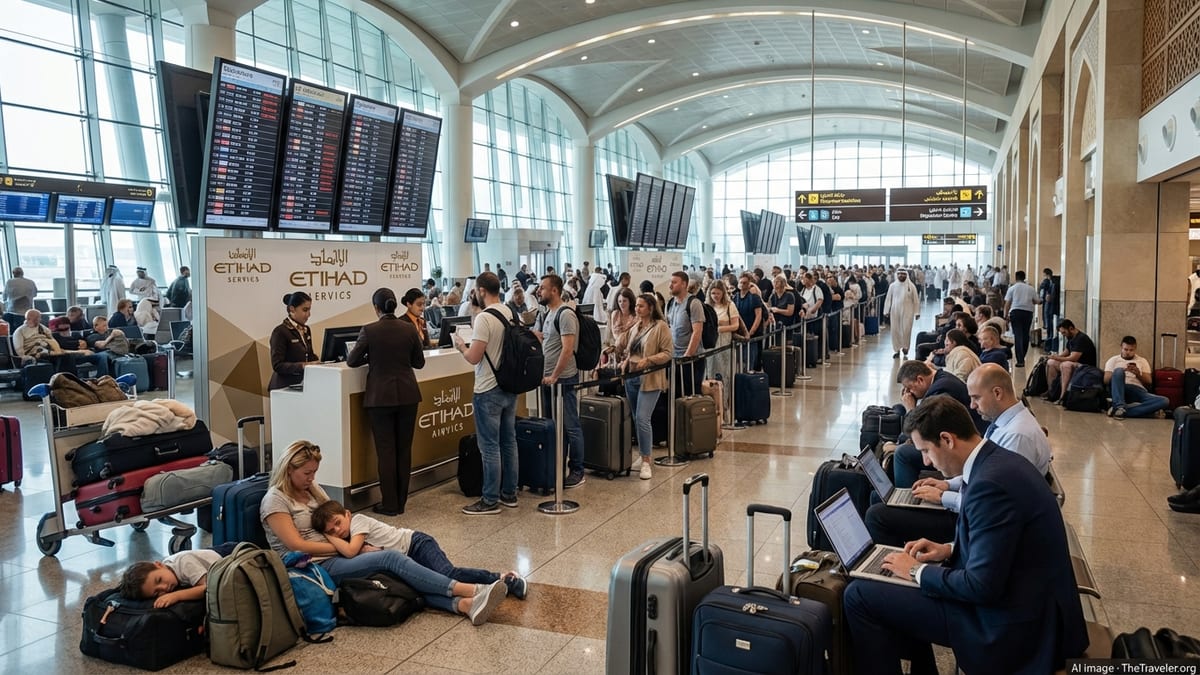
Etihad Airways cancelled a scheduled Abu Dhabi service in connection with the disruption, according to published coverage on September 20. For passengers, a cancellation of a single flight can still translate into missed onward connections, rebooking queues, and last-minute overnight stays, especially on routes with limited daily frequencies.
In similar recent regional disruption episodes, Etihad and other Gulf carriers have adjusted selected services at short notice, citing operational or safety-related considerations and working to reaccommodate customers through later departures or alternative routings where possible. Travelers booked on affected flights have typically been directed to airline rebooking channels and airport service desks for the fastest confirmation of options.
Because availability can tighten rapidly after a cancellation, passengers often face a narrow window to secure seats on the next departure, particularly on high-demand business routes between the UAE and Saudi Arabia. This is especially true when multiple carriers are disrupted simultaneously and interline options become constrained.
Wider ripple effects across Gulf flight networks
Even when an incident is localized to one airport, schedules across the Gulf can be affected by air traffic flow restrictions, aircraft diversions, and late-arriving crews. Published reporting has noted that disruptions linked to Saudi operations can extend to flights in the UAE, including Dubai and Sharjah, when regional traffic management issues build up or when inbound aircraft are delayed.
Airline networks in the region are built around tight banked connections, meaning a late arrival into a hub can cascade into multiple missed departures later in the day. That dynamic can be amplified when carriers choose to hold aircraft on the ground while they assess conditions, or when airport capacity is reduced due to runway, ramp, or airspace constraints.
For travelers with time-sensitive plans, the most vulnerable itineraries are short connections via hubs and same-day turnarounds. A delay of one to two hours can be enough to break an itinerary and require a full reroute, particularly if the onward flight is the last departure of the day.
Security environment and why aviation is sensitive to it
The latest disruption is taking place against a backdrop of heightened regional tensions, with published reporting describing renewed Houthi missile and drone activity toward Saudi Arabia and intercept operations by Saudi air defenses. Separate recent coverage has also discussed attacks affecting infrastructure and the resulting strain on defensive resources, underscoring a volatile security picture.
Aviation is particularly sensitive to this kind of risk because safety management relies on keeping aircraft clear of potential threat zones and maintaining predictable airport operations. Even when an incident does not directly strike an active runway or terminal, the response can include temporary restrictions, additional screening measures, or procedural slowdowns that reduce throughput.
For international travelers, the key point is that disruptions may not be confined to the place named in headlines. A departure from Abu Dhabi, Dubai, or another nearby hub can still be delayed or cancelled if the destination airport is constrained, if routings must be adjusted, or if inbound aircraft cannot arrive on time.
What passengers can do now: practical steps before heading to the airport
Travelers with flights to or through Saudi Arabia and nearby Gulf hubs should verify status directly with their airline as close to departure as possible and again before leaving for the airport. Because flight numbers can remain in schedules even when timings change, the most useful information is the latest live status showing whether a flight is operating, delayed, or cancelled.
Passengers should also review ticket rules for same-day changes and ensure contact details are up to date in the booking so rebooking messages arrive quickly. If a flight is cancelled, the fastest path to an acceptable solution is often to request re-accommodation immediately rather than waiting at the airport, since remaining seats can disappear within minutes during irregular operations.
For those transiting, it can help to consider longer connection times or, where possible, selecting routings with multiple later backup departures. Travelers should keep essential items in carry-on luggage, including any required medications, chargers, and documents, in case checked bags are delayed during rebooking or rerouting.