


More news on this day
A severed fiber optic cable in New Jersey on Monday rippled across the U.S. aviation system, triggering widespread disruptions at major Northeast airports and prompting fresh scrutiny of how a single infrastructure failure can upend thousands of trips.
Get the latest news straight to your inbox!
From Construction Mishap to Ground Stops in Minutes
Publicly available information indicates the disruption began late Monday morning, when a fiber optic line near an Amtrak corridor between New Brunswick and Newark, New Jersey, was accidentally cut during construction work. The damaged cable supported critical communications for a regional air traffic control facility that manages arrivals and departures into some of the nation’s busiest airports.
Flight operations data and federal system notices show that after a circuit failure at the Philadelphia Terminal Radar Approach Control facility, traffic managers attempted to switch to backup systems. That process revealed that the backup fiber route had already been compromised by the New Jersey cut, leaving controllers without full communications and radar feeds needed to safely space aircraft.
In response, the Federal Aviation Administration ordered ground stops and flow restrictions affecting Newark Liberty, John F. Kennedy International, LaGuardia and Philadelphia International airports. According to reporting from multiple outlets drawing on FlightAware data, the cascading effects contributed to roughly 7,000 delays and cancellations across the network, including around 1,400 flights involving New York City’s three main airports.
Transportation officials later said telecom crews restored the lines by Monday evening, allowing normal arrival and departure rates to resume. Even as operations restarted, schedules and crew rotations remained out of position, leaving many travelers facing disruptions into Tuesday.
Former United Executive: Why One Break Hits the Whole Network
Rich Davis, a senior security advisor at International SOS and former chief security officer at United Airlines, provided one of the clearest technical explanations in an interview highlighted by Fox Business and other outlets. According to that coverage, Davis characterized the fiber incident as a textbook case of how tightly coupled airline and air traffic systems have become.
The former United executive noted that even a localized failure at a single facility can quickly disrupt flying far beyond the immediate region because airline schedules are built on precise sequencing of aircraft, crews and turnaround times. When an air traffic center restricts arrivals and departures, aircraft cannot reach their next assigned flights, crews time out under duty rules, and connections unravel across subsequent banks of departures.
Reports summarizing Davis’s analysis describe these events as “irregular operations” in airline planning. That category includes severe weather, equipment failures and telecommunications outages that fall outside routine delays. Once irregular operations begin at a major hub like Newark, the effects spread along that carrier’s network to secondary cities, often for several scheduling cycles.
Davis also emphasized, according to published accounts, that while airlines invest heavily in redundancy, they remain dependent on national air traffic infrastructure. When a shared system such as a regional radar or communications link fails, multiple carriers feel the impact simultaneously, constraining options to reroute passengers or borrow spare capacity from rivals.
Impact on Key Hubs and Travelers Across the Northeast
Newark Liberty International Airport, a primary hub for United Airlines, experienced some of the most severe disruption. Flight-tracking services cited in Associated Press and Washington Post coverage showed commercial arrivals into Newark dropping to near zero for several hours after about 9:40 a.m. local time, with operations not significantly resuming until early evening.
Similar ground stops and slowdown programs affected New York’s JFK and LaGuardia airports, as well as Philadelphia, a major American Airlines hub. Boston Logan also saw knock-on delays and cancellations as aircraft and crews stranded in New York and New Jersey could not position for later departures, according to local reports.
The timing compounded the disruption. The outage coincided with heavy traffic linked to the United Nations General Assembly in New York, when airspace and airport capacity are already constrained by security-related restrictions and VIP movements. Airlines had scheduled additional capacity and tighter connection banks to accommodate demand, leaving less margin to absorb unexpected delays.
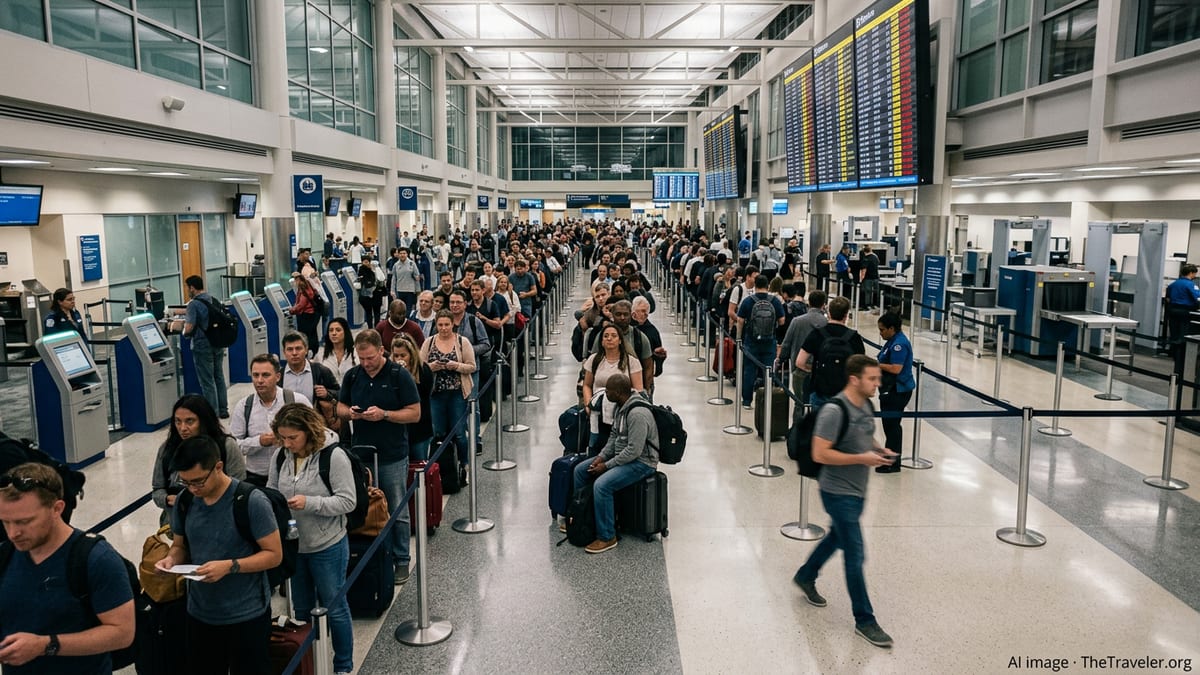
Travelers reported missed connections, diversions to alternate airports and overnight strandings as airlines worked through backlogs. With aircraft and crews scattered across the network, carriers were forced to trim later departures, rebook passengers on limited remaining seats, and in some cases substitute smaller aircraft than planned, reducing available capacity on high-demand routes.
What the Fiber Cut Reveals About Aviation Infrastructure Risks
The New Jersey incident highlighted a vulnerability that industry analysts and federal reviews have pointed to for years: the reliance of modern air traffic management on external telecommunications infrastructure that can be compromised by relatively routine construction activity.
According to reporting that draws on federal briefings, the affected fiber segment stretched several hundred feet along or near a rail right of way used by Amtrak and New Jersey Transit. Work crews apparently severed a cable supporting the backup communications path serving the regional air traffic control center. When the primary circuit failed, there was no fully functional redundancy in place.
Coverage from outlets including ABC News and the Associated Press notes that Congress has already approved billions of dollars for modernizing the U.S. air traffic control system, including upgrades to communications and data networks. The latest disruption is likely to intensify debate over how those funds are allocated, particularly around building physically diverse routes and more resilient backup capabilities for critical facilities.
Industry experts quoted across several analyses argue that while rare, such failures can have disproportionate consequences when they intersect with peak travel times at major hubs. They point to the need for closer coordination between transportation agencies, telecom providers and construction contractors to map and protect sensitive infrastructure around airports and radar facilities.
What Travelers Can Expect After the Disruption
By Monday evening, public statements from federal transportation leaders indicated that the damaged fiber lines had been repaired and that operations across the Northeast were resuming. Flight-tracking data showed a gradual recovery in arrival and departure rates at Newark, JFK, LaGuardia and Philadelphia overnight into Tuesday.
However, airline operations specialists caution in published commentary that passengers can expect lingering effects for at least a full day after a disruption of this scale. Aircraft and crews must be repositioned, maintenance checks rescheduled, and connection banks rebuilt before carriers can reliably return to pre-outage schedules.
For travelers with imminent itineraries involving the Northeast corridor, industry guidance widely shared on Monday and Tuesday emphasized close monitoring of airline apps and status pages, even after the official end of the ground stops. Same-day rebooking options may remain limited on certain routes where aircraft are still out of position or where crew duty limits constrain operations.
The New Jersey fiber cut has renewed attention on a persistent tension in modern aviation: while airlines and airports advertise increasingly sophisticated technology and real-time tracking tools, the system remains vulnerable to a single severed cable in the wrong place at the wrong moment. Analysts suggest that as traffic continues to grow, preventing similar incidents will require not only technical fixes but also tighter safeguards around the everyday construction work that happens just beyond the runway fences.