


More news on this day
The US Mission to the United Arab Emirates has issued fresh security guidance urging American citizens to exercise heightened vigilance across the Middle East and prepare for possible flight disruptions as regional tensions and the threat of attacks increase.
Get the latest news straight to your inbox!
New Alert Highlights Escalating Regional Tensions
According to recent public advisories, the US Mission in the UAE has warned that the security environment across the Middle East has become more complex, with a greater risk of sudden escalation affecting civilians and transport links. A security alert highlighted an increased threat of armed attacks linked to Iranian supported groups, including the Houthis, and noted that American interests and officials in the region could be potential targets.
The latest message to US citizens in the UAE builds on a series of regional alerts issued since mid 2026. Coverage of the alert in Gulf based media on November 7, 2026, describes the mission urging Americans both in the UAE and elsewhere in the Middle East to remain highly alert to changes in the situation and to monitor official channels for updated instructions on safety and movement.
The warning aligns with a broader pattern of international concern over the regional security outlook. Governments including the United States, the United Kingdom, Canada, Australia and New Zealand have all updated their advisories for the UAE in recent months, citing the threat of terrorism, missile and drone attacks, and the risk that renewed confrontation involving Iran could spill over into Gulf states.
Travel Advisories Raised for the United Arab Emirates
On October 23, 2026, the US Department of State elevated its travel advisory for the United Arab Emirates to Level 3, advising travelers to reconsider travel. Public information on the advisory explains that the change reflects an increase in the potential for armed attacks by Iranian supported Houthis and renewed concerns over Iranian efforts to target US government personnel in the region.
The advisory notes that US citizens in the UAE should stay aware of both regional and local security risks. It also points out that US government employees in the country require special authorization to visit military bases and critical energy infrastructure because of both Emirati regulations and potential security threats. These restrictions indicate how sensitive certain locations have become in light of missile and drone activity earlier in the year.
Other governments have taken similar steps. The United Kingdom updated its travel advice for the UAE in late October 2026, citing recent strikes and retaliatory attacks across the wider region and advising travelers to be ready for changes to airspace status. Canada’s latest guidance, issued in mid October, recommends that visitors exercise a high degree of caution, avoid non essential travel near certain military facilities, and remain alert to evolving tensions linked to conflict involving Iran.
Risks for Air Travel and Transit Through Gulf Hubs
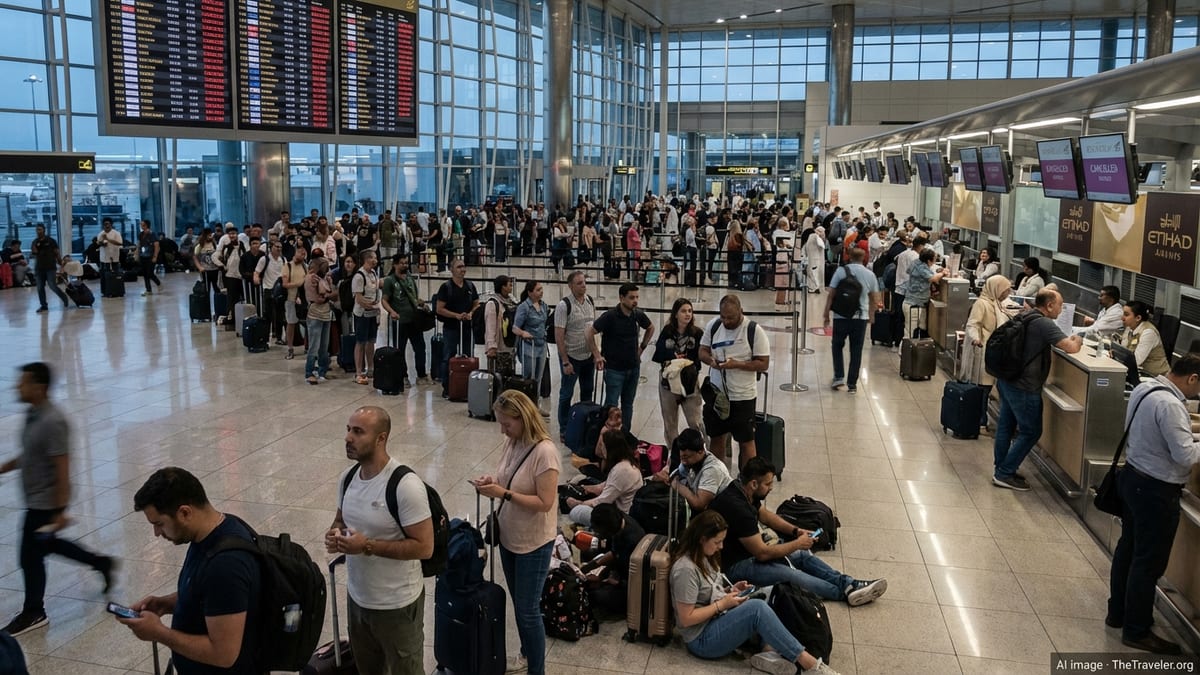
The US Mission’s alert and related regional warnings place particular emphasis on the possibility of travel disruption. Publicly available notices and media reports describe Americans being advised to prepare for flight cancellations, periodic airspace closures and sudden changes to airline schedules if tensions worsen or if new missile or drone incidents occur.
Gulf based carriers, including those operating out of Dubai and Abu Dhabi, have already had to adjust operations at various points in 2026 due to security concerns and temporary airspace restrictions. Earlier in the year, international coverage documented that major airlines reduced services and rearranged routings while governments sought to reopen key corridors around the Strait of Hormuz.
The new security alert recommends that travelers keep flexible itineraries where possible, closely track messages from airlines and travel providers, and ensure that contact details attached to their bookings are accurate so that schedule changes or cancellations can be communicated quickly. Travelers using the UAE purely as a transit hub are being encouraged in public advisories and analysis to have contingency plans in case of extended layovers or last minute rerouting through other hubs.
Implications for Americans Living and Working in the UAE
The heightened risk assessment has particular significance for the large American expatriate community in the UAE, especially in Dubai and Abu Dhabi. Public security assessments note that the presence of US business operations, consular facilities and cooperation with Western militaries increases the sensitivity of certain districts and infrastructure, including ports, airports and energy installations.
International travel advice platforms now recommend that foreign residents in the UAE review their personal security plans. Common recommendations include identifying safe shelter locations away from military or critical energy facilities, ensuring that travel documents are current, and maintaining a supply of essential items in case movement becomes temporarily restricted after a regional incident.
Public guidance from multiple governments stresses that individuals should avoid military sites, government buildings and key energy infrastructure where possible, and should pay attention to local instructions if an incident occurs. Advice also highlights the value of enrolling in notifier systems run by home governments so that emergency messages and evacuation information can be received promptly if the situation deteriorates.
Planning Tips for Travelers Considering UAE and Wider Region
For travelers planning trips involving the UAE or nearby countries, the latest warnings mean that careful preparation is now essential. Publicly available guidance suggests checking the most recent government travel advisories immediately before booking and again shortly before departure, as the risk level for some destinations in the Middle East has changed several times during 2026.
Travel insurance has become a key consideration, especially policies that explicitly cover disruption caused by regional conflict, closure of airspace or diversion of flights. Industry analysts quoted in recent news coverage have underlined that some standard policies exclude war related events, so travelers are being encouraged to read the fine print and, if necessary, seek coverage designed for higher risk regions.
Americans are also being urged in open source guidance to keep digital and paper copies of passports, residence permits, and key contact numbers, including those of airlines and their nearest US embassy or consulate. While commercial travel in and out of the UAE continues, the pattern of alerts during 2026 indicates that the regional environment can change quickly, making preparation and situational awareness critical for anyone moving through the country or the broader Middle East.