


From street level, Naples can feel like a tangle of sounds and staircases: scooters cutting between buses, laundry lines crisscrossing sunless alleys, the smell of espresso and fried dough leaking out of every doorway. It is intense, exhilarating and, at times, disorienting. Only when I finally rode the funicular up to Castel Sant’Elmo and stepped onto its wind‑brushed ramparts did the city fall into place. Naples stopped being a maze and became a map, and that single view from the fortress on Vomero Hill changed the way I understood everything below.
Get the latest updates straight to your inbox!
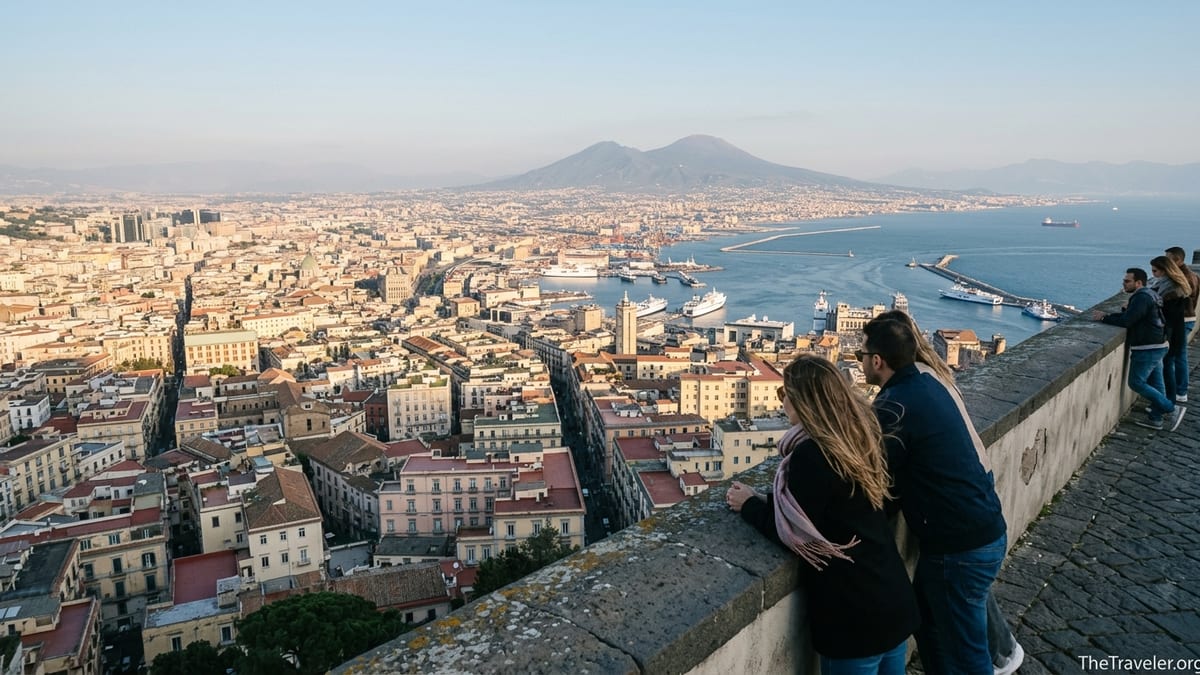
The Climb to a Different Naples
The change began long before I reached the castle walls. Leaving the dense centro storico near Montesanto station, I joined commuters shuffling into the Montesanto funicular, one of three that pull locals “up” to Vomero, the hilltop district that sits roughly 150 meters above the historic center. The ticket cost little more than a standard metro ride, and in under ten minutes the carriage had swapped graffiti‑tagged sidestreets for bright balconies and tree‑lined avenues at Morghen station.
From there, the walk to Castel Sant’Elmo is short but steep, about ten minutes along a sloping lane that suddenly opens onto blank stone ramparts. There is nothing romantic about the entrance: concrete, turnstiles, a small ticket office where you can tap a card and be inside in seconds. Yet that bureaucratic threshold matters. It separates the Naples of honking horns and crowded pavements from the one that exists in wide angles and long lines, the city that locals bring visiting relatives to see when they want to explain home in a single look.
Even before you reach the highest terraces, the air feels different. Vomero’s elevation brings a cooler breeze, and in summer the temperature can feel noticeably lower than down by Via Toledo. On clear mornings the sky above the ramparts is already bright while much of the city below is still in shadow. That early light, combined with the relative quiet of a residential quarter where people jog past with dogs and children bike to school, starts to soften the image of Naples as nothing but chaos and noise.
By the time you walk the last ramp to the Piazza d’Armi, the fortress’ broad central terrace, the climb has already done something to your perspective. You have literally risen above your own first impressions, leaving behind the competing narratives of news headlines, guidebook warnings and hurried anecdotes from friends. You are about to replace them with something your own eyes can test.
The Fortress That Watches the City
Castel Sant’Elmo itself is far from a decorative castle. Perched on the ridge of Vomero beside the white bulk of the Certosa di San Martino, it is a star‑shaped, six‑pointed fortress carved partly into yellow tuff rock and long used as a military stronghold. From the outside it looks severe and almost geometric, with few ornamental flourishes to distract from its purpose: to watch and, if needed, control the city below.
Knowing a little of that history affects the way you look out from its walls. For centuries, this was where Spanish and Bourbon rulers monitored Naples, its harbor and the sea routes beyond. Political prisoners once paced the same stone corridors that tourists now wander with cameras and gelato. When you trace your hand over the rough masonry or notice a weathered cross scratched into the stone by some long‑gone guard or inmate, the view stops being just scenic. It becomes the same strategic panorama that shaped decisions about trade, security and revolt.
Today, the cannons and garrisons are gone. Instead, the castle hosts contemporary art exhibitions and cultural events, and families drift through with strollers. On a recent afternoon, a school group spread out across the terrace while a guide used the view as a giant blackboard. She pointed toward the port, the train tracks slicing inland, the sprawl of new suburbs along the coast. For those students, the fortress was not just a monument; it was a tool to understand the geography and growth of their own city.
For travelers, that same function is even more powerful. Many visitors arrive in Naples for pizza and Pompeii, staying only in the central streets around Spaccanapoli and Piazza del Plebiscito. From the high bastions of Sant’Elmo, you realize how partial that experience is. The centro storico suddenly shrinks to a narrow band of stone wedged between the sea and the slopes of Capodimonte, just one chapter in a much thicker book.
A 360‑Degree Lesson in Geography
Step up to the outer walkway and Naples rearranges itself into a single, continuous story. Directly below, the jumble of the historic center becomes legible: the arrow‑straight line of Spaccanapoli slicing the city in two, the dome of San Domenico Maggiore rising from a knot of roofs, the grid of the Spanish Quarter stacked like theater seating toward the waterfront. The streets that felt labyrinthine from within resolve into a pattern you can sketch in your mind.
Turn slightly and the port fills the frame: ferries nosing toward Procida and Ischia, container ships parked like toy blocks beyond the passenger terminals, cruise liners dwarfing the medieval Maschio Angioino. The railway tracks splay inland from Napoli Centrale, reminding you that this is not just a picturesque bay but a working gateway that pushes people and goods into the rest of Italy and Europe. What looked like a romantic seafront from Santa Lucia reveals itself as an economic engine, beating steadily beneath the postcard surface.
Look east and Vesuvius dominates everything, a flat‑topped giant hovering over the sprawl of San Giovanni, Portici and the archaeological fields of Pompeii and Herculaneum. From this height it is easier to understand how the volcano both threatens and defines the city. You can trace the curve of the bay and see exactly how ash and lava once reached the ancient towns, and why Neapolitans speak of living with beauty and danger as two faces of the same coin.
Rotate west and the tone softens. The cape of Posillipo stretches into the sea, its villas stepping down to hidden coves. Beyond, on a clear day, Capri floats on the horizon like a low blue hill. You start to appreciate how diverse Naples is in the space of a short metro ride: dense tenements in the Spanish Quarter, the understated elegance of Chiaia, the clipped gardens and Art Nouveau facades of Vomero itself. From the ramparts, those contradictions stop feeling like disorder and start looking like a single, coherent landscape where different ways of living have grown side by side.
Seeing Everyday Naples From Above
One of the surprises at Castel Sant’Elmo is how much of what you see is ordinary life rather than monuments. Peer down and you notice schoolyards on the rooftops of old palazzi, laundry lines strung between fifth‑floor windows, rooftop gardens where someone has coaxed a lemon tree to grow in a rusted metal tub. Between churches and museums, there are basketball courts, solar panels and terrace bars where young couples lean over railings to share a cigarette.
That mix is what shifts your perception of Naples from museum piece to living city. From above, you grasp that the same narrow alleys where you tasted fried pizza at a hole‑in‑the‑wall stand are also family neighborhoods, with supermarkets tucked under arches and kids’ bicycles chained to drainpipes. You see why locals complain that visitors crowd the Decumani yet rarely ride a bus out to the working‑class districts beyond the port, which spread inland in wide bands of apartment blocks well outside the usual tourist frame.
The vantage point also recalibrates your sense of safety and scale. Streets that may have felt intimidating at night, with scooters rattling past and fireworks crackling in the distance, now appear as part of a dense but comprehensible grid. You can trace how quickly you can walk from Via Toledo to the sea, or from Piazza Bellini to the Archaeological Museum, and realize that central Naples is more compact than it feels on first arrival.
On one visit, I watched an elderly man in a flat cap slowly circle the terrace, stopping every few steps to point out districts to his grandson. At one point he gestured toward the concrete slabs of the eastern suburbs and then to the glossy high‑rises near the business district, explaining how the city had sprawled in his lifetime. For that boy, the view was a family history lesson. For me, it was a reminder that every photograph I had seen of Naples before arriving had cropped out more than it included.
Vomero: The Hilltop Quarter That Puts Naples in Context
Part of what makes the experience at Castel Sant’Elmo so transformative is the character of Vomero itself. This residential hilltop district has long been considered one of the city’s most livable neighborhoods, with wide sidewalks, a pedestrianized core around Piazza Vanvitelli and Via Scarlatti, and a calmer pace than the old streets below. You feel it as soon as you step off the funicular into a plaza lined with cafes where locals linger over espresso and sfogliatelle rather than jostling for a takeaway slice.
From the castle, you can look back toward Vomero’s tree‑shaded streets and understand why many Neapolitans choose to live here and commute “down” to the city center for work. It is not a sanitized suburb; scooters still thread between parked cars, and the evening passeggiata can be as crowded as any in Italy. But the mood is more residential than touristic. On the walk from Castel Sant’Elmo back toward Piazza Vanvitelli you pass small neighborhood bakeries, kiosks selling school supplies and pizzerias with menus clearly priced for regulars rather than day‑trippers.
This context matters for travelers. Many people visit Naples on a tight schedule that squeezes in Pompeii, the Amalfi Coast and Capri. Without ever leaving the historic center, it is easy to think of the city only in terms of noisy lanes and crumbling facades. Spending an afternoon in Vomero and at Sant’Elmo adds another layer: you see how Neapolitans who are not in the tourism business live, shop and raise children, still within easy reach of the center but in a setting of parks, schools and mid‑rise apartment blocks.
Right below the fortress, the Certosa di San Martino spreads out like a white stone ship. Once a Carthusian monastery and now a museum, its cloisters and terraces offer another, slightly lower set of views, framed by baroque architecture and hanging gardens. Visiting both the Certosa and the castle in a single day makes a compelling pairing: one space inward‑looking and contemplative, the other outward‑facing and watchful. Together, they show how spiritual, political and everyday lives have all used this hill as a vantage point over the same city.
Transforming Your Own Itinerary From the Ramparts
The most practical impact of that view from Castel Sant’Elmo is what it does to your itinerary. When you can see the entire city spread below, planning stops being theoretical. You stand at the parapet and physically trace your next days with a finger, from the port where ferries leave for the islands to the archaeological museum where statues from Pompeii wait in cool, echoing halls.
From the terrace, you might decide to reach the seaside promenade in Chiaia by walking down the Gradini del Petraio, a stepped pedestrian path that zigzags from Vomero through a quiet, almost village‑like neighborhood to the waterfront. What looked like a random set of stairs on the map now reads as a direct, scenic link you can see etched into the hillside. On another visit, watching trains glide in and out of Napoli Centrale from above reinforced how feasible it was to reach Herculaneum or Pompeii as a morning trip rather than a complicated expedition.
Even food choices start to feel more intentional. Looking down at the strip of pizzerias around Via dei Tribunali and Sorbillo, you may decide to sample a classic there one night and then balance it with an evening in Vomero, where neighborhood spots along Via Cilea serve excellent margheritas and fried cuoppi without the same queue of guidebook‑toting visitors. From Sant’Elmo you see how close those worlds are: ten or fifteen minutes by funicular, yet far enough apart in atmosphere to feel like two cities.
For travelers wary of Naples’ reputation, the fortress view can also recalibrate expectations. Watching ferries glide calmly across the bay while joggers loop around the castle ramparts, it is harder to reconcile the reality before you with the more sensational image sometimes painted abroad. The city remains gritty, complex and imperfect, but from up here you can weigh that complexity against its scale, beauty and the everyday normalcy of life you can literally observe on hundreds of balconies at once.
The Takeaway
Standing atop Castel Sant’Elmo did not make Naples simpler. If anything, it revealed more layers: the working port humming behind the cruise terminals, the web of neighborhoods extending beyond the usual tourist triangles, the intimate proximity of risk and beauty in the shadow of Vesuvius. What changed was my ability to hold those layers together in my head, to see the city not as a collage of disconnected impressions but as one continuous landscape shaped by geography, history and daily routine.
After that first visit, every walk through Naples felt different. When I stood in Piazza del Gesù, I could imagine the line of sight from the fortress above. When I boarded a ferry to Procida, I pictured the wake I had seen from the ramparts tracing a white line across the bay. Even a plate of margherita pizza on a plastic table in the Spanish Quarter tasted slightly different, flavored by the knowledge of how that small street fit into the wider city I had finally seen in full.
For anyone arriving in Naples for the first time, or returning after years away, casting at least one look at the city from Castel Sant’Elmo is more than a photo opportunity. It is a way of tuning your eyes and expectations before you plunge into the alleys again. In a city that often overwhelms, that brief pause above it all can be the difference between passing through and truly understanding where you are.
FAQ
Q1. Is Castel Sant’Elmo worth visiting if I only have one day in Naples?
Yes. If your time is limited, an hour or two at Castel Sant’Elmo gives you a citywide overview that helps every other stop make sense, even if you only manage a quick walk through the historic center and a slice of pizza afterward.
Q2. How do I get to Castel Sant’Elmo from the historic center?
The most straightforward route is to take the Montesanto funicular up to Morghen or the funicular from central areas near Via Toledo up to Piazza Fuga or Piazza Vanvitelli, then walk about 10 minutes uphill following signs for Castel Sant’Elmo and the Certosa di San Martino.
Q3. How much time should I plan for a visit to Castel Sant’Elmo?
Plan at least 90 minutes to walk the ramparts, take in the views and visit any exhibitions. If you also want to explore the nearby Certosa di San Martino or stroll through Vomero, set aside half a day.
Q4. What is the best time of day to visit for views and photos?
Clear mornings and late afternoons typically give the best light, with softer colors and fewer harsh shadows. Sunset can be beautiful, but you should check current opening hours to be sure the terrace will still be accessible when the sun goes down.
Q5. Is Castel Sant’Elmo suitable for families with children?
Yes. Children generally enjoy the wide open terrace, the sense of exploring a real castle and riding the funicular to reach it. Parents should still keep an eye on little ones near the ramparts and stairs, but the main terrace areas feel spacious and manageable.
Q6. Can I visit Castel Sant’Elmo and the Certosa di San Martino on the same day?
Absolutely. The two sites sit next to each other on the hill. Many travelers start with the more inward‑looking Certosa, with its cloisters and museum, then move to Castel Sant’Elmo for the expansive outdoor views and a different angle on the city.
Q7. Are there places to eat or drink near Castel Sant’Elmo?
While options right at the castle are limited, a short walk back into Vomero brings you to streets like Via Tito Angelini and the areas around Piazza Vanvitelli and Via Scarlatti, where you will find cafes, pastry shops and pizzerias popular with local residents.
Q8. Is the area around Castel Sant’Elmo safe for visitors?
Vomero is widely considered one of Naples’ calmer, more residential districts. As in any city, normal precautions apply, but the walk between the funicular stations, the castle and the main squares typically feels relaxed and well used by locals.
Q9. What should I bring for a visit to Castel Sant’Elmo?
Comfortable shoes, water, sun protection and a light layer for the breeze on the ramparts are helpful. A camera or phone with enough battery and storage is almost essential, given how many angles you may want to capture.
Q10. Can a visit to Castel Sant’Elmo change how I experience the rest of Naples?
Many travelers find that it does. Seeing the entire city, bay and Vesuvius laid out together helps put busy streets, day trips and even small details like bus routes and ferry rides into clearer context, making the rest of your time in Naples feel more connected and intentional.