


More news on this day
Automated landing systems powered by computer vision and embedded artificial intelligence are rapidly moving from experimental projects into everyday cockpits, reshaping how pilots, passengers and regulators think about the final, most critical minutes of flight.
Get the latest news straight to your inbox!
From Research Projects to Real-World Landings
Automatic landing is not new, but the latest wave of systems is different in one crucial respect: they rely less on ground beacons and more on what the aircraft can see and process for itself. Modern camera arrays, lidar and infrared sensors feed neural networks that can recognize runways, obstacles and weather cues, allowing aircraft to complete approaches even when traditional radio-based guidance is unavailable.
Experimental programs in Europe and North America are demonstrating that computer vision can deliver landing performance comparable to instrument landing systems while remaining independent of airport infrastructure. A series of vision-based trials on large commercial test aircraft has shown that onboard cameras and trained algorithms can guide an airliner through taxi, takeoff and landing under tightly controlled conditions, proving the core feasibility of the technology.
In the general aviation market, embedded AI is already flying passengers to the runway. Garmin’s certified Emergency Autoland, now installed on a growing list of business turboprops and light jets, can take control when a pilot is incapacitated, select a suitable airport, follow published procedures and bring the aircraft to a full stop. Reports on a December 2025 incident in the United States, in which an Autoland-equipped turboprop completed a runway landing after detecting unsafe cabin conditions, have been widely cited as a landmark moment for automated emergency intervention.
Industry analysts note that these capabilities are arriving first in smaller aircraft, where certification cycles are faster and retrofitting is easier, before scaling up toward larger commercial platforms. That path mirrors how glass cockpits and satellite navigation entered service, suggesting that what is today an option on private aircraft could be standard equipment on airliners in the coming decade.
Dragonfly-Inspired Vision and Europe’s New Landing Tests
In Europe, one of the most closely watched experiments is Airbus UpNext’s DragonFly demonstrator, which uses cameras, computer vision and advanced guidance software to support pilots during taxi, takeoff and landing. Drawing inspiration from the insect’s wide field of view and fast visual processing, the project combines multiple sensors with AI models that can identify runway markings, signage and other aircraft in complex airport environments.
Publicly available information on DragonFly indicates that flight tests on an A350 platform have focused on low-visibility approaches and emergency scenarios in which the system can suggest or execute diversion and landing options. The same underlying vision stack assists with taxi guidance, reading airport layouts and clearances from the outside world and relaying them to the crew through intuitive cockpit displays and audio cues.
Alongside DragonFly, European-funded research projects are pursuing vision-based landing solutions able to work at airports that lack precision ground equipment. A recently highlighted initiative, known as IMBALS, is developing an onboard camera system and AI pipeline intended to automate the full landing sequence for large transport aircraft. Project descriptions emphasize the need to serve thousands of runways that do not have instrument landing systems, especially in regions where air traffic is expanding faster than ground infrastructure.
These efforts are being followed closely by airlines and airports that see an opportunity to expand service without costly upgrades to local navigation aids. For travelers, the practical effect could be more reliable operations into secondary destinations, particularly in poor weather that currently forces diversions to larger hubs.
Embedded AI in the Glass Cockpit
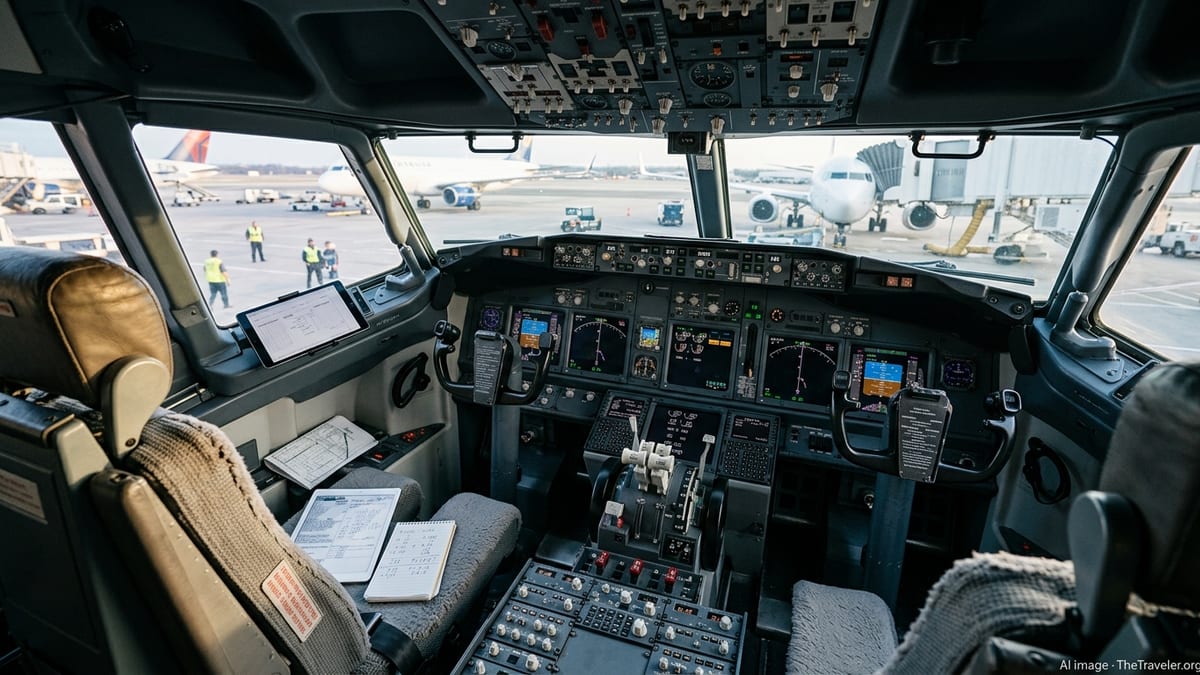
Behind the scenes, automated landing is part of a broader shift toward embedded AI throughout the flight deck. Modern avionics suites already blend synthetic vision, terrain awareness and flight management into unified glass displays. The newest systems add machine learning layers that can interpret sensor data in real time, supporting tasks from runway selection to energy management on final approach.
Avionics manufacturers describe architectures in which relatively modest onboard processors run specialized models that are trained offline on large datasets of flight imagery and sensor logs. These compact models are then deployed into certified hardware, where they function as advisory or supervisory layers on top of traditional autopilots rather than as fully autonomous pilots. This configuration allows regulators to maintain clear lines of responsibility while still harnessing AI’s pattern-recognition strengths.
The same embedded AI building blocks that power automated landing are also being used for predictive maintenance, anomaly detection and enhanced hazard awareness. For example, algorithms that learn what a “normal” approach profile looks like for a given airport can alert crews to deviations earlier than traditional thresholds might, potentially heading off unstable approaches before they become safety events.
As these capabilities converge, cockpit interfaces are evolving to present AI-derived insights in ways that are understandable and actionable to human crews. Developers are prioritizing explainable cues, such as visual overlays on synthetic vision displays and plain-language callouts, to avoid overwhelming pilots in high-workload moments like the final descent.
Safety, Certification and New Human Factors Questions
Regulatory authorities are responding to these advances with targeted research agendas on automation, human factors and software assurance. Strategic planning documents from agencies in the United States and Europe highlight the need to validate AI-based vision systems under a wide range of lighting, weather and terrain conditions, and to understand how pilots interact with tools that can both monitor their performance and, in extreme cases, overrule it.
Recent emergency autoland activations have intensified interest in how passengers and crew perceive automated decision-making. In the widely reported December 2025 turboprop case, the system automatically initiated descent and landing after detecting a potentially dangerous pressure event, while communicating its intentions through synthesized speech and cockpit messages. Analysts note that such high-profile real-world uses will shape public expectations of what “automation” means in aviation, for better or worse.
Certification remains one of the main pacing items. Traditional safety frameworks were built around deterministic software and well-characterized sensor inputs, while modern computer vision and AI involve statistical models and vast training datasets. Manufacturers are investing heavily in simulation and scenario generation to demonstrate that their systems perform reliably across edge cases such as glare, snow-covered runways or partial sensor failures.
Human factors specialists also warn against complacency as automation deepens. Embedding AI into landing workflows can reduce workload and catch human errors, but it can also introduce new failure modes if pilots overtrust the system or lose manual proficiency. Training programs are starting to address this by treating automated landing tools as collaborative partners rather than black boxes, emphasizing the need for crews to understand both capabilities and limits.
What It Means for Future Travel
For travelers, the most immediate impact of computer vision and embedded AI in landing systems is likely to be incremental rather than dramatic. Flights may divert less often, approach minima could be lowered on certain runways, and small aircraft operations may become more resilient to rare but serious events such as pilot incapacitation. These changes will largely unfold behind the cockpit door, visible only in improved on-time performance statistics and safety records.
Over a longer horizon, industry forecasts suggest that maturing automated landing technology will be a foundation for more autonomous operations, including cargo aircraft and advanced air mobility vehicles serving urban and regional routes. Vision-based navigation that can work without extensive ground infrastructure is viewed as essential for scaling electric air taxi networks and uncrewed cargo flights to smaller airports and vertiports.
At the same time, the aviation community is cautious about promising pilotless passenger flights on a specific timetable. Publicly available policy papers and expert commentary consistently point to a future of “increasingly automated, but still supervised” cockpits, in which human pilots remain central while delegating more routine tasks to embedded AI. Automated landing, in this view, is less a replacement for pilots than an additional layer of resilience in the most demanding phase of flight.
As test campaigns expand and more aircraft quietly add automated landing functions, passengers may never notice the algorithms at work. Yet the convergence of computer vision, embedded AI and traditional avionics is steadily redrawing the line between what pilots must do themselves and what the cockpit can safely handle on its own, setting the course for tomorrow’s air travel experience.