


You land in Lisbon after an overnight flight from New York. Your freelance client in Berlin has just paid your invoice in euros, your marketplace earnings from Los Angeles arrived in dollars, and you are about to tap your card to pay for a pastel de nata. For many global freelancers, digital nomads, and small business owners, Payoneer is the bridge between those cross-border payments and real-world spending abroad. Understanding how it works in practice, and what it really costs, can make the difference between a smooth trip and an expensive surprise.
Get the latest updates straight to your inbox!
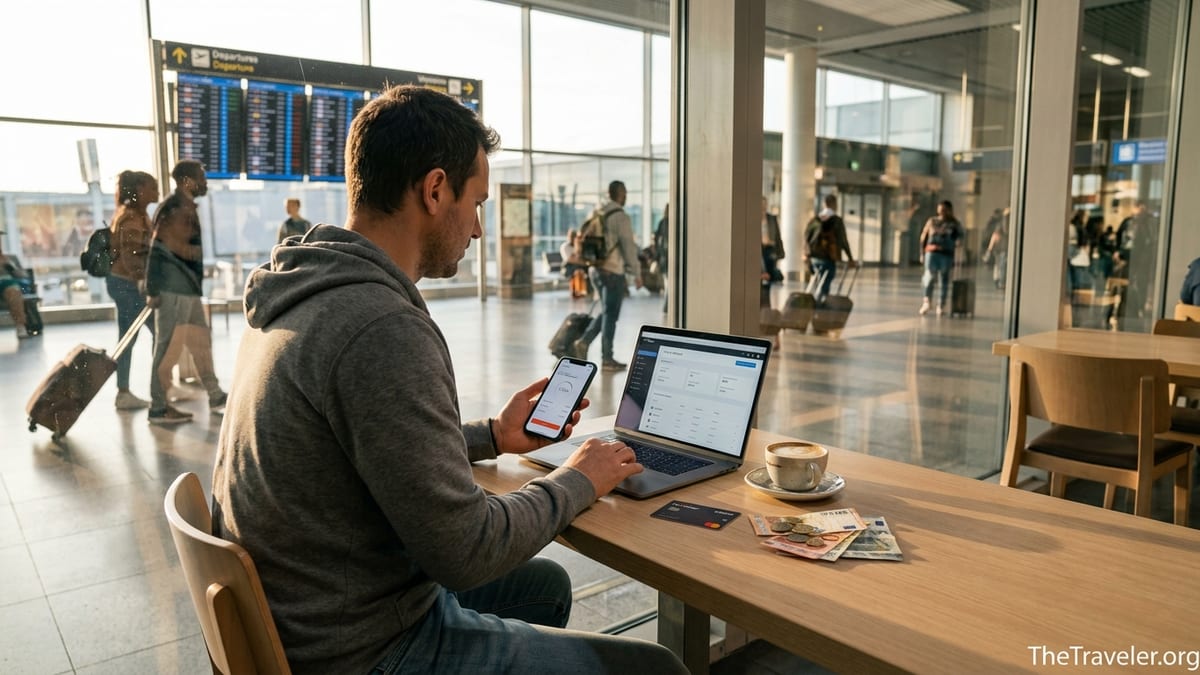
What Payoneer Actually Is in Day-to-Day Travel Life
Payoneer is a financial services platform that lets you receive, hold, convert, and spend money in multiple currencies across more than 190 countries and territories. In everyday terms, it acts as a hub between the places you earn money online and the places you physically spend it, whether that is withdrawing cash from an ATM in Thailand or paying for a hotel in Spain with a card. For many remote workers, it effectively becomes a secondary multi-currency account that travels with them.
Unlike a traditional bank, Payoneer is built around cross-border business payments: marketplace payouts, client invoices, and B2B transfers. Marketplaces like Fiverr, Upwork, Airbnb, and many Amazon marketplaces can pay directly into a Payoneer balance, often in the same currency where those platforms operate. A Bulgarian designer, for example, might receive euros from a German agency, dollars from a US marketplace, and pounds from a UK partner, all into the same Payoneer profile.
From a traveler’s perspective, that balance is not just numbers in an app. It can be turned into local cash at an ATM, used to pay in-store with a Payoneer card, or withdrawn to a personal bank account in your home country. The key is understanding which route makes the most sense in each country you visit and which combination of withdrawal or card use keeps your overall fees under control.
Crucially, Payoneer is not a bank account for everyday consumer use in the same way as a local checking account. It is optimized for receiving business-related income. That means you will usually get the most value if you use it as a central payment rail for your work and then move or spend money strategically, rather than treating it solely as a travel card loaded from your salary.
How Receiving Money Works When You Are Paid From Abroad
The first step in using Payoneer for global spending is getting paid into your account. Payoneer offers what it calls receiving accounts: local-style account details in major currencies such as USD, EUR, GBP and others. To your overseas client, those details often look like a regular bank account in their own country, even though the funds ultimately arrive in your Payoneer balance.
Imagine a US-based copywriter who spends winters in Mexico. She invoices a New York client in US dollars and includes her Payoneer USD receiving account on the invoice. The client pays by a standard domestic bank transfer, and within around one to three business days the money appears in her Payoneer USD balance. No international wire from the client’s perspective, and no need for her to maintain a US bank account herself while on the road.
In Europe, a Polish web developer might share a Payoneer EUR receiving account with a French startup. The startup pays in euros from a French bank. The developer sees the payment in his EUR balance and can decide whether to keep the funds in euros for an upcoming trip to Spain or convert part of it to PLN to withdraw back home. In practice, many location-independent workers let multiple currencies accumulate during a busy project season, then convert and withdraw strategically based on where they plan to travel.
For travelers who work with marketplaces, Payoneer often integrates directly with payout systems. A Colombian Airbnb host, for instance, can receive guest payouts in USD or EUR into Payoneer, then later move that money into a local bank or spend directly using a card on trips abroad. The important habit here is to check each marketplace’s payout settings and confirm that Payoneer is selected as the payout method, so new earnings land where you can actually use them.
Understanding Payoneer Fees and Exchange Rates in Real Situations
Because Payoneer is built around cross-border flows, fees and exchange rates are a critical part of using it wisely on the road. Payoneer’s own pricing page highlights that there is no fee to receive payments from another Payoneer user in the same currency, while card payments in the card’s own currency are generally free of extra transaction fees. However, once you start converting money between currencies, withdrawing to a bank, or taking out cash from ATMs, various fees come into play, typically expressed as percentages on top of the underlying exchange rate or as fixed per-transaction charges.
For example, Payoneer states that converting between balances usually involves a margin of around 0.5 percent above the mid-market rate, though the actual rate offered can vary by corridor and region. When you use a Payoneer card in a different currency than the card’s base currency, Payoneer indicates that the total currency conversion fee can reach up to about 3.5 percent. On top of that, if the merchant’s country is different from the country where the card was issued, an additional international transaction charge of up to roughly 1.8 percent may be applied. These percentages sound small in isolation, but on a 1,000 dollar hotel bill in a foreign currency, they can quickly add up.
Cash withdrawals are another area where travelers need to plan. Official Payoneer materials list a fixed ATM withdrawal fee in the region of 3.15 dollars, 2.50 euros, or 1.95 pounds per withdrawal, plus up to 1.8 percent of the amount withdrawn and any currency conversion fee if the withdrawal involves a different currency. On top of that, the ATM operator in countries like Thailand, Mexico, or the Philippines might charge its own local fee, often around the equivalent of 3 to 7 dollars. If you withdraw 50 dollars’ worth of local currency, those fixed charges consume a large share of your money. Withdrawing 250 or 300 dollars in a single transaction, where safe, usually makes the effective percentage cost much lower.
There are also account-level costs to consider. In recent years some Payoneer users have reported annual account fees being charged when their yearly incoming volume is relatively low, for example under a certain threshold such as 2,000 dollars in incoming payments over 12 months. If you use Payoneer only occasionally and let the balance sit inactive, those kinds of charges can quietly erode your funds. Before relying on Payoneer as a travel wallet, it is wise to log into your account’s pricing section and review whether any annual or inactivity fees apply in your region and usage pattern.
Using the Payoneer Card Abroad for Everyday Travel Spending
The Payoneer card works in most places where Mastercard is accepted, both online and in physical stores. When you are abroad, you can pay for meals, metro tickets, or hotel stays in the same way you would with any other debit or prepaid card. If your card is denominated in euros and you buy a train ticket in Paris priced in euros, the transaction is usually treated as a domestic currency purchase and Payoneer’s materials suggest there is no additional transaction fee beyond what the merchant’s terminal charges.
Complications arise when the currency or country does not match your card’s base settings. Picture a Romanian graphic designer whose Payoneer card is in US dollars. She flies to Tokyo for a conference and taps to pay for a 4,000 yen lunch. The Mastercard network first converts yen to dollars; Payoneer may then apply its own conversion margin, up to around 3.5 percent, plus a possible international fee of up to about 1.8 percent because the merchant country is different from the card’s issuing country. The result is that her lunch might cost several dollars more than the raw exchange rate would suggest.
Dynamic currency conversion is another common pitfall. Many card terminals and ATMs in tourist areas ask if you want to be charged in your “home currency” instead of the local one. If you accept, the terminal does its own conversion, often at an unfavorable rate, on top of any Payoneer-specific costs. A Brazilian videographer paying for a hotel in Prague might be offered a rate where the terminal converts Czech koruna into US dollars directly. In almost all cases, it is better to decline that offer and insist on paying in the local currency, leaving currency conversion to the card network and Payoneer’s own systems, which tend to be more transparent and closer to market rates.
Travelers who use the Payoneer card heavily also find that keeping an eye on ATM networks matters. Large international banks in cities like Berlin, Bangkok, or Buenos Aires often publish their ATM fees in English on-screen, and some charge less than smaller local banks. Because Payoneer’s own fixed withdrawal fee is the same regardless of which machine you use, choosing an ATM with a lower local surcharge can make a meaningful difference across a long trip.
Withdrawing to Local Bank Accounts and Timing Your Conversions
For many location-independent professionals, the most cost-effective way to use Payoneer is not through ATMs but through withdrawals to local bank accounts. Payoneer lets you transfer funds from your multi-currency balance to a bank account in your home country or in some cases to an account in the country where you are temporarily based. The transfer typically takes one to three business days, though this can vary with weekends and local holidays in both countries involved.
Consider a Serbian developer who spends several months each year in Spain. He receives marketplace earnings in US dollars into his Payoneer account and watches the USD to EUR rate for a few days. When the rate is favorable, he converts a larger chunk of his USD balance to euros within Payoneer, absorbing the platform’s FX margin once for a substantial amount instead of multiple times on smaller card purchases. He then withdraws 1,500 euros from Payoneer to his Spanish bank account and uses a local debit card for daily spending, avoiding additional currency conversion on each transaction in Barcelona.
In other regions, particularly where local banking infrastructure is less friendly to foreign-currency inflows, Payoneer can act as an intermediary. A Nigerian content moderator who works for US companies may prefer to receive payments in USD into Payoneer, then withdraw naira to a domestic bank account. Here, the key is to look closely at Payoneer’s displayed exchange rate and local withdrawal fee, and then compare it with other routes such as a direct marketplace payout in local currency or using alternative services. It is not uncommon for travelers to mix methods: for example, using Payoneer for bulk withdrawals when rates look good and keeping a separate local bank or fintech card for small daily expenses.
Timing can be as important as the method. Currency markets move daily, and Payoneer’s conversion rates track those movements with an added margin. If you know you will need 2,000 euros for a two-month stay in Portugal, converting your dollar or pound earnings gradually over several days can smooth out rate volatility. On the other hand, if your income is irregular and you are suddenly facing a large expense like a security deposit in Berlin, you may have to accept whatever rate Payoneer offers at that moment in order to get the money into your local account quickly.
Practical Strategies to Keep Costs Down While Traveling
Using Payoneer abroad works best when you actively manage fees rather than assume a flat rate. One effective strategy is to match your spending currency to your card or balance currency as often as possible. A designer who knows she is spending six weeks in the eurozone might prioritize keeping client invoices denominated in euros or converting a chunk of her US dollar earnings to euros before she arrives, so that in-restaurant and supermarket card payments in Rome are treated as same-currency transactions.
Another useful habit is consolidating ATM withdrawals. If the total fixed cost of a withdrawal ends up around 5 to 8 dollars after Payoneer and local ATM fees, taking out the equivalent of 300 dollars instead of 50 can reduce your effective fee from more than 10 percent to closer to 2 or 3 percent. Of course, that has to be balanced against safety. In cities where carrying large amounts of cash feels risky, consider keeping daily ATM withdrawals small but more frequent, and use card payments where merchants accept them.
Travelers should also regularly review Payoneer’s fee schedule within their account dashboard, not just the public marketing page. For instance, some users notice differences between what is promised in general pricing tables and what appears as specific charges in transaction histories, especially for internal transfers or currency conversions involving less common payment routes. Keeping screenshots or notes of key fees before a long trip can help you detect if anything changes while you are on the road and decide quickly whether to adjust your strategy or move part of your balance to another provider.
Lastly, diversify your travel wallet. Payoneer can be an excellent tool if most of your income flows through marketplaces or clients that already use it, but relying on it exclusively can leave you exposed to regional outages, card issues, or sudden pricing changes. Many seasoned digital nomads carry at least one additional debit card from a local bank or another international provider and keep a modest cash reserve in major currencies like dollars or euros for situations where card networks or ATMs are temporarily unavailable.
The Takeaway
For frequent travelers who earn across borders, Payoneer can turn foreign invoices and marketplace payouts into practical spending power abroad. Its multi-currency balances, local-style receiving accounts, and Mastercard-based cards are particularly attractive if most of your clients or platforms already support Payoneer as a payout option. Used thoughtfully, it can simplify your financial life from Warsaw to Kuala Lumpur and cut down on the need to open multiple local bank accounts.
At the same time, Payoneer is not magically fee-free. Exchange rate margins, ATM withdrawal charges, potential annual fees, and international transaction costs all shape how much of your hard-earned income actually ends up available for that guesthouse in Chiang Mai or co-working pass in Lisbon. The travelers who do best with Payoneer are those who take a few minutes each month to review their pricing, compare withdrawal routes, and time currency conversions around their travel plans.
If you approach Payoneer as a flexible, business-focused payment rail rather than an all-purpose consumer bank, it can slot neatly into a broader travel money strategy. Combined with at least one local bank account or alternative card and backed by a little fee awareness, it offers a powerful way to bridge your online earnings and your offline adventures around the world.
FAQ
Q1. Can I use my Payoneer card at any ATM while traveling?
Yes, you can normally use a Payoneer card at ATMs that accept Mastercard, but each withdrawal usually incurs a fixed Payoneer fee, a percentage-based fee, and often an additional local ATM surcharge, so it is best to withdraw larger amounts less frequently where it is safe to do so.
Q2. Is it cheaper to pay in local currency or in my home currency with Payoneer?
In most cases it is cheaper to pay in the local currency and let Mastercard and Payoneer handle the conversion, because dynamic currency conversion at terminals that charge you in your home currency tends to use a poorer exchange rate on top of any Payoneer fees.
Q3. How long does it take to withdraw money from Payoneer to my bank account?
Payoneer withdrawals to a bank account typically arrive within one to three business days, though weekends, local holidays, and time zones in either the sending or receiving country can add delays.
Q4. What happens if I do not use my Payoneer account for a long time?
If your Payoneer account remains largely inactive or receives only small amounts over a 12-month period, you may face annual or inactivity fees depending on your region and account type, so it is important to review your account’s detailed pricing section.
Q5. Can I hold multiple currencies in Payoneer at the same time?
Yes, Payoneer lets you hold balances in several major currencies at once, such as US dollars, euros, and pounds, and you can choose when to convert between them based on your travel plans and the exchange rates offered.
Q6. Is Payoneer a replacement for a traditional bank account?
Payoneer is designed primarily for receiving and managing cross-border business payments and is not a full replacement for a traditional local bank account, so most travelers use it alongside at least one domestic account or other card.
Q7. Are Payoneer exchange rates good compared with other services?
Payoneer’s rates are usually based on the live market rate with an added margin that can be up to a few percent, so they may be competitive in some corridors but not always the absolute cheapest, and it is sensible to compare them with other providers for large conversions.
Q8. Can I get paid from marketplaces like Fiverr or Airbnb into Payoneer?
Many major marketplaces, including well-known freelance and e-commerce platforms, support Payoneer as a payout method, allowing your earnings to flow directly into your Payoneer balance in currencies such as USD or EUR, though you should always confirm availability in each platform’s payout settings.
Q9. What should I do if a card payment abroad is declined?
If a Payoneer card payment is declined while traveling, first check your available balance and recent transactions in the app, then try another terminal or merchant, and if the problem persists, contact Payoneer support and have a backup card or cash option ready for emergencies.
Q10. Is Payoneer safe to use when moving large amounts of money across borders?
Payoneer is a regulated financial services provider in the jurisdictions where it operates and uses standard security measures such as card controls and account verification, but as with any provider you should enable strong passwords, two-factor authentication, and keep at least one alternative route for critical funds.