


More news on this day
Flight delays across Nigeria’s domestic network are back in focus after United Nigeria Airlines Chief Commercial Officer Adedayo Olawuyi linked recurring disruptions to airport congestion, infrastructure constraints, and weather, arguing that industry-wide fixes are needed to reduce knock-on delays and cancellations.
Get the latest news straight to your inbox!
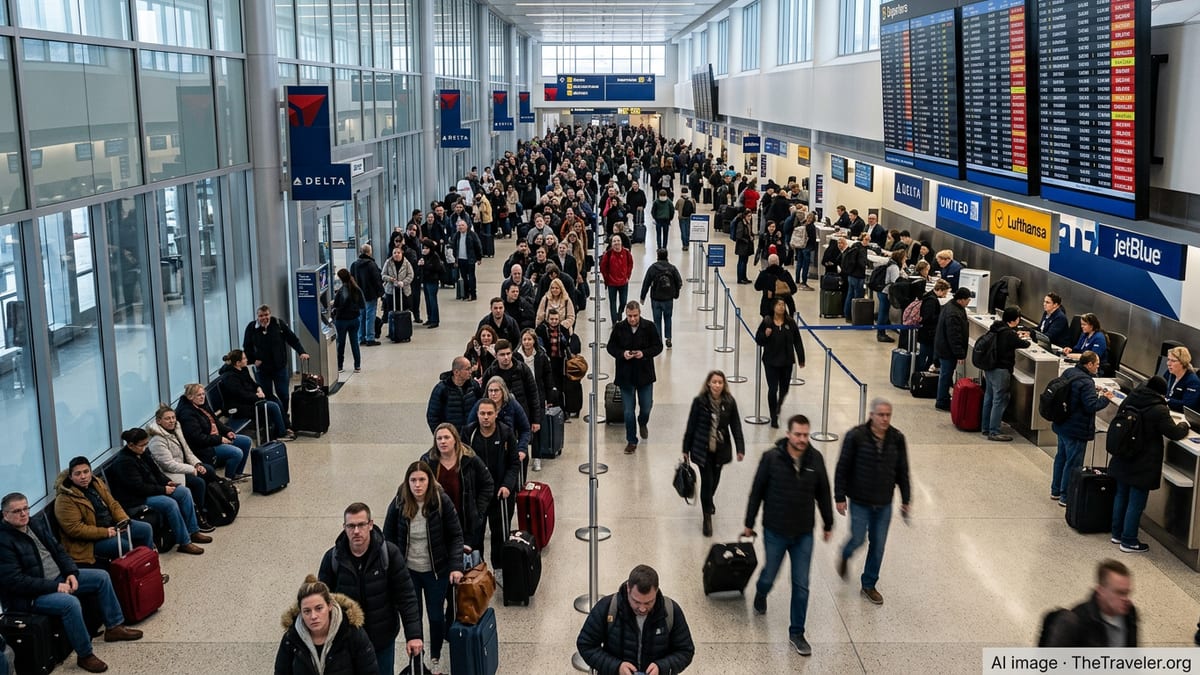
Delay debate resurfaces after August performance figures
Published coverage from mid-September 2026 points to renewed scrutiny following Nigerian Civil Aviation Authority (NCAA) performance data indicating that domestic flights recorded delays above the 60% mark in August 2026. The figure has been widely discussed in aviation circles because it frames delays as a system-wide reliability issue rather than an occasional operational hiccup.
In remarks delivered during the Aviation Day session of the 23rd Akwaaba African Travel Market in Lagos, Olawuyi challenged how delay statistics are interpreted, stressing that public reporting is more useful when it separates controllable delays from those stemming from external constraints such as airfield capacity, weather limitations, and infrastructure failures.
The comments have landed as Nigeria’s domestic market continues to expand. Public reporting citing Federal Airports Authority of Nigeria (FAAN) figures put domestic air passenger traffic at 13.09 million in 2025, while separate capacity tracking cited in the same coverage showed Nigeria’s total airline capacity at 1,013,999 available one-way departing seats in June 2026, up year on year. The combination of growing demand and finite airport capacity has amplified the impact of even short disruptions.
Congestion at ramps and taxiways: when minutes compound
One of the sharpest points raised in the recent discussion centers on congestion on the ground, particularly at peak morning waves. According to the same published coverage, Olawuyi described scenarios where aircraft are blocked from moving because of ramp crowding and sequencing challenges, turning small scheduling gaps into larger delays that then cascade downline.
Congestion is especially visible on high-frequency city pairs. Reporting tied to MMA2 operations in Lagos has repeatedly highlighted the Lagos to Abuja corridor as a dominant domestic route from the terminal, with other high-traffic sectors also feeding peak-hour pressure. When several carriers attempt to push back, taxi, and depart within tight windows, throughput constraints can create delays even before weather or technical issues are factored in.
Terminal operators are also experimenting with new tools to manage demand. MMA2, operated by Bi-Courtney Aviation Services Limited, has publicly discussed implementing a structured slot system in 2026 as part of efforts to coordinate aircraft movements and reduce peak-period gridlock. While a slot regime is not a cure-all, it reflects a broader shift toward managing congestion as a predictable planning problem rather than an unavoidable surprise.
Infrastructure limits: lighting, power, and “dusk-to-dawn” operations
Infrastructure capacity remains a recurring theme in Nigeria’s reliability debate. Published coverage of the Akwaaba panel included the point that many airports served by domestic airlines still operate effectively on a “dusk-to-dawn” basis, with limited ability to handle late-night recovery flying. When earlier delays push flights into the evening, the lack of night operations at some stations increases the risk of cancellations or diversions.
Lighting and power resilience can be decisive for whether a flight can land and turn safely. In one example cited in the same coverage, a thunderstorm was described as disabling runway lighting, forcing an aircraft to abandon its planned landing and return to the departure city. For passengers, such incidents feel like airline failures even when the constraint is physical infrastructure at the destination airport.
FAAN budgeting and project documents in recent years have pointed to maintenance and upgrades of power supply and airfield lighting systems at multiple airports, underlining that these are known pain points. Separately, government communications in 2026 have referenced ongoing airport works and requests linked to airside capacity, including discussions around taxiway expansion at Abuja ahead of longer-term runway planning. The operational impact is immediate: better lighting and stronger redundancy can extend usable hours, reduce weather-related closures, and make schedule recovery more feasible after disruptions.
Bad weather realities: why storms can disrupt the whole network
Weather remains a central driver of delays worldwide, and Nigeria’s rainy-season operations can be particularly vulnerable when thunderstorms, low visibility, or windshear reduce runway throughput or trigger approach restrictions. The NCAA has issued guidance to operators on hazardous weather in the rainy season, reflecting an industry emphasis on pre-flight planning and risk management during periods when convective storms are common.
Even when weather is localized, its effect can spread through the system. A delayed arrival can prevent an aircraft from operating its next leg on time, while crews and ground services become misaligned with planned rotations. When airports are already running close to their capacity, the ability to “catch up” later in the day is limited.
International comparisons show how weather can dominate system impacts. The U.S. Federal Aviation Administration has published data indicating that weather accounted for a large majority of system-impacting delays in its own reporting over multiple years, illustrating why airlines and regulators often treat weather as a structural challenge rather than a solvable airline-only issue. The practical takeaway for travelers is that weather disruptions are frequently compounded by congestion and infrastructure limitations, not isolated from them.
What passenger rights and enforcement look like as pressure rises
As debate over responsibility intensifies, Nigeria’s passenger protection framework has become a more prominent reference point for both travelers and airlines. NCAA’s Nigeria Civil Aviation Regulations, Part 19 (Consumer Protection), outline minimum obligations tied to delays, including care measures such as communication and refreshments in specified time bands, and additional provisions around lengthy delays and “extraordinary circumstances.”
The NCAA has also built out an online Consumer Protection Portal that allows passengers to submit complaints and track cases, reflecting a push toward more standardized handling of disputes. Publicly available information on the portal emphasizes complaint submission and case referencing, with the aim of improving accountability and responsiveness.
For travelers, the emerging picture is that delays are increasingly being treated as an ecosystem problem, one where better data classification, airside capacity management, infrastructure upgrades, and weather readiness all matter. For airlines, the discussion signals rising expectations that they communicate clearly and comply with consumer-protection obligations even when the root cause of disruption lies outside the carrier’s direct control.