


More news on this day
A sharp surge in flight disruption across Asia is rippling through three of the region’s busiest gateways, with published tracking and airport updates pointing to roughly 3,900 combined delays centered on Jakarta, Tokyo, and Delhi, and knock-on effects for long-haul connections into Europe, the Middle East, and North America.
Get the latest news straight to your inbox!
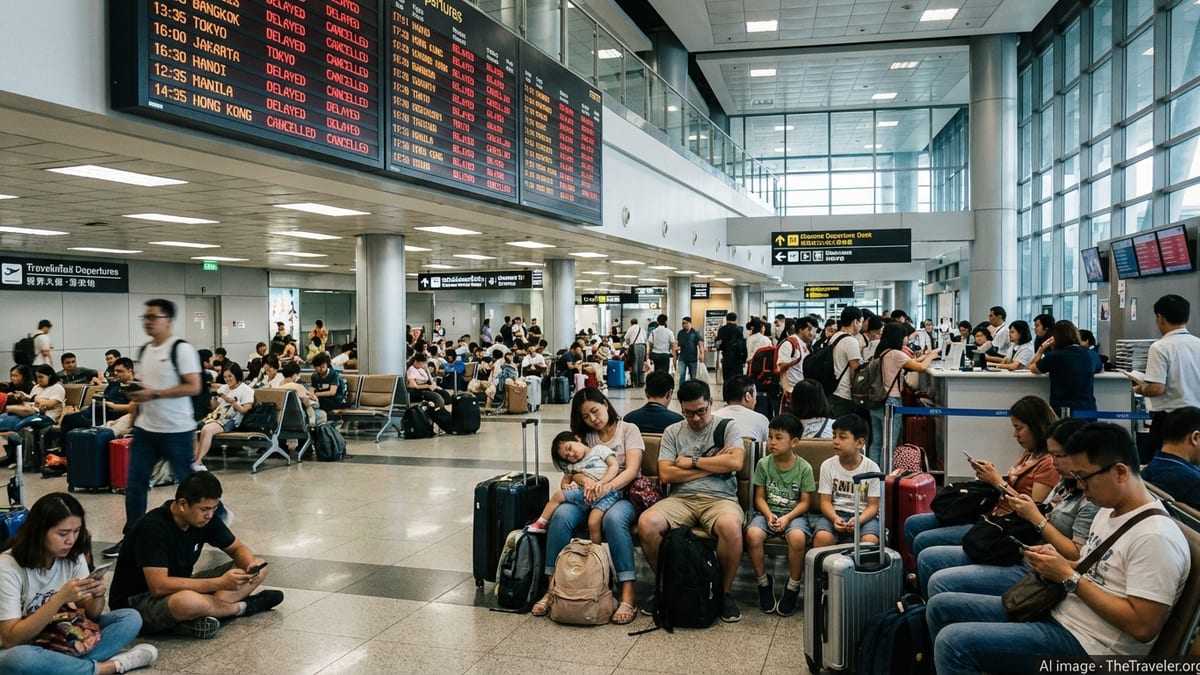
Jakarta: ash alerts, re-openings, and backlog math at Soekarno-Hatta
In Greater Jakarta, the most acute disruptions have been tied to volcanic ash advisories associated with Mount Anak Krakatau. Publicly available updates from Indonesia’s airport operator and transport ministry describe periods of airspace restrictions followed by staged re-openings, a pattern that tends to generate a multi-day backlog even after departures resume.
InJourney Airports data cited in Indonesian coverage put at least 624 flights delayed at Soekarno-Hatta International Airport during the peak of the disruption. Separate reporting in the same window also described a much larger number of affected movements that included cancellations, reflecting how airports and airlines often publish different “affected” totals depending on whether they count delayed flights, cancellations, diversions, and schedule removals together.
Indonesia’s transport ministry also published forward-looking operational expectations as services normalized, including a daily schedule for September 9, 2026, of 966 flights at Soekarno-Hatta with an estimated 131,495 passengers. That figure helps explain why even a single day of constrained airspace can cascade into longer queues at check-in, retiming of aircraft rotations, and missed connections for travelers routed through Jakarta to secondary Indonesian cities.
Tokyo: high-frequency hubs magnify disruption when weather and capacity collide
Tokyo’s two-airport system offers many daily options, but that frequency can be a double-edged sword during disruption: when banks of arrivals and departures slip, the network quickly runs out of “slack.” Publicly available on-time performance snapshots for Haneda in late August and early September 2026 show multiple days with well over 150 delayed flights and, on at least one provisional day, more than 260 delays.
Weather remains a recurring amplifier. Earlier in 2026, published Reuters video coverage showed a tropical-storm event grounding large numbers of flights in Tokyo, illustrating how fast-moving systems can halt departures, force holding patterns, and crowd gates, even when runway conditions recover sooner than terminal congestion.
Tokyo-area taxiway and airfield maintenance can also contribute to slower surface movement. A published Narita aerodrome notice for September 2026 lists multiple taxiway closures for maintenance through the end of the month, the kind of constraint that can lengthen taxi-out times and raise the odds that an arriving aircraft misses its next assigned departure slot.
Delhi: monsoon bursts and operational strain at one of India’s busiest hubs
In Delhi, recent disruption has been closely tied to intense rain events. Published coverage in early September 2026 described waterlogging and weather-related diversions, with reports indicating 11 flights diverted during one period and “hundreds” delayed, as conditions affected both flight operations and road access to the airport area.
For travelers, the key issue is that the worst pinch can occur even when your flight is not cancelled. Diversions, arrival metering, and ramp slowdowns can push departure times deep into the night, then compound into the next morning’s wave. In parallel, carrier-specific irregular operations can further complicate recovery, as seen in mid-September 2026 coverage describing repeated rescheduling and long delays on certain Delhi-origin international flights.
Delhi’s runway and air traffic management environment is also structurally complex. Publicly available Indian aviation documentation over recent years has described multi-runway operating procedures and dependencies within the runway system. In practice, that means certain combinations of runway availability and wind conditions can reduce throughput, increasing the chance that weather or a technical hiccup translates into long ground delays.
What “3,900 delays” really means for travelers booking connections
A headline number like 3,900 delays is best understood as a network indicator, not a single-airport count. The most useful takeaway is how delays cluster: volcanic ash and airspace constraints can suppress departures at the origin; storms can shut down arrival flows; and high utilization at major hubs means recovery often takes longer than the weather event itself.
For itineraries that involve Jakarta, Tokyo, or Delhi as a connection point, the practical risk is misconnects and baggage misrouting when minimum connection times are tight. This is most visible on “banked” schedules where international arrivals feed short-haul departures within a narrow window. Once the bank is disrupted, rebooking availability can disappear quickly, especially during school holidays or peak inbound travel periods.
Travelers planning trips in the coming weeks can reduce exposure by selecting longer layovers, avoiding last-flight-of-the-night onward connections, and choosing routings with multiple later same-day alternatives. When disruption is weather- or ash-related, same-airline or same-alliance itineraries often re-accommodate more smoothly because the carrier can move passengers within its own inventory without waiting for interline approvals.
How to navigate disruption days: verification steps that matter most
During major irregular operations, the most time-sensitive information is not a news headline but your flight’s latest operational status. Travelers can cross-check airline apps, airport departure boards, and independent flight-tracking delay indicators to confirm whether a delay is still building or beginning to recover. The goal is to avoid arriving at the airport too early for a rolling delay, while still meeting check-in and security cutoffs.
When cancellations occur, airline policies typically focus on rebooking or refunds rather than cash compensation, particularly when disruptions stem from volcanic ash, severe weather, or air traffic flow controls. Travelers should verify the rebooking options offered in-app before standing in long service lines, and keep documentation of schedule changes if onward hotels, tours, or rail connections require proof of disruption to change reservations.
Finally, travelers transiting these hubs should plan for the secondary effects of disruption: ground access delays in heavy rain, long walks when gates change at the last minute, and lounge crowding when multiple delayed widebodies overlap. A small buffer such as downloading boarding passes, packing essentials in carry-on, and enabling airline notifications can make a meaningful difference when the sky above Asia turns into a traffic jam.