


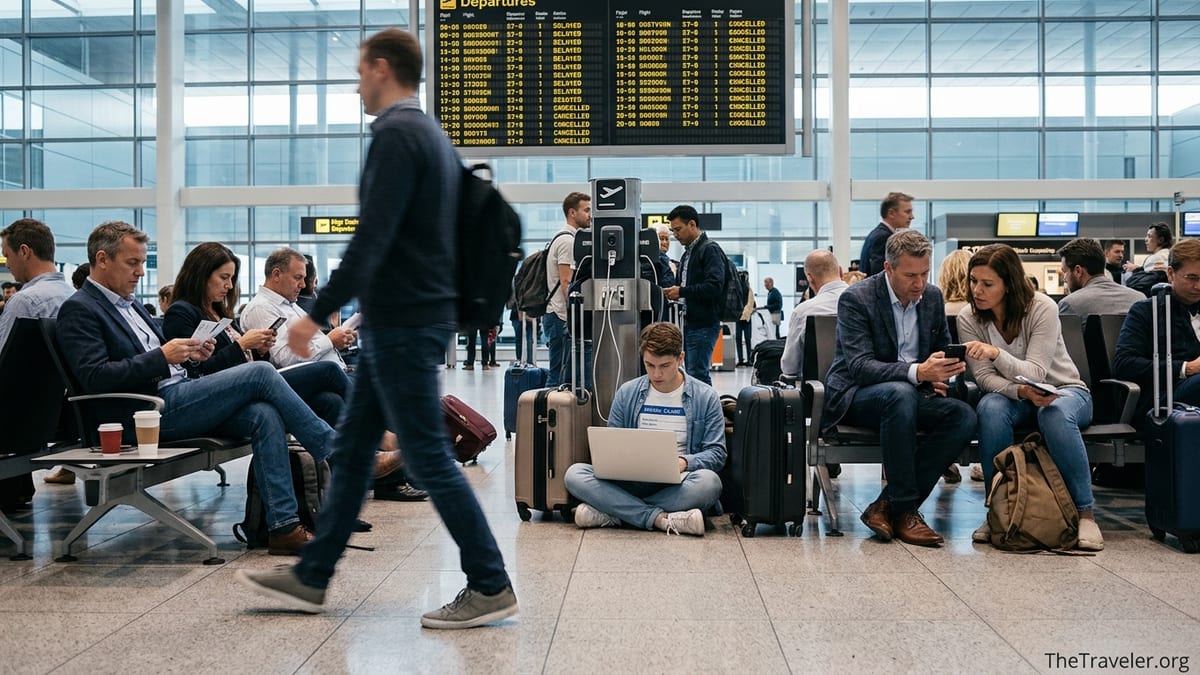
Few travel experiences are as frustrating as watching your long‑planned flight slip from “on time” to “delayed,” or worse, “cancelled,” with little explanation. In Europe and some other jurisdictions, strong passenger rights laws mean you may be entitled to hundreds of euros in compensation. The catch is that actually getting that money from an airline can be slow, confusing, and full of dead ends. That is the gap Refund.me set out to fill: a technology‑driven service that pursues flight delay and cancellation claims on your behalf, in exchange for a success‑based fee.
Get the latest updates straight to your inbox!
What Refund.me Is and Where It Operates
Refund.me is a Germany‑based company that focuses on enforcing air passenger rights when flights are cancelled, significantly delayed, overbooked, or when missed connections cause long delays. It was founded in 2012 and built around European Regulation EC 261/2004, often called EU261, which entitles passengers on many European flights to compensation that can range, in typical cases, from about 250 to 600 euros depending on distance and delay length. Over the years, Refund.me has processed claims involving hundreds of airlines and airports, helping travelers who either did not know they had rights or had given up after unproductive exchanges with airline customer service.
In practice, Refund.me’s core strength is Europe‑related claims. Most of the cases it handles involve EU261 or similar European rules, which cover flights departing from an airport in the European Union (and some associated countries such as Iceland and Norway), as well as flights to the EU on EU‑based carriers. A New York traveler stuck in Frankfurt before a connection to Chicago, or a Singaporean traveler whose Paris to Lisbon flight arrives six hours late, can both in principle ask Refund.me to pursue compensation even though they live outside Europe.
Although EU261 is the backbone, Refund.me’s model can extend to other passenger‑rights frameworks where it works with partner law firms and local specialists. For example, some claims may draw on UK261 rules for flights linked to the United Kingdom, or national rules in countries that have adopted protections similar to the European system. For a leisure traveler who simply wants to know “Do I have a case?” and “Roughly how much might I get?,” the attraction is that Refund.me translates complex laws and court decisions into a simple yes‑or‑no eligibility check.
It is important to distinguish Refund.me from online travel agencies or insurance products. The company is not selling a policy that pays out when your flight goes wrong. Instead, it is a claims service that steps in after the disruption has already occurred, in order to extract compensation directly from the airline under existing legal rules.
How Refund.me’s Claim Process Works Step by Step
Refund.me positions itself as a digital first service. Travelers usually start on the company’s website or app, where a claim wizard asks for essential flight information: booking reference, flight number, date, departure and arrival airports, and details of what went wrong. Travelers may also be asked to upload documents such as a boarding pass, booking confirmation, or written messages from the airline that confirm the cause of the disruption or any rebooking that was offered.
Once the basics are entered, Refund.me uses what it describes as an automated “Advanced Business Logic” system to check eligibility. Behind the scenes, this means your case is compared with the text of EU261 and related regulations, as well as past court outcomes and airline practices. For example, if your Madrid to Berlin flight arrived three hours and fifteen minutes late because of a minor mechanical fault, the system will flag that as potentially compensable under EU261. If it was delayed the same amount because of a large‑scale air traffic control strike that courts have treated as an “extraordinary circumstance,” the system may mark the claim as unlikely to succeed.
If your claim appears viable, Refund.me then generates a formal demand to the airline. This can include legal references, a calculation of the compensation amount based on route distance and delay at arrival, and sometimes a power of attorney form that allows Refund.me or its partner law firms to negotiate on your behalf. Airlines vary widely in how quickly they respond. Some low‑cost carriers in Europe may reply within a few weeks and either agree or refuse. Others, such as legacy flag carriers, may ask for additional documentation, argue that the disruption was caused by extraordinary circumstances, or simply delay the conversation for several months.
When the airline rejects a claim that Refund.me believes is valid, the company can escalate. This might involve sending further legal arguments, filing a complaint with a national enforcement body, or handing the case off to a partner law firm that can initiate court proceedings. As a passenger you usually do not need to attend court; most of the process happens in writing. The trade‑off is time. Straightforward cases sometimes settle in a month or two, while more heavily disputed cases can take a year or longer before any money arrives in your bank account.
Real‑World Examples of Refund.me in Action
Consider a family of four from Boston who book a summer holiday that starts with a flight from Boston to London and then a separate ticket from London to Rome. Their London to Rome flight, operated by an EU carrier, is cancelled the evening before departure due to a technical defect on the aircraft. The airline offers them rebooking the next day and a hotel night at the airport, which they accept, but it means they lose a prepaid night in their Rome apartment rental. When they return home, they search online and discover EU261. They try to contact the airline directly and receive only generic responses for weeks. Frustrated, they submit their details to Refund.me, which quickly confirms that a last‑minute cancellation for a technical fault on a European carrier is typically compensable.
In this scenario, the family could be entitled to several hundred euros per ticket in EU261 compensation, separate from any refund of hotel or meal costs. Refund.me would file the claim, handle the back‑and‑forth, and eventually, if successful, the family might see approximately 400 euros each in compensation land in their account, minus Refund.me’s success fee. For a group, this can add up to a sizable sum, enough to offset several days of lost vacation time.
Another common pattern involves missed connections. Imagine a traveler flying from Warsaw to Lisbon with a change in Frankfurt, all on one ticket. A late arrival into Frankfurt causes her to miss the connection, and she is rebooked to arrive in Lisbon more than five hours after the original schedule. She is given meal vouchers but no further explanation. Once home, she submits a claim herself through the airline’s online form and hears nothing for three months. At that point she hands the case to Refund.me, which already knows from similar cases that missed connection delays of more than three hours often qualify for compensation under EU rules, provided the cause is not an extraordinary circumstance like a major storm. The company resubmits the claim with detailed legal references and pushes for a decision.
Even when a traveler technically could have succeeded on their own, Refund.me may make the difference between a stalled, ignored complaint and a properly processed payment. This is particularly true when passengers live outside Europe and find it difficult to escalate matters with European regulators or foreign small‑claims courts.
Fees, Payouts, and What You Actually Receive
Refund.me operates on a “no win, no fee” basis. That means there is usually no upfront cost to submit a claim. If the company does not manage to secure a payout from the airline, you are not billed for the attempt. If it does succeed, Refund.me takes a percentage of the recovered amount as its success fee, and sometimes may pass on certain court or enforcement costs if legal action was needed. Historically, similar claims companies have charged a success fee in the region of a quarter to just over a third of the compensation amount, with higher percentages sometimes applied when complex litigation is required. Exact numbers can change over time, so travelers should always check the latest fee schedule on Refund.me’s own materials before signing.
To see how this feels in practice, imagine you are entitled to 600 euros in EU261 compensation after your long‑haul flight from Barcelona to New York arrived more than four hours late for a reason the airline controls, such as a crew scheduling problem. If Refund.me’s fee were around 25 percent plus applicable taxes, you might receive roughly 420 to 450 euros in your bank account, depending on the final fee structure and any additional costs. If the case had to go through court, and a higher fee level applied, your net payout could be somewhat lower, although still likely several hundred euros you would not otherwise have had.
Payments are typically routed through bank transfer or another common method such as PayPal, depending on your country of residence and Refund.me’s current options. You will often be asked to provide banking details only after the airline has accepted the claim and transferred the funds, which helps reassure cautious travelers who are nervous about sharing financial information with a third party. It is worth remembering that currencies can shift between the time your claim is filed and when it is paid. Compensation under EU261 is calculated in euros, so passengers based in the United States, Canada, or the United Kingdom may see their final amount in dollars or pounds fluctuate slightly based on exchange rates.
Another practical point is that Refund.me’s fee is usually calculated on the gross compensation, not on top of or instead of it. You do not pay anything out of pocket. Instead, if an airline agrees to 400 euros of compensation and Refund.me’s fee is 25 percent, Refund.me keeps 100 euros and transfers 300 euros to you. For many travelers, this trade‑off is acceptable, especially when they have already spent months trying to obtain a response from the airline on their own.
When Using Refund.me Makes Sense vs Claiming Yourself
Travelers always have the option to claim directly with the airline without using an intermediary such as Refund.me. Many airlines provide web forms for EU261 or similar compensation, and some even have dedicated departments for passenger rights. If you are comfortable reading the basic rules, can articulate your case clearly, and have time to follow up, you might succeed on your own and keep 100 percent of the compensation. There are numerous reports of passengers who submitted a straightforward claim to a major carrier and received the full legal amount within a few weeks, especially when the cause of the delay was undisputed.
However, airlines do not always make the process easy. Some carriers respond with generic emails that do not clearly address the legal arguments you raise. Others cite extraordinary circumstances without providing evidence, or they simply do not reply at all for long stretches. If you are dealing with a foreign language, or if the national enforcement body in the airline’s home country is slow to act, the burden can become heavy. This is where Refund.me can be a valuable intermediary, especially when the compensation per person is high enough to justify a success fee.
As a rule of thumb, using a service like Refund.me tends to make more sense in the following situations: your delay or cancellation involved several passengers on the same booking, so the total potential compensation is significant; the events took place more than a year ago and you are no longer sure which documentation you still have; the airline is based in a country where you feel unable to deal with regulators or courts; or your initial direct claim has been rejected with arguments you do not fully understand. In these cases, the convenience and the company’s experience in pushing back against airlines' standard responses can outweigh the loss of a portion of the payout.
On the other hand, for a very short‑haul flight with limited compensation, or when the airline has already acknowledged responsibility and is processing your request, it may be more rational to see the direct claim through yourself. If you already have a clear email from the airline promising EU261 compensation, handing the case over to Refund.me at that point might simply mean sharing part of a payment that would have arrived anyway.
Limitations, Risks, and Common Misunderstandings
Refund.me cannot turn every frustrating flight experience into a successful claim. Passenger rights laws contain several important limitations. Under EU261, for example, compensation is usually not owed when the disruption was caused by what courts consider extraordinary circumstances. These can include severe weather that grounds multiple airlines, sudden airspace closures for security reasons, major strikes by air traffic control, or unforeseeable safety emergencies. Travelers sometimes assume that any long delay in Europe automatically qualifies, but if your Paris to Dublin flight was caught in a widespread snowstorm that shut airports across the region, neither Refund.me nor any other service is likely to obtain EU261 compensation beyond basic care like meals and accommodation.
Another common misunderstanding is about time limits. Each country that applies EU261 has its own statutes of limitation for bringing claims in court. In some places passengers have only a couple of years from the date of travel, while in others the window is longer. Refund.me’s systems are designed to take these national rules into account when evaluating a claim. However, if you wait until three or four years after the disruption to seek help, there is a real risk that even a strong case on the facts may be legally time‑barred. This is one reason why travel experts often advise submitting your initial claim as soon as you return home from a disrupted trip.
Passengers also occasionally expect that Refund.me will recover every type of cost associated with a disruption, from airport taxis and meals to lost hotel nights at the destination. In reality, EU261 and similar frameworks focus primarily on flat compensation amounts plus “right to care” expenses such as meals, transport to a hotel, and in some cases accommodation when the delay forces an overnight stay. Other losses, such as a missed cruise departure or non‑refundable activity tickets, may fall outside the scope of these regulations and instead be addressed, if at all, through separate claims with travel insurance or credit card protection. Refund.me is most effective in securing the standardized compensation amounts and core care obligations rather than every possible knock‑on expense.
Finally, travellers should understand that Refund.me is not a personal lawyer in the traditional sense. It is a specialist claims service that cooperates with law firms where necessary. Its role is to screen your case, manage communications, and push for compensation using streamlined processes and legal arguments that have already been tested across thousands of similar cases. If you have a highly unusual or extremely high‑value claim, or if you wish to pursue damages outside the standard passenger‑rights regimes, you may need bespoke legal advice independent of any claims platform.
The Takeaway
For many air passengers, the existence of Refund.me can be the difference between walking away from a frustrating flight experience with nothing and turning that disruption into meaningful compensation. By combining automated eligibility checks with a network of legal partners, Refund.me simplifies what would otherwise be a bewildering maze of regulations, deadlines, and airline procedures. Travelers who have neither the appetite nor the time to argue with carriers and authorities can outsource the entire process and simply wait for the outcome.
At the same time, using Refund.me involves a clear trade‑off: you are paying, in the form of a success‑based fee, for expertise and persistence that you could in theory provide yourself. On straightforward cases where the airline is cooperative, a determined traveler might prefer to file a claim directly and keep all of the compensation. On more complex or contested cases, especially for those living far from Europe or dealing with non‑English speaking carriers, the fee can be an acceptable price for a much higher chance of success.
As air travel continues to recover and airports once again become crowded chokepoints, disruptions are likely to remain a regular feature of global journeys. Knowing that services like Refund.me exist, understanding how they work, and being realistic about both their strengths and their limits can help you make smarter decisions the next time a departure board in front of you quietly flips from green to red.
FAQ
Q1. What kinds of flight problems can Refund.me help with?
Refund.me focuses on cancellations, long delays, overbookings that lead to denied boarding, and missed connections that cause you to arrive several hours late, particularly on flights covered by European passenger rights rules.
Q2. Do I have to live in Europe to use Refund.me?
No. You can live anywhere in the world. What matters is that your disrupted flight itself falls under the relevant rules, such as departing from an EU airport or being operated by an EU carrier.
Q3. How much compensation might I receive through Refund.me?
Under EU261, typical compensation ranges from about 250 to 600 euros per person depending on flight distance and length of delay, although the exact amount in your case will depend on specific circumstances.
Q4. What fees does Refund.me charge if my claim is successful?
Refund.me works on a no win, no fee basis and takes a success‑based percentage of whatever compensation it recovers from the airline; the precise rate can change over time, so you should always check the current fee schedule before signing.
Q5. How long does the Refund.me process usually take?
Simple cases where the airline cooperates may settle in a few weeks or a couple of months, while more complex disputes that require escalation or court involvement can take many months or even more than a year.
Q6. Can Refund.me guarantee that I will receive compensation?
No. Refund.me can only accept or decline your case based on its assessment of the rules and past outcomes, but airlines, regulators, and courts ultimately decide whether compensation is paid.
Q7. What documents should I have before submitting a claim to Refund.me?
You should keep your booking confirmation, boarding passes if available, written information from the airline about the disruption, and any receipts for meals or accommodation that the airline was supposed to cover.
Q8. Will using Refund.me affect any separate refund or voucher I already received from the airline?
In most cases, Refund.me focuses on statutory compensation and care obligations that are separate from basic ticket refunds or goodwill vouchers, but you should disclose anything you have already accepted so the company can assess your position accurately.
Q9. Is it better to try claiming directly with the airline before going to Refund.me?
Many travelers do start with a direct claim, and if the airline rejects it, does not reply, or gives confusing answers, they then turn to Refund.me, which can be more effective in pushing for a clear outcome.
Q10. Does Refund.me replace travel insurance or legal advice?
No. Refund.me complements, but does not replace, travel insurance or independent legal advice; it is designed to enforce existing passenger rights rules rather than cover every possible loss or provide full‑scope legal representation.