


Husky safaris are one of the most unforgettable ways to experience winter in the Arctic. Yet once you start researching, the options can feel overwhelming: 5-kilometre taster rides, full-day wilderness journeys, week-long expeditions, family-friendly kennel visits, private safaris under the northern lights. This guide breaks down how to choose the right husky safari based on three key factors you can control: location, duration and the kind of experience you actually want on the trail.
Get the latest updates straight to your inbox!
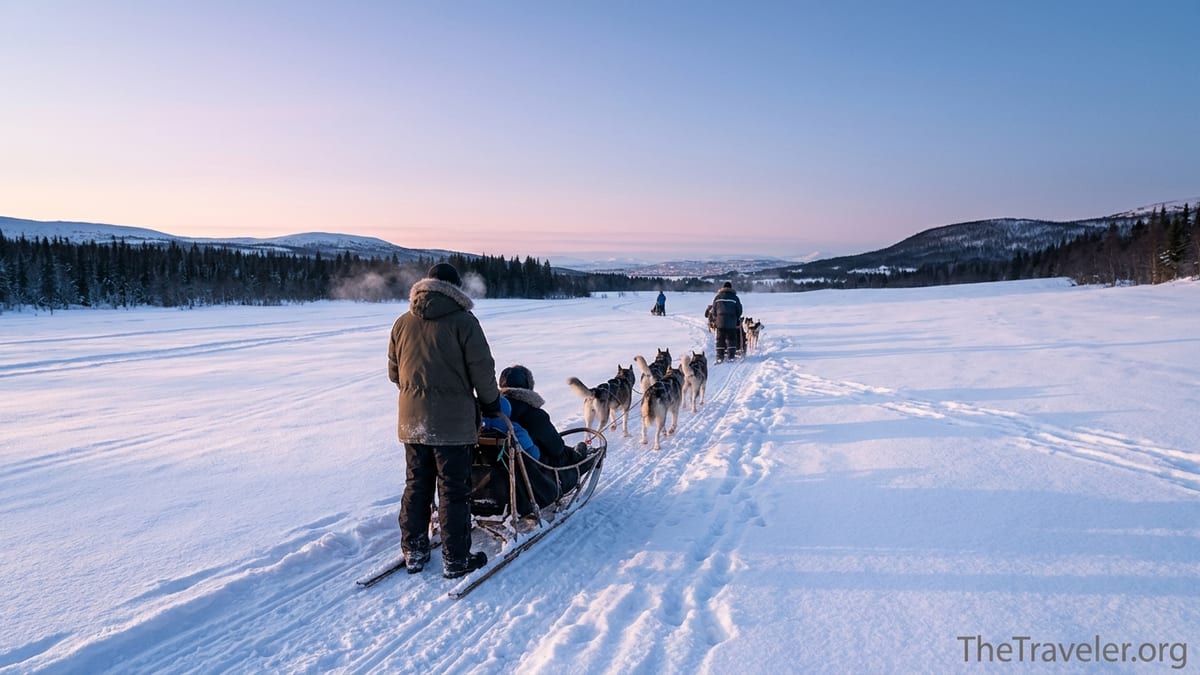
Understanding Where Husky Safaris Happen
Most bucket list husky safaris take place in the Nordic Arctic and sub-Arctic, especially Finnish and Swedish Lapland, northern Norway and Svalbard. Within those regions, experiences vary a lot. Around Rovaniemi in Finnish Lapland, for example, you will find dozens of kennels offering short scenic rides near Santa Claus Village as well as longer wilderness routes that head deep into the forest outside town. In Tromsø in northern Norway, tours typically run on nearby islands like Kvaløya or in valleys such as Tamokdalen, reached by a 60 to 90 minute transfer from the city.
Rovaniemi and Levi in Finland, and Kiruna and Abisko in Sweden, are strong choices if you want husky safaris combined with ski resorts, Santa-themed activities or easy connections by train and domestic flights. Multi-day expeditions often base themselves in quieter areas further north and west, such as Muonio and Enontekiö, where outfitters like Harriniva and Hetta Huskies run several-day safaris across frozen lakes and through low fells with few roads or lights nearby.
Norway is ideal if you want dramatic coastal scenery and the chance to combine dogsledding with fjord cruises or whale watching day tours. In Tromsø you might spend a morning driving your own dog team across Kvaløya and be back in the city in time for dinner. Further north, some winter cruises call at ports where husky visits and short sled rides are offered as shore excursions, which can work if you have only a few hours ashore but still want a taste of mushing.
For the most remote feel, Svalbard and Greenland host specialist expeditions where distances are longer, terrain is wilder and group sizes are often small. These trips usually require several days, solid fitness and a higher budget. They can include camping on the sea ice or overnighting in simple wilderness cabins with no road access at all. If you are mainly looking for a gentle introduction or are travelling with younger children, Lapland or northern Norway will usually be a better fit than these high Arctic expeditions.
Matching Duration to Your Comfort and Budget
The length of a husky safari is one of the biggest drivers of both price and how intense the experience feels. Entry-level safaris around Rovaniemi often last 1 to 2 hours door to door, with perhaps 20 to 40 minutes actually on the sled. Typical distances range from about 2 to 5 kilometres for very short runs to around 10 kilometres for standard half-day style tours. Recent price checks in Lapland show short self-drive tours of 5 to 10 kilometres commonly starting from roughly 110 to 200 euros per adult, with simple passenger-only rides a bit cheaper.
Half-day excursions are a good middle ground. In Lapland and northern Norway, these usually involve around 45 to 90 minutes of sled time and 3 to 5 hours in total including transfers, kennel tour, clothing and safety briefing. Distances often fall in the 10 to 18 kilometre range depending on snow conditions and route choice. Prices tend to sit somewhere between short tasters and full-day programs, and many operators offer morning and afternoon departures to fit around other activities.
Full-day safaris can involve covering 20 to 40 kilometres over several hours with a lunch stop in a wilderness shelter. In practice, you might leave Tromsø or Rovaniemi mid-morning, spend the middle of the day mushing and return in the late afternoon tired but exhilarated. These longer days often cost several hundred euros per person once you factor in transport, thermal clothing and meals. They suit travellers who are reasonably active and want to feel they have really learned to handle a sled, not just sat in it for a short loop around the forest.
Multi-day safaris start at 2 days and can stretch to a week or more. A typical three-day Lapland itinerary might include several hours of mushing each day, covering 25 to 40 kilometres, and overnights in simple wilderness cabins with shared facilities, wood stoves and no running water. Longer expeditions of five or seven days often move point-to-point between cabins with little or no vehicle support. The price difference compared to a single day is significant, but these trips usually include all meals, gear and guiding, and deliver a complete Arctic immersion rather than a single highlight activity.
Choosing the Right Experience Level: From Taster to Expedition
Not all husky safaris feel the same from the sled. At the easiest end are kennel visits and husky walks. In Tromsø, for example, companies offer summer and autumn husky walks where you are paired with a dog on a harness for a guided hike, followed by time with puppies and coffee back at the farm. In winter, some kennels near Santa Claus Village focus on short passenger rides for families who want photos with huskies more than a demanding adventure. These are ideal if someone in your group has limited mobility or if you have very young children.
Most winter visitors opt for a self-drive tour where two guests share a sled and team of four to six dogs. One person stands on the runners and drives while the other sits in the sled, and you swap halfway. On gentle trails you will learn to use the brake, lean into turns and help the dogs by pushing on uphill sections. This format is common around Rovaniemi, Levi and Tromsø, and suits travellers with average fitness who are comfortable being outdoors for several hours in temperatures that can fall below minus 15 degrees Celsius.
At the more demanding end are full-day and multi-day expeditions where you drive your own sled for extended periods over rolling terrain. Outfitters specialising in wilderness safaris in Muonio or Enontekiö, for example, expect guests to help with feeding, harnessing and un-harnessing the dogs, collecting water from ice holes and helping maintain the trail around cabins. On some Finnish Lapland expeditions, participants may cover distances each day similar to those in amateur sled dog races, though at a touring rather than racing pace.
Before booking, read the operator’s description of required fitness and previous experience carefully. A five-day wilderness safari might specify that you should be able to stay active outdoors for several hours and manage basic tasks with cold fingers, but does not usually require prior mushing experience. Very technical expeditions in places like Svalbard may ask that guests have completed a shorter husky safari or multi-day ski trip in Arctic conditions beforehand. If in doubt, email the kennel and describe your recent trips, such as multi-day hiking or ski touring, to gauge whether a demanding safari will be enjoyable rather than overwhelming.
Comparing Popular Husky Safari Hubs
Rovaniemi is often the first name that comes up when people think of husky safaris, and for good reason. The town combines a major airport, a compact centre and the Santa Claus Village, so there are many kennels operating within a short drive. You will find everything from budget-friendly 2 kilometre loops for families to mid-range 10 kilometre safaris and higher-end private tours that run 15 kilometres or more with small groups and slower pacing. Some resorts outside the town centre, such as lakeside lodges or glass igloo complexes, have their own kennels on site, which can be convenient if you prefer not to transfer by minibus.
Levi and Ylläs, the main ski resorts in Finnish Lapland, also offer a good range of husky tours that fit around downhill skiing. You might ski in the morning and then join a twilight husky safari in the late afternoon, ideally somewhere away from the brightest resort lights to improve your chances of seeing the northern lights. In these areas, it is common to find both simple 8 kilometre runs aimed at first-timers and more robust full-day programs heading into nearby national parks.
In northern Norway, Tromsø remains the primary hub. Operators run classic day trips where you are picked up at a central hotel like the Radisson Blu, driven 30 to 90 minutes to a husky farm, and spend several hours with the dogs. Some farms focus on small groups and a quiet, non-touristy atmosphere, while others can handle larger numbers from cruise ships. Outside winter, a few kennels stay open for summer and autumn visits, offering husky hiking, kennel tours and even glacier-based sledding with wheeled rigs in certain parts of the country.
For travellers seeking more isolation and a strong wilderness feel, Muonio, Hetta and other small communities in northwestern Finnish Lapland stand out. Kennels there specialise in multi-day husky safaris and expeditions, and their marketing materials emphasise small group sizes, self-sufficiency and moving through areas with few other visitors. If your priority is a deep immersion into Arctic landscapes rather than a quick taste of dog sledding, planning your trip around one of these hubs may be preferable to booking a short ride from a busy resort town.
Reading the Fine Print: Group Size, Ethics and Comfort
Once you have narrowed down destination and rough duration, it pays to compare the details of individual tours. Group size can make a big difference to the feel of a safari. Some kennels near Tromsø and Rovaniemi regularly take 20 or more guests on a single departure, with several guides managing a line of sleds. Others cap tours at 6 to 8 participants and emphasise quieter trails and longer time for photos and dog interaction. If you value space and a more personal atmosphere, look for operators that highlight small-group departures or private safaris.
Animal welfare and kennel ethics are increasingly important to many travellers. Reputable operators typically provide information about their dogs’ living conditions, retirement and rehoming policies, and how they manage working hours during busy holiday periods. Some Lapland kennels publish details about how many kilometres each team runs per day in high season and what rest periods look like, reassuring guests that tourism runs are far below the distances covered by race dogs and tailored to conditions.
Comfort is another point of comparison. Standard tours often include thermal overalls, winter boots, mittens and hats, plus a snack or hot drink. More premium safaris might add hearty wilderness lunches, upgraded clothing, heated changing rooms, indoor lounges and private transfers. In Finnish Lapland, for example, a more expensive half-day safari may include a slow-cooked reindeer or vegetarian stew in a kota hut, while budget options might offer coffee and biscuits around an open fire. Decide in advance whether you are content with simple facilities or would prefer a more polished experience with extra comforts.
Finally, look at how much hands-on involvement is expected. Some family-oriented safaris near Santa villages keep guests mostly as passengers, with guides controlling the sleds and dogs. Others encourage guests to help harness the teams, learn basic commands and participate in feeding after the run. The latter can be especially rewarding for animal lovers and older children, as long as everyone in the group is ready to get a bit cold, tired and possibly covered in snow and dog hair.
Planning for Weather, Season and Safety
Husky safaris depend heavily on weather and snow conditions, so understanding the local season will help you choose wisely. In Rovaniemi, the main sledding season typically runs from late November to early April, with the most reliable snow and long routes usually available from December through March. In Tromsø, high season also spans roughly December to March, though coastal weather can change quickly and strong winds or rain may alter routes or force last-minute changes.
Midwinter in the Arctic can be very cold, with temperatures dropping below minus 20 degrees Celsius away from the coast. Early and late season tours sometimes use shorter routes or reserve tracks with better snow cover. When reading tour descriptions, look for notes on minimum age, fitness expectations and what happens in marginal conditions. Some kennels clearly explain that if heavy snowfall or warm weather affects trails, they may switch from self-drive to guided sleds or shorten distances for safety.
Safety on the trail is closely linked to guide experience, group size and equipment. Established operators train their teams to handle runaways, sudden stops and wildlife encounters, and they run regular drills on what to do if a sled tips. You will usually receive a safety briefing before departure covering how to use the brake, what to do if you fall and how to signal for help. It is worth paying attention during this briefing even if you have been on a husky safari before, because different kennels use slightly different equipment and local terrain can vary.
Travel insurance is an often-overlooked element. Make sure your policy covers winter activities such as dogsledding and that you are comfortable with any exclusions related to speed, remoteness or participation level. For multi-day expeditions, check whether emergency evacuation from a remote cabin or valley is included. While serious incidents on commercial husky tours are rare, having appropriate cover will help you relax and enjoy the experience rather than worrying about what might happen if you twist a knee in deep snow.
The Takeaway
Choosing the right husky safari starts with being honest about the kind of trip you want. If you simply want to meet huskies and feel a sled glide over snow for a few minutes, a short taster near a major town like Rovaniemi or Tromsø will deliver that magic without demanding much from your budget or fitness. If you dream of mushing for hours beneath pale winter skies, stopping at frozen lakes and sleeping in remote cabins, then planning around a multi-day expedition with a specialist kennel will be far more satisfying.
Location shapes everything from scenery to ease of access and price. Duration determines how deeply you will step into the world of mushing, while experience style decides whether your day is a gentle introduction or a genuine adventure. By checking group size, welfare standards, what is included and how the operator communicates about safety and weather, you can choose a safari that fits your values as well as your itinerary.
Spend some time comparing real itineraries, asking kennels about their dogs and reading recent traveller feedback. The extra research pays off the first time your team surges forward and you realise you have chosen a husky safari that matches both your dreams and your comfort level.
FAQ
Q1. Do I need previous experience to drive my own husky sled?
Most commercial husky safaris are designed for beginners, and guides teach you the basics before you set off. As long as you are reasonably fit, willing to follow instructions and comfortable standing on a moving sled, you should be fine. Very demanding multi-day expeditions sometimes recommend that guests have completed an easier safari or similar outdoor trip in cold conditions first.
Q2. How long is a typical husky safari?
Short taster safaris often last 1 to 2 hours door to door, with 20 to 40 minutes of actual sledding. Standard half-day tours usually run 3 to 5 hours in total, including transfers and a break, and full-day safaris can take 6 to 8 hours with several hours on the sled. Multi-day expeditions involve several hours of mushing on consecutive days, usually covering 20 to 40 kilometres per day at a touring pace.
Q3. What should I wear on a husky safari?
Dress in warm, layered clothing such as thermal underwear, a fleece or wool mid-layer and a windproof outer shell. Most reputable operators in Lapland and northern Norway provide insulated overalls, winter boots, hats and mittens, but you should still bring warm socks, a neck gaiter and thin liner gloves. Avoid cotton next to your skin, as it holds moisture and makes you feel colder.
Q4. Are husky safaris suitable for children?
Many husky safaris near major resorts welcome children, often from around 4 to 6 years old for passenger rides. Age limits for driving a sled are usually higher, often 12 to 16 years depending on size, conditions and operator policy. If you are travelling with young children, look for shorter tours where they can ride in the guide’s sled and spend extra time meeting the dogs rather than mushing for long distances.
Q5. How much does a husky safari cost?
Prices vary by location, duration and what is included. In Finnish Lapland, recent listings show short 5 to 10 kilometre self-drive safaris starting around 110 to 200 euros per adult, with simple passenger rides somewhat cheaper and longer 12 to 18 kilometre tours costing more. In northern Norway, full-day adventures often run to several hundred euros per person. Multi-day expeditions are more expensive but usually include all meals, guiding and gear.
Q6. What if the weather is very cold or there is little snow?
Operators in the Arctic are used to variable conditions and adjust routes, distances and departure times for safety. In extreme cold, they may shorten the tour or add extra clothing and breaks by the fire. If mild weather or rain damages trails, some kennels switch to reserve routes or wheeled rigs, or cancel and offer refunds or rebooking. Check the operator’s policy on weather-related changes before you book.
Q7. How can I tell if a kennel treats its dogs well?
Look for signs of transparency, such as information about retirement and rehoming, how many dogs they keep relative to staff, and whether they explain working hours and rest days. Reviews from recent travellers can give a sense of how the dogs behave on and off the trail. On site, healthy huskies should look lean but not underweight, with bright eyes, good fur and enthusiasm when harnessed. You should feel able to ask questions about their care and training.
Q8. Will I see the northern lights during a husky safari?
Evening safaris in northern Norway and Lapland are often timed to maximise your chances, but seeing the aurora is never guaranteed. Clear, dark skies and a bit of solar activity are required, and clouds or full moonlight can reduce visibility. If seeing the northern lights is important to you, consider staying several nights in the region and booking your husky tour early in the trip so you have time to try again with a dedicated aurora outing if needed.
Q9. How physically demanding is a husky safari?
Short, mostly passenger-based tours are not especially demanding, though you will still be outdoors in cold air and uneven snow. Self-drive safaris require more effort, as you balance on the runners, lean into turns and sometimes push uphill to help the dogs. Multi-day expeditions can be tiring, involving several hours of activity day after day plus chores such as carrying water and firewood. If you are unsure, start with a half-day tour before committing to something longer.
Q10. How far in advance should I book a husky safari?
Popular departures around Christmas, New Year and school holidays in February and March often sell out months ahead, especially in hubs like Rovaniemi, Levi and Tromsø. If you have limited flexibility in your dates or want a specific type of safari, such as a private tour or multi-day expedition, booking as early as possible is wise. Outside peak weeks, you may find space closer to departure, but options and departure times will usually be more limited.