


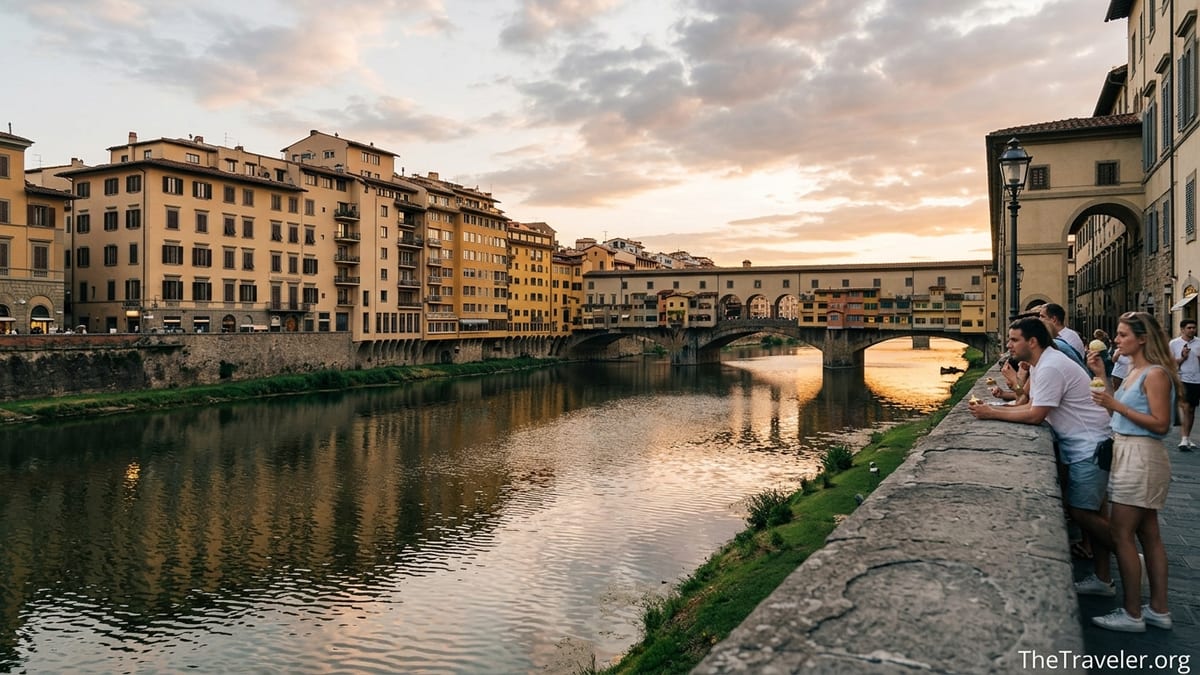
The Arno River is Florence at walking pace. It reflects church domes and medieval towers, catches the last light of the day and quietly divides the city into two distinct characters: the elegant historic center and the more bohemian Oltrarno. Experiencing the Arno is less about ticking off sights and more about knowing where to walk, when to arrive and which bridge or riverside bench to claim as the sky turns gold. This guide focuses on concrete routes, viewpoints and real experiences that will help you see the river at its best, especially at sunset.
Get the latest updates straight to your inbox!
Understanding the Arno and Its Lungarni
The Arno runs straight through the heart of Florence and the streets that line its banks are called the Lungarni. On the north side of the river you are close to landmarks like the Duomo, Piazza della Signoria and the Uffizi Gallery. On the south side, known as the Oltrarno, the streets are narrower, more residential and dotted with artisan workshops and neighborhood bars. Walking the Lungarni is one of the simplest ways to understand how Florence is laid out and how daily life flows around the water.
Most visitors first meet the Arno at Ponte Vecchio, the medieval bridge crowded with gold and jewelry shops. It is a powerful introduction, but it is rarely the place where you will get the most peaceful or beautiful view of the river itself. The best Arno experiences usually come when you step one or two bridges away from the busiest crossing and use the water as your reference point for an evening stroll.
Because the Arno cuts the city in two, it also becomes a natural orientation tool. If you are staying in a hotel near Santa Maria Novella station, a five to ten minute walk south will bring you to the river around Lungarno Corsini. From here you can decide whether to turn left toward Ponte Vecchio and the Uffizi or right toward quieter residential stretches and less crowded bridges such as Ponte alla Carraia. First-time visitors often find that once they know where they are in relation to the river, Florence becomes much easier to navigate.
Season and time of day matter. Between late May and early September, the stone embankments hold the daytime heat and the Lungarni feel most comfortable from around 6 pm onward, when locals come out for a pre-dinner walk. In spring and autumn, sunsets often bring softer colors and cooler air, and a riverside walk at 5 or 6 pm can easily form the backbone of your evening plan, linking a museum visit to an aperitivo stop in Oltrarno.
The Classic Arno Walk: From Ponte alla Carraia to Ponte alle Grazie
If you only have one evening to get to know the Arno, a simple, flat route connects some of the river’s best views without requiring any transport. Start on the north bank at Ponte alla Carraia, about ten minutes’ walk from Santa Maria Novella. Arrive an hour before sunset so you have time to watch the light change. From the middle of the bridge, look east and you will see Ponte Vecchio in the distance framed by the buildings on either bank, with the dome of the Duomo and the tower of Palazzo Vecchio rising behind.
From Ponte alla Carraia, walk east along Lungarno Corsini and Lungarno Acciaiuoli, passing elegant 19th century palazzi that now house hotels, bank headquarters and a handful of riverside bars. Many travelers choose to stop for an aperitivo here. Expect to pay around 10 to 14 euros for a spritz or glass of wine with small snacks at a mid-range bar with outdoor seating facing the river. You are paying partly for the view of the water and the soft glow on the bridges as the sun drops behind the hills to the west.
Continue toward Ponte Santa Trinita, a graceful stone bridge slightly upstream from Ponte Vecchio. Many local photographers recommend this as the single best bridge in Florence for watching the sunset over the Arno because you can look west toward rolling hills and east through the arches of Ponte Vecchio. If you want a classic photograph of Ponte Vecchio lit by golden-hour light, stand on the downstream side of Ponte Santa Trinita and point your camera up river as the sky changes color.
From Ponte Santa Trinita it is an easy ten to fifteen minute walk along the north bank to Ponte alle Grazie, another key viewpoint. This bridge gives you a more open, less crowded feel with views back toward the historic center and forward toward the eastern neighborhoods. Some visitors combine this route with a late-afternoon visit to the Uffizi Gallery, exiting toward the river and joining the Lungarno just as the galleries close and the city moves outside.
Crossing to Oltrarno: Quieter Views and Local Life
For a calmer Arno experience, cross to the south bank and explore Oltrarno. From Ponte Santa Trinita, head over the bridge and turn right along Borgo San Jacopo before rejoining the river at Lungarno Guicciardini. The atmosphere shifts quickly: fewer tour groups, more locals walking dogs, and small wine bars tucked into ground-floor stone arches. Here, early evening often brings a mix of students, artisans finishing their day and families pushing strollers along the embankment.
Walk east along Lungarno Guicciardini and then Lungarno Torrigiani. This stretch is prized for its view back to the Uffizi, the Vasari Corridor and Ponte Vecchio on the opposite bank. Some boutique hotels and apartment rentals advertise rooms that look directly onto this section of the river, and travelers often find that even a modest balcony or French window facing the Arno can be worth a higher nightly rate simply for the chance to watch the sunset from bed or over a simple takeaway pizza.
As you continue along the south bank toward Ponte alle Grazie, look for small terraced bars and seasonal kiosks that set up directly on or just above the riverbank in warmer months. A typical early evening routine might be to join locals at a simple kiosk-style bar near San Niccolò, order a glass of Tuscan white wine for around 6 to 8 euros and watch as the water turns from green to bronze. Many of these pop-up spots do not take reservations, so arriving thirty to forty minutes before sunset can make the difference between a front-row table and a seat further back from the view.
From the Oltrarno side, you are also well placed to continue your evening after the sun has dropped. A ten-minute uphill walk from the San Niccolò area brings you to clusters of trattorias where a plate of fresh pasta with seasonal mushrooms or a simple bistecca alla Fiorentina is still relatively priced compared with the streets directly around the Duomo. In this way, the Arno becomes not just the focus of your sunset plan but a practical route between a riverside aperitivo and a quieter dinner away from the busiest tourist lanes.
Sunset From the Bridges: When and Where to Go
Florence’s bridges are natural viewing platforms and choosing the right one can transform your sunset experience. Ponte Vecchio itself is often shoulder-to-shoulder in high season, which makes it more atmospheric than relaxing. You may still want to cross it close to sunset to see the light hit the jewelry shop fronts and to glimpse the river through the central arches, but for the actual moment when the sun meets the horizon, most travelers find it more pleasant to stand on a neighboring bridge and include Ponte Vecchio in the view.
Ponte Santa Trinita is the most famous alternative. Its central position means you can look east toward Ponte Vecchio framed by the river and the city skyline or west toward the rolling Tuscan hills. In June and July, when sunset can be after 9 pm, many people arrive around 8 pm with take-away gelato from a nearby shop and simply sit on the stone ledges. In shoulder seasons like April or October, light can fade closer to 7 pm, so checking the exact sunset time the same day on your phone is worth the few seconds it takes.
Ponte alle Grazie offers a broader, more open panorama and tends to feel less packed. From here, the riverbanks are lined with leafy trees and you get a wider, almost cinematic sweep of the Arno running under multiple bridges. Travelers staying in apartments in the Santa Croce or San Niccolò districts often choose this as their regular evening bridge because it is easy to reach on foot and feels more like a neighborhood lookout than a major monument. You may see joggers pausing briefly to watch the colors, couples leaning on the railing and friends sharing a drink brought from a nearby supermarket rather than an expensive bar.
Further west, Ponte alla Carraia gives a different perspective toward the historic center, especially during the blue hour when the sky deepens and streetlights glow on the water. Standing on the upstream side, you can see Ponte Santa Trinita and Ponte Vecchio lined up along the river, with reflections stretching across the surface. Photographers often use a small travel tripod here, setting a low ISO and long exposure to smooth the water and capture the traffic lights as trails, taking advantage of the fact that the sidewalks are wide enough not to block foot traffic.
Riverside Experiences: Boat Tours, Kayaks and Aperitivo Spots
For many visitors, the most memorable Arno moments come from being on the water rather than beside it. Several companies run one-hour boat tours on traditional flat-bottomed boats, usually timed around sunset. A typical semi-private tour might cost in the region of 50 to 70 euros per person, often including a glass of local prosecco and commentary in English and Italian. Routes generally pass under Ponte Vecchio, glide by the Uffizi and the Vasari Corridor and turn near Ponte alle Grazie or the downstream weir, giving you a low, river-level view of the city’s stone architecture.
Kayak or stand-up paddleboard outings on the Arno are less widely known but can be arranged with local operators, especially from spring through early autumn. These excursions usually keep to calmer central sections of the river, avoiding the strongest currents and focusing instead on slow paddling under Florence’s main bridges. Prices vary, but a guided small-group sunset paddle might start around 40 to 60 euros per person, including equipment and basic instruction. Participants should be comfortable on the water but do not need advanced skills, and most tours are marketed as suitable for families with older children or active couples.
Back on land, riverside aperitivo is one of the easiest ways to slow down and let the light show unfold. Along Lungarno degli Archibusieri and Lungarno Acciaiuoli, several mid-range hotel lounges and independent bars set tables facing the river. Expect table-service prices: a classic spritz, Negroni or glass of Chianti Classico can cost more here than in a side street, but the trade-off is the ability to sit, talk and watch boats cross under Ponte Vecchio as the sun drops behind it. Many venues offer simple aperitivo buffets or plates of crostini, olives and cured meats as part of the drink price early in the evening.
In summer, temporary river-level platforms sometimes appear on the Oltrarno side, furnished with deckchairs, wooden benches and string lights. These are usually casual, come-as-you-are spaces where locals buy bottled beer or carafes of wine, share paper cones of fried seafood and sit with their feet resting on the stone edge of the embankment. Seating is often unassigned and it is common to share a table with another couple or group. These pop-up spots are especially atmospheric on warm evenings when a slight breeze moves along the water and the sounds of traffic from the city above seem to soften.
Beyond the Center: East and West Arno Walks
While most visitors stay around the central bridges, the Arno extends far beyond the postcard views. To the east, follow the south bank from Ponte alle Grazie toward the San Niccolò and Gavinana districts. The embankment becomes greener, with more trees and fewer cars, and the river feels broader and slower. Locals use this stretch for jogging, dog walking and cycling, and you may find simple benches under plane trees that make good spots to sit with a takeaway coffee in the late afternoon. The views back toward the historic center are particularly lovely when the high buildings catch the last light while the eastern riverbank is already in shade.
On the north side, beyond the main tourist zone, the Lungarno del Tempio area opens into wider pavements and a handful of residential towers and office buildings. Here, you can experience Florence as a functioning city rather than a museum piece. Typical scenes might include teenagers practicing skateboard tricks near the river wall, office workers having a quick drink at a simple bar with outdoor tables and parents cycling home with children in bike seats. While the sunset colors may be less dramatic than around Ponte Vecchio, the atmosphere is more everyday and can be a refreshing contrast to the crowded center.
West of the historic core, follow the north bank from Ponte alla Carraia toward the Cascine Park, Florence’s largest green space. This walk gradually swaps Renaissance facades for 19th and 20th century buildings and then for the open lawns and tree-lined paths of the park itself. In summer, small kiosks in and around the park sell gelato, bottled water and simple sandwiches, and you may come across open-air concerts or evening markets. The river is broader here, and watching the sunset over the park’s tree line while locals jog or picnic nearby gives a completely different flavor to the Arno experience.
If you have a bike, either your own or from a local rental shop, both the eastern and western stretches of the Arno offer easy traffic-light routes. Several rental outlets in the center charge roughly 15 to 25 euros per day for a city bike. Riding out in the late afternoon, locking the bike at a rack near a less crowded stretch of river, and then walking a short distance to a bench or low wall to watch the sunset can be an efficient way to string together multiple viewpoints without relying on taxis or buses.
Planning Your Perfect Arno Sunset
Making the most of an Arno sunset is mostly about timing and simple preparation. First, check the sunset time for the specific day you will be in Florence using your phone’s weather app or a basic time search. Plan to be in position at your chosen bridge or riverside spot at least thirty minutes before that time so you can see the full color shift from warm gold to pink and finally to deep blue. The most beautiful light often occurs not at the exact moment the sun drops behind the hills, but in the fifteen minutes after, when the sky still holds color and the streetlights reflect on the water.
Next, decide what you want the sunset to include. If your priority is the outline of Ponte Vecchio itself, aim for Ponte Santa Trinita or the Oltrarno side of Lungarno Torrigiani. If you want a broader skyline with the Duomo and Palazzo Vecchio alongside the river, consider walking or taxiing up to Piazzale Michelangelo before golden hour and then returning to the river afterward for a close-up view from one of the bridges. Many travelers combine these experiences in a single evening: a panoramic sunset above the city followed by a slower blue-hour walk along the Arno with gelato in hand.
Comfort is an underrated part of sunset planning. The stone parapets of Florence’s bridges and embankments can be hard and cool, especially outside high summer, so bringing a light scarf or thin sweater to sit on makes waiting more pleasant. In July and August, a portable fan or hand-held paper fan can help if the heat lingers into the evening. Comfortable shoes are essential, as many of the pavements along the Lungarni are uneven stone or cobblestones and you may be standing for thirty minutes or more while watching the light show.
Finally, remember that sunset is a shared ritual in Florence. Expect company, especially in peak months, and embrace it as part of the scene rather than a problem to solve. If you prefer quiet, lean toward less famous spots: the benches near Lungarno del Tempio, the small platforms east of San Niccolò or a low wall west of Ponte alla Carraia. Bring a reusable water bottle, a small snack from a local bakery and a simple camera or smartphone, and let the river dictate the pace of your evening.
FAQ
Q1. What is the best bridge on the Arno River for sunset views?
Ponte Santa Trinita is often considered the best because you can look through Ponte Vecchio toward the historic center in one direction and toward the hills in the other, all with excellent golden-hour light.
Q2. At what time should I arrive at the Arno to enjoy sunset properly?
Plan to arrive about 30 to 45 minutes before the listed sunset time. This gives you time to find a good spot, watch the colors build and stay through the blue hour when city lights reflect on the river.
Q3. Is it safe to walk along the Arno River after dark?
The central Lungarni and main bridges are usually busy and feel safe in the evening, especially while restaurants and bars are open. As in any city, keep valuables secure and favor well-lit, populated stretches.
Q4. Can I take a boat tour on the Arno at sunset?
Yes, several operators offer one-hour sunset cruises in small groups, generally including a drink and basic commentary. These tours typically cost in the range of 50 to 70 euros per person and pass under Ponte Vecchio.
Q5. Are there good budget-friendly ways to enjoy the Arno at sunset?
Absolutely. Buy takeaway gelato or a simple drink from a supermarket, then find a spot on a bridge like Ponte alla Carraia or on a public bench along the Lungarni to watch the light change at no extra cost.
Q6. Which side of the Arno is better for evening walks?
Both sides are rewarding, but the Oltrarno (south bank) often feels more local and relaxed, with smaller bars and artisan streets just behind the river, while the north side keeps you closer to major monuments.
Q7. What should I wear for an evening by the Arno?
Comfortable walking shoes and a light extra layer are sensible. Stone embankments can feel cool after dark, even in summer, and some sections of pavement are uneven or cobbled.
Q8. Can I combine a museum visit with an Arno sunset walk?
Yes. Many travelers leave the Uffizi Gallery or Palazzo Vecchio in late afternoon and walk directly to nearby stretches of Lungarno degli Archibusieri or Ponte Vecchio to transition straight into a riverside sunset.
Q9. Are there specific areas along the Arno that are less crowded at sunset?
Stretches east of Ponte alle Grazie and west toward Cascine Park tend to be quieter, as do some parts of Lungarno del Tempio and the benches near the San Niccolò district, away from the main tourist bridges.
Q10. Is it possible to see the Arno and Florence skyline from above at sunset?
Yes. Piazzale Michelangelo and the nearby San Miniato al Monte church offer elevated views over the Arno, Ponte Vecchio and the city. Many visitors watch the sun set there and then walk down to the river afterward.