


Oslo Cathedral sits at the very heart of Norway’s capital, surrounded by lively squares, arcaded brick bazaars, and the city’s main shopping street. For most visitors it is not a stand‑alone stop but the anchor point for an easy day of walking between the cathedral, the waterfront, the royal quarter, and some of Oslo’s most atmospheric neighborhoods. This guide explains how to explore Oslo Cathedral in depth and then link it with nearby attractions and walking routes for a perfectly paced day in the city center.
Get the latest updates straight to your inbox!
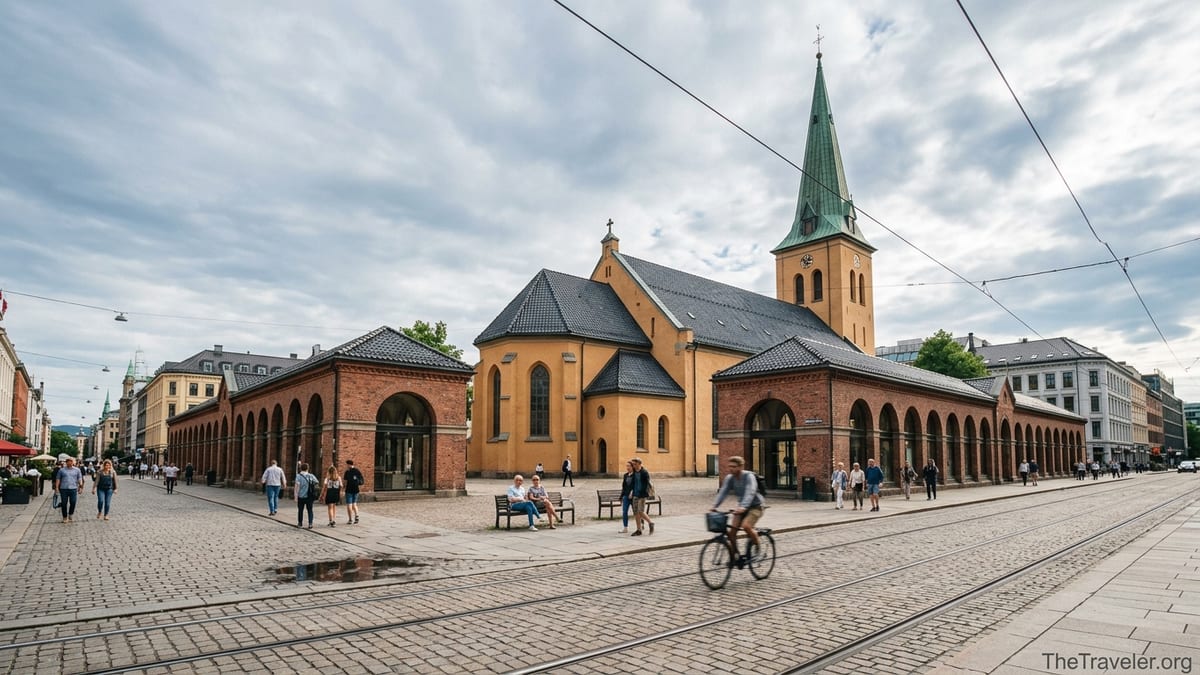
Understanding Oslo Cathedral and Its Setting
Oslo Cathedral, known locally as Oslo Domkirke, is the main church of the Church of Norway in the capital and the parish church for the downtown area. It stands on Stortorvet square, just north of Karl Johans gate, the city’s principal avenue. The current building dates from the late 17th century and has been repeatedly restored, so visitors encounter layers of Norwegian religious and civic history in a compact space that is easy to add into almost any Oslo itinerary.
The cathedral’s location is one of its biggest advantages for travelers. From Oslo Central Station it is roughly a 7 to 10 minute walk, mostly along or parallel to Karl Johans gate, so many visitors naturally pass it as they head toward hotels near the parliament, the National Theatre, or the Royal Palace. Stortorvet square around the cathedral is a busy transport and meeting hub, with trams circling the church and office workers, students, and shoppers using it as a cut‑through between the old town streets and the modern commercial district.
Directly surrounding the cathedral are the Oslo Bazaars, a semicircle of brick arcades in Romanesque Revival style that once housed butchers and small traders and today are used by a mix of shops and cafes. These low, curved buildings wrap around the east and south sides of the church and help to frame it from street level, creating one of central Oslo’s most photogenic corners. For travel photographers, this combination of spire, ocher stone, and brick arches is a natural place to pause before you move on.
The cathedral also has a living role in Oslo’s civic life, hosting royal ceremonies, national memorial services, and major religious holidays. Even on an ordinary weekday you might encounter a lunchtime organ recital, a school choir rehearsal, or locals lighting candles in the side chapels. This active use gives the building an atmosphere very different from a museum church, and it is worth timing your visit to see at least a short portion of a service or musical event if possible.
Practical Visitor Information: Hours, Access, and Etiquette
Opening hours at Oslo Cathedral vary slightly through the year and with church activities, but in practice visitors can normally expect daytime access most days of the week, with the busiest schedule on Sundays and around religious holidays. Mid-mornings from Monday to Saturday are typically the most reliable times for sightseeing inside, since services are less frequent then than in the early morning or late afternoon. If you arrive and find the main doors closed, it is worth waiting a few minutes or checking the small notices near the entrance, as short closures often relate to private ceremonies.
There is no standard admission charge to enter the cathedral for individual visitors, which makes it an attractive stop if you are balancing Oslo’s generally high costs. Donation boxes inside give you an opportunity to contribute a small amount if you wish; many travelers drop in 20 or 50 Norwegian kroner in cash, while others use contactless payment where it is available. Concerts, guided tours, and special events may have separate ticket prices that are advertised on posters outside and on church information sheets.
The main entrance to the cathedral fronts Stortorvet square, reachable on foot via gentle slopes with only a few steps. Inside, the central nave has level flooring, with pews separated by a wide central aisle that allows wheelchair users and visitors with strollers to move relatively easily. Some side chapels and galleries may involve steps or narrow passages, so if mobility is a concern it is sensible to focus on the main space, where you can still see the richly painted ceiling, glass, and altar area without climbing.
As an active place of worship, the cathedral expects visitors to show basic church etiquette. Photography is generally permitted, but flash should be avoided, especially during services or when people are praying. Dress codes are relaxed by European standards, but shoulders covered and beachwear avoided is a sensible rule of thumb. If you visit during a service, you can quietly slip into a rear pew to listen for a few minutes; when you leave, do so between hymns or readings to minimize distraction.
Inside Highlights: What Not to Miss
The interior of Oslo Cathedral surprises many visitors with its color and decorative richness. The ceiling vaults are covered in painted scenes and floral motifs created in the mid-20th century, giving the nave an almost theatrical quality when sunlight filters through the tall windows. Standing at the back of the church and looking toward the altar allows you to take in this full ceiling panorama; a mid-range zoom lens in the 35 to 50 mm range is useful if you want to capture the details without too much distortion.
The altar area and pulpit are focal points. The altarpiece features sculpted biblical scenes framed by ornate woodwork, while the pulpit showcases fine carving from the baroque period. Many visitors spend a few minutes walking down the central aisle to study these elements close up, then step back to the middle rows of pews to take in the overall effect. If you are particularly interested in church art, consider timing your visit around scheduled organ recitals, when the space is dimly lit and the illuminated altar stands out in contrast.
One of the more subtle pleasures is the stained glass, which is easier to appreciate on bright days when colored light splashes across the interior pillars and floor. In the late afternoon, low-angle sunlight from the west can create especially dramatic patches of color on the pews. This can be a good moment to sit quietly for five or ten minutes, rest your feet, and absorb the atmosphere after walking through the city center.
Before leaving, take a slow circuit around the back of the nave and along the side aisles. You will find small chapels, memorials, and plaques that reference events in Norway’s modern history. These details help connect the building not only to religious life but also to national milestones and periods of mourning, which is why the cathedral often features on television during state occasions.
Linking Oslo Cathedral with Karl Johans Gate and the Royal Quarter
Oslo Cathedral is a natural starting point for exploring Karl Johans gate, the city’s signature avenue that runs from the area near Oslo Central Station up to the Royal Palace. Stepping out from the church’s main entrance, you can join the flow of pedestrians moving along Karl Johans gate toward the west in the direction of the parliament and palace, or east toward the station and the Bjørvika waterfront district. Walking the full length from the station side to the palace at a relaxed pace takes around 20 to 30 minutes without stops, but most travelers extend this to an hour or more by pausing for photos and coffee.
A classic route links the cathedral with the Royal Palace and back in a loop. From Stortorvet, follow Karl Johans gate west past clothing and outdoor gear shops until you reach the Stortinget, Norway’s parliament building, recognizable by its yellow brick facade and curved central section. Continuing further, you pass the National Theatre and the historic University of Oslo buildings before the street broadens into a tree-lined approach to the Royal Palace. Here, grassy slopes and benches invite you to rest while looking back down the length of Karl Johans gate toward the city center.
On the return, you can either retrace your steps or shift one block north or south to explore quieter side streets with independent boutiques and cafes. For example, a traveler might walk up to the palace around mid-morning, then drop back via a side street to stop at a small bakery for a cinnamon bun and coffee before cutting through to Stortorvet and the cathedral again. This creates a satisfying half-day circuit that introduces the ceremonial and commercial faces of central Oslo without needing transport.
If you have limited time, say a few hours between trains at Oslo Central Station, it is still worth walking from the station to the cathedral and a short stretch of Karl Johans gate. A simple version of this route might involve walking from the station up Karl Johans gate to Stortorvet, visiting the cathedral for 20 to 30 minutes, then continuing as far as the parliament before turning back. This gives a compact but representative taste of the city center.
From the Cathedral to Akershus Fortress and the Waterfront
Another highly rewarding walking route links Oslo Cathedral with Akershus Fortress and the harborfront. Leaving the cathedral, you can head south toward the waterfront by using streets such as Kongens gate or Dronningens gate, which lead you past a mix of older low-rise buildings and newer offices. In roughly 10 to 15 minutes you will reach the outer walls of Akershus Fortress, a medieval castle complex that occupies a low promontory above the harbor and has watched over the city for centuries.
The grounds of Akershus Fortress are open to the public and free to walk around, making them one of Oslo’s finest no-cost attractions. Paths wind between stone walls, gates, and grassy embankments, and from the ramparts you get views across the harbor, toward the modern opera house in Bjørvika, and back toward the skyline where the cathedral spire is visible among office blocks and apartment buildings. Many visitors combine a short interior visit to one of the fortress museums with a longer outdoor stroll and photo stops on the walls.
From the fortress it is straightforward to continue on foot to the modern waterfront areas of Aker Brygge and Tjuvholmen, where piers, restaurants, and public art line the quays. One common route is to exit the fortress near Oslo City Hall and follow the harbor promenade west, watching ferries depart for the Oslofjord islands. After a late-morning cathedral visit, some travelers walk to the fortress, explore for an hour or so, then continue to Aker Brygge for a seafood lunch overlooking the water.
Alternatively, you can create a loop between the cathedral, the fortress, and the contemporary Bjørvika district around the opera house and Munch museum. This might mean walking from the cathedral to the fortress, crossing to the city hall, following the harbor edge east to the opera house, then turning back inland past Oslo Central Station to finish again near Karl Johans gate and the cathedral. In total, this loop takes most people three to four hours at a sightseeing pace, with plenty of chances to stop for coffee or ice cream.
Public Transport, Oslo Pass, and When to Walk
Oslo is compact enough that many visitors explore the cathedral and nearby attractions entirely on foot, but public transport is efficient and can save time, especially in poor weather or if you want to reach viewpoints or museums outside the immediate center. The system is coordinated by Ruter, which operates metro, tram, bus, and local ferries within a zone model. Most central sights, including Oslo Cathedral, Karl Johans gate, Akershus Fortress, the opera house, and Aker Brygge, sit inside Zone 1, which covers almost all typical city-center itineraries.
For most short-stay travelers, the most practical tickets are either single rides or 24-hour Zone 1 passes. As of 2026, a 24-hour adult ticket for Zone 1 costs in the region of a few hundred Norwegian kroner and allows unlimited travel by metro, tram, bus, and local ferries within that area. Children, youth, seniors, and full-time students with valid identification receive significant discounts compared to the adult fare. Ticket machines, the official mobile app, and staffed service points at central locations sell these passes, and inspectors conduct random checks, so it is important to have a valid, activated ticket whenever you board.
Because the main cathedral area lies so close to Oslo Central Station, many travelers choose to walk between the cathedral and the station even if they are using public transport for other parts of the day. A common pattern might involve using a 24-hour pass to ride the metro up to Holmenkollen or Frognerseteren for views over the city, then returning to the center and walking from the station through Bjørvika and Karl Johans gate to finish at the cathedral before dinner. Using public transport selectively in this way lets you maximize your time at each attraction while still enjoying Oslo’s pedestrian-friendly core.
Visitors who plan to see many museums or ride public transport frequently may find value in an Oslo city pass, sold in different durations and typically including unlimited Ruter Zone 1 travel plus free or discounted entry to a long list of attractions. While the exact pricing and included sights change over time, it is usually most cost-effective for travelers who plan an intensive program of museum visits over one or more full days. If your priorities are primarily the cathedral, the fortress, the waterfront, and Karl Johans gate, walking plus a basic transport ticket may be enough.
Suggested Half-Day and Full-Day Walking Itineraries
For a concise introduction to the area, a half-day walking route starting and ending at Oslo Cathedral works well. One example begins with a morning visit inside the cathedral just after it opens, when the interior is quietest. After 30 to 45 minutes exploring and photographing the nave, you step out through the Oslo Bazaars and join Karl Johans gate heading west toward the parliament and Royal Palace. After a pause on the palace lawns or at a nearby cafe, you return toward the center, turning down a side street to reach the harbor between Oslo City Hall and Akershus Fortress. A leisurely walk around the fortress grounds followed by a coffee at the waterfront rounds out a route that can comfortably fit into four to five hours.
Travelers with a full day can add newer districts and museums without making the schedule feel rushed. A full-day itinerary might start at the cathedral and Karl Johans gate in the morning, include a loop up to the palace and back, then continue to the harbor for a lunch stop at Aker Brygge. In the afternoon, you can walk or ride a tram to the Bjørvika district, exploring the rooftop and plaza of the opera house, perhaps visiting the Munch museum, and finally strolling back toward the cathedral area via Oslo Central Station. This kind of day gives a good sense of how Oslo’s historic core, 20th-century civic buildings, and 21st-century waterfront developments connect.
Another option for energetic walkers is to combine city and nature by linking the cathedral with a stretch of the riverside path along the Akerselva river. This might involve using public transport from the city center up to a starting point near the river, then following the path downstream past waterfalls, old mills, and green spaces until you reach the lower stretches close to the central station. From there, you can walk a final few minutes through Bjørvika and along Karl Johans gate to end your day at the cathedral, having experienced both Oslo’s urban and more tranquil sides.
Many visitors appreciate that Oslo remains manageable in scale. Even if you only have one long layover or an overnight stop, a carefully chosen loop that runs cathedral to palace to fortress to opera house and back can leave you with a surprisingly well-rounded impression of the city. Because the cathedral is so central, it functions as an anchor point: you can always navigate back to its tower if you feel turned around among the side streets.
The Takeaway
Oslo Cathedral is both a spiritual landmark and a practical compass point for exploring Norway’s capital on foot. Its central position at Stortorvet, just off Karl Johans gate and within a short walk of major transit hubs, makes it an easy first or last stop on almost any itinerary. Once you have oriented yourself by the tower and bazaar arcades, the rest of downtown Oslo begins to feel smaller and more approachable.
By pairing a visit to the cathedral with nearby routes to the Royal Palace, Akershus Fortress, the harbor promenades, and the contemporary waterfront at Bjørvika, you can build half-day or full-day walks that highlight both historic and modern Oslo without constant reliance on transport. Occasional use of the metro, tram, or bus extends your reach to viewpoints and outlying neighborhoods, while the cathedral remains a free, welcoming space to pause, reflect, and reset between activities.
Whether you are in Oslo for a few hours or several days, planning your exploration around Oslo Cathedral and its adjoining walking routes offers a simple way to experience the city’s architecture, civic life, and waterfront landscapes in a coherent, time-efficient way. With a little forethought about opening times, local etiquette, and how far you like to walk, the cathedral can anchor some of your most rewarding hours in the Norwegian capital.
FAQ
Q1. Is there an entrance fee to visit Oslo Cathedral?
Most of the time there is no set entrance fee for individual visitors, and casual sightseeing is free, though donations and paid concert tickets are encouraged.
Q2. How much time should I plan for inside Oslo Cathedral?
Plan around 30 to 45 minutes to walk the nave, study the ceiling and altar, and sit quietly; allow longer if you want to attend part of a service or concert.
Q3. How do I get to Oslo Cathedral from Oslo Central Station?
From Oslo Central Station it is roughly a 7 to 10 minute walk, mainly following or paralleling Karl Johans gate toward Stortorvet square, where the cathedral stands.
Q4. Can I combine Oslo Cathedral with Akershus Fortress in one walk?
Yes, the cathedral and fortress are easily linked on foot; most people take 10 to 15 minutes to walk between them, often extending the route along the harbor.
Q5. Is Oslo Cathedral accessible for visitors with limited mobility?
The main entrance and central nave are on largely level ground and accessible, though some side chapels and galleries involve steps or narrow passages.
Q6. What is the best time of day to visit Oslo Cathedral?
Mid-morning on weekdays is usually calmest for sightseeing, while late afternoon on bright days offers more dramatic interior light through the stained glass.
Q7. Do I need a public transport pass to see the cathedral and nearby sights?
No, the cathedral, Karl Johans gate, Akershus Fortress, and the waterfront are all within walking distance, though a Zone 1 ticket helps if you go further afield.
Q8. Are there guided tours that include Oslo Cathedral?
Several city walking tours and some bus tours include short stops at or near the cathedral as part of broader routes covering central highlights and the waterfront.
Q9. Is photography allowed inside Oslo Cathedral?
Photography for personal use is generally allowed, but you should avoid flash and be discreet, especially if a service or private ceremony is in progress.
Q10. Can I attend a church service as a visitor?
Yes, visitors are welcome at regular services; you can quietly join a pew, follow the order of service if available, and leave respectfully between hymns or readings.