


Oslo Cathedral, or Oslo domkirke, sits at the heart of Norway’s capital, a short walk from Karl Johans gate and the main railway station. For many travelers it is both a quiet refuge from the city’s bustle and a key stop for understanding Norwegian history, monarchy and everyday religious life. This guide brings together current opening hours, worship times, background history and practical visitor tips so you can make the most of your time at Oslo’s main church.
Get the latest updates straight to your inbox!
Where Oslo Cathedral Fits Into the City
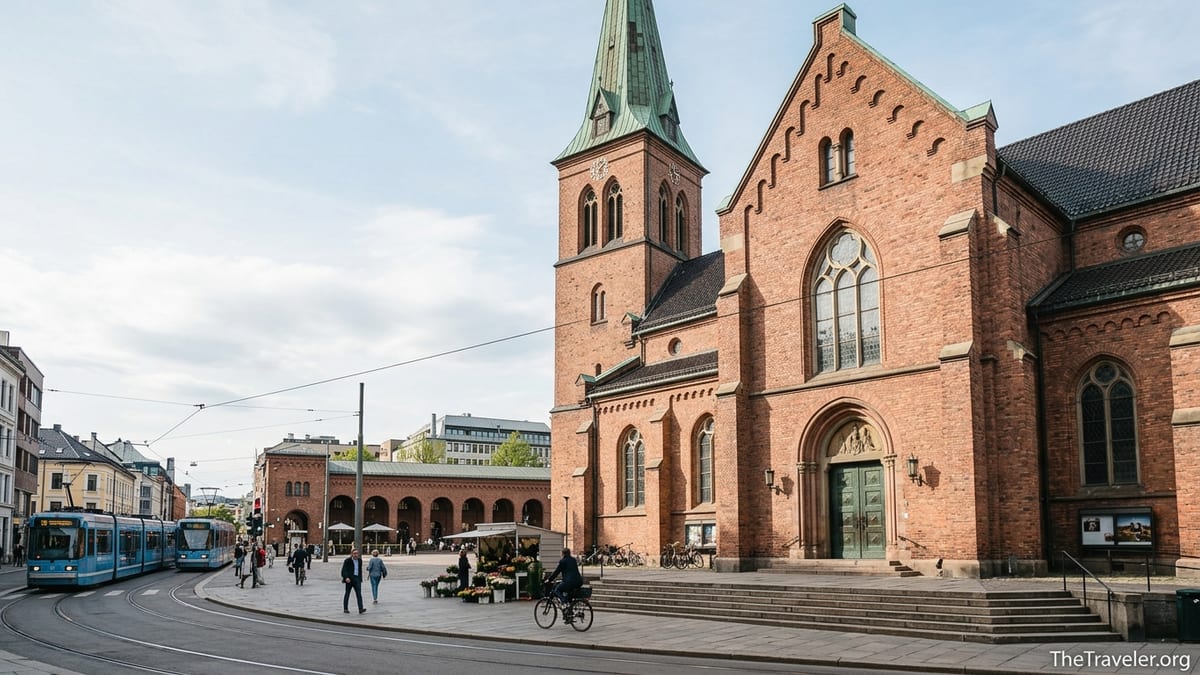
Oslo Cathedral is the main church of the Church of Norway’s Diocese of Oslo and serves as the parish church for the downtown area. The brick tower and green copper spire rise above Stortorvet square, just north of Karl Johans gate, one of the city’s main pedestrian streets. In practical terms, this means you can easily combine a visit with nearby attractions such as the Oslo Opera House, the Parliament building and the shopping streets between Jernbanetorget and the National Theatre.
The cathedral stands beside the arched brick arcades of Kirkeristen, where small shops and cafes, including Café Cathedral, line the old bazaar buildings. Many visitors will first spot the church as they cross Stortorvet where trams curve past flower stalls and outdoor seating areas. In winter, the cathedral’s tower lights create a focal point in the early afternoon darkness, while in summer the square becomes a lively meeting place with extended daylight hours.
Because of its central location, it is an easy landmark to drop into more than once. Travelers staying near Oslo Central Station often walk past in the morning on their way to museums at the waterfront and then return for an evening concert or to see the church illuminated after dark. The cathedral’s role as both a working parish church and a national ceremonial space shapes its schedule, something visitors should keep in mind when planning a visit.
Current Opening Hours and When to Visit
The cathedral keeps regular daytime hours for quiet visits, with variations across the week. As of late spring 2026, Oslo Cathedral typically opens mid-morning and remains accessible until late afternoon or early evening from Sunday through Thursday, with extended hours from Friday afternoon into the early hours of Saturday for its “open church” initiative. Exact opening times can shift with the season, special events and staffing, so it is wise to check the official Oslo Cathedral pages or local tourist information shortly before you travel.
One distinctive feature is the Friday overnight opening. On Fridays the church opens in the afternoon and remains open until approximately 06:00 on Saturday morning, providing a space for reflection, conversation and pastoral care in the city center while nightlife continues around Stortorvet. For example, a traveler returning from dinner in Grünerløkka around midnight can step into the softly lit nave to escape the noise of the bars and trams outside.
During peak summer months, hours for tourists are often slightly longer, especially on weekdays, to accommodate cruise passengers and tour groups arriving mid-morning. In shoulder seasons like March or October, the cathedral may close earlier in the afternoon on some days. Holiday periods such as Easter, Christmas and Norway’s Constitution Day on 17 May bring additional services and sometimes restricted sightseeing times around major ceremonies.
To avoid disappointment, build a little flexibility into your schedule. If you plan to see the interior in detail, consider arriving not long after the doors open, when the church is quietest and natural light through Emanuel Vigeland’s stained-glass windows is at its best. Those more interested in atmosphere than architecture might prefer early evening, when candles and warmer artificial lighting change the character of the space.
Services, Music and How Visitors Can Participate
Oslo Cathedral is first and foremost a living church, with a full weekly program of services, prayers and concerts. A standard week usually includes a main Sunday service in the late morning, often around 11:00, along with weekday prayers, shorter devotions and occasional special liturgies. A published “fast ukeprogram,” or fixed weekly program, outlines regular worship and is updated with additional events such as confirmations, memorial services or civic ceremonies.
Travelers are welcome to attend services, whether or not they speak Norwegian. The liturgy follows the Evangelical Lutheran tradition, and while most readings and hymns are in Norwegian, some services may include English-language elements or printed summaries. For instance, a visitor staying at a nearby hotel might attend the Sunday high mass, experiencing Norwegian hymnody accompanied by the cathedral’s large Ryde & Berg organ, installed in the late 1990s behind the original baroque façade.
Music plays a central role in the cathedral’s life. Choral concerts, organ recitals and seasonal performances are held regularly, especially around Advent, Christmas and Easter. Tickets for larger concerts are often sold through Norwegian ticketing platforms or at the entrance, with prices typically ranging from modest parish-level contributions to higher amounts for professional ensembles. Even outside formal concerts, visitors may hear organ practice or choir rehearsals filling the vaulted nave, adding to the experience.
Because the cathedral hosts weddings, funerals and national events, parts of the interior may occasionally be closed to sightseeing visitors. Security staff or volunteers will usually indicate when a private ceremony is taking place. If you find the main nave roped off, it is common courtesy to return later rather than trying to linger in side aisles. Planning some flexibility, such as pairing your visit with a coffee at Café Cathedral or exploring Kirkeristen’s arcades, makes it easy to adjust around scheduled ceremonies.
A Short History: From City Fires to Royal Weddings
The present Oslo Cathedral is the third cathedral in the city’s history. The first, dedicated to St Hallvard, was built in the 12th century near what is now the Old Town area, about 1.5 kilometers east of today’s center. After a devastating fire in 1624, King Christian IV moved the city closer to Akershus Fortress, and a second cathedral, the Holy Trinity Church, was built in the new settlement. When that church burned down after only about fifty years, the current cathedral was commissioned.
Construction of the new church began in the 1690s on a rocky outcrop at the eastern edge of what would become Stortorvet square. The foundation stone was laid in 1694 and the church was consecrated in 1697. Its early appearance was more modest than today’s, but it already served as the city’s principal church and a focal point for civic life. Over time, the surrounding bazaar arcades and fire station buildings were added, all in red brick, framing the cathedral in an architectural ensemble.
The 19th century brought major changes. Between 1848 and 1850 the cathedral was rebuilt under the direction of architect Alexis de Chateauneuf, with construction management by Heinrich Ernst Schirmer. Later, in the mid-20th century, architect Arnstein Arneberg oversaw a significant restoration completed in 1950 for Oslo’s 900th anniversary, removing many neo-Gothic additions and reintroducing earlier interior elements. Modern artworks, including Hugo Lous Mohr’s painted ceiling, Emanuel Vigeland’s choir windows and Dagfin Werenskiold’s bronze west doors, were added between the early 1900s and 1930s, giving the interior its present character.
More recently, the cathedral closed for renovation in 2006 and reopened in April 2010, just in time to host services connected with national commemorations and the everyday life of the city. It has also been the site of major royal events, including the weddings of King Harald V and Queen Sonja in 1968 and Crown Prince Haakon and Crown Princess Mette-Marit in 2001. For visitors, this means that when you walk up the stone steps to the main entrance, you are treading the same route as members of the Norwegian royal family during state occasions.
What to See Inside: Art, Architecture and Atmosphere
Stepping inside Oslo Cathedral, most visitors notice the combination of baroque structure and early 20th century decoration. The nave is relatively compact compared with continental cathedrals, but it feels warm and intimate, with painted ceiling vaults by Hugo Lous Mohr depicting biblical scenes in muted yet rich colors. These paintings, completed over several years in the mid-1900s, give the space a distinctly Norwegian interpretation of sacred art.
At the east end, the choir features stained-glass windows by Emanuel Vigeland, installed between 1910 and 1916. In late-morning sunlight, the colors fall across the stone floor and wooden pews, creating a shifting pattern that many photographers try to capture. The altar area also includes a striking silver communion sculpture by Italian artist Arrigo Minerbi from around 1930. Close by, you can see the pulpit and other baroque furnishings that recall the church’s 17th-century origins.
At the west entrance, bronze doors by Dagfin Werenskiold date from the late 1930s, with reliefs depicting biblical motifs. Many visitors only appreciate these on their way out, so it is worth taking a moment on arrival to examine their details before entering. Look as well at the organ gallery above, where the large Ryde & Berg organ installed in the 1990s sits behind an ornate older façade, providing sound for both liturgy and concert performances.
Because Oslo Cathedral remains a functioning parish church, the interior often carries signs of daily use: baskets near the door for donations to local causes, noticeboards advertising diaconal work, and candles lit by residents marking personal anniversaries. This lived-in quality can be as memorable as the artworks themselves. Travelers who pause quietly in a side pew or near the prayer candles during a weekday afternoon often describe the visit as a calm interlude in an otherwise busy city itinerary.
Practical Visitor Information: Tickets, Etiquette and Nearby Amenities
Entry to Oslo Cathedral is normally free, with donations encouraged. A voluntary contribution placed in a box near the entrance or made via Norwegian mobile payment helps support the church’s work and maintenance. Occasionally, specific concerts or special events require tickets, with prices varying depending on performers and program. For example, a professional choir’s Christmas concert might cost the equivalent of 250 to 400 Norwegian kroner, while smaller parish-organized events are typically more modest.
Dress is casual but respectful. Travelers coming from sightseeing at the Opera House or waterfront museums will feel comfortable in everyday clothes such as jeans and sweaters, but very beachy attire or loud costumes can feel out of place. Photography is generally allowed for personal use when no service is in progress, though it is courteous to avoid flash and to refrain from photographing individuals at prayer. When in doubt, look for signage at the entrance or ask a steward.
Because the cathedral sits on a busy tram square, arriving by public transport is straightforward. Several tram lines stop at Stortorvet, and Oslo Central Station is within roughly ten minutes’ walk. This makes the church an easy stop between activities: you might, for instance, visit the cathedral after a morning stroll up Karl Johans gate and then continue toward the National Gallery or the Royal Palace. For those with reduced mobility, be aware that there are steps at the main entrance, but staff may be able to advise on the most accessible entry during staffed hours.
Before or after your visit, the surrounding Kirkeristen arcades offer shelter in wet weather and a handful of small shops. Café Cathedral, located in the old bazaar buildings, serves coffee, simple meals and pastries, making it a natural place to debrief your visit. Prices are in line with central Oslo averages, so expect to pay in the region of 40 to 60 kroner for a coffee and more for full meals. At busy times, such as late Sunday morning after services, both the café and the square can be lively, while weekday mid-afternoons are generally quieter.
Planning Around Seasons, Holidays and Events
The experience of visiting Oslo Cathedral changes markedly with the seasons. In winter, especially from November to February, the church often opens into darkness or twilight, and stepping inside offers warmth and candlelight. Advent and Christmas bring a dense program of concerts and special services, from children’s pageants to evening carol services. Travelers visiting Oslo for Christmas markets commonly add a concert at the cathedral to their itinerary, though these often sell out, so planning ahead is wise.
Spring and early summer, particularly around Easter and on Norway’s Constitution Day on 17 May, feature important national and religious celebrations. During Easter week, additional services and rehearsals can affect general visiting hours, and on key days the cathedral may be accessible mainly to worshippers. On 17 May, the area around the cathedral is woven into parades and civic events, with crowds filling the streets and services marking the day’s significance. For a visitor, this can be an atmospheric time to see the church as part of living national traditions, though it is less suitable for a quiet architectural tour.
During high summer, when cruise ships bring day visitors to Oslo, mornings often see groups visiting the cathedral as part of walking tours. If you are staying in the city for several days and prefer a quieter experience, consider arriving close to opening time or later in the afternoon once group traffic has peaked. Autumn, from September through October, can offer a balanced mix: fewer crowds, decent daylight and regular concerts as musical ensembles start their season.
Whenever you visit, remember that events like royal commemorations, state funerals or national memorial services can be scheduled at relatively short notice. These occasions may temporarily close the building or parts of it. Local news outlets and tourist information centers typically highlight such events in advance, and staff at the cathedral are accustomed to guiding foreign visitors around any short-term changes in access.
The Takeaway
Oslo Cathedral is more than a photogenic landmark at the center of the city. It is a compact but historically layered church that has accompanied Oslo through fires, urban relocation, royal weddings and modern restoration. For today’s traveler, it offers both quiet space and insight into Norwegian culture, from the baroque foundations and 20th century art to the open-church nights that meet the needs of a contemporary capital.
By checking current opening hours, being aware of service times and approaching the building with the same respect you would offer any living place of worship, you can fit a meaningful visit into almost any Oslo itinerary. Whether you slip in briefly between trams at Stortorvet, attend a Sunday service or book time in your day to absorb the stained glass and painted ceilings, Oslo Cathedral rewards unhurried attention and a sense of curiosity.
FAQ
Q1. What are the usual opening hours for Oslo Cathedral?
The cathedral is generally open to visitors during daytime from Sunday to Thursday, with extended open-church hours from Friday afternoon through the night into early Saturday. Exact times vary by season and events, so it is best to confirm locally shortly before your visit.
Q2. Is there an entrance fee to visit Oslo Cathedral?
No, entry is normally free of charge, although voluntary donations are encouraged to support the cathedral’s maintenance and parish activities. Some concerts and special events may require paid tickets.
Q3. Can I attend a service if I am not Norwegian or not Lutheran?
Yes. Services are open to all, regardless of nationality or church background. Most liturgies are in Norwegian, but visitors are welcome to sit quietly, listen to the music and participate as they feel comfortable.
Q4. Are there guided tours available inside the cathedral?
Guided visits are occasionally arranged, particularly for groups or during special seasons, but they are not guaranteed daily. Independent visitors usually explore on their own, using printed information inside the church or resources from the local tourist office.
Q5. Is photography allowed inside Oslo Cathedral?
Personal photography is typically allowed when no service is in progress, but flash and intrusive equipment should be avoided. During services, concerts and private ceremonies, visitors are expected not to take photographs.
Q6. How do I get to Oslo Cathedral using public transport?
The cathedral is located at Stortorvet square in central Oslo, served by several tram lines. It is also within a short walking distance of Oslo Central Station and the main downtown bus routes.
Q7. What should I wear when visiting the cathedral?
Dress is informal but respectful. Everyday travel clothing such as jeans, sweaters and comfortable shoes is fine, but very revealing or costume-like outfits can feel out of place, especially during services.
Q8. Are there cafes or restrooms available nearby?
There are cafes and restaurants in the immediate area, including Café Cathedral in the old bazaar arcades, where you can find coffee and light meals. Restroom access is more limited inside the church itself, so many visitors use facilities in nearby cafes or shopping centers.
Q9. Is Oslo Cathedral accessible for visitors with limited mobility?
The main entrance involves steps, and accessibility can depend on staffing and any temporary arrangements. Visitors with limited mobility are advised to contact the cathedral office or ask on-site staff during opening hours for the most suitable access route.
Q10. Does Oslo Cathedral have specific visiting rules for groups and tour parties?
Groups are welcome but should be mindful of services, private ceremonies and other visitors seeking quiet. Larger tour parties are often asked to move to the side aisles for explanations, keep voices low and follow any guidance from cathedral staff regarding timing and group size.