


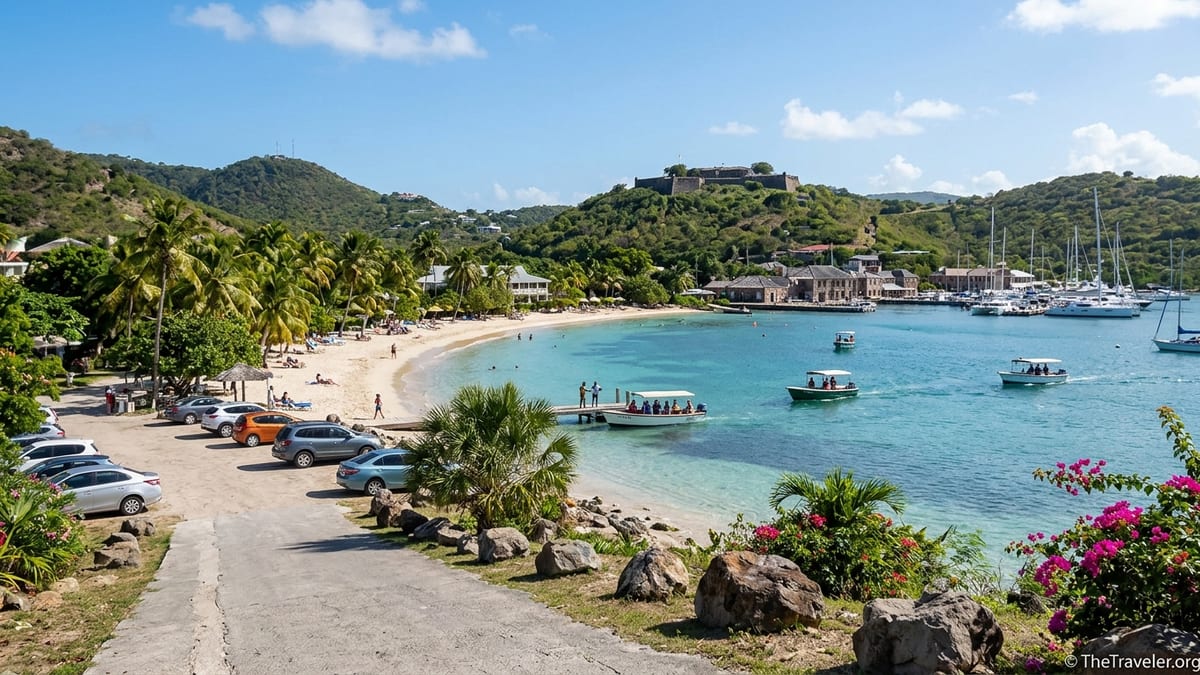
Galleon Beach sits on Antigua’s south coast at the mouth of English Harbour, on Freeman’s Bay within the Nelson’s Dockyard National Park area. Although much of the land behind the sand is occupied by hotels and private accommodation, the beach itself is publicly accessible, and there is a designated public access route by road as well as access by water taxi and on foot via national park trails.
Get the latest updates straight to your inbox!
Understanding Galleon Beach’s Location and Public Access
Galleon Beach lies on the southern tip of Antigua in the parish of St Paul, forming the quiet curve of Freeman’s Bay opposite Nelson’s Dockyard. It is part of the wider English Harbour and Nelson’s Dockyard National Park landscape, with forts, lookouts and hiking trails overlooking the anchorage. This setting means access is shared between resort guests, yacht tenders, water taxis and day visitors, so it helps to understand how the different approaches fit together before you set out.
The beach runs broadly between two main properties: Galleon Beach Resort at one end and The Inn at English Harbour at the other. Current local guidance indicates that the public road reaches the shoreline between these properties, and that this gap is the reference point for public access on foot from the road to the sand. There are also small internal tracks and paths used by accommodation guests, so visitors arriving independently should look for signs or ask locally for the public access path rather than cutting through private gardens.
Like all beaches in Antigua, Galleon Beach itself is treated as public, while the land immediately behind it may be privately managed. In practice this means you are allowed to enjoy the sand and sea, but loungers, cabanas and some shaded structures are typically operated by resorts or beach businesses on a paid basis. Facilities such as restrooms are limited and are generally tied to hotels or beach bars, so arriving with realistic expectations and your own essentials is important.
Reaching Galleon Beach by Car or Taxi
For most visitors the most straightforward way to reach Galleon Beach is by road, at least as far as English Harbour. Official tourism information notes listed distances of around 21 kilometres from both St John’s and V. C. Bird International Airport to Galleon Beach, with typical driving times of roughly 40 to 60 minutes depending on traffic, time of day and your exact start and end points. Local accommodation providers in English Harbour commonly quote around 40 minutes from the airport in normal conditions, which aligns with current mapping estimates.
From English Harbour itself, the drive to Galleon Beach is short but more confined. Current directions indicate that you follow the main road towards Shirley Heights and The Inn at English Harbour, then turn off on the downhill road signposted for the inn and the resort. The last stretch narrows, with some steeper sections and mixed surfacing, and it can feel enclosed if you are unused to Antiguan back roads. Visitors are strongly advised to use up-to-date GPS mapping, zoom in carefully on the final approach and, if in doubt, ask at their accommodation or in English Harbour for the latest recommended route, as minor access roads can be affected by rain and maintenance.
Road conditions across Antigua vary, with some potholes, speed bumps and occasional roadworks, especially on busier arteries leading out of St John’s. Driving is on the left and many rental vehicles are compact, which helps on narrower lanes near the coast. If you are not comfortable driving, licensed taxis are widely available at the airport, in St John’s and around English Harbour. Official taxi tariff tables list specific fares for Galleon Beach from the cruise pier and from central St John’s, and drivers usually work from these government-approved rates, although visitors should still confirm the price per vehicle and any waiting time before departure.
Driving Routes and Approximate Times from Key Bases
From St John’s, including the main cruise port, the standard route to English Harbour runs through the island interior via All Saints. Current mapping suggests a travel time of around 40 to 60 minutes by car or taxi in normal traffic. This timing reflects the mix of urban streets leaving St John’s, interior roads with variable surfaces and the final bends approaching the south coast. Cruise passengers should allow extra time at the start and end of the day when traffic around the port can be heavy.
From V. C. Bird International Airport, drivers typically follow one of the main east-west highways and then cut south towards English Harbour, again in roughly 40 to 60 minutes in ordinary conditions. The airport itself sits on the north-east side of the island, so almost any route to English Harbour crosses the interior and involves roundabouts, junctions and occasional congestion at market times. Official road information for Antigua highlights that primary roads can be busy and that work is periodically carried out on key arteries, so it is sensible to keep an eye out for temporary diversions.
From Jolly Harbour on the west coast, current mapping tools indicate a similar range of about 45 to 60 minutes by car, usually heading inland and then south-east. The drive offers a cross-section of the island, from the resort belt on the west coast into greener interior villages and then down to the historic south coast. Conditions again vary by rainfall and maintenance, and visitors should avoid tight turnaround schedules, especially if they plan to return to Jolly Harbour before dark.
From English Harbour and neighbouring Falmouth, Galleon Beach is just a short hop. Expect a drive of roughly 5 to 15 minutes depending on where you start and how confident you are with the final downhill section. The key is to navigate carefully from the harbour area onto the correct turnoff for The Inn at English Harbour and Galleon Beach Resort, rather than inadvertently following the main road all the way up to Shirley Heights. Because this segment is short but winding, taxis in English Harbour often quote a modest flat fare for the run, and some visitors choose to combine it with a wider mini-tour or a pre-arranged collection time for the return.
Parking and Public Beach Access on Arrival
Recent visitor guides and local accommodation handbooks describe informal roadside parking close to the public access point between Galleon Beach Resort and The Inn at English Harbour. Current descriptions indicate that the access road levels out near the back of the beach and that cars commonly park along the wide verge or at the edge of the road before reaching the resort entrance signs. Drivers are typically advised to ignore any suggestion that the entire shoreline is private, while still respecting clearly marked private driveways, gates and hotel-only spaces.
Most up-to-date travel accounts characterise this parking as unmarked rather than as a structured public lot. In other words, there are no painted bays and often no attendants. At the time of writing, there is no widely advertised dedicated pay-and-display car park specifically for day visitors, and recent reports do not indicate a separate national park parking fee at this access point. However, parking rules and local arrangements can change, particularly as resort developments evolve. Visitors should therefore check signage carefully on arrival, avoid blocking gates or service roads and, if in doubt, ask a staff member or local resident where day visitors are currently expected to park.
The walk from roadside parking to the sand is short, but it may involve a slightly uneven track or path. This makes Galleon Beach relatively accessible compared with some wilder coves, but it is not as step-free as a purpose-built resort frontage. Travellers with limited mobility may want to have their driver drop them as close as practicable to the public path and confirm that they can be collected from the same spot later, especially if the vehicle needs to relocate to a less congested parking area.
Water Taxi from Nelson’s Dockyard to Galleon Beach
For visitors already in Nelson’s Dockyard or staying nearby in English Harbour, the classic alternative to the road is the short hop across the bay by water taxi. Small open boats shuttle between docks inside Nelson’s Dockyard and the jetty or shoreline at Galleon Beach, providing a direct and scenic crossing that usually takes only a few minutes. This option is especially appealing to cruise passengers who have come to see the historic dockyard and then want a beach break without navigating the hill roads.
Recent on-the-ground reports describe water taxis operating on a largely on-demand basis during the day, rather than to a fixed timetable. Visitors typically arrange a crossing at the dock by speaking with boat operators or through a local guide or taxi driver. Current examples suggest that fares are charged per person for a return trip, with prices varying by season and by how busy the harbour is. Some recent accounts mention approximate one-way prices in the single-digit US dollar range per person, but this can shift with fuel costs, cruise schedules and demand.
Because operating hours, prices and frequency are flexible, travellers should confirm both the outbound fare and the terms for the return journey before stepping aboard. It is wise to agree a pickup time or to collect the operator’s phone or messaging contact in case the weather turns or the harbour quietens down later in the afternoon. Cash in local currency or US dollars is generally expected, and card payment should not be assumed. In poor weather or if there is unusually heavy swell or rain, water taxi service may be reduced or paused, so keeping a road-based backup plan in mind is prudent.
Hiking Access via Shirley Heights and Pillars of Hercules
Galleon Beach also connects to a network of marked hiking trails within the Nelson’s Dockyard National Park, including routes that link the shore to the famous viewpoints at Shirley Heights and to the Pillars of Hercules rock formation. These routes are often mentioned in yachting and hiking guides as some of the most rewarding walks in the area, but they require reasonable fitness and good preparation rather than casual flip-flop strolls. The climate is hot and humid, the terrain can be loose or rocky in places and shade is limited along some sections.
Shorter paths run from the back of Galleon Beach up to local trail junctions, making it possible to combine a swim with a relatively brief hike. In contrast, ridge routes from the Shirley Heights Lookout area down to the coast are longer, with some guides suggesting walking times of around 40 to 60 minutes in one direction for certain segments, depending on pace and exact route. These paths can be steep underfoot, with uneven rock steps and sections exposed to the sun and wind.
Recent hiking notes circulated within the local sailing community emphasise that trail waymarking can change as park authorities update signage or reroute paths around erosion or vegetation. Before attempting any hike to or from Galleon Beach, visitors should check the latest maps and advisories from the national park information desk, from Nelson’s Dockyard visitor services or from knowledgeable local guides. Solid closed-toe shoes, sun protection and sufficient water are essential, and hikers should avoid starting longer climbs or descents in the peak midday heat.
Public Transport, Taxis and Accessibility Considerations
Public buses in Antigua link St John’s with many communities, but they do not run directly to Galleon Beach itself. The main southbound service for this part of the island travels from the West Bus Station in St John’s towards English Harbour and surrounding villages. Recent traveller reports suggest that the journey can take around 45 to 60 minutes depending on stops and traffic, and that fares are comparatively low by Caribbean standards. From the English Harbour bus stop it is then a short walk into Nelson’s Dockyard or to nearby taxi stands for the remaining distance to Galleon Beach.
Because routes and operating patterns are based on local demand rather than strict timetables, buses may wait to fill before departing and can be less frequent later in the day. This makes them a good option for budget-conscious travellers with flexible schedules, but less ideal for cruise passengers or visitors with fixed return times. In those cases, combining a one-way bus with a pre-arranged taxi back to St John’s or to a resort can provide more certainty.
Taxis are plentiful around the cruise pier, the airport and the main resort areas, and many drivers also offer island tours that can incorporate a stop at Galleon Beach alongside Nelson’s Dockyard and Shirley Heights. Official guidance in Antigua stresses that taxi rates are regulated, yet in practice visitors should still agree the total fare, whether it is per vehicle or per person, and any waiting charges before setting off. For those with mobility challenges, a taxi that can drop off close to the public access path is generally the most practical solution, though the final short walk and the sand itself can still present difficulties for wheelchair users and people who find uneven ground challenging.
Water taxi boarding typically involves stepping down into a small boat from a low dock or stone quay, sometimes with a small gap or height difference to negotiate. There are no formal gangways or lifts. Passengers who would struggle with this kind of step may find the road approach easier, especially if their driver can assist them to and from the vehicle at the closest safe drop-off point.
Example Itineraries from Common Starting Points
From the cruise port in St John’s, a realistic and popular option is to hire a licensed taxi for a combined visit to Nelson’s Dockyard, Shirley Heights and Galleon Beach. The drive from the pier to English Harbour often takes about 40 to 60 minutes each way depending on traffic. Many cruise visitors ask the driver to stop first at Nelson’s Dockyard for an hour or two, then cross by water taxi to Galleon Beach for swimming and snorkelling, and finally return by road with a photo stop at a lookout if time permits. Those attempting to use public buses should build in generous buffers of at least 90 minutes each way, and consider a taxi back if afternoon buses are thinning out.
From a west coast or Jolly Harbour resort, visitors with a rental car typically drive across the island to English Harbour in roughly 45 to 60 minutes, then follow the road towards Shirley Heights and down to Galleon Beach for informal roadside parking near the public access path. A common day involves a morning beach visit at Galleon, lunch at a harbour-side restaurant and either a short afternoon hike from the beach or a sunset trip up to Shirley Heights by car. Those not wishing to drive can ask their resort to arrange a taxi for a full or half-day excursion, with clear agreement on total cost and return time.
From English Harbour or Falmouth itself, the choice is between a brief car or taxi ride over the hill, taking care on the narrowing final stretch, or the quick water taxi crossing from Nelson’s Dockyard. Some visitors walk from Falmouth to Nelson’s Dockyard, explore the historic buildings and then catch a water taxi across to Galleon Beach, returning the same way. Others prefer the simplicity of arranging a local taxi to handle both the approach and the return via the access road, especially if they are carrying beach gear.
In every scenario, travellers should reconfirm the latest information on road conditions, any temporary closures, national park advisories, and taxi or water taxi availability close to their travel date. Antigua’s south coast remains a working harbour as well as a leisure destination, so the balance between traffic, construction, sailing events and visitor services can shift from season to season. A few quick checks on the ground will help ensure that the journey to Galleon Beach is as smooth and enjoyable as the time you spend on its sand.