


If I were applying for the Alaska Airlines Visa Signature® credit card today, I would not just hit “submit” and hope for the best. I would work backward from a specific trip, stack the welcome bonus with Alaska’s famous Companion Fare, and time my spending so that every dollar moved me toward a concrete flight plan. Done right, this single card can shave hundreds of dollars off a West Coast vacation or a Hawaii trip and unlock a stream of Alaska Mileage Plan miles for years to come.
Get the latest updates straight to your inbox!
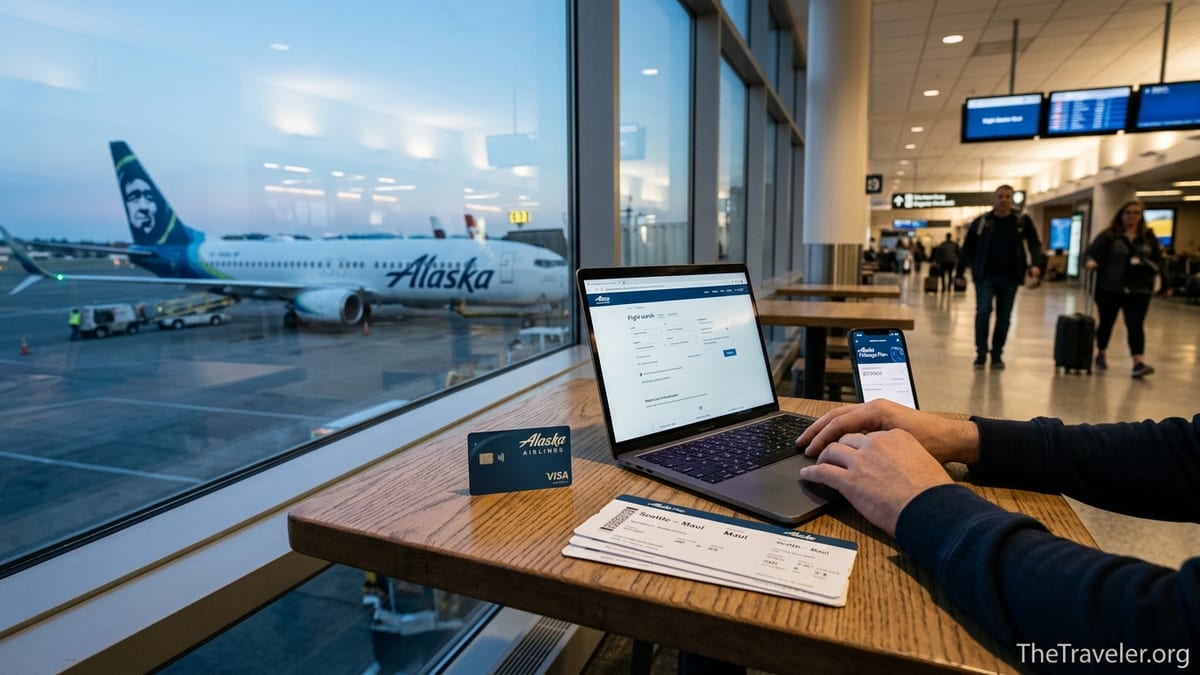
Why the Alaska Airlines Visa Signature Card Still Matters
The Alaska Airlines Visa Signature card remains compelling in 2026 for one core reason: the annual Companion Fare that can easily be worth several times the card’s relatively modest annual fee. Current public offers often include a welcome bonus in the ballpark of 50,000 Alaska miles after meeting a minimum spend, plus a promotional Companion Fare after you qualify, according to recent Bank of America and independent card reviews. That combination gives you a powerful one-two punch of miles and a deeply discounted second ticket on the same itinerary.
On top of the bonus, ongoing earning is solid for anyone who flies Alaska even a few times a year. Recent issuer disclosures show 3 miles per dollar on eligible Alaska Airlines purchases, 2 miles per dollar on categories like gas, EV charging, cable, streaming and local transit, and 1 mile per dollar on everything else. For a typical household that spends a few hundred dollars a month on gas and streaming, these everyday categories can quietly generate a few thousand extra miles per year without changing habits.
Alaska’s Mileage Plan program itself remains one of the more interesting airline currencies for travelers based in the western United States. Alaska serves more than 120 destinations in the U.S., Canada, Mexico, Costa Rica and Belize and partners with around 30 airlines worldwide, which means the miles you earn on this card can be used far beyond a simple Seattle to Los Angeles shuttle. For example, many points analysts still find strong value booking long-haul partner business class awards when saver space appears, or using miles on expensive last-minute domestic flights that would otherwise cost several hundred dollars in cash.
The catch is that Alaska has been tweaking Mileage Plan and partner earning, and specific award rates and earning rules can shift. That is exactly why, if I were getting this card right now, I would start from a realistic near-term trip, confirm current award options and cash fares, and then build a strategy around concrete numbers instead of assuming that any one redemption will stay a forever bargain.
How I’d Time My Application Around a Real Trip
The first step I would take today is to pick a specific trip where a Companion Fare and a stash of Alaska miles would clearly save me money. A classic use case is a pair of travelers based in Seattle planning a winter escape to Maui or Kauai. Round-trip Alaska economy tickets on popular Seattle to Maui routes commonly price in the range of about 450 to 650 dollars per person in peak periods, sometimes higher during school holidays. If you can line up a Companion Fare for that second ticket, you might pay roughly 500 to 600 dollars for the first ticket, then just 99 dollars plus taxes and fees starting around the low 20 dollar range for the second one.
Working backward, I would aim to apply three to five months before I want to book that Hawaii trip. Recent public offers from Bank of America have required around 3,000 dollars in purchases within the first 90 days to unlock the welcome bonus miles and the introductory Companion Fare. I would confirm the exact requirement on the issuer’s site, then plan my spending calendar to hit that target comfortably within the bonus window without overspending or carrying a balance.
For example, if I knew I had 1,200 dollars in insurance premiums due next month, 800 dollars in home improvement costs the following month, and about 1,000 dollars in ordinary groceries and gas, I would line up those bills to run across the new Alaska card. This way I’m not manufacturing spending; I am simply reallocating expenses I would pay anyway to collect the bonus miles and trigger the Companion Fare in time for my booking window.
As soon as the miles and the Companion Fare code post to my Alaska Mileage Plan account, I would be ready to shop flights. That usually happens a few weeks after the statement where you complete the required spending closes. If my Maui plans were for January, for instance, I might look to apply in late June or early July, wrap spending by September, see the bonus post by October, and have plenty of time to catch good flight pricing for winter dates.
Structuring My First 90 Days of Spending
In the first 90 days, every dollar matters twice: toward the minimum spend requirement and toward long-term Mileage Plan balances. I would start by moving any large, predictable expenses to the Alaska Visa as long as the merchant does not charge excessive surcharges. Property tax bills, tuition payments, and insurance premiums are perfect examples if the processing fee is low; a 2 to 3 percent surcharge might erase much of the value, but a flat 2 or 3 dollar fee on a 400 dollar bill might be worthwhile for the miles and bonus.
Next, I would deliberately use the card where it earns bonus miles. At 2 miles per dollar on gas and EV charging, a family that spends 400 dollars a month at stations in Portland or Los Angeles can generate nearly 10,000 Alaska miles a year just from refueling. Add streaming services like Netflix or Spotify and local transit or rideshare charges in cities like San Francisco or San Diego, and those routine purchases quietly build toward another one-way domestic award flight.
If I had Alaska or Hawaiian flights already planned during the bonus period, I would try to buy those tickets directly from Alaska using the new card. At 3 miles per dollar, a 600 dollar round-trip flight from San Francisco to Anchorage would earn 1,800 miles from the card alone, plus flight miles and any elite bonuses through Mileage Plan. That accelerates my path to meaningful redemption levels, like the 12,500 miles often needed for a shorter one-way domestic Alaska award when saver space exists.
Finally, I would be careful not to push non-essential spending just to reach the threshold a week or two early. The welcome bonus is valuable, but not at the cost of interest charges. The ideal approach is to map out your expected expenses before you apply, confirm they add up to at least the minimum spend, and then pay the card in full each month while you execute your plan.
Strategically Using the Companion Fare in Year One
The signature perk of the Alaska Airlines Visa card is the Companion Fare, which currently allows you to book a second economy ticket on the same Alaska or Hawaiian itinerary from 99 dollars plus taxes and fees when traveling on a paid published coach fare. Recent benefit guides and card terms indicate that the total out-of-pocket for the companion often starts from around 122 dollars once you include the base 99 dollar fare and typical U.S. domestic taxes and fees, though the final number depends on route and airport charges.
If I wanted to maximize this in my first year, I would target routes where Alaska commands strong pricing power or where cash fares are seasonally high. For example, summer flights from San Diego or Los Angeles to Anchorage, ski-season flights from California to Bozeman or Jackson Hole via Seattle, or holiday-period flights from West Coast hubs to Hawaii are all situations where round-trip economy tickets can run 450 to 700 dollars per person or more. Booking a 550 dollar main cabin ticket from Seattle to Maui and using the Companion Fare for a spouse or friend could easily save 300 to 400 dollars on that one trip.
I would also be flexible about departures and connections to make the most of the code. The Companion Fare is typically valid on round-trip or one-way itineraries within North America on Alaska and Hawaiian-operated flights, including connecting segments. So a trip like Phoenix to Fairbanks via Seattle for a Northern Lights adventure in March can be booked on one ticket, and the companion’s fare will still be 99 dollars plus taxes and fees even if the primary traveler’s ticket is several hundred dollars.
One subtle but important point I would keep in mind is that you generally have to pay for both tickets with the eligible Alaska Airlines Visa card. I would verify the exact rules in my Mileage Plan account before I book, then make sure not to split payment methods at checkout. If I had travel credits or wallet funds, I would check current restrictions, because past terms have limited the use of credits in combination with the Companion Fare, which can catch travelers off guard if they are trying to stack everything at once.
Planning Future Trips Around Mileage Plan Sweet Spots
Once my welcome bonus miles posted, I would sit down and sketch a rough plan for using them over the next 12 to 18 months rather than letting them sit idle. Alaska Mileage Plan still offers some attractive uses for West Coast travelers and beyond. For example, domestic economy awards between many U.S. cities can price in the low five-figure range in miles, and partner itineraries to Central America or Mexico often provide good cents-per-mile value during peak cash fare periods.
One practical scenario: Suppose I earn 50,000 bonus miles, 5,000 miles from my qualifying spending, and another 4,000 to 6,000 miles from actual Alaska flights in the first year. That gives me around 60,000 miles to work with. I could use roughly 15,000 to 25,000 miles for a peak-season economy trip from Portland to Cabo San Lucas when cash fares creep above 500 dollars. Alternatively, I could save up for a one-way business-class partner award to Europe or Asia when award space opens, often providing significantly higher value per mile.
I would also keep in mind that Alaska continues to adjust earning and redemption charts, especially as it integrates Hawaiian Airlines. For travelers based in Honolulu or Maui, this card becomes more compelling as more intra-island and West Coast routes show up under the same Mileage Plan umbrella. A Honolulu-based couple might use the Companion Fare on an annual Hawaii to Seattle or Hawaii to San Diego trip, then use miles for shorter domestic or partner hops during the year.
To avoid disappointment, I would regularly price both miles and cash options before transferring or spending any other flexible currencies I might hold. If a Seattle to Denver trip is on sale for 129 dollars each way, for example, I might pay cash and save miles for a future redemption that yields more value, such as a last-minute West Coast flight during a busy weekend when cash fares jump to 300 or 400 dollars one way.
Stacking Card Perks With Elite Status and Everyday Travel
Beyond the headline bonus and Companion Fare, the Alaska Airlines Visa Signature includes practical benefits that matter on real trips. Cardholders get a free first checked bag for themselves and up to several companions on the same reservation when flying Alaska, which can save around 30 to 35 dollars per bag each way on many routes. If I fly from Oakland to Portland twice a year with a checked ski bag and suitcase, for example, that perk alone could offset a large chunk of the annual fee.
The card also typically offers priority boarding on Alaska flights, which is useful when you are flying out of busy West Coast hubs like Seattle, Portland or Los Angeles where overhead bin space fills quickly. While this is not as glamorous as a lounge membership, it is the sort of small, repeatable perk that quietly improves the experience every time you fly.
For travelers who also hold eligible Bank of America or Merrill accounts, some offers include a 10 percent mileage bonus on miles earned from card purchases. If I were a Bank of America customer already, I would double-check that my accounts qualify and that I am enrolled correctly before leaning on this card. Over the course of a year with 20,000 miles earned from spending, that 10 percent boost would mean an extra 2,000 miles on top of everything else.
Finally, if I were chasing or maintaining Alaska elite status, I would pay close attention to how my flown miles, fare classes and partner flights earn elite-qualifying credit under the latest Mileage Plan rules. While the credit card itself does not currently offer large chunks of status miles like some competitors, it does make it easier to consolidate my travel on Alaska and partners, and the miles I earn from the card help fund the award travel that fills in my year between paid work trips.
Common Pitfalls I’d Avoid With the Alaska Visa
Even a strong airline card can disappoint if you are not careful. The first trap I would avoid is applying without a clear use case for the Companion Fare. If you and your partner only fly Alaska once every couple of years, or you routinely grab ultra-low-cost carrier tickets from your home airport, it may be harder to get outsized value from the annual certificate. I would run the numbers on at least one realistic itinerary where I can save a few hundred dollars before deciding to apply.
The second pitfall is assuming that all partner flights will earn the same generous Mileage Plan credit or that award charts will stay static. Alaska has already reduced or complicated earning on some partners in recent years, particularly for tickets not booked through Alaska. If a big reason you want the card is to earn miles on complex itineraries to Europe or Asia via partners, I would take the time to review current partner earning charts and confirm how many miles you will realistically earn on the flights you book most often.
A third issue is spreading spending too thin across many different co-branded airline cards. If your household already splits purchases across a general travel card, a hotel card and another airline card, adding the Alaska Visa may mean none of them sees enough volume to accumulate meaningful rewards. In that case, I would consider consolidating everyday spend on one or two primary cards and dedicating the Alaska Visa mainly to Alaska tickets, travel-related expenses and the minimum spend window for the welcome bonus.
Lastly, I would not treat Alaska miles as an investment to hoard indefinitely. Loyalty programs can and do devalue their currencies with little notice. The healthiest pattern is to earn for a goal, book a trip within a year or two, and then repeat. That way you are enjoying premium cabins or expensive routes while they still represent good value instead of waking up to an announcement that your dream 70,000-mile business class award has quietly climbed to 95,000 miles.
The Takeaway
If I were getting the Alaska Airlines Visa Signature card today, I would approach it as a trip-planning tool, not just a rewards product. I would start by picking a high-value itinerary where a Companion Fare clearly saves serious money, such as a peak-season Hawaii vacation or a summer Alaska adventure. Then I would work backward, timing my application and spending to unlock the welcome bonus and Companion Fare in time to book that trip at a favorable cash price.
From there, I would use the card strategically for Alaska tickets, gas, streaming and local transit, letting those bonus categories quietly build my Mileage Plan balance. I would reevaluate award opportunities at least once or twice a year, aiming to redeem miles for flights that provide strong real-world value instead of hoarding them indefinitely. Combined with free checked bags, priority boarding and the potential for ongoing annual Companion Fares, this approach turns a single airline card into a repeatable play that can meaningfully reduce the cost of the trips I actually want to take.
FAQ
Q1. How valuable is the Alaska Airlines Visa Signature companion fare in practice?
The Companion Fare can easily save a few hundred dollars when used on higher-priced round-trip itineraries, such as peak-season flights from the West Coast to Hawaii, Alaska, or popular ski destinations. On a 550 dollar main cabin ticket from Seattle to Maui, for example, paying 99 dollars plus taxes and fees for the second traveler often represents several hundred dollars in real savings compared to buying two tickets outright.
Q2. When do I receive my first companion fare after opening the card?
Recent public offers have tied the initial Companion Fare to completing a minimum spend requirement, such as 3,000 dollars in purchases within the first 90 days. Once you meet that threshold and the statement closes, the Companion Fare code typically posts to your Alaska Mileage Plan account within a few weeks, but exact timing can vary, so it is wise to allow a full billing cycle before planning a time-sensitive booking.
Q3. Can I use the companion fare on one-way or multi-city trips?
The Companion Fare is generally valid on round-trip or one-way itineraries within North America on Alaska and Hawaiian-operated flights booked on a single reservation, including connections. However, complicated multi-city or open-jaw itineraries can be more restricted, so you should check the current terms and conditions in your Mileage Plan account and test your desired routing in the booking engine before assuming it will qualify.
Q4. Do both tickets earn miles when I use the companion fare?
Under current rules, both the primary and companion tickets on a qualifying Companion Fare booking usually earn Mileage Plan miles and, where applicable, elite-qualifying credit, as long as they are published coach fares and your Mileage Plan numbers are correctly attached. This is part of what makes the benefit attractive, since you are not only saving money on the second ticket but also accumulating miles on both travelers for future trips.
Q5. Is the Alaska Airlines Visa Signature card worth it if I do not live on the West Coast?
The card offers the most obvious value to travelers who regularly fly Alaska from hubs like Seattle, Portland, San Francisco, Los Angeles or Anchorage. However, it can still make sense for people in other regions who take at least one Alaska or Hawaiian-operated trip per year or who want access to Mileage Plan partner awards. The key is to identify at least one concrete trip where the Companion Fare and miles together will offset the annual fee and then some.
Q6. How do the card’s ongoing earning rates compare to other airline cards?
With 3 miles per dollar on Alaska purchases and 2 miles per dollar on gas, EV charging, streaming, cable and local transit, the Alaska Visa holds its own against many co-branded airline cards, especially for travelers who buy several Alaska tickets a year. However, general travel cards that earn flexible bank points at 2 points per dollar on most travel and dining can be more versatile, so the Alaska card is best used as a complement focused on Alaska-specific value rather than a universal, stand-alone solution.
Q7. Can I use the companion fare for someone else if I am not traveling?
Current interpretations of the Companion Fare terms and real-world reports suggest that the cardholder does not always have to be one of the travelers on the reservation, as long as the eligible credit card is used to pay for the tickets. Policies can change and may be enforced differently, so it is important to review the latest official language in your Mileage Plan account and, if necessary, complete a small test booking well before any critical trip.
Q8. What are some of the best ways to redeem Alaska Mileage Plan miles from this card?
Popular high-value redemptions include domestic Alaska flights on busy routes where cash fares spike, international partner awards in premium cabins when saver space appears, and flights to Mexico and Central America during peak vacation seasons. For example, using 20,000 to 30,000 miles for a ticket that would otherwise cost 400 to 600 dollars in cash often yields a solid return, while long-haul business class partner awards can deliver even higher cents-per-mile value when booked strategically.
Q9. How does the free checked bag benefit work with the card?
When you use your Alaska Airlines Visa Signature card and add your Mileage Plan number to the reservation, you typically receive a free first checked bag for yourself and several companions traveling on the same itinerary, provided the flight is operated by Alaska. On routes where checked bags would normally cost about 30 to 35 dollars each way, a couple taking two round-trip flights per year with checked luggage can recoup a significant portion of the card’s annual fee through this perk alone.
Q10. What should I watch for as Alaska updates Mileage Plan and its partnership with Hawaiian?
As Alaska continues integrating Hawaiian Airlines and adjusts Mileage Plan earning and redemption charts, it is wise to monitor changes to partner earning rates, award pricing and Companion Fare rules. Before planning a major trip or banking on a specific redemption, check current program details and run up-to-date cash versus miles comparisons so that your strategy with the Alaska Airlines Visa Signature card reflects the latest reality, not assumptions from several years ago.