


Oslo Airport Gardermoen is compact and well signed, but when you are tired, jet-lagged or racing a connection, even a small airport can feel confusing. The good news is that Gardermoen is designed around one main terminal with an integrated underground railway station, so once you understand the basic layout and timing, moving between trains, arrivals and check in is straightforward. This guide walks you through real-world scenarios, from landing and catching the train to Oslo Central Station to making tight domestic connections, with concrete timing tips and examples of what to expect at each step.
Get the latest updates straight to your inbox!
Understanding the Layout of Oslo Airport Gardermoen
Oslo Airport Gardermoen has a single main terminal building with two broad zones: Schengen and non-Schengen. International arrivals from most of Europe enter the Schengen side, while long-haul flights from places such as the United States, the United Kingdom or the Middle East use the non-Schengen pier. Both flows funnel into the same arrivals hall on the ground level, which makes onward transfers and wayfinding simpler than at many hub airports with multiple terminals.
Directly above the ground-level arrivals hall is the departures level, where check in and security are located. Departures is essentially one long hall, with airline check in areas grouped rather than split into separate terminals. For example, Norwegian Air has a large check in area on one side of the hall, while SAS and Widerøe occupy counters closer to the center. Overhead signs list airline names and show which check in zone to use, so you rarely need more than a few minutes to orient yourself even at busy times.
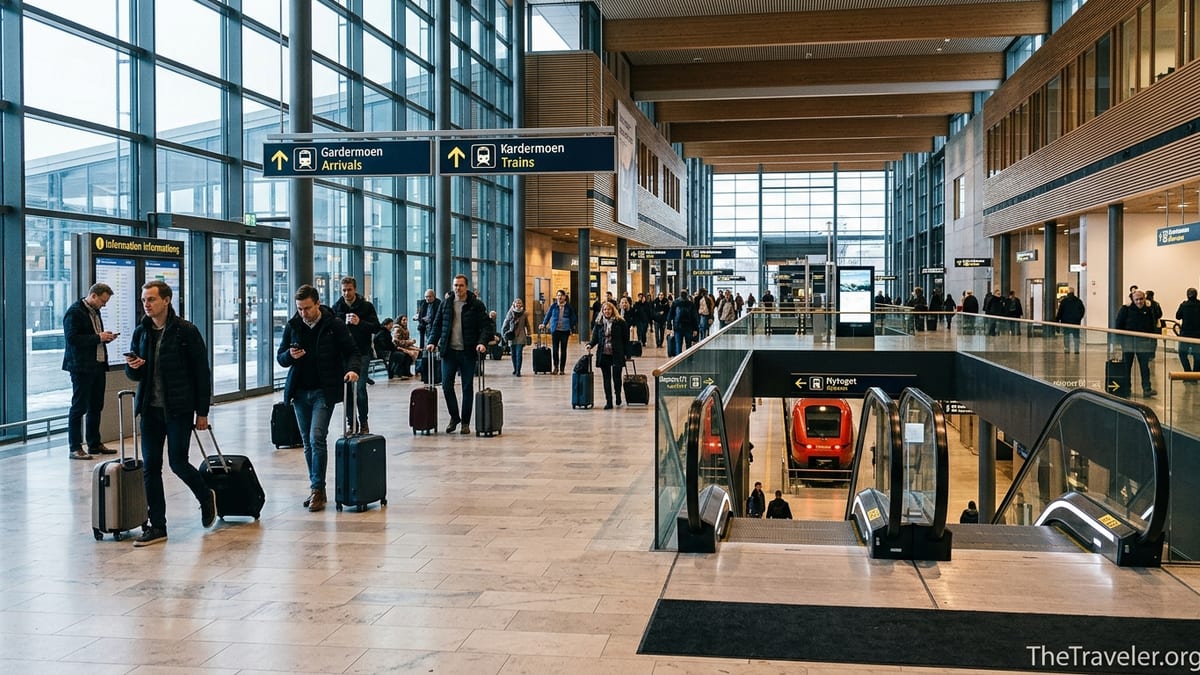
Beneath arrivals, one level down, sits Oslo Airport Station. This is the underground railway station that handles both the Flytoget Airport Express Train and the regular Vy regional and commuter trains. To reach it, you simply follow the large train symbols from the baggage hall or arrivals exit toward the middle of the building. Escalators and elevators lead directly down to the train concourse, so you do not need to leave the terminal or go outside, which is especially welcome in winter.
Because everything stacks vertically, typical walking times are short. Walking from a Schengen gate to baggage claim usually takes 5 to 10 minutes, and from baggage claim to the train platform another 3 to 5 minutes if you walk steadily. Even if you arrive at a non-Schengen gate at the far end of the pier, pass through passport control and then continue to baggage claim, most travelers report reaching the arrivals hall in 15 to 20 minutes when the airport is operating normally.
Getting from Plane to Train: Step-by-Step
If you are landing at Oslo and heading directly into the city or to another part of Norway by rail, your key move is from the gate to Oslo Airport Station. After disembarking, follow the “Baggage claim” signs. Non-Schengen passengers will first pass border control, usually with automated e-gates for EU and EEA passports and staffed booths for others. Once through, everyone merges into the same baggage hall, where the carousels are numbered and flights are clearly listed on screens.
After you collect your suitcase, move toward the “Exit” and “Trains” signs. When you step into the public arrivals hall, you will see a central open space with information boards and a few service counters. In this area there are often Flytoget ticket machines and branded signs, which reassures you that you are heading the right way. Look for the large hanging signs with a train symbol and the words indicating the railway station; these lead you to a bank of escalators and elevators descending to the station concourse.
At the concourse level you reach a wide, bright hall with ticket machines, information boards and clearly marked access points to the platforms. The Flytoget Airport Express and the Vy regional or commuter trains share the same physical platforms. Digital boards list each departure with its destination, departure time and platform number. For example, you might see “Flytoget Oslo Lufthavn – Oslo S 12:03” and, a few minutes later, a Vy train showing “Vy L12 Oslo S 12:10.” Passengers can walk freely to either train; the difference lies in tickets, price and travel time rather than in separate tracks.
In normal conditions, a traveler arriving from a European Schengen city with hand luggage only can move from aircraft door to a departing train in about 20 to 25 minutes. With checked baggage or at busier times, allow closer to 35 to 45 minutes. For instance, someone arriving from Amsterdam at 14:00, collecting luggage by 14:20 and walking directly to the station would comfortably catch a 14:36 Vy train or 14:40 Flytoget departure to Oslo Central Station.
Choosing Between Flytoget and Vy Trains
From Oslo Airport, most travelers heading to the city center choose between two main rail options: the Flytoget Airport Express Train and the Vy regional or commuter trains that use the same Gardermoen Line. Flytoget is the premium service branded specifically for airport passengers. It typically runs every 10 minutes during the day, takes about 19 minutes to reach Oslo Central Station and continues on some departures to Nationaltheatret station, which is closer to the western part of the city center. Tickets cost roughly double the price of the regular train, with 2026 adult one-way fares to central Oslo in the mid-200 Norwegian krone range.
The Vy regional and commuter trains are the standard national rail services that also stop at Oslo Airport Station. Direct services such as the L12 line to Oslo S usually take around 25 to 30 minutes to reach central Oslo, with departures roughly every 10 to 20 minutes depending on the time of day. Fares are significantly lower than Flytoget, with typical adult single tickets to Oslo Central Station around the low- to mid‑100 krone range in 2026 when bought via the app or ticket machines. For many leisure travelers, saving around half the price in exchange for arriving 6 to 10 minutes later is an easy decision.
As a real-world example, consider a couple landing at 09:00 and heading to a hotel near Oslo Central Station. If they choose Flytoget, they might pay around 460 kroner in total and arrive at Oslo S about 09:50, including walking and waiting. If they opt for the Vy L12 service, they could pay around 230 kroner combined and reach Oslo S about 10 minutes later. Over a weeklong trip, that difference in cost could comfortably pay for a good lunch at a mid-range restaurant in the city.
Flytoget can still be a smart choice in some situations. Business travelers rushing to a meeting in downtown Oslo or catching a tight onward rail connection often appreciate the fixed 10‑minute frequency, slightly more spacious seating and generous luggage racks. During peak holiday periods, regular Vy trains can be crowded with standing passengers, while many Flytoget departures still offer seats. If your priority is comfort and predictability rather than budget, it can be worth paying the premium, especially if your employer or a client covers travel expenses.
Buying Train Tickets at Oslo Airport
When you arrive at the station level beneath the terminal, you will see ticket machines and branding for both Flytoget and Vy. For Flytoget, there are dedicated orange or branded machines where you can buy tickets using a card or mobile payment. You can also pay contactless directly at the gates by tapping a bank card at the Flytoget readers, which then automatically charges the correct fare when you exit at Oslo Central Station or another stop. Many regular users in Oslo simply tap their card without printing or displaying a physical ticket.
Vy tickets can be bought from shared ticket machines on the concourse or via the Vy app, which is often a little cheaper than buying on board. The app allows you to select Oslo Airport Station as your origin and Oslo S as your destination, and it typically shows several departure options, including direct and semi‑fast trains. If you are continuing beyond Oslo, for example to Lillehammer or Drammen, you can buy a through ticket from the airport to your final station so you do not need to purchase a separate city ticket.
Travelers familiar with the local public transport system may also use the Ruter app and zone tickets in combination with the Vy trains, especially if they are staying in the suburbs and frequently using tram, bus and metro. However, for most visitors who simply want to get from the airport to a central hotel, the simplest approach is to buy a plain Vy ticket to Oslo S or to use the straightforward Flytoget system if they choose the express option. Tickets are normally checked on board rather than at gates, so keep your phone or printed ticket ready when the conductor passes through.
There is no strong need to buy train tickets in advance for specific times for typical daytime arrivals. For example, someone landing from London at 13:30 would normally be safe waiting to see how long immigration and baggage take, then buying whichever ticket suits their budget once they are at the station. Prices are generally fixed for these short airport routes and do not rise sharply for last‑minute purchases in the way long‑distance train fares sometimes do in other countries.
Making Train-to-Flight and Flight-to-Train Transfers
Because the station is integrated directly under the terminal, rail connections at Oslo Airport are usually quite efficient. If you are arriving by train to catch a flight, you ride to Oslo Airport Station, step off on the underground platform and head up the escalators or lifts to the arrivals hall level. From the station concourse to the airline check in desks on the departures level above typically takes around 5 to 10 minutes of walking, even with luggage, as long as you follow the “Departures” and airline signs.
When planning a transfer from train to flight, it is wise to follow the airline’s guidance for arrival times rather than relying solely on the airport’s compact size. Many carriers serving Oslo, such as Norwegian and SAS, recommend arriving about 2 hours before departure for European flights and around 3 hours for long-haul services. For a domestic flight with only carry-on luggage, frequent local travelers sometimes arrive 45 to 60 minutes before departure, but visitors unfamiliar with the airport are usually better off allowing at least 90 minutes to cover check in, bag drop and security.
For example, if you have a 17:00 domestic departure to Bergen with checked luggage, a sensible plan is to arrive at Oslo Central Station around 14:45, board a 15:00 Vy or Flytoget train, reach Oslo Airport about 15:25 to 15:40, and be at your airline’s check in desk by roughly 15:45. That gives you a comfortable 75 minutes to drop your bag and clear security. In contrast, catching a 16:00 train and arriving at the airport as late as 16:25 would leave you with only about 35 minutes to check in and pass security, which could be stressful if there is a queue or if bag drop closes 30 to 40 minutes before departure.
If you are landing at Oslo and then connecting onward by train, timing is slightly more flexible. For a typical European arrival with checked baggage, scheduling your onward rail journey 60 to 90 minutes after scheduled landing usually works well. For instance, if you land from Paris at 11:00 and need to reach Lillehammer, you might plan to board a 12:15 or 12:30 train from the airport, allowing time for immigration, baggage claim and a short wait at the station. Because long-distance Vy trains can have seat reservations and run less frequently than the airport shuttles, it is wise to check the timetable for your specific route in advance.
Check In, Security and Domestic vs International Transfers
Check in at Oslo Airport is organized by airline rather than destination, but procedures differ slightly between domestic, Schengen and non-Schengen flights. For domestic flights within Norway, such as Oslo to Trondheim or Tromsø, Norwegian and SAS both encourage passengers to check in online or in their apps and then use bag-drop machines at the airport if they have checked luggage. Online check in usually opens around 24 hours before departure. Bag drop for domestic flights commonly closes around 30 to 45 minutes before departure, although exact times depend on the carrier.
For European Schengen flights, check in timetables are similar, but security lines can be slightly longer at peak times. Many airlines suggest arriving at least 2 hours before these departures, especially during busy summer holiday periods or around Christmas. For long-haul flights beyond Europe, such as Oslo to New York or Doha, airlines often advise arriving 3 hours before departure, and check in counters may open around that time window. At Gardermoen, travelers frequently report that counters for major long-haul carriers do not open more than about 2 to 3 hours before scheduled departure, so arriving extremely early may simply mean waiting in the public hall until check in opens.
Transfer procedures within the airport depend on whether you are moving between domestic and international flights and which airlines you use. If you arrive from abroad with a through ticket on carriers such as SAS or Norwegian and continue domestically, your luggage is often tagged to your final Norwegian destination and transferred automatically. You follow signs for “Transfer” and usually pass through a quick security or passport check before re-entering the departures area. If you arrive on a carrier without a transfer agreement for your onward domestic flight, you may need to collect your bag, clear customs into the arrivals hall and then re-check in at the departures level, effectively leaving and re-entering the system.
Travelers connecting from a domestic flight to an international non-Schengen departure normally pass through passport control after security when heading to their outbound gate. If you have an EU or EEA passport, you can typically use the automated e-gates; other nationalities use staffed booths. For short transfers, the compact layout is helpful, but you should still allow a solid margin in case your inbound flight arrives late. Locals accustomed to the airport sometimes make connections of 45 to 60 minutes, but visitors are safer booking longer gaps, particularly when moving from separate tickets where the second airline will not protect you if you miss the onward flight.
Practical Time-Saving Tips and Real Examples
Several small decisions can noticeably smooth your journey through Oslo Airport and its station. One of the most effective is to decide in advance which train service you will use and how you will buy tickets. For example, a family of four arriving on a winter evening might conclude that saving money matters more than saving a few minutes. They could install the Vy app before departure, register a payment card and, once on the ground at Gardermoen, buy four standard tickets for the next L12 departure. They would then head straight down to the station without pausing at the machines, scan the digital tickets on board if asked, and arrive at Oslo Central Station within about half an hour.
Another time saver is to position yourself sensibly on the aircraft if you have a tight train or flight connection. On arrivals into Oslo, sitting closer to the front of the cabin can help you clear the jet bridge and reach passport control before a large queue forms. For example, someone with only 45 minutes between landing from Stockholm and boarding a regional train at the airport might choose a front-row seat, walk briskly at arrival, skip duty free and proceed straight to the station level, where trains to Oslo and beyond are frequent.
On departure, packing with security in mind helps keep you moving. Oslo Airport uses standard security screening, and liquids must fit into a small transparent bag. If you arrive with your electronics and liquids already separated, you can often clear security in 10 to 15 minutes outside of heavy peaks. Many local travelers keep their winter coats and larger items in checked luggage to avoid repeated removal at security checkpoints, although this can be less practical for visitors who need warm clothing immediately on landing.
Finally, remember that while Gardermoen is efficient, unexpected queues do appear, particularly during school holidays and severe weather. A cautious strategy is to treat the recommended arrival times from your airline as a baseline and add at least 15 to 30 minutes on top for peace of mind. Missing a Flytoget or Vy train is usually a minor inconvenience because another will arrive soon, but missing a flight can disrupt an entire trip. Allowing a modest buffer at each step is the simplest way to keep the journey calm.
The Takeaway
Oslo Airport Gardermoen is one of the easier major airports in Europe to navigate, thanks to its single-terminal layout and integrated railway station. Once you know that the trains sit directly beneath the arrivals hall and that Flytoget and Vy share the same platforms, the process of getting from plane to train or train to plane becomes much less intimidating. Within a short walk and a few escalator rides, you can be on your way to central Oslo or back toward your departure gate.
Choosing between the premium Flytoget express and the regular Vy trains mostly comes down to your balance of budget and time. Flytoget is slightly faster and more spacious, while Vy is significantly cheaper and only marginally slower. With ticket purchase possible via machines, contactless payment or easy-to-use apps, there is rarely a need to buy in advance or stress about reservations for the airport segment itself.
For check in and transfers, treating Gardermoen like any other modern European hub is a good rule of thumb. Arrive 2 to 3 hours before international flights if you are checking baggage, keep an eye on airline-specific bag drop closing times and allow a sensible buffer when planning train connections. If you build in modest cushions at each step, the airport’s size and design work in your favor, providing a predictable and manageable flow.
With these practical details in mind and a rough sense of timing, you can approach Oslo Airport with confidence. Whether you are stepping off a long-haul flight into the Norwegian winter or racing to catch an evening train after a business trip, understanding how Gardermoen is laid out and how its train links work will help you move quickly, stay relaxed and start or end your journey in Norway on the right note.
FAQ
Q1. How long does it take to get from Oslo Airport to Oslo Central Station by train?
The Flytoget Airport Express Train takes around 19 minutes, while the regular Vy trains usually take about 25 to 30 minutes between the airport and Oslo Central Station.
Q2. Do Flytoget and Vy trains use the same platforms at Oslo Airport?
Yes. Both Flytoget and Vy services use the same underground station directly beneath the terminal. You choose the correct carriage by checking the departure boards and your ticket type.
Q3. Is it cheaper to take the Vy train instead of Flytoget from the airport?
In most cases, yes. Vy tickets to Oslo Central Station are typically around half the price of Flytoget, in exchange for a slightly longer journey time.
Q4. Can I buy train tickets in advance for Oslo Airport transfers?
You can, but it is rarely necessary. Prices for the short airport route are generally fixed, so most travelers buy tickets on arrival using machines, contactless payment or mobile apps.
Q5. How early should I arrive at Oslo Airport before my flight?
As a guideline, arrive around 2 hours before European flights and about 3 hours before long-haul departures, especially if you have checked luggage. For domestic flights, locals often find 60 to 90 minutes sufficient.
Q6. Where is the train station in relation to the terminal building?
Oslo Airport Station is located directly beneath the main terminal. From arrivals, you follow the train signs to escalators or elevators that take you down one level to the station concourse and platforms.
Q7. What happens if my incoming flight is delayed and I miss my planned train?
For airport transfers, you usually just board the next suitable Vy or Flytoget departure. The trains run frequently, and tickets for this short segment are generally not tied to a specific departure time.
Q8. Are there good luggage facilities on the trains from Oslo Airport?
Both Flytoget and Vy trains have space for luggage. Flytoget tends to offer more dedicated racks and open floor space for suitcases, while Vy trains combine overhead shelves with end-of-carriage racks.
Q9. Can I connect to long-distance trains directly from Oslo Airport?
Yes. Some Vy services from the airport continue beyond Oslo to cities such as Lillehammer or Skien. You can often buy a through ticket from Oslo Airport Station to your final rail destination.
Q10. Is Oslo Airport difficult to navigate for first-time visitors?
No. The airport has a single main terminal with clear English signage. Once you know that departures are upstairs and the train station is directly below arrivals, navigation is usually straightforward.