


Oslo Airport Gardermoen is Norway’s main international gateway and, for many travelers, their first impression of the country. With a single terminal, integrated rail station and a reputation for efficiency, it is often held up as a model of how a modern airport should work. Yet reviews from recent passengers tell a more nuanced story that mixes praise for smooth transport links with frustrations about prices, queues and limited late night options. Here is how easy Oslo Airport really is to use in 2026, based on current information and what travelers say about the experience.
Get the latest updates straight to your inbox!
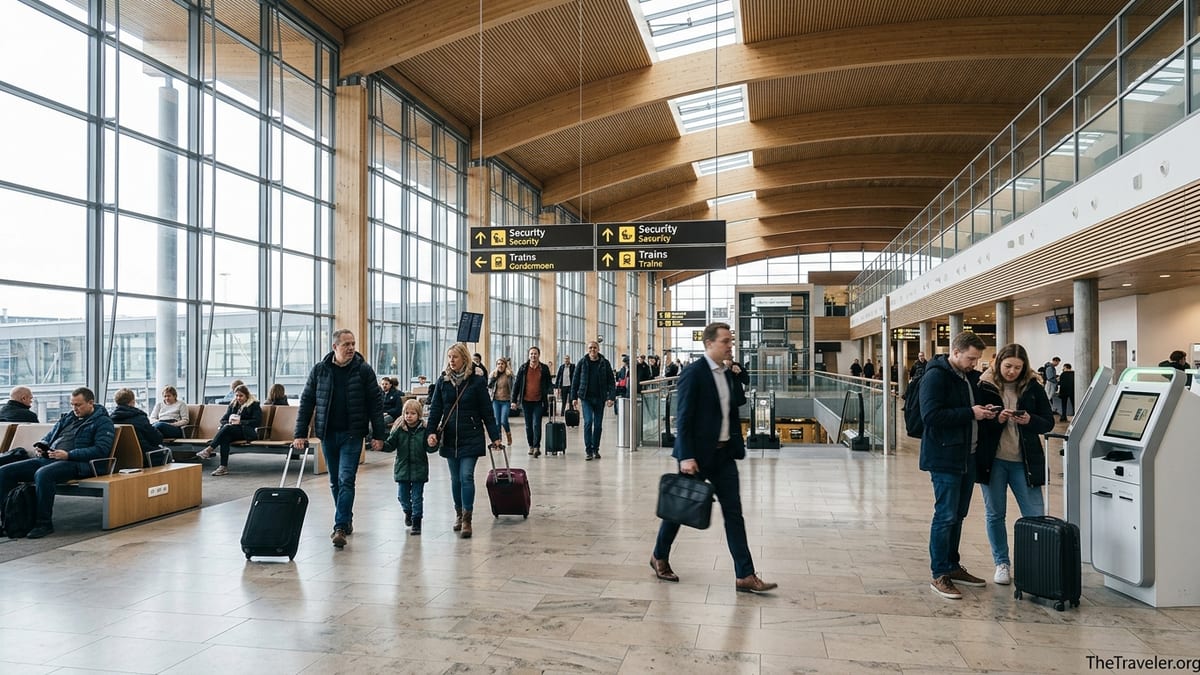
First Impressions: Layout and Wayfinding
Oslo Airport Gardermoen is designed as a single terminal with multiple piers, which already makes life easier for most travelers. You do not have to shuttle between terminals to change flights, and the central departures hall connects directly to security and all gate areas. From the moment you step out of arrivals, clear overhead signs in Norwegian and English point the way to baggage claim, customs, trains, buses and taxis. For someone landing from New York or London for the first time, this usually means you can be walking toward the train station within a few minutes of clearing customs, without needing to puzzle over maps.
The terminal itself is light, spacious and built around a lot of glass and wood, in typical Scandinavian style. Corridors are generally wide, and the main departures hall opens out in front of you in a way that feels intuitive rather than maze like. Travelers often comment that Oslo feels less chaotic than many other European hubs of a similar size, which is partly due to the single terminal concept and partly to how the flows of arriving and departing passengers are separated. If you are used to changing terminals at airports like Paris Charles de Gaulle or London Heathrow, Gardermoen’s compact layout feels refreshingly straightforward.
That said, distances can still be substantial when you have a gate at one of the farther ends of the piers. Non Schengen flights often depart from the D gates or the remote G gates, which can require a walk of 10 to 15 minutes from the central security area. Travelers with short connections sometimes report brisk walks through long corridors, and those arriving with heavy hand luggage or young children can feel the distance. The upshot is that the airport is easy to understand, but you should not assume that “single terminal” automatically means everything is only a couple of minutes away.
Wayfinding is helped by clear gate numbering and frequent display screens, but some first time visitors note that it is possible to walk quite far before spotting another staff member. The terminal is well signposted, yet those who prefer to ask directions rather than rely on signs may find they need to flag down staff at check in or information desks rather than encounter roving helpers.
Getting To and From Oslo: Trains, Buses and Taxis
One of the standout features of Oslo Gardermoen is how easy it is to get to and from the city center. The airport has its own underground rail station directly beneath the terminal building, connected by escalators and elevators from the arrivals and departures levels. The Flytoget Airport Express train and regular Vy trains both run along the high speed Gardermoen Line into Oslo Central Station, with a typical journey time of around 19 to 23 minutes. Trains run frequently through most of the day, and many travelers report being on a train within 20 to 30 minutes of landing when they travel with hand luggage only.
In practice, this means that a traveler arriving from Berlin or Amsterdam can often be standing on the platform at Oslo Central less than an hour after touchdown, assuming a standard day without disruptions. The Airport Express train is the most heavily advertised option inside the terminal and is priced accordingly, with higher fares but simple ticket machines and card payments that international visitors find easy. The slower Vy regional trains that use the same line are usually cheaper, and recent independent guides highlight that budget conscious travelers can save a noticeable amount by choosing them, especially on round trips.
Buses and coaches provide direct services from Gardermoen to various neighborhoods in Oslo and to cities such as Lillehammer and Fredrikstad. The Flybussen airport buses, for example, link the airport to several areas of Oslo and can be convenient if your accommodation is not near the central station. However, most visitors still find the rail link easier to navigate, since the bus area involves going outside the terminal and picking the right operator and route. Taxis line up outside arrivals and are easy to find, but Norway’s generally high cost level means fares into central Oslo are significant, so travelers often reserve them for late night arrivals or when public transport is not practical.
The main caveat that seasoned passengers mention is the overnight window. After around 1:00 to 2:00 in the morning, train and bus departures thin out sharply, and on some nights there may be no public transport at all until early morning. Recent traveler discussions mention arriving around 2:00 a.m. and finding that the realistic options were a costly taxi into town or an airport hotel. So while Oslo Airport is very easy to use by public transport at normal hours, late night arrivals should plan ahead or budget for a cab.
Check In, Security and Passport Control
For many travelers, security screening is where an airport feels easy or stressful, and Oslo Gardermoen generally scores well. The airport operator reports typical security wait times under 15 minutes, and independent queue guides suggest that off peak waits can be as low as 5 to 10 minutes. Morning peaks between about 5:30 and 9:00, and late afternoon banks of flights on weekdays, can see queues stretching to 20 or 30 minutes, especially at the start of school holidays or before major travel weekends.
The departures hall is split into two main security entrances that feed into a central area behind the checkpoints. Airlines like Norwegian and SAS have their own check in zones, but the concept for passengers is the same: drop bags, walk to security, and then proceed to your pier. Many travelers using mobile boarding passes and hand luggage only report going from the train platform to airside in under 20 minutes when arriving outside the main rush periods. Those with checked bags or families naturally take longer, yet the process is still simpler than at multi terminal hubs where you may need to ride trains or buses before even seeing a scanner.
Fast Track security is offered by several airlines and can be purchased as an add on, often costing the equivalent of roughly 20 US dollars. Some recent flyers note that Fast Track is most valuable on Monday mornings or Friday afternoons, when business and leisure traffic combine. Premium cabins on SAS and certain status levels on Star Alliance partners usually include access, and some Norwegian domestic passengers with upgraded tickets also benefit. Travelers who have turned up with only 60 to 90 minutes for a non Schengen departure sometimes credit Fast Track as the reason they made their flights after unexpectedly long queues formed in the regular lanes.
Passport control is required for flights to and from non Schengen countries such as the United Kingdom, the United States and many destinations in Asia or Africa. Automatic gates are in place for eligible travelers, and lines here are generally shorter than at some neighboring hubs. However, during peak times or when several long haul flights arrive close together, the passport queues can back up. Some passengers arriving from overseas in recent months report waiting 20 to 30 minutes at border control before reaching baggage claim. This is not unusual in Europe, but it is worth factoring into tight onward connections, especially if you plan to connect from an intercontinental arrival to a domestic Norwegian flight on a single ticket.
Transfers and Making Connections
Because Oslo Gardermoen has a single terminal, connecting flights are usually straightforward compared with airports that require terminal hops. On a typical connection from a domestic Norwegian flight to a European Schengen destination, you get off the aircraft, follow signs to transfer security or the main departures area, and walk directly to your new gate. As your bags are checked through, you only need to worry about the time it takes to walk and clear any internal checks. Travelers regularly report making 60 to 90 minute domestic to Schengen connections without stress when flights are on time.
International to international connections are a bit more complex, particularly when moving between non Schengen and Schengen flights. For example, if you are arriving from New York and connecting to Tromsø, you need to clear passport control, collect your checked luggage, pass customs and then drop your bags again before heading through security to your domestic gate. Many airlines offer through checked tickets that minimize the risk, but real world experiences show that disruptions still matter. One traveler flying in from northern Norway noted arriving about 90 minutes before a long haul departure to Asia and feeling anxious after queueing at security for much longer than expected on a busy day.
For most connections of two hours or more on a single ticket, Oslo functions smoothly. The airport’s punctuality has been relatively strong, with average departure delays in recent summers lower than in the immediate post pandemic years. Nonetheless, occasional baggage system glitches or localized security issues can create temporary bottlenecks. Norwegian media recently reported on technical trouble affecting a couple of baggage belts for international arrivals, forcing bags to be reassigned to other carousels. According to airport statements, such incidents are usually resolved with limited knock on delays, but they highlight that even a well organized airport is not immune to sudden pressure.
Self connecting passengers, especially those buying separate tickets on low cost carriers, should be more conservative. While the airport is easy to navigate, a missed connection can still be expensive to fix. Seasoned travelers using Gardermoen as a self made hub between, say, a transatlantic arrival and a budget flight to the fjords often build in at least three hours and avoid tight overnight connections where a late arrival could leave them stranded with no public transport into the city.
Facilities, Food and Shopping: What Travelers Like and Dislike
Inside the terminal, Oslo Airport offers the range of services you would expect from a major European hub: duty free shops, clothing and design stores, coffee bars, fast food outlets and sit down restaurants. There are also lounges run by airlines and third party operators, and the domestic side has plenty of kiosks for quick snacks and newspapers. Many passengers praise the airport’s clean restrooms and the abundance of natural light, which make waiting for a departure feel less claustrophobic compared with older, windowless terminals.
However, a recurring theme in traveler reports is price. Norway is an expensive country, and the airport amplifies this. Visitors sometimes comment online that they consider bringing their own food to avoid paying high prices for sandwiches, coffee and hot meals at Gardermoen. A simple coffee and pastry can cost noticeably more than in many other European airports, and full meals at sit down restaurants quickly add up for families. Local residents often shrug this off as comparable to downtown Oslo prices, but international travelers unused to Norwegian costs can find the bill surprising.
Choice and quality also attract mixed reviews. Some passengers feel that the restaurant and bar options have become less appealing over the years, with a focus on standardized concepts rather than distinctive Norwegian food. Others appreciate the reliability of familiar international chains and point out that the airport is primarily a transit space, not a dining destination. On the plus side, quick grab and go options like convenience stores in the arrivals area and near the train station let travelers pick up bottled water, snacks and simple groceries for the journey into the city.
For families, the airport offers play areas and open spaces where children can move around, though these can be crowded during holiday peaks. Power outlets and charging points are relatively common, but some older seating areas lack convenient sockets, leading travelers to cluster around the more modern charging stations. Free Wi Fi is available throughout the terminal and usually performs well for everyday tasks, which helps make the waiting time more productive and is a point many passengers mention positively.
Comfort, Crowds and Overall Atmosphere
Travelers often describe Oslo Gardermoen as calm and orderly, especially when compared with some of Europe’s busiest mega hubs. The combination of Scandinavian design, high ceilings and ample natural light produces a feeling of space even when passenger numbers are high. On a typical weekday midday, you might find enough seating at the gates, short lines at cafes and relatively quiet walkways. This contributes strongly to the perception that the airport is easy to use, particularly for those who value a stress free environment over a huge range of entertainment options.
But the atmosphere changes at peak times. Early mornings see a “wave” of domestic and European departures that fill the check in hall, security area and nearby cafes. Frequent flyers report that Monday mornings in winter and early summer can feel quite crowded, with lines snaking back from the scanners and popular coffee bars stacked several customers deep. In those moments, Gardermoen can feel much like any other busy hub airport, and travelers who have cut their timing fine can experience significant stress.
Noise levels vary accordingly. When several wide body flights board at neighboring gates, announcements and crowds can make it harder to find a quiet corner. The airport does not have as many dedicated quiet zones as some Asian hubs, although lounges provide an escape for those with access. Overnight, the terminal quiets down considerably, but passengers trying to sleep in public areas sometimes report that cleaning machines and occasional announcements interrupt their rest. Security checkpoints usually open early in the morning, so travelers camping in the landside area during the night may find themselves waiting until around 4:00 a.m. before they can clear to the gates.
In general, the atmosphere is efficient rather than leisurely. Gardermoen is built to move passengers through at a steady pace, not to encourage extended stays. This suits most visitors who are simply passing through, but those on long layovers occasionally comment that, after a couple of hours of browsing the shops and using the Wi Fi, there is not much else to do unless you pay for lounge access or head into Oslo for a few hours.
How Reliable Is Oslo Airport in Practice?
Reliability is a major part of how “easy” an airport feels, and Oslo Gardermoen performs reasonably well here. European air traffic reports show that average ground delays at Oslo have been reduced compared with the immediate recovery years after the pandemic, and both departure and arrival punctuality have been solid by regional standards. Summer remains the most challenging period, with airlines, air traffic control and ground handling all under pressure, but Oslo has not featured among Europe’s worst disruption hotspots in recent seasons.
Where frustrations do arise, they are often linked to baggage handling and peak season staffing. Norwegian news outlets occasionally cover technical problems on individual baggage belts, which can lead to suitcases from certain flights being redirected to other carousels. Typically, airport representatives stress that the impact is limited and that other belts pick up the slack. Still, from a traveler’s point of view, arriving after a long haul only to wait an extra half hour for bags is understandably annoying, and those unlucky enough to experience it will likely describe the airport as less than perfectly efficient.
Weather related disruptions are part of the picture in winter, though Norway’s extensive experience with snow operations means Gardermoen is generally well prepared. De icing queues and runway clearing can cause delays on the coldest and snowiest days, but the infrastructure is designed with winter in mind. Travelers connecting to smaller regional airports in northern Norway are usually more concerned about weather at the onward destination than about Gardermoen itself, which tends to function relatively reliably even in adverse conditions.
Recent traveler feedback suggests that, while individual bad experiences do occur, the majority of passengers pass through Oslo without serious issues. Many online reviews are either neutral or quietly positive: check in was straightforward, security was fine, the train into town was easy. Negative reviews tend to focus on specific episodes, such as poor service at a baggage desk or confusion over self service check in machines, rather than systemic chaos. This pattern supports the view that the airport is generally easy to use, but not immune to occasional service lapses that leave a strong impression on affected travelers.
The Takeaway
Oslo Airport Gardermoen balances a compact, clearly organized terminal with excellent rail connections to the city and broadly efficient security and passport control. For many travelers, this adds up to an airport that is easy to understand and relatively low stress, especially when compared with sprawling multi terminal hubs elsewhere in Europe. The ability to walk directly from the arrivals hall to a train platform and reach central Oslo in about 20 minutes is a major plus that shapes the entire experience.
At the same time, traveler testimonies highlight some consistent weak points. Food and drink are expensive, some restaurant options feel underwhelming, and late night arrivals can face limited public transport. Peak security queues and occasional baggage issues show that even a well designed, single terminal airport can strain under heavy traffic. Those who arrive unprepared for Norway’s price levels or who cut their connection times too tightly are the most likely to come away with negative impressions.
Overall though, the pattern from recent real world accounts is clear. If you allow sensible time for check in and security, plan your transport into the city, and accept that prices will be high, Oslo Gardermoen is an airport most travelers find straightforward to use. The experience may not be luxurious or especially entertaining, but it is usually calm, predictable and functional. For visitors starting or ending a trip in Norway, that combination of clarity and reliability goes a long way toward making travel feel manageable.
FAQ
Q1. Is Oslo Airport Gardermoen easy to navigate for first time visitors?
Yes, most first time visitors find Oslo Airport easy to navigate. The single terminal layout, clear bilingual signage and straightforward links from arrivals to trains, buses and taxis make orientation simple compared with many larger multi terminal airports.
Q2. How long does it usually take to get from Oslo Airport to the city center?
In normal conditions, the journey by train from the airport station under the terminal to Oslo Central Station takes around 20 minutes. Including time to walk from arrivals to the platform and wait for the next departure, many travelers reach central Oslo within 30 to 45 minutes of clearing customs.
Q3. Are security lines at Oslo Airport very long?
Security lines vary by time of day and season. Outside peak periods, many passengers report getting through in 5 to 15 minutes. During busy morning and late afternoon waves, especially around holidays, waits can stretch to 20 or 30 minutes, and on rare bad days even longer.
Q4. Is it worth paying for Fast Track security at Gardermoen?
Fast Track can be useful if you are traveling at a known busy time or have a tight schedule. Travelers flying early on Monday mornings, Friday afternoons, or at the start of school holidays often find value in paying for Fast Track or holding a ticket class or status that includes it.
Q5. What are the main complaints travelers have about Oslo Airport?
The most common complaints focus on high prices for food and drink, occasional long lines at security during peaks, and sporadic baggage handling issues. Some passengers also feel that restaurant options are limited or unexciting for the size of the airport.
Q6. Is Oslo Airport a good place for a long layover?
Oslo Airport is comfortable and efficient but not particularly rich in entertainment. For layovers longer than four or five hours during the day, some travelers choose to take the train into the city for a short visit rather than spend the entire time in the terminal.
Q7. How late do trains and buses run from Gardermoen into Oslo?
Trains and buses run frequently from early morning until late evening, but overnight services are limited. After about 1:00 to 2:00 a.m. on many nights, there may be few or no public transport options until early morning, so very late arrivals often rely on taxis or airport hotels.
Q8. Is Oslo Airport family friendly?
Yes, families generally find Oslo Airport manageable. The terminal is step free with elevators, there are play areas for children and restrooms are clean. However, during holiday peaks, crowds can make it harder to find quiet seating, and food costs for families can be high.
Q9. How reliable is baggage handling at Gardermoen?
Most passengers receive their luggage without issues and within a reasonable time, but occasional technical problems or peak season pressures can cause delays. Media reports sometimes describe short term glitches affecting specific carousels, though these are usually resolved with limited overall impact.
Q10. Is Oslo Gardermoen a good choice for connecting flights?
For connections booked on a single ticket with sensible layover times, Oslo is generally a good and easy hub. The single terminal design simplifies transfers, and punctuality has been relatively strong. Self connecting travelers on separate tickets should allow extra time to protect themselves from unexpected queues or disruptions.