


Oslo Airport Gardermoen is one of Scandinavia’s most efficient hubs, but it still catches unprepared travelers off guard. From early-morning security peaks to the quirks of Norway’s baggage and duty-free rules, a little advance knowledge can turn a stressful transit into a smooth, almost relaxing experience. Here is what passengers should know before flying through Oslo Airport in 2026.
Get the latest updates straight to your inbox!
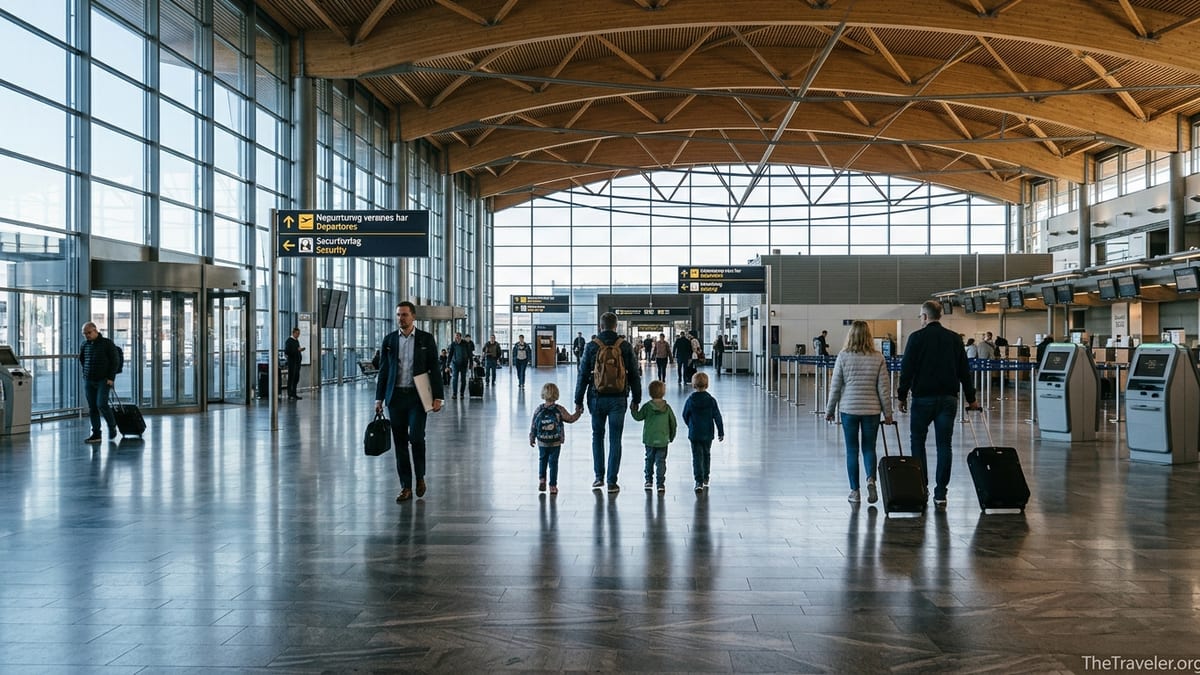
Understanding Oslo Airport’s Layout and Check In
Oslo Airport Gardermoen operates as a single-terminal airport, but the building is effectively split between domestic and international flights, with Schengen and non-Schengen gates on different piers. Check in and security are all on one large departures level, with two main security entry zones usually referred to informally as the “Norwegian side” and the “SAS side.” Norwegian Air Shuttle typically uses the left-hand area of the departures hall, while SAS and many Star Alliance carriers are on the right. This matters because lines can be quite different on each side at the same time of day.
Most airlines serving Oslo support online check in and mobile boarding passes, which are widely accepted at the self-service bag drops used by carriers such as SAS, Norwegian and Widerøe. If you have only hand luggage, you can usually go straight to security unless your airline requires a document check for visas or onward travel. During busy school holiday periods, self-service check in and bag drop are noticeably faster than traditional desks, so downloading your airline’s app in advance is worth the minor effort.
For early departures between 06:00 and 08:00, long lines can appear at the main check-in islands used by big European carriers. A family flying to Alicante with checked bags, for instance, might find a 20-minute queue for bag drop with a package tour operator, while SAS self-service bag drops a few meters away are moving much faster. If your fare allows it, checking in the evening before with “evening bag drop” on SAS or Norwegian when offered can save time, especially before peak travel weekends.
Travelers arriving by train from Oslo or other regions step directly into the arrivals hall under the main terminal. From there, elevators and escalators connect to the departures level. If you are connecting from a domestic arrival to an international flight on a single ticket, follow the transfer signs; in many cases you can stay airside after re-clearing security, but international arrivals that are the first point of entry into Norway may need to collect bags and go through customs before re-checking for a domestic leg, depending on airline and routing.
When to Arrive and How to Handle Security
Security at Oslo Airport has a reputation for being efficient, with average queue times often under 10 minutes outside of peaks according to several independent queue-tracking services updated in 2026. However, there are predictable rush hours. The heaviest congestion is typically between about 05:30 and 09:00, particularly on Monday mornings and Friday afternoons when business travelers and weekend trippers overlap. Travelers on a 07:00 SAS flight to London or a Norwegian departure to Berlin during this window have reported lines that snake far back into the hall, even if they still move at a steady pace.
On the other hand, mid-morning and early afternoon are usually calmer. Data collated by flight-queue websites indicates that between roughly 10:00 and 13:00 on weekdays, many passengers clear security in under 10 minutes, and queues thin out again after around 20:00. During Norwegian school holidays in late June to mid-August and at Easter, as well as around Christmas and New Year, you should build in extra time; it is not unusual for security lanes to be full of families with outdoor gear and ski bags, which slows down the scanning process even if the staffing is solid.
As a rule of thumb in 2026, arriving at Oslo Airport 2 hours before departure is usually sufficient for Schengen flights with hand luggage only, and 2.5 to 3 hours is sensible for non-Schengen or flights with checked bags at busy times. For example, a traveler on a 06:30 departure to Amsterdam with only a backpack could reasonably arrive around 04:30, while a family checking three suitcases for a 10:00 long-haul flight to the United States would be wise to be at the terminal by 07:00 to account for check in, security and passport control.
Fast Track security is available for eligible premium-class passengers and certain status holders, and some airlines sell access as an add-on. In 2026, independent tracking sites list Fast Track add-ons for Norwegian around the mid-hundreds of Norwegian kroner per person, which can be worthwhile if you must travel during the early morning rush. However, Fast Track closes overnight and may open later than the first wave of passengers expect, so very early flyers should not rely on it without checking their airline’s latest information.
Liquids, Duty Free and Baggage Rules That Surprise Visitors
Oslo Airport follows standard European Union aviation security rules for liquids, even though Norway itself is not an EU member but part of the EEA and Schengen arrangements. That means liquids, creams and gels in hand luggage must be in containers of 100 milliliters or less, placed in a transparent one-liter bag. Many Nordic passengers are well used to these rules and organize their toiletries accordingly, but visitors sometimes underestimate how strictly they are enforced. Full-size water bottles are routinely removed at security, and travelers are directed to empty them before screening.
There are some ongoing upgrades to security technology, including the gradual introduction of CT scanners that may eventually relax the need to remove liquids and laptops at all lanes. For now, though, most travelers at Oslo should still be prepared to take laptops and tablets out of bags and to separate liquids in a single clear pouch. A common scenario is the business traveler with a laptop backpack and a separate camera bag; security staff will often ask for both electronic devices to be placed in trays, which can add a minute or two to your screening time.
Norway’s baggage rules contain one quirk that matters for international transfers. For many non-Schengen arrivals that are the first entry point into Norway, passengers must collect their checked luggage, pass through customs, and then re-check their bags for onward domestic flights, even when flying on a through ticket. This “first point of entry” customs rule means that a traveler arriving from New York and connecting to Tromsø may need to factor in time to retrieve a suitcase at Oslo and hand it back to the airline, rather than assuming it will be checked through automatically.
Duty-free is another area that can trip up visitors. Oslo Airport has a large duty-free store in departures and a smaller one in the baggage hall for arriving passengers. Prices on typical Scandinavian favorites such as aquavit, gin, and cosmetics are often significantly lower here than in downtown Oslo shops, which leads many Norwegians to stock up. However, Norway’s customs allowances are strict and can change, so guests should check current alcohol and tobacco limits before making large purchases. A frequent real-world example involves travelers buying multiple cartons of cigarettes or several bottles of spirits on arrival, only to discover that their allowance is lower than they assumed from another European trip.
Getting To and From Oslo Airport: Trains, Buses and Taxis
Oslo Airport lies roughly 50 kilometers north of central Oslo and is directly connected to the city by a dedicated airport express train and regular regional trains. The airport station is underneath the terminal, reached by escalators from the arrivals hall. The express train is fast and frequent, with journey times of around 20 minutes to Oslo Central Station. It typically runs at a premium price compared with local trains, which take only a few minutes longer but cost noticeably less. Visitors on city breaks or family trips often choose the cheaper regional trains that use the same platforms but require buying different tickets.
Several coach companies operate services between Oslo Airport and other parts of eastern Norway. The best known are airport buses serving districts of Oslo and nearby towns such as Lillehammer or Hønefoss. These are especially useful in late evening or early morning when train frequencies drop. For instance, a traveler landing after 23:00 might find that the regional train frequency has thinned out, while an airport coach still offers a direct ride to a major hotel district without changes.
Taxi travel to and from Oslo Airport can be expensive compared with many European capitals. Fares into central Oslo commonly run into the upper hundreds of Norwegian kroner or more, depending on traffic, time of day and company. However, arriving passengers will see boards near the taxi rank that list typical prices from different companies to the city center and major suburbs. This allows you to compare set rates before choosing a cab. Some locals pre-book taxis with fixed-price offers from specific firms, which can be worthwhile for groups of three or four sharing the cost on an early-morning departure.
For late-night arrivals, public transport options can be limited, particularly after 01:00. Norwegian travelers often recommend booking an airport hotel that is reachable by short shuttle or even on foot rather than paying for an expensive taxi all the way into the city at that hour. For example, a solo traveler landing at 02:00 might check into a hotel near the terminal, rest for a few hours and then take the first morning train into Oslo instead of paying for a long, high-priced taxi ride in the middle of the night.
Food, Shopping, Lounges and Where to Wait
Oslo Airport has a broad range of cafes, quick-service outlets and sit-down restaurants both landside and airside. Familiar Scandinavian and international chains serve coffee, pastries, sandwiches and hot meals. Prices are high even by Nordic standards, and Norwegian residents often comment that identical brands cost noticeably more inside the terminal than in downtown Oslo. For travelers on a budget, a common strategy is to buy snacks or a simple meal in the city before heading out to the airport, then topping up with a coffee or light bite airside if needed.
Retail at Gardermoen includes fashion, electronics, outdoor gear and Norwegian design stores, alongside the large duty-free area. The outdoor and sports shops are particularly popular with passengers heading to or from the mountains, selling everything from wool base layers to compact hiking equipment. Travelers who realize they have forgotten a key item such as a rain jacket or a power adapter for European sockets will generally find one easily, although at a premium price. It is not uncommon to see visitors bound for the fjords buying last-minute waterproofs in the terminal after watching the local weather forecast turn gloomy.
For those seeking a quieter place to work or relax, Oslo Airport offers several lounges. In 2026 there are multiple lounges split between domestic and international areas, including SAS-branded lounges and independent facilities. Access varies: business-class and certain premium-economy passengers may enter free of charge, while holders of bank-issued lounge cards such as Lounge Key through Norwegian banks, or members of global lounge programs, can often pay an entry fee. Facilities usually include light snacks, soft drinks, some alcoholic beverages, Wi-Fi and power outlets, with views over the apron.
Passengers without lounge access will find plenty of seating throughout the gate areas. Power outlets are not always abundant at every seat bank, so travelers with several devices often appreciate carrying a small multi-USB charger or a compact extension cord. Overnight sleepers occasionally use benches landside before security in the public areas, but the airport is not designed as a sleeping hub, and cleaning staff and security may wake travelers who are blocking corridors or emergency exits. If you plan to camp out before a dawn departure, choosing a quiet corner near a cafe that opens early is usually more comfortable than lying on the main concourse floor.
Making Tight Connections and Deciding Whether to Leave the Airport
Because Oslo Airport is compact and fairly efficient, many travelers successfully make relatively short connections. Walking time between the furthest gates rarely exceeds 15 to 20 minutes for an average adult, and same-pier Schengen-to-Schengen transfers can be as quick as a few minutes if you arrive and depart near the central terminal spine. However, if your itinerary involves switching between Schengen and non-Schengen flights, you will need to factor in passport control in addition to any security re-screening.
Typical minimum connection times sold by major airlines can be tight but achievable when operations run smoothly. For example, a 55-minute connection from a domestic Widerøe flight to a SAS service to Copenhagen is common and usually workable, provided the inbound is on time and your bags are checked through. Where travelers often run into trouble is with self-booked separate tickets or low-cost carriers. A visitor assembling their own route with one ticket into Oslo on a non-Schengen airline and a separate budget flight onward may face a long walk, immigration, baggage collection, customs and re-check in, all on a tight schedule and without protection if a delay occurs.
For layovers of four to six hours, some passengers wonder whether they have time to visit Oslo itself. The fast train’s 20-minute ride to the city center makes this tempting. In practice, you should add walking time from the gate, any passport control, waiting for the next train, and the need to be back at the airport well before your onward departure. Many frequent flyers estimate that anything under five hours of total layover time is better spent relaxing in the terminal, especially if you need to re-clear security.
When the weather is good, a realistic option for a longer layover is to take the train one stop to a nearby town on the same line, enjoy a coffee or a short walk, and head back without venturing all the way into central Oslo. Some travelers with deep nighttime layovers instead book a short-stay airport hotel, allowing them to properly sleep for a few hours and shower before their next leg. Given Norway’s high accommodation costs, this is not cheap, but for a long-haul traveler arriving from Asia or North America it can make a significant difference to comfort and jet lag.
The Takeaway
Flying through Oslo Airport Gardermoen in 2026 is generally a calm and predictable experience, especially compared with some larger European hubs. The key is to respect the early-morning peaks, allow extra time around Norwegian school holidays, and be aware of local specifics such as customs rules for baggage on international arrivals and the strict approach to carry-on liquids. Using online check in, self-service bag drops and, where appropriate, Fast Track access can shave valuable minutes off your airport journey.
On the ground, the train link to the city is fast and reliable, but travelers should think carefully before leaving the airport on short layovers, given the time needed to re-clear security and reach the gate. Food and shopping options are extensive but expensive, lounges provide welcome calm for those with access, and airport hotels are a pragmatic solution for late-night arrivals or early departures. With these practical tips in mind, most travelers will find Oslo Airport an efficient gateway to Norway and the wider Nordic region.
FAQ
Q1. How early should I arrive at Oslo Airport before my flight?
For most Schengen flights, arriving around 2 hours before departure is usually enough, while 2.5 to 3 hours is sensible for non-Schengen or at peak holiday times.
Q2. Is security at Oslo Airport usually busy?
Security is generally efficient, but it gets crowded from about 05:30 to 09:00 and during Norwegian school holidays, so expect longer lines at those times.
Q3. Does Oslo Airport have Fast Track security?
Yes. Fast Track is available for premium and status passengers, and some airlines sell it as an add-on, which can be worthwhile during the early-morning rush.
Q4. Can I drink tap water at Oslo Airport and refill my bottle?
Yes. Tap water in Norway is safe and high quality. Empty your bottle before security, then refill it from taps or fountains airside.
Q5. How do I get from Oslo Airport to the city center?
The fastest option is the airport express train, taking about 20 minutes, while slightly slower regional trains are cheaper and also run directly to Oslo Central Station.
Q6. Is it worth leaving the airport during a layover?
Generally you need at least five hours of total layover to comfortably go into central Oslo and back, including time for passport control, trains and security on your return.
Q7. Are there luggage storage facilities at Oslo Airport?
Yes. There are baggage lockers and storage services in the terminal, useful if you want to explore the area or Oslo without carrying all your bags.
Q8. Does Oslo Airport have lounges I can pay to enter?
Several lounges operate at Oslo Airport. Some allow paid access or entry via lounge programs and certain bank cards, in addition to business-class tickets.
Q9. Are food and drinks at Oslo Airport expensive?
Prices are high even by Norwegian standards, so many travelers eat in the city first and then buy only snacks or drinks at the airport.
Q10. Is it possible to sleep overnight at Oslo Airport?
Sleeping is not officially encouraged, but some travelers rest on benches in the public areas. For better comfort, an airport hotel is usually a wiser choice.