


High above the Arctic Circle in Finnish Lapland, Saariselkä combines a reliable Northern Lights season with easy access to fells, forests and national parks. It is compact enough for first-time Lapland visitors, yet wild enough for serious outdoor enthusiasts. This guide walks you through how to plan a trip to Saariselkä step by step, from timing and transport to where to stay, typical prices and what to pack, with plenty of real-world examples to help you turn an Arctic daydream into a workable itinerary.
Get the latest updates straight to your inbox!
Why Choose Saariselkä for Northern Lights and Nature
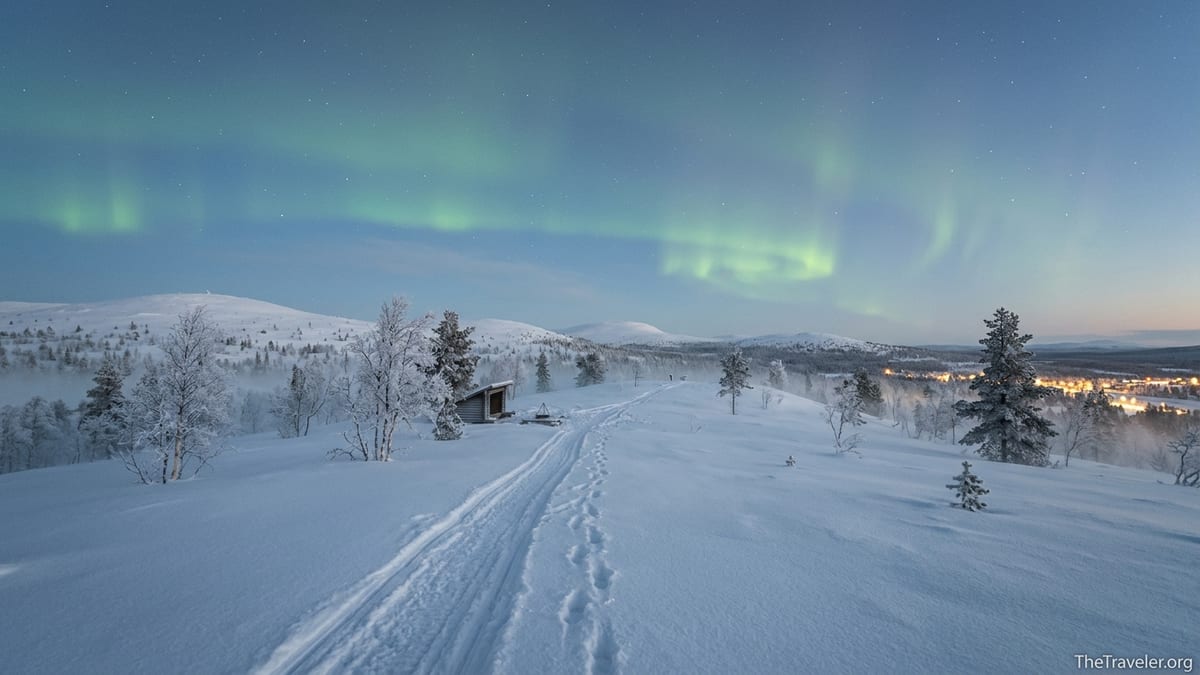
Saariselkä is a small resort village in northern Finnish Lapland, roughly 250 kilometres north of the Arctic Circle and close to Urho Kekkonen National Park. It is known as one of the northernmost ski resorts in Europe, with downhill slopes spread over the fells of Kaunispää and Iisakkipää, and a large network of cross-country ski trails. The location means long, dark winter nights ideal for aurora hunting, while the surrounding fells provide an accessible introduction to Lapland’s tundra landscapes.
For many travellers, Saariselkä hits a sweet spot between wilderness and convenience. Ivalo Airport is only about a 20-minute drive away, so you can land on an afternoon flight from Helsinki and still make a guided Northern Lights tour that same evening. In the village itself you will find several hotels, cabin complexes, glass-roof igloos, a grocery store, equipment rental shops and a small selection of restaurants, so you can manage without a car if you prefer.
Compared with larger Lapland hubs like Rovaniemi and Levi, Saariselkä feels quieter and less commercial. Instead of big theme parks, the main draw is the landscape itself: snow-laden spruce forests, open fell tops, and wide skies where auroras can appear even above the village. This makes it particularly appealing for couples, photographers and outdoor travellers who want a calmer base with direct access to trails, ski tracks and wilderness tours.
At the same time, Saariselkä offers enough structured activities for those who like their nature with a bit of organisation. In winter you can book husky safaris, reindeer sleigh rides, guided snowshoe hikes and snowmobile safaris through local operators. In autumn and summer, the focus shifts to hiking, mountain biking, river trips and berry picking. Planning your trip is largely about deciding which season suits you best, then building your days around a mix of self-guided and guided experiences.
Best Time to Visit for Northern Lights and Seasons
The Northern Lights are typically visible in the Saariselkä region from late August through late April, whenever the sky is dark, clear and auroral activity is strong. In practice, most visitors aiming to see the aurora choose the window from September to late March. During this period, nights are reliably dark and long, especially from October to February, when there can be as little as a few hours of twilight in midwinter.
If your priority is the aurora combined with deep winter scenery and snow-based activities, consider planning between early December and late March. Around Christmas and New Year, Saariselkä is busy and prices are at their highest, with glass-roofed cabins such as those at Northern Lights Village or similar resorts often selling out months ahead. A glass cabin there, with a partially transparent roof for aurora viewing, can easily cost from around 300 euros per night in peak weeks, sometimes more depending on demand and package inclusions.
For slightly milder temperatures, better daylight for outdoor photography and good aurora odds, many repeat visitors favour late February and March. At this time, the sun is higher, days are longer for skiing and snowshoeing, but nights remain dark enough to chase the lights. Daytime temperatures can still drop well below freezing but are often more manageable than the minus 25 Celsius or lower that is not unusual in January.
Autumn, from early September to early October, is another attractive period if you want to see auroras arching over colourful forests instead of deep snow. Trails are generally accessible without snowshoes, and daytime temperatures can hover just above freezing. Several Saariselkä operators run “autumn aurora” programs with activities like hiking, husky cart rides on wheels instead of sleds, and photography-focused tours. By late April, the midnight sun season is approaching, and while skiing is still possible on the fells, the sky no longer gets truly dark for auroras.
Getting to Saariselkä and Getting Around
The quickest way to reach Saariselkä from abroad is usually to fly to Helsinki and connect to Ivalo Airport. During the main winter season, there are daily flights between Helsinki and Ivalo, and on some weeks seasonal direct flights operate from cities elsewhere in Europe. A typical winter itinerary from North America might involve an overnight transatlantic flight to Helsinki, a short domestic flight of around 1 hour and 30 minutes to Ivalo, and then a 20 to 30 minute pre-booked transfer to your accommodation in Saariselkä.
From Ivalo Airport, you can arrange a shared airport bus or private transfer through your hotel or a local transfer company. In winter 2025–2026, shared shuttle prices for the airport-to-Saariselkä run are often in the range of 10 to 20 euros per person one way, while private transfers for a couple or family cost more but can be convenient if you arrive late at night. Many resorts, such as glass igloo villages and spa hotels, allow you to add the transfer when you book your room.
It is also possible to reach Saariselkä by long-distance bus from Rovaniemi or by driving yourself. The drive from Rovaniemi to Saariselkä takes roughly 3 to 4 hours in winter conditions on main roads, and rental cars can be picked up at Rovaniemi or Ivalo. For a one-week winter trip, some visitors choose to rent a car in Ivalo and keep it for the entire stay, especially if they want to visit nearby areas like Inari, Kiilopää or smaller wilderness trailheads. Daily rental rates vary, but for planning purposes, mid-range winterized cars often start somewhere around 60 to 80 euros per day before fuel.
Once in Saariselkä, you can comfortably manage on foot for a short stay if your accommodation is near the village centre or along the main ski bus route. The resort area is compact, and many hotels are within walking distance of ski lifts, restaurants and rental shops. Winter sidewalks can be snowy and occasionally slippery, so plan on using sturdy boots with good traction. If you stay at a fell-top hotel or an out-of-town glass cabin resort, check their shuttle or minibus schedule, as some operate regular runs to and from the village and ski area, especially in the evening for diners and aurora excursions.
Where to Stay: From Glass Cabins to Village Hotels
Saariselkä offers a mix of accommodation styles that suit different budgets and travel styles. At the premium end, glass-roofed igloo cabins and suites are designed for aurora viewing from bed. For example, at a dedicated aurora village a typical glass-roof cabin for two people in mid-winter might start from around 300 to 400 euros per night, sometimes including half-board dining and selected activities. These cabins usually have heated glass roofs, private bathrooms and cosy Scandinavian interiors. Some newer suites on the fells combine partial glass roofs with small lounge areas and private saunas.
For travellers who prefer a more traditional hotel experience, Saariselkä village has several full-service hotels with standard rooms and apartments. A mid-range hotel room in winter might fall roughly in the 150 to 250 euro per night range, depending on exact dates, booking timing and whether breakfast is included. Apartment-style units with kitchenettes are popular with families and longer-stay guests who want to self-cater. Many of these properties sit within a short walk of the supermarket, ski bus stops and trailheads.
Cabin-style lodging is another strong option in Saariselkä. Many privately owned log cabins and semi-detached chalets are rented on a weekly basis, often including a fireplace and private sauna. Prices vary widely, but budget-conscious groups can sometimes find basic cabins for under 150 euros per night in shoulder periods if they are willing to stay slightly outside the main village and share facilities. When comparing options, consider whether bed linen and final cleaning are included, as these can be extra costs with some cabin rentals.
If your budget is tight but you still want to experience Saariselkä in winter, look for guesthouses or smaller apartment complexes a bit away from the main strip. Booking midweek stays outside the Christmas and school holiday peaks usually yields lower rates. A practical compromise many travellers choose is to book two or three nights in a premium glass-roof cabin for the aurora experience, then move to a simpler hotel room or cabin for the rest of the week. This keeps overall costs manageable while still giving you a memorable night under the Arctic sky.
Planning Your Northern Lights Strategy
Seeing the Northern Lights in Saariselkä is never guaranteed, but thoughtful planning can significantly improve your chances. Start by booking at least three to four nights in the region during the darker months; the longer you stay, the more likely you are to get at least one clear, active night. Many aurora travellers aim for four or five nights in January, February or March for this reason, structuring their days around outdoor activities and evenings around flexible aurora plans.
Consider combining independent sky-watching with one or two guided aurora tours. On your first night, for example, you might book a guided “aurora chase” by minibus or snowmobile operated by a local company. These tours typically cost in the region of 110 to 180 euros per adult, depending on duration and transport mode, and often include warm overalls, hot drinks and photography advice. Guides use local weather forecasts and aurora monitoring apps to drive guests toward clearer skies, sometimes heading toward Inari or more remote lay-bys away from village lights.
On other nights, you can watch the sky independently from near your accommodation. If you stay in a glass-roof cabin near the forest, you may only need to step outside to a darker spot and look north. Visitors staying in village hotels often walk 10 to 20 minutes to nearby open areas or the lower slopes of Kaunispää to escape streetlights. It is common to check an aurora forecast app after dinner, then head out around 10 pm and stay adaptable; displays may build around midnight, but weaker auroras can appear earlier or later.
Photographers should prepare properly for Arctic night conditions. A sturdy tripod, a camera that allows manual exposure control and a fast wide-angle lens are key. Many successful aurora images around Saariselkä use settings such as f/2.8, ISO between 1600 and 3200, and shutter speeds of 5 to 15 seconds, adjusted to brightness and movement. In temperatures below minus 15 Celsius, batteries drain quickly; travellers often carry two or three fully charged spares in an inner pocket and keep camera handling as efficient as possible to avoid removing gloves for long periods.
Outdoor Activities: Winter Adventures and Summer Trails
Saariselkä is not only about the aurora. In winter, the ski resort on Kaunispää and Iisakkipää fells offers around 18 kilometres of marked downhill runs served by a small network of lifts. The slopes cater mainly to beginners and intermediates, with a few steeper options and snow parks. A full-day lift pass for an adult in high season is typically a little over 50 euros, with discounts for children and multi-day passes. Equipment rental shops in the village provide ski and snowboard packages, helmets and clothing, making it simple to put together a few ski days even if you arrive with only your winter boots.
For many visitors, cross-country skiing is the real highlight. The area around Saariselkä is crisscrossed by roughly 200 to 230 kilometres of groomed ski trails, many of which loop through Urho Kekkonen National Park. You can rent cross-country skis and boots locally and try an easy 3 to 5 kilometre loop on your first morning, then progress to longer routes with open fell views. Some trails have atmospheric wilderness cafés or shelters where you can stop for hot berry juice or grill sausages over a fire.
Husky safaris, reindeer sleigh rides and snowmobiling are widely available through local safari companies. A typical two-hour husky tour might cost from around 150 to 200 euros per adult, including transfers, winter clothing, instruction and time to meet the dogs. Half-day snowmobile tours that combine trail riding with a visit to a reindeer farm or a remote camp may be priced in a similar range, with a per-snowmobile rate for two riders. For something gentler, guided snowshoe walks into the nearby fells or forests are often cheaper and accessible to most reasonably fit travellers.
In summer and autumn, Saariselkä transforms into a hiking and biking base. Trails lead directly from the village into rolling fells and birch forests, and waymarking is generally good. You might spend a July day walking from Kiilopää to a fell summit and back, then unwind in a riverside smoke sauna. Mountain bike rentals open up longer routes that combine gravel roads and singletrack. Autumn visitors often time their trips for the “ruska” season in September, when vegetation turns vivid shades of red, orange and gold, and the first frosts dust the highest fells with white.
Costs, Food and Practical Daily Planning
A trip to Saariselkä is a significant investment for most travellers, so it helps to have realistic cost expectations. A mid-range winter visit for two people, staying five nights, might involve accommodation in the 150 to 250 euro per night range, airport transfers at around 20 to 40 euros total, and several paid activities such as one aurora tour, one husky safari and two days of ski passes. Including meals and occasional drinks, a conservative rough estimate for such a trip can climb into several thousand euros, particularly if you add one or two nights in a premium glass-roof cabin.
Food prices reflect the remote location and reliance on imported goods. Many visitors self-cater at least some meals to keep costs under control. The main grocery store in the village offers fresh produce, dairy, bread, snacks and Finnish staples like rye crispbread and Karelian pies. A simple dinner cooked in an apartment, such as pasta with sauce and salad, will generally be far cheaper per person than dining out every evening. When you do eat in restaurants, plan for main dishes at resort prices, with casual burgers or pizzas at lunchtime and more elaborate reindeer, salmon or vegetarian dishes in the evening.
Day planning is often shaped by the limited daylight in midwinter and the desire to stay flexible for aurora watching. A typical January day might begin with a late breakfast, followed by a few hours of skiing, snowshoeing or a guided tour that ends before dusk. Many travellers take a rest or sauna break in late afternoon, then have an early dinner and gear up for a potential evening outside. It is wise not to schedule intense daytime excursions every single day; leaving some buffer evenings without paid tours allows you to rest or spontaneously head out if forecasts look promising.
For payments and logistics, Saariselkä is straightforward. Cards are widely accepted, including in most taxis, restaurants and activity centres. Dress codes are casual, and it is perfectly normal to show up at a restaurant in fleece layers and winter boots. English is commonly spoken by staff and guides. Still, carrying a small amount of cash in euros can be useful for small purchases at roadside cafés, firewood huts or rural attractions if you venture farther afield.
What to Pack for Arctic Conditions
Packing for Saariselkä is all about mastering layers. Winter temperatures can swing from just below freezing to well below minus 20 Celsius, sometimes on the same trip. A common strategy is to bring a moisture-wicking base layer top and bottom, an insulating mid-layer such as a fleece or light down jacket, and a windproof, waterproof outer shell or parka. For legs, thermal long underwear under insulated trousers or shell pants works well. Many travellers add a compact down or synthetic insulated jacket for evenings when they will be standing still watching the sky.
Footwear is critical. Insulated winter boots with good grip and room for thick wool socks make a big difference to comfort. Some visitors bring light crampon-style traction devices to pull over boots when walking on icy paths, particularly in the village. High-quality wool or wool-blend socks, plus spare pairs in case of dampness, are worth the luggage space. For hands, bring both thin liner gloves for operating camera controls and thicker insulated mittens for general wear. A warm hat that covers your ears and a buff or scarf to protect your face from wind are essential.
Many safari operators in Saariselkä supply heavy-duty winter overalls, boots and mittens as part of their tour packages, so you do not necessarily need a full expedition wardrobe to participate in activities. However, you will still appreciate having your own comfortable layers underneath and your own boots for day-to-day walking. For a practical example, someone visiting in February might wear a merino base layer, fleece mid-layer and insulated parka on top, with thermal long johns and padded ski pants on the bottom, plus insulated boots rated to around minus 20 Celsius, and then use the operator’s overall as an extra shell on snowmobile or husky excursions.
Do not forget small but useful accessories: chemical hand warmers, spare power banks for phones, protective cases for camera batteries and a simple headlamp with a red-light mode for navigating dark paths without ruining your night vision. Sunglasses and sunscreen are surprisingly important in late winter and spring when the sun reflects off snow. If you wear prescription glasses, consider anti-fog wipes or coatings, as they can mist up quickly when you move between warm interiors and cold outside air.
The Takeaway
Planning a trip to Saariselkä for Northern Lights and outdoor activities means balancing dreamlike images of green skies and snow-draped fells with practical decisions on timing, budget, accommodation and clothing. The reward for that preparation is a destination where you can spend your days skiing, sledding or hiking across open fells, then slip into a sauna before stepping out under a sky that may suddenly come alive with auroral arcs and curtains.
By choosing a suitable season, allowing several nights for aurora chances, mixing guided tours with independent exploration and packing sensible layers, you can make the most of Saariselkä’s unique location on the edge of one of Finland’s great national parks. Whether you splurge on a glass-roof cabin, base yourself in a modest village hotel or rent a log cabin with its own sauna, the essential experiences are the same: the crunch of snow underfoot, the stillness of the forest and the possibility that at any moment, the northern sky will begin to glow.
FAQ
Q1: When is the best time of year to see the Northern Lights in Saariselkä?
The Northern Lights are usually visible from late August to late April, but many travellers choose October to March for the combination of long dark nights and good chances of snow.
Q2: How many nights should I stay in Saariselkä for a good chance of seeing auroras?
A stay of at least three to four nights is recommended, and many visitors plan four or five nights to increase their odds of getting at least one clear, active night.
Q3: Do I need a car in Saariselkä in winter?
No, you can manage without a car if you stay near the village centre or use hotel and activity shuttles, but renting a car gives more flexibility for exploring nearby areas like Inari or Kiilopää.
Q4: Are aurora tours worth booking if I am staying in a glass-roof cabin?
Yes, many visitors combine one guided aurora tour, which can reach clearer skies away from clouds, with independent viewing from their cabin on other nights.
Q5: What kind of clothing is essential for a winter visit to Saariselkä?
Layered clothing is key: thermal base layers, insulating mid-layers, a windproof outer shell, insulated boots, warm hat, mittens and a buff or scarf for face protection.
Q6: Is Saariselkä suitable for beginners who have never skied before?
Yes, the ski resort offers gentle slopes, ski schools and rental equipment, and there are easier activities such as snowshoeing and reindeer sleigh rides for non-skiers.
Q7: How expensive are activities like husky safaris and snowmobile tours?
As a rough guide, a two-hour husky safari or snowmobile tour often costs from around 150 to 200 euros per adult, including guiding, gear and hot drinks.
Q8: Can I visit Saariselkä in summer and still enjoy nature?
Absolutely. In summer and autumn you can hike, mountain bike, canoe and enjoy long daylight hours, with autumn offering colourful foliage and occasional early auroras.
Q9: Is English widely spoken in Saariselkä?
Yes, English is commonly spoken by hotel staff, guides and in shops and restaurants, so most international visitors have no difficulty communicating.
Q10: Is Saariselkä suitable for families with children?
Yes, many families visit for gentle ski slopes, toboggan runs, short husky rides and child-friendly winter activities, though you should plan warm clothing and regular indoor breaks.