


High above the Arctic Circle, Saariselkä sits at the edge of one of Europe’s last great wildernesses. For many travelers, the name is still unfamiliar compared with Rovaniemi or Levi. Yet this small fell village in Finnish Lapland has quietly become a favorite for those chasing northern lights, learning cross-country skiing, or simply wanting to feel what real Arctic solitude is like. So is Saariselkä worth visiting, and what exactly draws travelers so far north? The answer depends on what you are looking for in Finland’s farthest reaches.
Get the latest updates straight to your inbox!
Where on the Map Is Saariselkä, Really?
Saariselkä is a compact fell resort in the municipality of Inari in northernmost Finnish Lapland, roughly 250 kilometers north of the Arctic Circle and close to the Russian border. The village sits on the western edge of Urho Kekkonen National Park, Finland’s second largest national park, which covers about 2,550 square kilometers of protected fells, forests and bogs. In practice, this means that you can walk from hotel reception onto marked trails that almost immediately lead into real wilderness, with no large towns for many kilometers in any direction.
Reaching Saariselkä is less complicated than its remote position suggests. Most international visitors fly to Helsinki and connect onward to Ivalo Airport, about 25 minutes by road from the resort. Several local companies and scheduled buses typically meet incoming flights in winter, so you can roll your suitcase from baggage claim straight to a coach and be at your accommodation without needing a rental car. In summer and autumn, a mix of buses and prebooked transfers cover the same route, although services are usually less frequent, so checking timetables when you book flights is important.
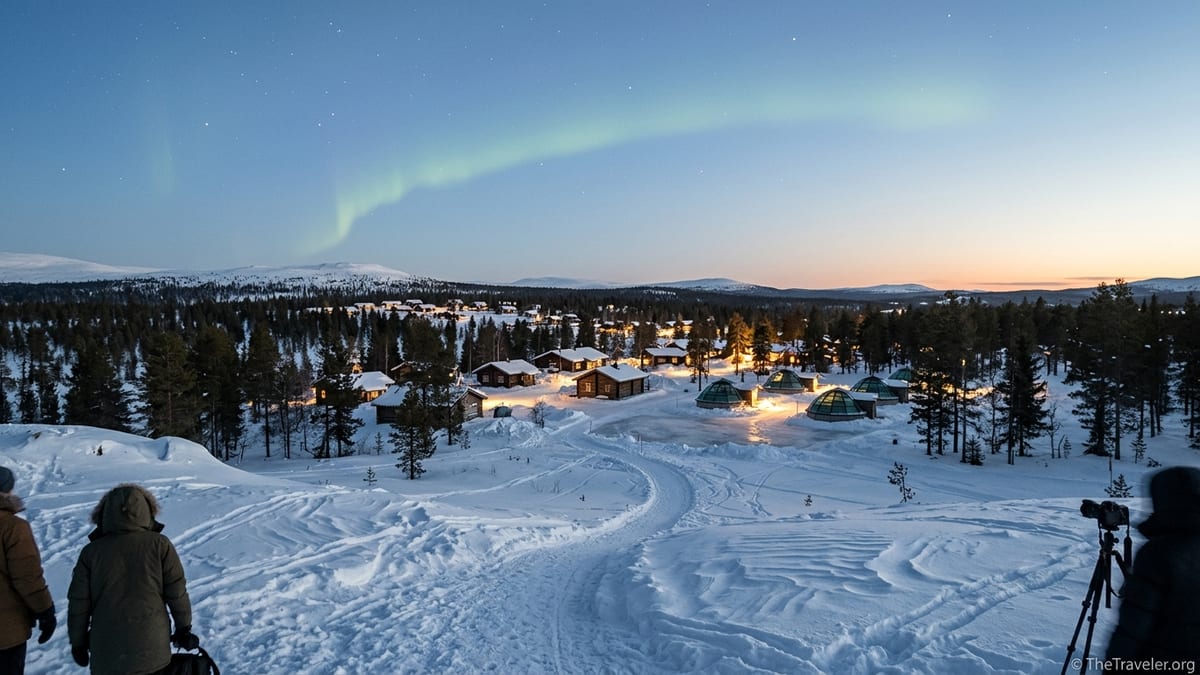
The village itself is small and walkable. A cluster of hotels, glass igloo resorts, rental cabins, restaurants, a supermarket, ski and outdoor shops, and a modest spa and activity center spread along the main road and up toward the base of the fells. Compared with Rovaniemi, there is little in the way of nightlife or big-brand shopping. For most travelers that is exactly the appeal: Saariselkä feels like a base camp pressed up against the vast Urho Kekkonen wilderness rather than a full-blown resort town.
Costs reflect its remote Arctic setting. Food and activities tend to be more expensive than in southern Finland, and visitors commonly report that restaurant mains in winter fall in the mid-20 to 30-euro range, while guided excursions such as husky safaris or aurora tours can easily run over 100 euros per person. At the same time, access to the national park is free, and many of the best experiences, from fell hikes to sledding hills, cost nothing more than good boots and warm clothing.
Winter Magic: Northern Lights, Ski Trails and Silent Fells
For many visitors, Saariselkä is synonymous with winter. From roughly late November to April, the region transforms into a deep-snow landscape, with groomed cross-country ski tracks, gentle downhill slopes and a high chance of northern lights on clear nights. The resort maintains an extensive cross-country trail network that appeals both to beginners taking their first lesson and to experienced skiers looking for long-distance loops through quiet forest.
Downhill skiing in Saariselkä is modest compared with major Alpine resorts, but the small set of fells above the village provides several runs served by lifts, a snow park and a famous toboggan run that descends from Kaunispää fell back toward the village. Families particularly value the relaxed atmosphere and uncrowded slopes. It is common to see parents taking beginner children onto easy runs in the morning, then swapping to sledding and hot chocolate in a cafe in the afternoon rather than racing through a packed network of lifts.
Winter in Saariselkä is not only about skis. Local operators based around the resort and nearby glass-roof villages offer husky safaris, snowmobile tours, reindeer sleigh rides, snowshoe excursions and fatbike trips on packed-snow trails. A typical 2-hour husky tour that includes transfers, warm clothing and a hot drink often costs in the region of 130 to 190 euros per adult, while a short reindeer ride combined with a visit to a small reindeer farm might be slightly less. Travelers often describe the silence of switching off a snowmobile or stopping a sled on an open fell as the moment they finally grasp how empty and wide Lapland really is.
Then there are the northern lights. Saariselkä’s latitude, relatively low light pollution and generally clear midwinter skies give it strong aurora potential from roughly late August through April. Many accommodations provide aurora wake-up calls or signals, and several tour companies run nightly aurora-chasing excursions, sometimes combining minibus transfers with campfires in simple kota huts or by frozen lakes. It is important to remember that no destination can guarantee a display, but visitors often report seeing at least faint green arcs during a weeklong winter stay if weather cooperates.
Summer and Autumn: Saariselkä Beyond the Snow
Because most marketing images show snowy glass igloos and sled dogs, many travelers are surprised that Saariselkä is also a strong summer and autumn destination. From June to early August, the sun barely dips below the horizon, creating a long period of midnight sun when trails and fells are bathed in soft orange light even at midnight. Daytime temperatures are usually mild rather than hot, and the combination of open fells and extensive marked paths makes the region attractive for hikers who prefer cooler conditions.
Urho Kekkonen National Park, which begins right at Saariselkä’s doorstep, offers around 200 kilometers of marked summer hiking trails of varying difficulty. Short routes might take you on a 1.5-kilometer loop from the village to a nearby laavu shelter, while more demanding routes connect Saariselkä with trailheads such as Kiilopää or deeper wilderness areas. Some day hikes lead to viewpoints like Iisakkipää or secluded spots such as Paratiisikuru, a small gorge that many Finnish hikers describe as one of the park’s highlights in late summer and early autumn.
Autumn, roughly from early September to early October, brings ruska, the intense display of fall colors across the fells and birch forests. Many Finns plan annual trips to Lapland during ruska to hike or mountain bike under golden and red leaves. Saariselkä’s trail network and easy access to Urho Kekkonen make it one of the more popular bases for this season, although you will still find wide stretches of trail where you see only a handful of people in a full day. Cooler nights also mean fewer insects, which many hikers and photographers consider a major advantage over midsummer.
Summer and autumn activities go beyond hiking. Operators in and around Saariselkä rent mountain bikes and fatbikes adapted for fell terrain, organize guided canoe or packraft trips on local rivers, and sometimes run berry-picking or foraging walks. Families often appreciate that many trails start directly from the village or from nearby starting points accessible by short transfers, so a half-day hike with school-age children does not require complex logistics.
Urho Kekkonen National Park: The Wilderness on Your Doorstep
What sets Saariselkä apart from many other northern resorts is its immediate relationship with Urho Kekkonen National Park. While some visitors initially imagine the park as one scenic viewpoint, it is better understood as a vast mosaic of open fells, spruce and pine forests, river valleys and wetlands that stretches for many tens of kilometers eastward toward the Russian border. The resort acts as one of its main gateways, alongside other entrance points such as Kiilopää and Tankavaara.
For day visitors, the park’s marked routes make it relatively simple to experience genuine wilderness in a controlled way. Trails often connect a series of maintained shelters, laavus and wilderness huts, some open and some bookable, which provide places to rest, cook over a fire and, in some cases, stay the night. It is common to meet Finnish families with children hiking short loops between shelters, carrying sausages and coffee to grill over the hut fireplace in the middle of an otherwise quiet fell landscape.
More experienced hikers and ski tourers use Saariselkä as a starting or ending point for multi-day hut-to-hut journeys deeper into the park, reaching remote spots such as the legendary Anterinmukka wilderness hut near the park’s eastern edge. In winter, these routes demand solid navigation skills, cold-weather gear and an understanding of how quickly conditions can change, but for those prepared, they offer one of the most accessible ways in Europe to experience a multi-day journey through almost uninhabited Arctic terrain.
Even without venturing far, you can feel the park’s character simply by walking up onto Kaunispää or other nearby fells. Once you gain a little elevation above the tree line, the view opens over rolling tunturi hills, interlaced rivers and dark forest extending to the horizon. Many travelers who have previously known Finland only through city visits comment that this panorama is what finally makes them understand the scale often mentioned in discussions of Lapland’s nature.
Staying in Saariselkä: From Glass Igloos to Simple Cabins
Saariselkä’s accommodation reflects its mix of international visitors and Finnish domestic travelers. At one end, there are glass-roofed cabins and igloo-style suites designed for aurora watching from bed, often clustered slightly outside the main village. These typically package accommodation with half board and activities, and prices in peak winter can be high, sometimes several hundred euros per night for two people. Visitors who prioritize watching the night sky without stepping outside are the main audience for these properties.
In the village itself you will find a range of hotels, apartment-style lodgings and traditional log cabins. Many come with their own saunas, fully equipped kitchens and drying cabinets for clothes, which are particularly appreciated after long days in the snow. Self-catering cabins are popular with Finnish groups who often split the cost among several friends or family members, cook most meals themselves and use the place as a base for day trips on skis or snowshoes.
Budget-conscious travelers frequently look for guesthouses or smaller apartment units a short walk from the main services, making use of the local supermarket to keep food costs manageable. Because there is no large city nearby, last-minute budget options in peak winter can be limited, so booking early is important for December through March, especially if your dates are inflexible. In shoulder seasons such as late April or after the main autumn color peak, prices can drop significantly and availability improves.
One detail many first-time visitors notice is how seriously accommodations in Saariselkä take drying and storing outdoor gear. It is common to find heated drying cabinets, boot racks and ski storage areas even in mid-range properties. These practical touches reflect the reality that most guests spend a large portion of their time outdoors in potentially harsh conditions and need a comfortable place to return to at the end of the day.
Who Will Love Saariselkä, and Who Might Not
Saariselkä tends to appeal strongly to travelers who prioritize nature and quiet over nightlife and elaborate attractions. If your ideal Lapland experience involves long days of skiing, hiking or simply wandering in near-silence, followed by an evening sauna and maybe a drink by the fireplace, you are likely to find the resort close to ideal. Photographers, aurora chasers, hikers and cross-country skiers routinely recommend it as a base that balances infrastructure with a sense of genuine remoteness.
The destination also works well for families who want a safe, small-scale environment with diverse outdoor activities. Children can learn to ski on uncrowded slopes, explore short nature trails and experience reindeer and husky encounters in settings that feel more intimate than large theme-parks. English is widely spoken, and local guides are used to adjusting pace and content for both adult adventure groups and mixed-age families.
On the other hand, Saariselkä is not the right choice for everyone. Travelers seeking lively nightlife, extensive shopping or large resort entertainment complexes may find it quiet. The village has a handful of bars and restaurants but evenings tend to wind down early, partially because many guests are getting up before dawn for tours or staying awake late for the possibility of auroras. In deep winter, the combination of long dark hours and extreme cold can also feel challenging for some, especially if they are not used to spending time outdoors below freezing.
Budget is another consideration. While it is possible to manage costs by cooking for yourself and focusing on free activities like independent hiking or skiing on public trails, Saariselkä will rarely be a low-cost holiday. Remote logistics, seasonal demand and the high level of equipment and safety planning required for Arctic operations are all reflected in prices, from restaurant meals to half-day excursions. Being realistic about your budget and prioritizing a few key experiences rather than trying to do everything can help ensure you leave satisfied rather than overwhelmed by costs.
The Takeaway
So is Saariselkä worth visiting? For travelers drawn to wild landscapes, quiet trails and the idea of stepping almost directly from hotel door into a national park, the answer is often a resounding yes. Saariselkä offers one of the most direct gateways into Finland’s northern wilderness, with the immense Urho Kekkonen National Park beginning at the village edge and a network of trails and huts that invite everyone from casual walkers to seasoned backcountry skiers.
The village combines enough infrastructure to feel comfortable in harsh Arctic conditions with an atmosphere that remains more nature base camp than polished resort. Northern lights, husky safaris, fells glowing under the midnight sun and autumn hillsides blazing with color are not marketing abstractions here but common experiences for those who choose the right season and give themselves enough days to adapt to the pace of the north.
Saariselkä will not suit travelers who want big-city energy or bargain prices, and its long winter darkness can feel intense for some. Yet for many, those same qualities are part of the appeal. This is a place where the wilderness still feels close and where, despite growing popularity, you can often stand on a fell ridge and hear nothing but wind. If your idea of a memorable Finnish trip involves more time on trails than in shops, Saariselkä deserves a serious place on your itinerary.
FAQ
Q1. When is the best time of year to visit Saariselkä?
The best time depends on what you want to do. For northern lights and winter activities, many travelers choose December to March, when snow is reliable and ski trails are fully open. For hiking, mountain biking and midnight sun, late June through August works well. If you want autumn colors with cooler temperatures and fewer insects, early September to early October is usually ideal.
Q2. How do I get to Saariselkä from Helsinki?
The simplest route is to fly from Helsinki to Ivalo Airport with a domestic airline, then continue by airport bus or prebooked transfer for about 25 minutes to Saariselkä. In winter, buses are typically timed to meet most flights. In summer and autumn there may be fewer daily services, so it is worth checking current schedules when planning your trip. Driving all the way from Helsinki is possible but involves a long journey of several hundred kilometers.
Q3. Is Saariselkä a good place to see the northern lights?
Yes, Saariselkä lies far enough north and has relatively low light pollution, so on clear nights from roughly late August to April you have a reasonable chance of seeing auroras during a multi-night stay. Many accommodations offer aurora alerts, and local companies run tours that drive away from any remaining lights to darker viewpoints. As always, sightings depend on both solar activity and weather, so no operator can guarantee a display.
Q4. Do I need a car in Saariselkä?
You can visit without a car, especially in winter, when airport buses, hotel transfers and guided excursions cover most needs. Many ski trails and hiking paths start directly from the village, and local activity companies typically include transport to and from trailheads. A rental car can be useful in summer and autumn if you want to explore a wider area at your own pace, but it is not essential for enjoying the core Saariselkä experience.
Q5. How expensive is Saariselkä compared with other parts of Finland?
Saariselkä is generally more expensive than southern Finland due to its remote location and focus on seasonal tourism. Restaurant main courses often cost in the mid- to high-teen to 30-euro range, and popular guided activities like husky safaris or snowmobile tours commonly exceed 100 euros per person. You can control costs by choosing self-catering accommodation, using the local supermarket and focusing on free activities such as hiking, cross-country skiing on public trails and independent aurora watching.
Q6. Is Saariselkä suitable for families with children?
Yes, Saariselkä is well suited to families. The village is compact and safe, ski slopes are small and uncrowded, and many activities such as husky rides, reindeer visits, tobogganing and short snowshoe walks can be tailored for younger children. Many cabins and apartments have kitchen facilities and private saunas, which make family routines easier. Warm, layered clothing and breaks for indoor play are essential in deep winter, especially for very young children.
Q7. What kind of clothing and gear do I need in winter?
In winter you will need proper cold-weather clothing, including a moisture-wicking base layer, insulating mid-layers, a windproof and waterproof outer shell, insulated boots, warm gloves or mittens, a hat and a buff or balaclava. Many activity providers supply thermal overalls, boots and mittens for tours, but you should still bring good base layers and socks. For independent cross-country skiing or walking, consider hand warmers and goggles for windy days, and plan on using your accommodation’s drying cabinet after outings.
Q8. Can beginners enjoy Urho Kekkonen National Park from Saariselkä?
Yes, beginners can experience the edge of Urho Kekkonen National Park quite easily. Several short, clearly marked trails start near Saariselkä and lead to viewpoints or shelters suitable for half-day walks or ski trips. Visitor information centers, hotels and local guides can recommend routes that match your fitness and experience, and guided excursions are available for those who prefer to follow an expert rather than navigate alone. Deeper, multi-day routes are better left to experienced hikers and skiers with appropriate gear.
Q9. How crowded does Saariselkä get in peak season?
During peak winter weeks, particularly around Christmas, New Year and school holiday periods, Saariselkä can feel busy around the main street, ski lifts and popular excursions. However, the surrounding trail and wilderness network is extensive, so it is still possible to find quiet sections even on popular days. Booking accommodation and key activities well in advance is advisable for these periods. Outside peak weeks and in shoulder seasons, the village feels noticeably calmer.
Q10. How long should I stay in Saariselkä?
Many travelers find that a stay of four to seven nights provides a good balance between structured activities and free time, especially in winter when weather may occasionally limit outdoor plans. This allows you to schedule a mix of guided experiences such as a husky safari or aurora tour, plus independent skiing or hiking days and some time simply to rest and enjoy the sauna. In summer and autumn, shorter trips of three to five nights can still be rewarding, particularly for those focused on specific hikes or photography.