


From Arezzo, the Foreste Casentinesi, Monte Falterona e Campigna National Park looks close on the map, yet on the ground it is a large, articulated mountain system spread between Tuscany and Emilia-Romagna. Travellers who imagine “one bus to the park” are quickly surprised by slow roads, scattered village gateways and trailheads hidden deep in forested valleys. This guide explains how to plan realistic visits from Arezzo, with specific access points, verified transport options, and concrete hiking examples around La Verna, Camaldoli and Badia Prataglia.
Get the latest updates straight to your inbox!
Understanding the Park’s Geography and Access Gateways
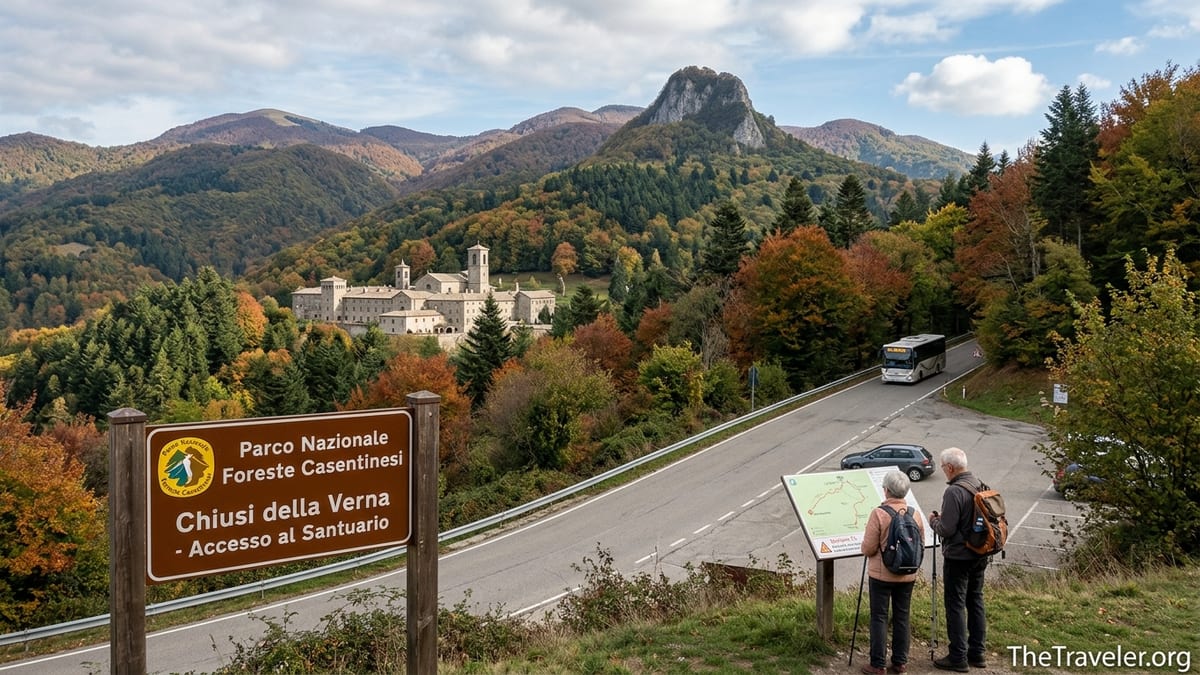
The Foreste Casentinesi National Park extends along the Tuscan-Romagnol Apennines, straddling the provincial borders of Arezzo, Forlì-Cesena and Florence. Instead of a single compact block, it is a long ridge with deeply cut valleys. On the Tuscan side the park leans over the Casentino valley and includes territories belonging to Bibbiena, Poppi, Pratovecchio Stia and Chiusi della Verna. On the Romagna side it drops towards Santa Sofia, Bagno di Romagna and Premilcuore. This elongated shape means that “going to the park from Arezzo” can mean very different journeys and landscapes.
From Arezzo the natural gateways are the Casentino towns aligned along the Arno: Subbiano, Bibbiena, Poppi, Pratovecchio and Stia. Official information from the park and local authorities highlights these centres as bases for excursions towards Chiusi della Verna, Camaldoli, Badia Prataglia and the high ridges of Monte Falterona and Monte Falco. Reaching these access towns already involves about 40 to 70 minutes of driving or train plus bus, even before you step onto a forest trail.
Because the park covers a wide area and many of the most interesting forests lie well above 1,000 metres, travellers should choose a specific access area instead of treating the park as a single, interchangeable destination. A visit based around La Verna, for example, is very different in character and logistics from one around Camaldoli or the Romagna ridges. Planning first which monastery, forest sector or village you wish to explore makes transport and itinerary design much more realistic.
The main Tuscan gateways can be summarised as follows. Bibbiena works as a hub between Arezzo, La Verna and Camaldoli. Poppi offers easy rail access and quick car links towards Camaldoli. Pratovecchio Stia is best placed for the upper Arno sources, Mt Falterona and connections over the pass to Romagna. Chiusi della Verna is an upland village directly inside the park’s forest belt, focusing on the Sanctuary and surrounding beech woods rather than on long-distance connections.
Getting from Arezzo to Bibbiena, Poppi, Pratovecchio Stia and La Verna
From Arezzo to the Casentino valley, travellers can rely on the regional railway and bus network. Rail services between Arezzo and Stia, with stops at Bibbiena, Poppi and Pratovecchio, are operated on the so-called Casentino line. Recent regional information notes that trains connect Arezzo to these towns in roughly 50 to 75 minutes, depending on intermediate stops. Schedules vary by season and day of the week, so it is essential to check current times close to your travel date using the Tuscany regional rail operator’s channels or station ticket offices.
From Bibbiena, buses climb towards Chiusi della Verna and the Sanctuary. Public-transport manuals and park documents mention a route linking Bibbiena station to La Verna via Rassina and Chitignano, with dedicated “La Verna” services. On paper, this allows a connection from a morning train from Arezzo to a bus up to the Sanctuary area. In practice, frequencies are limited and can change during school holidays or summer, so travellers should verify the relevant La Verna line and ensure that their chosen bus operates on the specific day of travel.
The Sanctuary of La Verna itself provides access advice that matches this pattern: train to Arezzo, on to Bibbiena, then a bus to Chiusi della Verna, followed by the short uphill walk from the village to the Sanctuary complex. This last stretch, roughly 30 minutes on foot, is on steep but paved lanes and paths through woodland, and counts as the “last mile” that no public bus covers. For visitors with heavy luggage or reduced mobility, arranging a local taxi in Bibbiena or Chiusi della Verna is often more practical than relying solely on scheduled services.
Driving times from Arezzo to these gateways are modest but affected by winding mountain roads. Current mapping data indicates about 45 minutes to Bibbiena on the SR 71, slightly less to Poppi, around one hour to Pratovecchio Stia, and 60 to 70 minutes to Chiusi della Verna via Bibbiena and the SP 208. These estimates assume normal conditions. In fog, rain or winter snow, driving can be significantly slower, which is important when returning from a trail in late afternoon light.
Reaching Camaldoli, Badia Prataglia and Remote Trailheads
Camaldoli sits in dense forest at roughly 800 to 850 metres above sea level, with the Hermitage higher again around 1,100 metres. Official and local tourism sources agree that the most common approach from Arezzo is by road up the Casentino valley to Bibbiena or Poppi, then along mountain roads into the park. Orientation brochures state that from Arezzo you follow the Umbro-Casentinese road to Bibbiena and Poppi, then continue towards the Mandrioli Pass and turn for Camaldoli. The total driving time from Arezzo to Camaldoli is around one hour for the 45 to 50 kilometre distance, but the final climb is narrow and sinuous.
Bus access to Camaldoli is more limited than to La Verna. The Camaldoli monastic community itself notes that travellers can reach Arezzo or Bibbiena by train and then continue by bus to Camaldoli with services operated under the Casentino network. However, these buses are infrequent, and in some periods they mainly run on school days. In practice it is possible to reach Camaldoli Monastery by public transport on specific weekdays and seasons, but not to rely on a convenient service every morning and late afternoon.
Badia Prataglia on the Tuscan side is another traditional forest village inside the park, reachable by road from Bibbiena along the Mandrioli road towards Romagna. It offers access to extensive beech forests and marked trails but has only modest public-transport connections. Regional documents on long-distance routes like the Alta Via dei Parchi describe access via combinations of regional buses and occasionally long coach lines from Forlì or Cesena on the Romagna side. From an Arezzo base, this means either long, multi-leg public journeys or driving your own car to reach the trailheads around Badia Prataglia.
The “last mile” problem is a recurring theme. Park maps and brochures show many trailheads at passes, forest roads and parking areas that do not align with bus stops. Even where a bus exists, such as between valley towns and upland villages, it may run only a handful of times per day. A traveller who takes a mid-morning bus to Camaldoli, spends four or five hours walking and visiting the monasteries, and misses the last return bus may find there is no later service and must rely on a taxi or pre-arranged transfer. When using public transport to reach remote trailheads, it is important to choose short, looped walks that return to the same access point well before the time of the last bus.
Trails, Difficulties and the Sacred Forests World Heritage
The park’s trail network is marked jointly by the Italian Alpine Club (CAI) and the park administration, using numbered routes and red-and-white waymarks. Official information emphasises that conditions can change due to landslides, fallen trees or forestry work and that hikers should always check the park’s trail-status page or contact the information office before departure. On this trail-status page, the park notes for instance that the Camaldoli to Cotozzo path, known as Sentiero 72, has had its trailhead moved in Camaldoli because of a landslide. This means that guidebook descriptions or older GPS tracks starting directly from the original point in the village may no longer match the current on-the-ground situation.
One representative route promoted by the park is the “anello di Camaldoli”, a loop beginning at the Camaldoli information point, following CAI 72 through the historic fir and beech stands to the small Cotozzo refuge, then continuing to the Sacro Eremo before descending again. The park describes this circuit as entering immediately into thick conifer forest and then climbing into beech woods around the refuge. Distances and exact ascent can vary slightly depending on the chosen variant, but a realistic description is a moderate day walk with several hundred metres of total climb and some sustained uphill sections between the monastery and the Hermitage.
Around La Verna, the park highlights a nature trail from the Sanctuary to Monte Penna. This signed “Sentiero Natura” focuses on the themes of nature, history and spirituality, traversing the plateau forests and viewpoints above the Sanctuary. The official description from the Chiusi della Verna section notes the combination of centuries-old forest, rocky cliffs and religious heritage. In practical terms, visitors can expect a relatively short loop of a few kilometres, with some steps and rocky sections but no extreme ascent, suitable for families who are used to walking on uneven paths.
The park includes part of the Sasso Fratino Reserve, which forms one component of the UNESCO World Heritage serial site of “Ancient and Primeval Beech Forests of the Carpathians and Other Regions of Europe”. The UNESCO description underlines the old-growth character of the beech woods, their high biodiversity and the absence of logging over long periods. These core zones are not crossed directly by casual hikers, but marked trails around Camaldoli, Badia Prataglia and the high ridges allow visitors to see similar mature beech stands, deadwood-rich forest structures and a layered canopy typical of near-natural woods. Interpretation panels and guided walks, especially around Camaldoli, help explain these features without encouraging visitors to leave the marked paths.
Current Trail Status, Seasons and On-the-Ground Conditions
The park’s online trail-status list is the reference for recent landslides, washed-out bridges and temporary closures. One entry specifically mentions that the Camaldoli to Cotozzo path, Sentiero 72, has had the starting point shifted within Camaldoli village because of a landslide. Other notices highlight small slips on routes like 311 and localised difficulties. As these notes are periodically updated and not all minor issues are listed, the park repeatedly recommends checking directly with the information office or visitor centres before planning group excursions.
Seasonal conditions strongly shape what is realistic. From late autumn to early spring, higher sections above 1,200 metres can hold snow and ice. Roads over the Mandrioli and Calla passes may require winter tyres or chains, and after storms, fallen branches or trees are often reported along forest roads and trails. Even in spring, paths can be muddy for long stretches, and some wooden footbridges may be slippery. Summer brings stable conditions but also afternoon thunderstorms on the ridges and considerable heat in the valley bottoms, which makes starting early from Arezzo or the Casentino towns a sensible strategy.
Outside the strictly protected core of the park, hunting is allowed in some buffer and surrounding areas during defined seasons, generally in autumn and early winter. Visitors crossing these zones should pay attention to any posted signs, wear visible clothing and stick carefully to the marked routes. Inside the national park’s integral reserves and core conservation zones, hunting is not permitted. Encounters with wildlife such as deer, wild boar, foxes and numerous bird species are common, especially at dawn and dusk. The park also has a stable wolf population, but sightings along main tourist paths are rare, and standard advice focuses on not feeding wildlife and keeping dogs under control.
Because mobile coverage is patchy in the forest interior and on some slopes, carrying offline maps on a smartphone or GPS device is particularly important. The park and local authorities produce printed maps and brochures, as seen in recent Casentino cartography and train-access leaflets, but for navigation among the dense network of tracks and forestry roads it is safer to combine these with an offline digital map and a fully charged battery pack.
One-Day and Two-Day Itineraries from Arezzo
For a realistic one-day excursion from Arezzo by public transport, La Verna is usually the most straightforward choice. A practical pattern is to take a morning train from Arezzo to Bibbiena, then a connecting bus to Chiusi della Verna or directly to the Sanctuary area, depending on the current route. After visiting the Sanctuary complex, including the basilica, chapels and cliff-edge viewpoints, visitors can walk part of the nature trail towards Monte Penna or follow short signed loops that explore the surrounding beech woods. Allow at least two to three hours on site before descending in time for an afternoon bus back to Bibbiena and on by train to Arezzo.
A one-day visit to Camaldoli without a car is possible but more constrained. In seasons when buses run from Bibbiena or Poppi to Camaldoli Monastery in the morning and return in the afternoon, a visitor can travel Arezzo to Bibbiena or Poppi by train, then take the bus up into the forest. On arrival there is usually time to visit the Monastery, the ancient pharmacy and church, and to follow the short “Sentiero Natura” described by the park, which leaves close to the village and offers an introduction to the mixed conifer and beech forest. However, hiking from the Monastery up to the Hermitage and back, plus a longer loop like the “anello di Camaldoli”, is tight if you must not miss the last bus. This scenario is better suited to visitors with a rental car.
A richer two-day itinerary can be built by combining public transport with an overnight stay in the Casentino valley. One example is to travel from Arezzo to Poppi or Bibbiena on day one, check into a local hotel or guesthouse, then continue by bus or car in the afternoon to Camaldoli for a first short forest walk and Monastery visit before returning to sleep in the valley. On day two, return to Camaldoli very early by car or morning bus, hike the loop via CAI 72 and Cotozzo refuge to the Hermitage and back, taking advantage of the cooler morning temperatures, and descend to the valley in mid-afternoon for the train to Arezzo. This structure keeps the long forest walk within a single day without the stress of connecting directly back to a city train the same evening.
A car allows additional variations. For instance, on day one you might drive from Arezzo to Chiusi della Verna, explore the Sanctuary and short woods trails, then in the late afternoon descend to Poppi for dinner and an overnight stay. On day two you can drive up to Camaldoli or Badia Prataglia early, select a medium-grade route of 10 to 12 kilometres with 500 to 700 metres of ascent from the visitor information, and finish by mid-afternoon before driving back to Arezzo. In each case, always cross-check the chosen trail’s current status, especially after storms, and adjust distances to your group’s fitness.
Accommodation, Eating and Budget Considerations
Accommodation options differ by gateway. Poppi offers hotels, agriturismi and guesthouses within walking distance of the rail station, along with several restaurants and cafes in the historic centre and near the station area. Bibbiena has a slightly more urban feel, with business hotels and local trattorie and pizzerie. These towns make convenient bases for travellers who want evening services after a day in the forest and easy morning access to trains.
Camaldoli itself has only a small number of accommodation options near the Monastery, typically a simple hotel or guesthouse and a campsite, as highlighted by regional tourism pages. At the Hermitage there is no public accommodation, so visitors either stay in the Monastery area or in the valley and treat Camaldoli as a day destination. Chiusi della Verna and its vicinity offer pilgrim guesthouses and small hotels focused on Sanctuary visitors rather than resort-style stays. Badia Prataglia provides modest hotel and guesthouse capacity, valuable as a base for serious hikers but less connected for those without cars.
For budget planning as of late 2026, publicly available examples suggest that double rooms in Bibbiena or Poppi commonly range from about 70 to 110 euros per night in mid-season, with simpler guesthouses sometimes below this and higher-end agriturismi above. In upland villages like Camaldoli or Chiusi della Verna, simple rooms in religious guesthouses or small hotels may fall in the 40 to 80 euro range per person, often including breakfast, although availability is strongly seasonal. A sit-down meal in a local trattoria in the Casentino typically costs around 18 to 30 euros per person for a main course, side and water, with additional cost for wine and dessert.
Transport costs depend on choices. A regional train ticket from Arezzo to Bibbiena or Poppi is generally in the order of a few euros one way, with bus tickets for the mountain legs adding another few euros each direction. A traveller making a day trip Arezzo – Bibbiena – La Verna and back by train plus bus should expect transport costs in the rough range of 10 to 20 euros per person, depending on ticket type and any integrated passes. Daily rates for a small rental car collected in Arezzo often begin around 50 to 70 euros in the low season before insurance and fuel, rising in high season. Parking in small Casentino towns is often free or low-cost, while at Sanctuaries like La Verna and in some forest car parks there may be modest parking fees, which should be checked locally.
Accessibility, Winter Roads and Visitor Centres versus Reality
Accessibility varies widely across the park’s attractions. The cloisters and main church at La Verna are reachable on paved paths, but short sections can be steep or stepped. Around the Sanctuary, some viewpoints require walking on rocky or rooty ground. Camaldoli Monastery sits next to a paved road and has relatively easy courtyard and church access, while the path up to the Hermitage is steep, with significant ascent on forest tracks and paths. For visitors with limited mobility, focusing on the monasteries, Sanctuary courtyards and nearby viewpoints that can be reached by car offers a rewarding yet less demanding way to experience the atmosphere of the park.
In winter and early spring, the contrast between information at valley visitor centres and conditions in the high forest can be striking. Staff in town-based information points often give an overview based on recent reports, but snowfall, ice or windthrow may change things within a day. Mountain roads like those approaching Camaldoli, Badia Prataglia and the Calla or Mandrioli passes may require winter equipment or be temporarily restricted after heavy snow. Before setting out, check both the regional road bulletins and the park office, and be prepared to change objectives if conditions worsen.
Visitor centres and information points, such as those in Camaldoli and other Casentino towns, are invaluable for updated advice on which trails are currently recommended for your fitness level and available time. They may have very recent information on a blown-down tree along a popular circular walk or a small landslide that has altered the start of a route like CAI 72. Nevertheless, the park itself stresses that “effective walkability” must be verified individually in the field, especially for group leaders, which is a reminder that all printed maps and even the latest brochures can never fully replace on-the-ground judgment.
Using offline maps in combination with this local advice bridges part of the gap. Downloading the relevant sectors of open-source or commercial topographic maps for the Foreste Casentinesi before leaving Arezzo reduces the risk of navigation errors if a waymark is missing or a forestry road junction is confusing. For families and occasional walkers, it is generally wiser to stay on well-signed “Sentiero Natura” routes around La Verna and Camaldoli rather than attempting longer ridge crossings that may involve less trodden paths and more exposure to changeable weather.
Who Needs a Car and Final Recommendations
For families and beginner hikers, the combination of train to Bibbiena or Poppi and bus to La Verna or, when available, Camaldoli allows satisfying day trips without driving. These visitors should focus on short, signed nature trails, Sanctuary and monastery visits, and perhaps a gentle picnic in the forest near official picnic areas, always checking the time of the last bus back to the valley. Choosing accommodation in Bibbiena or Poppi for one or two nights can reduce time pressure and create a more relaxed schedule.
Experienced walkers keen on longer routes with significant ascent, such as loops from Camaldoli via Cotozzo and the Hermitage, or traverses from Badia Prataglia towards the ridges, will find a car or pre-arranged private transfer almost essential. The ability to start very early, choose from multiple trailheads and adapt plans if a particular path is temporarily affected by a landslide or forestry work is much greater when you control your own transport. A rental car also opens access to the Romagna side on multi-day trips, where different trail networks and refuges complement the Tuscan gateways.
Travellers interested mainly in spiritual heritage and viewpoints, with minimal walking, can rely on a mix of public transport and occasional taxis. Visiting La Verna Sanctuary and Camaldoli Monastery on separate days, using trains and buses as far as possible and then arranging short taxi legs for the final climbs, offers atmospheric experiences without strenuous hiking. In these cases, budgeting extra for local transfers is still cheaper than hiring a car for an entire week if you only plan two or three excursions.
Ultimately, Foreste Casentinesi should be approached as a cluster of distinct destinations rather than a single “park stop”. From Arezzo, deciding whether your priority is La Verna’s cliffs, Camaldoli’s forests, the high beech ridges or a gentle village-based stay in Bibbiena or Poppi will shape every logistics choice. With realistic expectations about transport, trailheads and seasonal conditions, travellers can craft anything from a contemplative day trip to a multi-day forest immersion that does justice to one of Italy’s most atmospheric mountain parks.