


Taganana feels like the end of the world, tucked into the green ravines and wild surf of the Anaga massif at the far north of Tenerife. In reality it is closer and more accessible than many first-time visitors expect. With a little planning around roads, buses and weather, you can reach Taganana and its neighbouring coastal hamlets of Roque de las Bodegas and Almáciga without stress, whether you are based in Santa Cruz, La Laguna or in the island’s main resort areas.
Get the latest updates straight to your inbox!
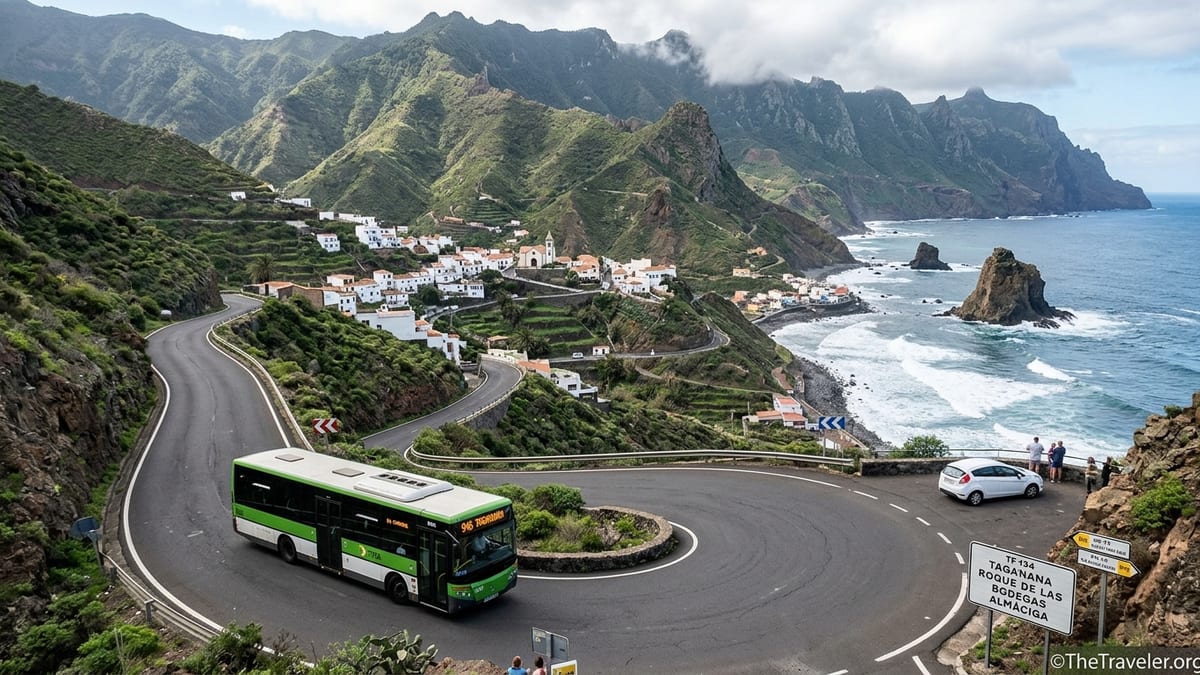
Where Taganana Is and How You Can Reach It
Taganana is a historic village on the north-facing side of the Anaga Rural Park, in the municipality of Santa Cruz de Tenerife. It sits in a steep amphitheatre of ravines that open to the Atlantic, with the small coastal settlements of Roque de las Bodegas and Almáciga spread out along the shore below. There is no flat, direct coastal highway here. Access is either across the Anaga mountain roads from the metropolitan area or by a single public bus route that threads the same ravines.
By road, the classic approach from Santa Cruz runs along the TF-11 coast road to San Andrés, then climbs into the Anaga massif on the TF-12 before dropping towards Taganana and the sea on the TF-134, which crosses a tunnel and then winds through the village and down to Roque de las Bodegas and Almáciga. Official planning documents for Anaga confirm that this TF-12 / TF-134 combination is the only road access to Taganana and these hamlets. In other words, once you commit to this route there are no alternative paved ways around the mountains, only the return the same way.
For those without a car or not keen on mountain driving, TITSA’s bus line 946 is the key public transport option. This service runs from the Santa Cruz Intercambiador and Avenida de Anaga waterfront through San Andrés, up into Anaga via the El Bailadero junction and on to Taganana, then continues down to the coastal stops at Roque de las Bodegas and Almáciga. Current stop listings and timetable PDFs published by TITSA show the route starting at the Intercambiador and ending at Almáciga, passing Taganana in both directions.
Whichever method you choose, it is important to understand that Taganana is genuinely remote in transport terms. Buses are limited rather than metro-frequent, mountain roads are narrow and exposed, and winter storms have caused temporary closures from landslides in recent years. That remoteness is part of the appeal, but it means you should take logistics seriously, particularly if you need to catch a ferry or flight later the same day.
Driving Across Anaga: What To Expect
For confident drivers, renting a car remains the most flexible way to reach Taganana from Santa Cruz or La Laguna. From central Santa Cruz, you normally follow the TF-11 along the seafront to San Andrés, then pick up the TF-12 into the Anaga Rural Park. This road climbs quickly in a series of bends, often with forested slopes on one side and steep drops on the other, before reaching the high ridge near El Bailadero. Here, the TF-134 branches off via a tunnel and then descends in tight curves to Taganana and the coast.
The character of the drive is very different from the wide dual carriageways that link Tenerife’s resorts and airports. Road-planning documents describe the TF-12 as a narrow mountain road of about five metres in width, and drivers consistently report that both TF-12 and TF-134 feel very winding, with successive hairpins, sharp blind corners and viewpoints where locals and visitors pull over. Average speeds are low even in perfect conditions. From the Santa Cruz Intercambiador to Taganana village, many visitors take between 45 and 60 minutes in normal traffic, sometimes a little more if stopping at viewpoints.
Weather can have a major impact. Anaga’s ridge often sits in cloud, and dense fog or rain can make the curves and steep drops feel intimidating. In March 2026, for example, the storm system known locally as Therese forced the temporary closure of several Anaga roads, including the TF-12 and sections of the Taganana access, due to landslides and debris. Similar closures have also been reported on the TF-134 in the past. While those specific incidents were temporary, they illustrate that roads into Anaga are vulnerable to winter storms and heavy rain. Drivers should always check same-day advisories from the Cabildo de Tenerife or TITSA before setting off, and avoid attempting the drive in heavy rain or thick fog if they are not used to mountain roads.
Practical driving advice is simple but important. Only drivers who are comfortable with narrow, winding routes should take the wheel here. Allow more time than navigation apps suggest, stay focused, avoid distractions such as admiring the view while driving, and anticipate oncoming buses or delivery vans that may need extra space in tight bends. Use signed viewpoints and wider lay-bys to stop safely for photos instead of halting in the roadway.
Parking in and around Taganana and the coast is limited. The village streets are narrow, with a mix of small parking pockets and residential access. Down at Roque de las Bodegas and Almáciga, there are small seaside parking areas and roadside pull-offs that can fill quickly on sunny weekends and holidays. It is essential to respect all traffic signs, yellow lines and residents’ garage entrances, and to be prepared to park a short walk away rather than forcing your car into a marginal gap that may block others.
Taking TITSA Bus 946: Low-Stress Access By Public Transport
For many visitors based in Santa Cruz or connected via La Laguna and the tram, the TITSA 946 bus service is the most relaxing way to reach Taganana and Anaga’s north coast. According to the current route description and stop listings from TITSA, line 946 starts at the Santa Cruz Intercambiador, opposite the main tram and interurban bus platforms, and also serves the Avenida de Anaga seafront area. From there it continues through San Andrés, crosses the Anaga ridge at the El Bailadero junction, stops in Taganana and then descends to the coastal stops at Roque de las Bodegas and the terminus at Almáciga.
Timetables published by TITSA and summarized on independent bus information sites indicate that the 946 typically offers several departures per day in each direction. On a recent weekday timetable, the pattern was roughly one bus every one and a half to two hours during the main daytime period, with fewer services early in the morning and in the evening. On Saturdays, Sundays and public holidays, there are usually fewer departures overall and longer gaps between them. Exact first and last departure times change over time and may vary by season, so visitors should always consult the current 946 timetable for their specific travel date on the TITSA website or app before planning a day in Anaga.
One of the most important points for stress-free travel is to know the last departures from the coast. Current timetables show an evening return from Almáciga and Taganana back to Santa Cruz, but not a late-night service. If you miss the last bus from Almáciga or Taganana, you may face an expensive taxi ride or a complicated wait and walk to find alternative transport. Safe planning means treating the second-to-last bus of the day as your real target and keeping the last one in reserve, especially in winter when darkness falls earlier.
Using the 946 itself is straightforward. You can pay the driver with a contactless bank card or use the island’s transport card and mobile options, and the fare from Santa Cruz to Taganana is typically only a few euros each way. The ride takes around an hour, comparable with driving but without the stress of handling the corners yourself. Seats near the middle of the bus may feel more comfortable to those prone to motion sickness, and having a small snack and water is sensible as there are no on-board services.
Taxi, Ride Services and Private Transfers
Taxis and pre-booked transfers provide a flexible option for those who want the comfort of a private vehicle without driving themselves. Official taxi tariff tables for Tenerife indicate that a trip from Santa Cruz to San Andrés has a fixed price in the mid-twenties in euros, while a pre-booked transfer price list from a local radio taxi cooperative quotes a one-way fare from the island’s main airports to Taganana at a little over fifty euros. A direct, metered journey from central Santa Cruz up to Taganana is therefore likely to fall somewhere between these levels, depending on distance, time of day and surcharges, with many recent visitors reporting approximate one-way costs in the range of 35 to 50 euros.
Using a taxi one way and the bus the other can be a good compromise, but there are some caveats. Taganana, Roque de las Bodegas and Almáciga are small communities with limited resident taxi activity, and you cannot rely on simply flagging a cab on the street, especially outside busy lunchtime periods. If you know you will want a taxi back to Santa Cruz after a coastal walk or meal, the safest approach is to pre-arrange a pickup with a radio taxi company or negotiate an agreed time and price with the driver who drops you off.
Pre-booked private transfers from resort areas in the south to Taganana do exist, usually marketed as custom excursions or hiking shuttles, and prices for these can easily reach into three figures for a return day trip because of the driving time involved. If you are staying in the south and mainly want a quick taste of Anaga’s coast rather than independent hiking, it is often simpler either to join an organised day tour that includes transport or to use the island’s fast interurban buses to reach Santa Cruz and connect there to the 946.
Organised Excursions and Guided Hikes
For nervous drivers or anyone who prefers to let someone else handle logistics, organised excursions can be an appealing solution. Several local tour operators and hiking guides offer day trips into the Anaga Rural Park that include transport from the main tourist areas, a guided walk through the laurel forest or along the coast, and often a lunch stop in a traditional village or at seaside restaurants in Taganana or Roque de las Bodegas.
Typical inclusions in these tours are return transport in a minibus or coach from either the southern resort belt or from Santa Cruz, an official mountain guide, and a set hiking route adapted to the group’s fitness level. Some itineraries focus on the high forests near Cruz del Carmen and the ridges overlooking Taganana, while others run as coastal circuits that start or end in Taganana itself and drop to the beaches at Roque de las Bodegas or Almáciga.
Departure points are almost always in the main resort areas, at hotel clusters in Costa Adeje, Playa de las Américas or Los Cristianos, or in central Santa Cruz near the Intercambiador. They are not based in Taganana itself, which remains a destination rather than a starting hub. If you are already staying in Santa Cruz or La Laguna, look for excursions that pick up in the metropolitan area to avoid backtracking to the south.
Organised excursions rarely run late into the evening. Most return to Santa Cruz or the resorts by late afternoon or early evening, which reduces the risk of missing the last public bus or driving back over the ridge in darkness. Even if you are confident about travelling independently, joining a guided day in Anaga early in your trip can be a good orientation before you return later by car or bus on your own.
Getting Around Once You Are In Taganana
Taganana itself is compact but steep. The main village lies on the slopes above the ravines, with narrow streets and stairways linking houses, church, viewpoints and the small number of bars and shops. Most visitors will explore the village and nearby viewpoints on foot, and walking shoes with good grip are recommended because surfaces can be uneven or slippery after rain.
Reaching the beaches involves additional descents and ascents. From Taganana, the road loops down to Roque de las Bodegas and then to Almáciga, and there are also marked paths that cut through ravines, such as the branches of the PR-TF 4.1 route that link the El Bailadero area, Taganana and the coast. These walks are scenic but can be steep, with sections of steps and rough trail, and are not suitable for all mobility levels. Anyone with knee issues, balance concerns or very young children should carefully consider whether a full village-to-coast hike is appropriate.
If you choose to walk along or across the road between Taganana, Roque de las Bodegas and Almáciga, be aware that there are no continuous pavements and that some stretches have minimal verge space between the asphalt and the crash barrier or slope. Visibility around bends can be limited. Reflective gear or small clip-on lights are strongly recommended if there is any chance you will be walking at dusk or after dark so that drivers and bus drivers can see you in time.
Within the coastal hamlets, services are limited. Roque de las Bodegas has a cluster of seafood restaurants facing the beach, while Almáciga is more residential and popular with surfers. There are no large supermarkets or banks. Carry enough water, sun protection and any medications you need for the day, as you cannot rely on picking them up locally, especially outside peak season or on public holidays.
Safety, Weather and Planning Essentials
Good planning is the key to enjoying Taganana and Anaga’s north coast without last-minute stress. The first step is always to check the current TITSA timetable for line 946 and any notices affecting Anaga routes on your intended travel date. Timetables and service patterns can change, and during events or construction works, TITSA has previously adjusted routes, including temporary changes to stops near Roque de las Bodegas and variations in how services connect through San Andrés.
Equally important is monitoring road conditions. The Cabildo de Tenerife and regional media regularly report on closures caused by landslides, storms or other incidents. In early 2026, the storm Therese led to the closure of the TF-12 and sections of other Anaga roads for periods while crews removed debris and stabilised slopes. Although such storms are not everyday occurrences, they underline why you should avoid planning tight same-day connections involving a drive or bus route over the Anaga ridge when severe weather is forecast.
Navigation in Anaga should not rely solely on mobile data. Signal coverage in ravines can be patchy, and GPS guidance can sometimes suggest impractical track alternatives that are not legal roads. Download offline maps in advance and, if driving, pay attention to physical road signs for Taganana, Roque de las Bodegas and Almáciga. For hikers, it is wise to carry a paper map or at least a fully charged phone with an offline hiking app and an external battery.
If you need to connect to a ferry or flight later the same day, allow generous margins. From Almáciga to Santa Cruz by bus or car, an hour is a reasonable estimate in good conditions, but you should add extra time to account for delays, slow traffic behind cautious drivers, photo stops, or minor incidents. For afternoon or evening ferries and flights, planning to be back in Santa Cruz or at your accommodation several hours ahead reduces the stress of unforeseen issues on the single access route.
Worked Example Itineraries
To make the logistics more concrete, it helps to sketch a few sample days. Exact bus times will change over time, so always substitute the actual current departures from the TITSA 946 timetable and other relevant lines for your travel date, but the structure of these example plans will remain valid.
For a car-based day trip from Santa Cruz, imagine leaving the city mid-morning after rush hour. You drive the TF-11 to San Andrés, then climb the TF-12, stopping at one of the official miradores to enjoy the laurel forest views. From the El Bailadero area, you continue on the TF-134 through the tunnel to Taganana, park respectfully in one of the marked spaces and explore the village on foot. Later you drive down to Roque de las Bodegas for lunch, perhaps continuing to Almáciga for a beach walk, before retracing the TF-134 and TF-12 in daylight back to Santa Cruz. By aiming to be on the return road at least a couple of hours before sunset, you minimise the chance of driving the most winding sections in the dark or in late-afternoon cloud.
For a full-day bus excursion using the 946, start by checking the current schedule and choosing an early-to-mid-morning departure from the Santa Cruz Intercambiador that suits you. Arrive at the station at least 15 minutes before departure to buy or top up your ticket and find the right bay. After about an hour, you can get off in Taganana to wander the village before catching a later bus down to Roque de las Bodegas or Almáciga, or you can stay on the same bus all the way to the coast and work back uphill by foot or by a later service in the opposite direction. Throughout the day, keep the printed timetable or a screenshot of the return services close at hand and plan to board a mid-afternoon bus back to Santa Cruz rather than leaving everything to the very last departure.
For those preferring an organised option, look for a guided Anaga tour departing from your accommodation area or from Santa Cruz that expressly mentions Taganana or the north coast. A typical outline might include morning pick-up in the resorts, a drive up through Anaga with stops at ridge viewpoints, a guided hike either in the forest or around Taganana’s ravines, a set lunch at a restaurant in Taganana or Roque de las Bodegas, and an afternoon return transfer. When booking, confirm that transport, guiding and lunch are included in the quoted price, check the approximate return time, and verify whether the tour runs in all weather or can be rescheduled if conditions in Anaga are unsafe.
Whichever of these styles fits you best, the same principles apply: verify the latest timetables and road conditions, allow more time than you think you need, and respect the constraints of this remote and beautiful corner of Tenerife. With that preparation, getting to Taganana and Anaga’s north coast can be part of the pleasure, not a source of stress.