


Indian Creek, in Utah’s Bears Ears National Monument, is one of the world’s great desert landscapes. It is best known for its soaring Wingate sandstone walls and flawless crack climbs, but the valley is far more than a training ground for climbers. Highway 211, the Indian Creek Scenic Byway, passes ancient petroglyphs, trailheads, side canyons and sweeping viewpoints on its way toward the Needles District of Canyonlands National Park. With a little planning, you can turn a climbing trip or day drive into a rich few days of hiking, camping and desert exploration.
Get the latest updates straight to your inbox!
Understanding Indian Creek and When to Go
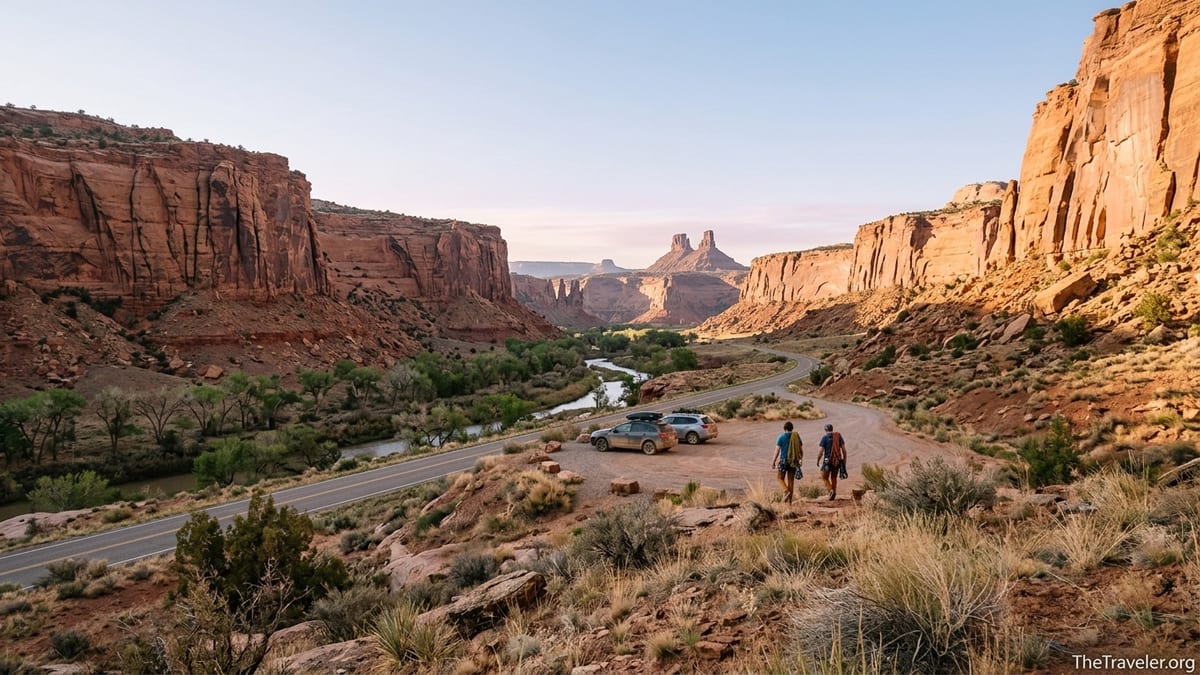
Indian Creek lies southwest of Moab and northwest of Monticello along Utah State Route 211, in the Indian Creek Unit of Bears Ears National Monument. The road follows the cottonwood-lined wash of Indian Creek, hemmed in by red sandstone cliffs that rise several hundred meters above the valley. For climbers, names like Supercrack Buttress and Battle of the Bulge are legendary, but even if you never tie into a rope, the drive out past Newspaper Rock, Bridger Jack Mesa and the distant Sixshooter Peaks is a classic Utah experience.
The desert climate shapes everything about a visit. Spring and fall are generally the most practical seasons for both rock climbing and hiking. From roughly late March through May and again from late September through early November, daytime highs often sit in a comfortable range for active days outside, while nights can still be quite cold, especially at the higher trailheads toward Canyonlands. In contrast, summer temperatures on the valley floor can regularly climb well above 90 degrees Fahrenheit, which makes long approaches in direct sun and non-stop crack climbing exhausting and risky for heat illness.
Winter can offer crisp, beautiful conditions and empty campgrounds, but storms can leave Highway 211 icy and the dirt side roads that access some crags or trailheads deeply muddy. Because the valley is at roughly 5,000 to 6,000 feet, nights in December or January often drop below freezing. Climbers who do come in winter usually plan short days on sunny south-facing walls and bring a warm sleeping bag plus a backup day to sit out poor weather. Hikers should be equally conservative about footing, since a light snow can disguise patches of black ice on slickrock.
Regardless of the month, Indian Creek is remote. The last services are in Moab or Monticello, both roughly 40 to 50 miles from the main climbing corridor. There are no fuel stations, grocery stores or gear shops in the valley itself, and mobile reception is spotty at best. The practical takeaway is to top up gas, water and food before leaving town, and to check the latest information on Bears Ears regulations and weather forecasts there rather than assuming you can look them up from camp.
Getting There, Fees and Staying in the Valley
Most travelers reach Indian Creek via U.S. Highway 191. From Moab you drive south for around 40 miles before turning west onto State Route 211; from Monticello it is roughly 14 miles north to the same junction. Shortly after the turnoff the road narrows and begins to wind along Indian Creek, with cottonwoods appearing near the first seep-fed stretches of water. Newspaper Rock State Historical Monument, one of the area’s most important rock art panels, sits beside the highway approximately 12 miles west of the junction, and from there the highway continues deeper toward the Needles District of Canyonlands.
There is no entrance station or fee checkpoint for Indian Creek itself. However, camping and some nearby destinations do have costs. Three main Bureau of Land Management campgrounds serve the Indian Creek corridor: Hamburger Rock, Superbowl and Creek Pasture. These are first come, first served and typically charge a modest per-site nightly fee, often in the range that many BLM desert campgrounds use. Each site generally includes a gravel pad, fire ring and access to vault toilets, but you should not expect potable water, showers or hookups. Bring all the water you will need or plan to drive back to Monticello or Moab to refill.
Demand peaks strongly in spring and fall, especially around long weekends when dozens of climbers converge. In October, for example, it is common for Creek Pasture and Superbowl to fill by mid-afternoon on a Friday. Because reservations are not available at these campgrounds, a practical strategy is to arrive midweek, or to come with a backup plan like dispersed camping in areas where it is legally allowed under current Bears Ears regulations. Always check updated information from land managers before relying on informal pullouts that may have been closed to protect cultural sites or vegetation.
For those who prefer more amenities, it is entirely realistic to base yourself in Monticello or Moab and day-trip to Indian Creek. Monticello offers small motels and basic groceries and is slightly closer to the climbing and hiking corridor; Moab, about an hour and a half away, has a wider range of lodging, restaurants and full-service outdoor shops that rent climbing racks, crash pads and satellite communicators. A common pattern is to spend a few nights camping in the valley, then retreat to town for a hot shower, laundry and resupply before heading back out.
Rock Climbing: What to Expect on the Creek’s Famous Cracks
Indian Creek is globally famous for pure crack climbing: laser-cut splitters in hard Wingate sandstone that swallow cams and challenge even experienced climbers. Routes like Supercrack of the Desert, Incredible Hand Crack and Scarface have appeared in films and guidebooks for decades, and entire parking lots fill with vans whose occupants have come specifically to test themselves on these lines. The style is almost entirely traditional, with climbers placing gear in parallel-sided cracks and building their own anchors, rather than clipping pre-installed bolts.
For a first visit, one of the biggest surprises is the gear requirement. Many classic lines follow uniform cracks that demand repeated cams of the same size for 30 or more meters. While a small local crag might be comfortable with a single standard rack, it is routine at Indian Creek to carry doubles, triples or more of key cam sizes. Experienced visitors often travel with armfuls of gear, for example multiple pieces from finger to hand sizes, then supplement by splitting racks within a group. If you are flying in and renting gear in Moab, factor this into your budget; renting enough protection for a week of Creek climbing can be a significant expense compared with sport climbing destinations.
The grades also demand respect. Because the climbing is very pure, a 5.10 hand crack might feel more physically intense than a mixed face-and-crack route of the same grade at home. Many experienced climbers recommend that your first few days involve climbs slightly below your usual limit while you refine jamming techniques and tape your hands properly. It is wise to bring a well-stocked kit of thin athletic tape or specialized crack gloves, since the coarse desert sandstone can quickly abrade skin.
Safety and access considerations are equally important. Approaches to buttresses such as Battle of the Bulge, Scarface or Cat Wall typically involve hiking across cryptobiotic soil and near archaeological sites. Land managers and tribal representatives repeatedly request that visitors stay on obvious paths, avoid sitting or caching gear near cultural features, and pack out all trash including tape and human waste where required. Some popular crags have designated parking and marked access trails to reduce impact; taking a few minutes to locate and follow these instead of forging your own shortcut is one of the simplest ways to protect the area and keep access open.
Hiking and Desert Exploration Beyond the Rope
Even if you never clip into a belay, Indian Creek offers worthwhile day hikes and short walks. One of the most accessible is Newspaper Rock itself, where a short paved path leads from the parking lot to a vertical panel covered in hundreds of petroglyphs carved over centuries. Visitors can stand on a viewing platform within a few meters of the rock, close enough to see spirals, riders, bighorn sheep and abstract symbols, but far enough to keep fingers and backpacks from damaging the surface. Because the walk is so short, it is an easy stop for families or anyone breaking up the drive toward Canyonlands.
For a more extended outing, the Lower Indian Creek Trail follows a bench along the creek corridor between the forested high country near the Abajo Mountains and the desert floor near Newspaper Rock. Beyond the main monument, other informal trails and social paths access side drainages and viewpoints above the climbing walls. Some travel across slickrock domes, where cairns mark the way, while others follow sandy washes lined with rabbitbrush and sage. A good example of a more committing desert hike nearby is the Chesler Park and Joint Trail loop within the Needles District of Canyonlands, which many Indian Creek visitors tackle as a rest day. That route blends sandstone spires, narrow passages and wide open grasslands in a single full day on foot.
Off-trail exploration here requires additional caution. Biological soil crusts, which appear as bumpy black patches on the ground, are living communities that help hold the desert floor together. Stepping on them can damage ecosystems that take decades to recover. A simple rule is to walk on durable surfaces such as existing trails, rock slabs or in the sandy bottoms of washes rather than cutting across open crust. Likewise, if you encounter pottery shards, corn cobs or other artifacts along a hike, the correct action is to enjoy them in place and leave them exactly as found. Taking, moving or stacking objects not only harms scientific and cultural values but can also lead to fines.
Because the valley is relatively low and exposed, hiking in Indian Creek is almost always in full sun. A three hour mid-morning stroll in April can still feel surprisingly intense without a wide-brimmed hat, high-SPF sunscreen and at least a couple of liters of water. Many visitors carry lightweight sun umbrellas or long-sleeved sun hoodies, and plan to be off the trail or back at camp for a shaded lunch before temperatures peak mid-afternoon.
Logistics: Water, Supplies, Safety and Regulations
Logistics in Indian Creek are simple but non-negotiable. There are vault toilets at established BLM campgrounds and at Newspaper Rock, but no potable water or trash collection along the highway corridor. The most practical strategy is to purchase large refillable containers in Moab or Monticello and fill them completely before heading out. Even for a weekend of climbing with two people, it is common to bring 10 or more gallons to cover drinking, cooking and basic washing, especially in warmer months.
Food planning should lean toward shelf-stable and compact items, because coolers warm quickly in parked vehicles under desert sun. Many climbers and hikers rely on simple camp meals such as couscous, instant rice mixes or tortillas with shelf-stable beans and cheese, supplemented by snacks like nuts and dried fruit while out for the day. If you plan to stay longer than four or five days, it may make sense to schedule a resupply run into town mid-trip rather than trying to cram a week’s worth of fresh food into one cooler.
Safety wise, this is classic remote desert. Emergency response times can be long, and mobile reception is patchy with frequent dead zones between the canyon walls. Carrying a paper map of the area, such as the official Bears Ears National Monument recreation map, is wise even if you normally navigate with a phone. Many groups now bring a small satellite communicator or personal locator beacon for emergencies. In practice, the most common issues are minor but trip-altering: vehicles stuck in mud after a spring storm, mild dehydration, sprained ankles on talus approaches, or lost gear. Simple steps such as checking the forecast, not driving side roads when they are saturated, and wearing supportive footwear on boulder fields prevent many problems.
Regulations continue to evolve as Bears Ears management plans develop, but a few themes are consistent. Pack out everything you bring in, including food scraps and in some zones human waste, using commercial waste bags if pit toilets are not available. Dogs are permitted in most of the Indian Creek corridor, but they must be under control, and owners should verify current rules, especially if venturing into nearby national park lands where dogs are far more restricted. Camp only in established sites where required, observe fire bans when they are in effect during dry periods, and keep vehicle travel to existing roads rather than creating new tracks across open desert.
Cultural Respect and the Context of Bears Ears
Indian Creek is not just a playground of cliffs and trails. It sits within a cultural landscape that remains deeply significant to Native American tribes, including the Navajo Nation, Hopi, Ute Mountain Ute, Ute Indian Tribe of the Uintah and Ouray Reservation, and the Pueblo of Zuni. The petroglyphs at Newspaper Rock, the remnants of dwellings tucked into alcoves above side canyons, and the scatter of grinding stones or pottery fragments all speak to many generations who lived, traveled and held ceremonies in these valleys long before they became well-known to climbers and hikers.
Bears Ears National Monument, which includes the Indian Creek Unit, was established in 2016, significantly reduced a year later, and then restored and expanded again in 2021. Ongoing planning efforts involve federal agencies working alongside a tribal commission to shape how visitors experience and impact places like Indian Creek. For travelers, this broader story matters because it underlines how fragile access can be if recreation conflicts with protection of cultural resources, and how important it is to treat every panel, alcove and midden with the same respect you would offer a historic church or cemetery.
In practical terms, cultural respect begins with where you walk and camp, and how you behave when you encounter ancient sites. Never climb on, lean against or touch rock art panels, and avoid eating lunch or setting gear down directly under them. If you find a potsherd or other artifact, photograph it if you wish, then leave it exactly where it lies. Refrain from stacking stones into new cairns or rearranging rocks in alcoves, which can obscure genuine archaeological features. At night, keep campfires modest, use existing fire rings, and be aware that loud music or shouting carries far in these open canyons.
For many visitors, learning more about the cultural context enhances their experience. Stopping at a museum or visitor center in Monticello, Blanding or Moab before or after your visit can provide background on the people who have called this region home. Some travelers choose to include a guided visit elsewhere in Bears Ears with Native-led tour operators who interpret rock art and ancestral sites, then carry that awareness with them when they later climb or hike independently in Indian Creek.
Sample 3 Day Itinerary Combining Climbing and Hiking
One way to structure a first visit is to mix world class climbing with a few carefully chosen hikes and viewpoints. On Day 1, you might leave Moab early, top off fuel and groceries, and drive Highway 191 south to the 211 junction. A first stop at Newspaper Rock serves both as a scenic break and an introduction to the region’s deep history. From there you continue west, perhaps pausing to photograph the towering Sixshooter Peaks and Bridger Jack Butte before pulling into Creek Pasture or Superbowl Campground to secure a campsite. An afternoon session at a nearby, shorter-approach crag gives everyone a chance to adjust to the crack climbing style before evening light turns the canyon walls orange.
Day 2 could start with a full morning of climbing at a classic wall such as Supercrack Buttress, choosing lines that match your group’s ability and gear. By early afternoon, as sun and fatigue build, you retreat to camp for a long lunch break and siesta in the shade of cottonwoods or a simple tarp. In the late afternoon, when temperatures drop slightly, a short exploratory walk up a side wash behind the campground or a drive to a viewpoint along the highway lets non-climbers stretch their legs and photographers chase the long shadows and saturated colors of golden hour.
For Day 3, consider a true rest day on the feet. After an early breakfast, drive the remaining miles along Highway 211 into the Needles District of Canyonlands and tackle the Chesler Park and Joint Trail loop or another moderate hike depending on permits and trail conditions. This gives a very different feel to the landscape, with mushroom-shaped spires, grassy basins and narrow slot-like passages that contrast with the more linear walls back in Indian Creek. Returning to your Indian Creek camp for a final night lets you catch desert stars in an area with relatively little light pollution, then pack up at dawn the next day for the return to town.
This simple three day pattern can be expanded or adapted easily. Dedicated climbers often build in an extra rest day for skin and muscles every three days or so, perhaps using it to explore the confluence overlook where the Green and Colorado rivers meet, or to visit a museum in Monticello or Moab. Families with younger children might reverse the emphasis, planning one short climbing session, several kid friendly hikes and plenty of downtime around camp watching lizards and ravens instead of trying to tick as many routes as possible.
The Takeaway
Visiting Indian Creek for rock climbing, hiking and desert exploration is as much about mindset as it is about logistics. The valley rewards those who prepare carefully, respect its cultural and ecological sensitivity, and then move slowly enough to notice more than just the next crack line. A balanced trip blends time on the rope with time on foot, and pairs memorable physical challenges with quiet moments staring up at petroglyphs or at a sky thick with stars.
By arriving with enough water and gear, staying on established trails, treating archaeological sites with reverence and planning your days around desert heat and changing weather, you not only protect a fragile place but also set yourself up for a more relaxed, immersive experience. Whether you come for a single day’s scenic drive or settle in for a week of climbing and hiking, Indian Creek offers a rare combination of world class adventure and deep time written into its rocks for those willing to look.
FAQ
Q1. Do I need a permit to climb in Indian Creek?
In most cases you do not need a specific climbing permit for Indian Creek itself, but permits may be required for overnight trips or certain activities in nearby Canyonlands National Park. Always confirm current regulations with land managers before your visit, since rules can change as Bears Ears planning evolves.
Q2. When is the best season to visit Indian Creek for climbing and hiking?
Spring and fall offer the most comfortable combination of temperatures and trail conditions. From roughly late March through May and late September through early November, daytime highs are usually moderate, while summer can be extremely hot and winter brings cold nights and occasional snow or ice.
Q3. Is Indian Creek suitable for beginner climbers?
Indian Creek is famous for relatively difficult, physical crack climbing, and many routes feel challenging even at moderate grades. True beginners may find it intimidating, but a motivated novice with guidance from experienced partners or a professional guide service can still enjoy a few well chosen routes, especially if expectations are flexible.
Q4. How much climbing gear should I bring for a typical trip?
Because many routes follow long, uniform cracks, it is common to need multiple cams of the same size. Experienced visitors often travel with doubles or triples in key finger to hand sizes, and share gear within a group. If you are renting gear in Moab, budget for more protection than you would use at a shorter, mixed style crag.
Q5. Are there reliable water sources in Indian Creek?
No. Apart from occasional seasonal flows in Indian Creek itself and natural springs that are not developed for visitors, you should not expect to find drinkable water. Plan to bring all water you need for drinking, cooking and basic washing from Moab, Monticello or another town before entering the valley.
Q6. Can I visit Indian Creek just for hiking and sightseeing?
Yes. Many travelers drive the Indian Creek Scenic Byway simply to see the scenery, stop at Newspaper Rock and continue into the Needles District of Canyonlands for hikes like Chesler Park. Even without climbing, the combination of rock art, side canyons and dramatic desert views makes the area worthwhile.
Q7. What are the camping options in the Indian Creek corridor?
There are several Bureau of Land Management campgrounds, including Creek Pasture, Superbowl and Hamburger Rock, which offer basic sites with vault toilets but no water. All are first come, first served and busiest on spring and fall weekends. Some dispersed camping is allowed in designated zones, subject to current Bears Ears regulations.
Q8. How should I behave around petroglyphs and archaeological sites?
Treat all rock art and ancient structures as you would a museum exhibit or sacred place. Do not touch or lean on panels, avoid eating or sitting directly beneath them, leave any artifacts exactly where you find them and never carve or add your own marks. Photograph them if you wish, but let your impact end there.
Q9. Is mobile phone coverage available in Indian Creek?
Coverage is limited and often nonexistent between the canyon walls, although you may occasionally find a weak signal near higher pullouts or along ridgelines. You should not rely on your phone for navigation or emergency communication, and many groups bring a paper map and, for added security, a satellite communicator.
Q10. Are dogs allowed in Indian Creek?
Dogs are generally allowed along much of the Indian Creek highway corridor and in BLM campgrounds, but they must be controlled and owners are responsible for waste and for avoiding cultural sites. If you plan to continue into Canyonlands National Park, be aware that dog restrictions there are much stricter, so check current rules before bringing a pet.