


The Oslo Opera House is one of Scandinavia’s most striking pieces of architecture, a shard of white stone that seems to slide straight out of the Oslofjord. For visitors, its most famous feature is the accessible rooftop, where you can walk up the sloping marble, feel the sea breeze, and look across the city skyline without buying a ticket. This guide explains exactly how to visit, how to get onto the roof, what to expect in each season, and how to combine the experience with nearby sights, food, and culture.
Get the latest updates straight to your inbox!
Understanding the Oslo Opera House and Its Rooftop
The Oslo Opera House is home to the Norwegian National Opera and Ballet, occupying a prime spot in the Bjørvika district at the head of the Oslofjord. Opened in 2008 and designed by the Norwegian firm Snøhetta, it quickly became a symbol of contemporary Oslo and a catalyst for redeveloping the old harbour into a modern waterfront neighborhood. Today, the building sits among new high-rises, the Barcode financial district, and the nearby Munch museum, making it an easy anchor point for exploring the city’s eastern waterfront.
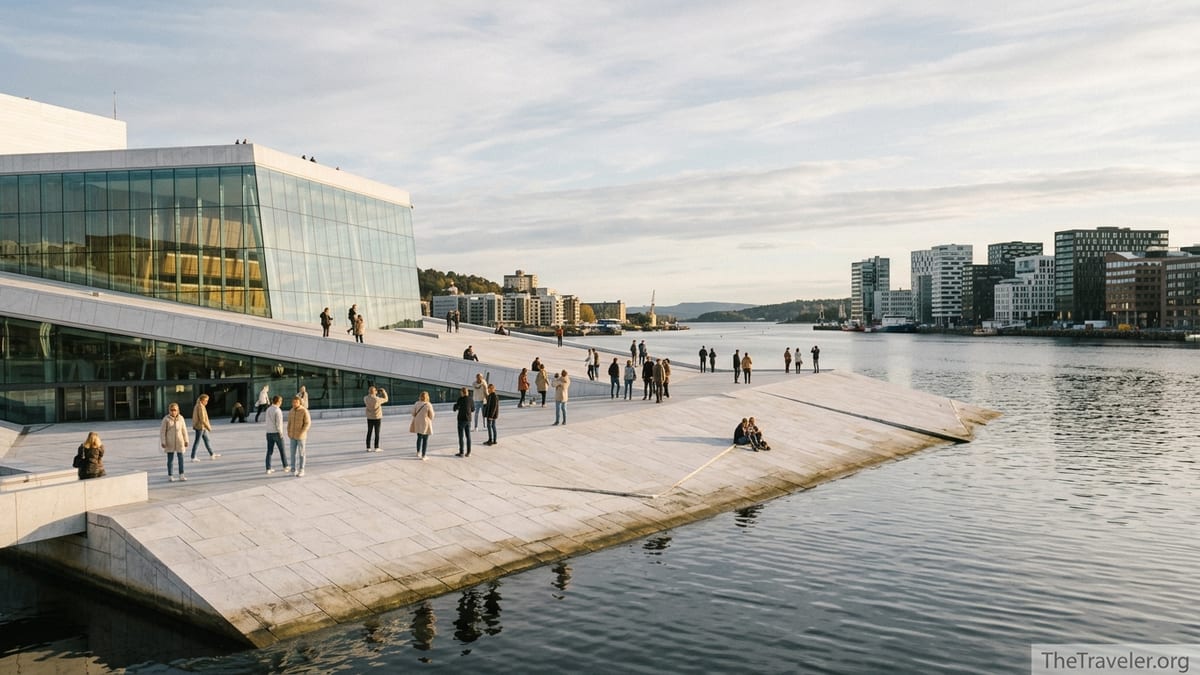
What makes the building so distinctive for travelers is its roof. Instead of walls and steps separating the public from the performance halls inside, the exterior folds gently up from the water’s edge, forming a continuous sloping surface of Italian marble and granite. This “walkable roof” is open to the public free of charge in most conditions, turning the entire building into a public plaza. Locals use it as a shortcut, a meeting point, and even a place to sit in the evening sun, while visitors come for the panoramas over the fjord and city.
Inside, the Opera House functions like a traditional cultural venue, with ticketed performances in the main auditorium and smaller spaces. But unlike many opera houses in Europe that feel formal or closed off, Oslo’s has a deliberately informal relationship with the city around it. You can visit simply to enjoy the architecture, linger in the glass-walled lobby, use the facilities, or grab a coffee, with no expectation that you will attend a performance. That flexibility makes it especially appealing to short-stay visitors and cruise passengers who may only have a few hours in Oslo.
For most travelers, the rooftop is both the highlight and the easiest way to experience the building. With no ticket checks and only a handful of clear safety barriers, it feels unusually free and accessible compared with many major attractions. That said, weather, seasonal light, and occasional closures can affect access, so it pays to understand how it works before you arrive.
Getting to the Opera House and Finding the Roof
The Opera House occupies Kirsten Flagstads Plass 1, just a short walk from Oslo Central Station, known locally as Oslo S. If you arrive by train from Oslo Airport Gardermoen, regional cities, or by metro, tram, or bus to the main Jernbanetorget hub, you are within a five to ten minute walk. From the south side of Oslo S, where the Airport Express exits, you simply follow the pedestrian route past the Thon Hotel Opera and Deichman public library toward the water and the broad plaza in front of the Opera House.
Travelers arriving from further out in the city will usually use Ruter-operated public transport: trams and buses stopping at the nearby Bjørvika stop, metro lines converging at Jernbanetorget, and local trains into Oslo S. For example, if you are staying in the popular Grünerløkka neighborhood, you might take a tram to Jernbanetorget and then walk five minutes down Dronning Eufemias gate toward the fjord. Tickets for local transport in Oslo are integrated across buses, trams, metro, and most local trains, and many visitors buy a 24-hour or 7-day pass to cover their stay.
Once you reach the Opera House plaza, finding the rooftop is straightforward. Standing on the open square facing the glass entrance, you will see broad, pale ramps of marble slanting up from each side. You can access the roof from multiple points: most visitors either walk up the main ramp that begins near the water’s edge on the east side or use the gentler incline starting near the western corner closer to the Deichman library. There are no turnstiles or checks; you simply step onto the sloping surface and begin the gentle climb.
There is no admission fee to walk on the roof, and you do not need a performance ticket. The area is generally open whenever conditions are safe, which usually means broad daytime access throughout the year and extended hours into the evening during the brighter months. In very icy or stormy weather, certain sections may be cordoned off, and access can be restricted temporarily. It is wise to plan your first visit during normal daytime hours, both because the views are better and because it is easier to see slight changes in the surface and avoid slippery patches.
What to Expect on the Rooftop: Routes, Views, and Safety
The roof unfolds in terraces and sloping planes rather than a single staircase, so you can choose your own route as you climb. Many visitors start at the fjord-facing edge, where the marble almost dips into the water, then follow the diagonal ramp toward the highest point above the main stage tower. Along the way you will cross subtle ridges, shallow steps, and changes in angle that create different vantage points for photos and people-watching.
From the higher platforms, the city panorama is impressive. Looking inland, you see the Barcode row of narrow high-rises, Oslo Central Station, and the city center climbing gently toward the Royal Palace. Turning toward the water, you look out over the Oslofjord, with ferries and small boats passing and, on clear days, the wooded islands beyond. To the east and south, you can pick out the Munch Museum’s leaning tower, the contemporary buildings of the Bjørvika and Sørenga neighborhoods, and the long promenade that locals use for evening strolls and winter sea swims.
The surface underfoot is mostly white or light grey marble, which can be smooth in some sections and slightly textured or ridged in others. In dry summer weather, standard sneakers or walking shoes are fine, and the sloping surfaces feel comfortable for most able-bodied visitors. In winter, or after rain, the stone can become slippery and patches of ice can form, especially in shaded areas. The Opera House staff sometimes rope off steeper sections or areas that have not yet been cleared, but it remains your responsibility to tread carefully.
There are low railings or glass barriers near some edges, but not everywhere, because the architecture is designed to feel open rather than fenced in. Children frequently play and run on the roof, and you will see families enjoying the space, but if you are visiting with small kids it is sensible to keep them close and avoid letting them run ahead near drops. For older travelers or anyone unsteady on slopes, it can help to stick to the gentlest ramp sections and avoid walking backward while taking photos. Simple precautions like carrying a lightweight backpack rather than loose bags and watching for slight changes in level will help you enjoy the views comfortably.
Best Times to Visit and Seasonal Conditions
Because the rooftop is a free public space without timed entry, you can choose when to visit based on light, weather, and crowd levels. In summer, from roughly late May to early September, Norway’s long days mean that the roof remains bathed in soft light late into the evening. Many visitors aim for late afternoon or early evening, around two to three hours before sunset, when the sun is lower, the marble glows warm, and the city skyline is at its most photogenic. On fine days locals come to sit on the terraces after work, so the atmosphere can be lively but rarely uncomfortably crowded.
In winter, from November through March, conditions can change quickly. Snow and ice are common, and the roof may partly resemble a gently sloping ski field. The Opera House maintenance teams work to keep key routes walkable, but you should assume that footwear with good grip is essential. Visiting in the middle of the day makes sense, both for safety and for light, as daylight hours are shorter and twilight arrives early. On very stormy days or during freezing rain, some areas may be closed for safety; in such cases, you can still enjoy the fjord views from inside the glass-fronted lobby while warming up with a hot drink.
Spring and autumn offer a quieter, often underrated experience. In April and early May, you may still find snow on distant hills while the city itself is warming up. The light can be crisp and clear, ideal for photography. September and early October bring softer light and autumn colors on the hills behind the city; on dry days, this can be one of the most pleasant times to wander across the roof without summer crowds. During shoulder seasons, layers are important, as wind from the fjord can make the exposed rooftop feel significantly cooler than the streets inland.
Time of day also shapes your experience. Early morning visits, shortly after the city wakes up, can be surprisingly quiet, especially on weekdays. You might share the roof with a few photographers and joggers, plus commuters cutting across the plaza. Late at night in midsummer, you may find small groups lingering in the pale Nordic twilight, using the sloping surfaces as informal seating while they chat. While some travelers enjoy that almost surreal light, most find that mid-morning to early evening offers the most comfortable combination of brightness, safety, and facilities.
Combining the Roof With Performances, Food, and Nearby Sights
Many visitors limit their stay to a quick walk on the rooftop, but you can easily turn the Opera House into the center of a longer outing. Inside, the lobby is open to the public, with ticket desks, a shop selling performance-related souvenirs and Norwegian design items, and seating areas where you can rest. If you are interested in seeing an opera or ballet performance, it is wise to book tickets in advance, especially for weekend evenings and popular productions; prices vary, but it is often possible to find seats in the upper tiers at more modest rates than major houses in cities like Paris or London.
Guided building tours are sometimes offered in English and Norwegian, taking you behind the scenes into rehearsal rooms, backstage corridors, and technical areas. Schedules and prices can vary by season, but expect to pay a moderate fee similar to guided tours at other major European cultural venues. For example, a visitor planning a weekend in Oslo might book a Saturday afternoon backstage tour, spend time exploring the roof afterward, then return in the evening for a performance in the main auditorium.
For food and drink, you have several options. Inside the building you will usually find a café or bar where you can order coffee, pastries, simple lunches, and drinks before performances. In recent years, a brasserie-style restaurant concept has been planned alongside an existing seafood-focused venue, reflecting the building’s waterfront setting. Menus often lean toward Nordic ingredients like local fish, shellfish, and seasonal vegetables. Prices mirror general Oslo standards, which are high by many international comparisons, so budget-conscious travelers may prefer to grab a coffee inside and then eat at more casual spots nearby.
Just a few minutes’ walk from the Opera House, you can reach the Deichman Bjørvika library, another striking contemporary building with fjord views from its upper floors, and the Munch Museum, which houses an extensive collection of works by Edvard Munch. Further along the waterfront, the Sørenga district offers a sea-pool for summer swimming and a string of cafes, pizzerias, and casual restaurants with outdoor seating in good weather. A typical afternoon might see a traveler arriving from Oslo Airport, dropping bags at a central hotel, walking to the Opera House for roof views, then continuing along the promenade to find dinner overlooking the water.
Practical Tips: Costs, Facilities, and Accessibility
From a budget perspective, the Oslo Opera House rooftop is one of the city’s best-value attractions, as access to both the plaza and the roof is free. You only pay if you choose to attend a performance, join a paid tour, or buy food, drink, or souvenirs. This is particularly attractive in a city where museum admission and casual dining can quickly add up. A typical visitor might spend nothing at all on the building itself while still enjoying an hour of architecture and views, perhaps purchasing only a coffee inside or an ice cream from a nearby kiosk in summer.
Facilities inside the building are useful even if you are not there for a show. The lobby has clean restrooms that visitors can usually use without charge, comfortable seating areas, and cloakroom facilities during performance times. In colder months, many travelers appreciate the chance to warm up indoors between rooftop photo sessions. Public drinking fountains are not as common as in some cities, so carrying a water bottle is sensible; you can refill it in your hotel or buy drinks from the café if needed.
The building was designed with accessibility in mind, though the sloping roof brings some specific considerations. Inside, there are elevators and step-free routes that serve performance spaces and public areas, so wheelchair users and those with limited mobility can access the main lobby and auditorium levels. The exterior roof surfaces include gradual ramps that many visitors with mobility aids can manage, but the marble can still be difficult in wet or icy conditions. If you use a wheelchair or have balance issues, it is worth focusing on the flattest lower sections near the plaza and avoiding steeper areas in poor weather.
Security at the Opera House tends to be discreet. There are no airport-style checks for entering the building or climbing the roof for general visits, though bag checks are possible for performances and major events. Norway is generally safe, and the area around the Opera House is busy and well-lit, but normal urban common sense still applies. Keep cameras, phones, and bags close to avoid accidental drops on the sloping surfaces, and be mindful when sitting close to ledges. Traveling light, with a small backpack rather than loose shopping bags, makes it easier to navigate the inclines comfortably.
Photography, Etiquette, and Responsible Visiting
The rooftop is one of Oslo’s most photogenic locations, so you will rarely be alone with your camera. Photography is allowed and encouraged for personal use on the roof and in the public areas of the plaza. If you plan to use tripods or do more elaborate shoots, it is considerate to keep equipment compact and avoid blocking walking routes, especially on narrow terraces. Many visitors are content with smartphone photos; others bring compact mirrorless cameras or DSLRs with wide-angle lenses to capture the sweeping geometry of the marble planes and the contrasts between glass, stone, and water.
Light plays a central role in how the building photographs. On bright days, the white surfaces can be extremely reflective, so it helps to check your camera’s exposure and avoid blowing out details in the marble. Overcast conditions can also be beautiful, giving the scene a calm, monochrome feel that emphasizes shapes and lines. In winter, a thin layer of snow can smooth some of the roof’s textures, while in summer the mixture of blue water, pale stone, and soft evening light is ideal for classic travel shots. If you are taking portraits, try positioning people along the edges of the sloping planes, with the city or fjord behind them rather than against bright sky alone.
As a shared public space, the rooftop has an informal but important etiquette. Locals often use the marble as a place to sit, sunbathe, or chat with friends, especially on warm evenings. Visitors are welcome to do the same, but it is polite to leave enough space for others to pass and to avoid spreading out across busy walkways. Eating simple snacks is generally accepted, but full-scale picnics or bringing glass bottles is discouraged due to the risk of broken glass and litter on the stone. Rubbish bins are available down on the plaza level; taking your trash with you helps preserve the clean appearance of the roof.
Noise levels are usually moderate. Groups sometimes gather on the roof before attending performances, and school trips or tours may be present during daytime hours, but the space is large enough that you can usually find a quieter corner. Music from portable speakers is uncommon and can feel intrusive, so using headphones is more in keeping with local habits. Dogs are occasionally seen on the plaza and lower ramps; if you bring a pet, keeping it leashed and under control is important, both for safety on the slopes and out of respect for others.
The Takeaway
For many travelers, the Oslo Opera House rooftop is their first real encounter with the city: a place where you can smell the sea air, understand the city’s recent architectural ambitions, and get your bearings in relation to the fjord and surrounding neighborhoods. Because it costs nothing and requires no reservations, it fits easily into almost any Oslo itinerary, from a brief layover to a multi-day urban stay. A traveler arriving on a morning flight can store luggage at Oslo Central Station, walk to the Opera House, climb the roof for panoramic views, and still have time to explore nearby museums or cafes the same afternoon.
The key to a rewarding visit lies in a few simple decisions: pick footwear suited to the season, choose a time of day with good light and comfortable temperatures, and allow yourself a little extra time beyond the quick photo stop. Pause on the terraces, watch ferries moving across the fjord, and look back at the city unfolding behind you. Whether you eventually book a ticket for an evening performance, join a guided tour, or simply treat the building as a memorable public viewpoint, the Opera House offers an unusually open invitation to experience one of Europe’s great cultural venues from the outside in.
FAQ
Q1. Do I need a ticket to walk on the Oslo Opera House roof?
In normal conditions, access to the rooftop and exterior plaza is free and unticketed. You only need tickets for performances, special events, or certain guided tours inside the building.
Q2. When is the rooftop open to visitors?
The rooftop is generally accessible throughout the day and into the evening, but specific hours are not rigidly posted and can change with weather and events. During heavy snow, ice, or strong winds, parts of the roof may be temporarily closed for safety.
Q3. How do I get to the Opera House from Oslo Central Station?
From Oslo Central Station or the Jernbanetorget transport hub, walk toward the waterfront past the Thon Hotel Opera and Deichman library. It usually takes about five to ten minutes on foot to reach the plaza in front of the Opera House.
Q4. Is the rooftop suitable for children and families?
Yes, families with children regularly visit and many kids enjoy the sloping surfaces. However, the marble can be slippery in wet or icy weather, and some edges are protected only by low barriers, so close supervision is important, especially for younger children.
Q5. What should I wear for a safe and comfortable rooftop visit?
Comfortable shoes with good grip are recommended in all seasons. In winter and during rain, footwear with traction is especially important, and windproof layers help on the exposed roof. In summer, sunglasses can be useful because the white marble reflects a lot of light.
Q6. Are there toilets, cafes, or places to sit inside?
Visitors can usually use restrooms and seating areas inside the main lobby without attending a performance. There is typically a café or bar offering drinks, snacks, and light meals, as well as a shop with souvenirs and design items.
Q7. Is the Opera House and its roof accessible for wheelchair users?
The interior of the building offers step-free access via elevators and ramps to key public areas and performance spaces. On the roof, some sloping sections are manageable for many wheelchair users, but surfaces can be challenging in poor weather, so sticking to the gentlest, flattest areas is advisable.
Q8. Can I visit the Opera House roof late at night or very early in the morning?
In summer, many people enjoy the roof in the late evening light, and it is often accessible. In winter, shorter daylight hours and icy conditions mean earlier visits are usually safer and more practical. Exact access can vary, so it is wise to observe any signage or barriers on arrival.
Q9. Are professional photo shoots or drones allowed on the roof?
Casual photography for personal use is welcome, but commercial photo shoots may require prior permission from the Opera House management. Drone use is typically restricted in central Oslo and near public buildings, so you should assume that flying drones from the roof or plaza is not allowed without specific authorization.
Q10. How long should I plan for a visit to the Opera House and its rooftop?
Most visitors spend between 30 minutes and 1.5 hours exploring the roof, taking photos, and relaxing. If you add time inside the lobby, visit a nearby museum, or attend a performance, you can easily extend your stay to half a day or more.