


Many travelers arrive in Oslo with only a few hours to spare and the same question on their mind: is the Oslo Opera House worth a stop if you are not planning to see a performance? Set on the edge of the Oslofjord with a roof you can walk up like a glacier, the building has become Norway’s most photographed piece of architecture. The good news for time-pressed or budget-conscious visitors is that almost everything that makes the Opera House special is available without buying a ticket at all.
Get the latest updates straight to your inbox!
Why the Oslo Opera House Matters, Even If You Skip the Opera
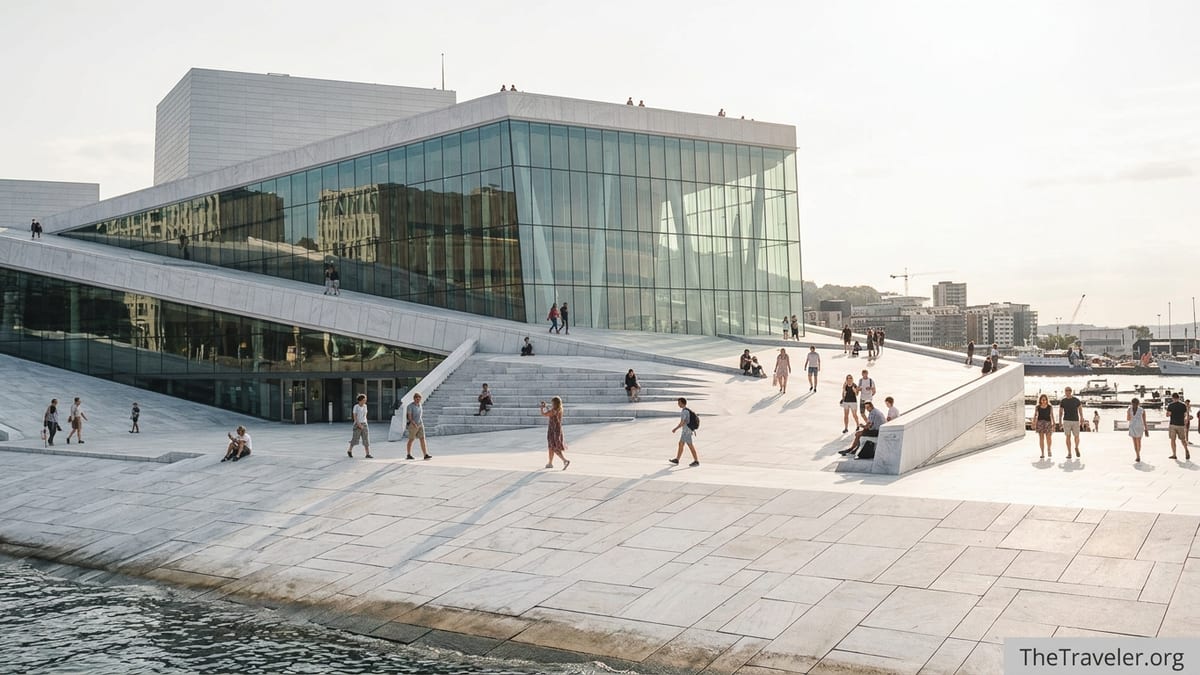
The Oslo Opera House is more than a venue for the Norwegian National Opera and Ballet. Since opening in 2008, its sloping white marble roof and glass facade have symbolized a new Oslo that faces the water rather than turning its back on the harbor. Locals use it the way they might use a central square: to meet friends, drink coffee in the sun, or sit on the steps watching ferries slide across the fjord.
For visitors, this means you do not need any cultural expertise or formal plans to enjoy it. You can walk directly from Oslo Central Station in about five minutes, step onto the angled roof, and simply explore. Travelers on tight layovers often do exactly that, pairing a stroll over the roof with a quick look inside the foyer before heading back to the train. It is one of the few major European opera houses where the most memorable experience is completely open and informal.
Architecturally, the building is a destination in its own right. Designed by the Norwegian firm Snøhetta, its angular marble planes appear to rise straight out of the water. Even if you never step into the main auditorium, understanding how this structure reshaped the Bjørvika waterfront gives context to much of modern Oslo. Many of the city’s newest landmarks, including the MUNCH museum and the Deichman main library, were built to interact visually and physically with the Opera House.
Walking the Roof: Oslo’s Free Viewpoint Over the Fjord
For most people, the highlight of a visit without tickets is walking up the roof. The entire exterior surface is treated as public space. You simply step onto the gently sloping white marble and follow the paths as they climb to a rooftop plateau around 22 meters above the water. There are no turnstiles, no entry fee, and no set route. On a clear evening in June, you might see office workers in shirtsleeves eating takeaway sushi, couples sharing a bottle of mineral water or soft drinks, and travelers taking panoramic photos of the fjord.
The views from the top are some of the best free scenery in Oslo. Look west and you see Akershus Fortress on its headland, the ferries coming and going, and the restaurants of Aker Brygge in the distance. Turn east and you face the sharp skyline of the Barcode business district and the leaning tower of the MUNCH museum. North, you get a sense of how quickly the city rises into wooded hills. For photographers, the soft evening light of late spring and summer is especially flattering, when the sun hangs low for hours and the white marble glows without being harsh.
Practically speaking, it is worth thinking about footwear and weather. The stone is textured, but in rain or snow it can still feel slippery on steeper sections. In winter, parts of the roof may be roped off if conditions are icy. If you arrive in March or November, bring a windproof layer: the waterfront can feel several degrees cooler than inland streets. Even with those caveats, the roof is open far more often than it is closed, and seeing locals walk up with baby strollers or bikes underlines how integrated it is into everyday city life.
Exploring the Interior: Foyer, Materials, and Public Spaces
Stepping inside the Opera House is also free during normal opening hours, and it offers a different kind of experience. The foyer is a tall glass box with blond-oak surfaces curving around the central performance “core.” Light pours in from the harbor side, reflecting off the marble floor. On a typical weekday morning, you might see school groups gathering near the ticket desk, tourists reading display boards about the building, and office workers using the indoor benches as an informal meeting place.
Even without a guided tour, you can appreciate the attention to materials. The floor and much of the exterior are clad in white Carrara marble, while the main interior surfaces are oak shaped into sweeping curves that feel almost like ship hulls. Small architectural details such as the perforated metal panels, the way the staircases float away from the walls, and the pattern of the ceiling lights all reward a slow wander. Architecture enthusiasts often spend an hour here, moving between viewpoints inside and out to see how the glass, stone, and wood interact with the changing light.
Visitors who travel with mobility concerns will find that the building is largely step-free on the main levels, with gentle ramps from the plaza to the entrance and elevators inside. There are quiet corners along the side windows where you can sit, warm up in winter, and simply watch harbor life unfold through the glass. Parents with young children often appreciate that this indoor space, filled with natural light, gives kids room to move without needing to purchase a ticket for a show.
Food, Coffee, and Everyday Life Around the Opera House
Part of what makes the Opera House worth a visit without a performance is the way it anchors a lively neighborhood. On the ground level you will find a cafe and often a kiosk-style spot in season selling coffee, pastries, or simple snacks. Prices are typical for central Oslo, so expect to pay the equivalent of a few euros for a coffee and more for cakes and sandwiches, but many travelers treat this as part of the experience: sipping a latte while looking straight out over the fjord from the glass wall.
Just beyond the building, the Bjørvika district offers more options. In under ten minutes on foot you can walk from the Opera House plaza to small wine bars and brasseries tucked between the Opera and MUNCH, as well as informal bakeries that serve cinnamon buns and open-faced sandwiches. Travelers with brief layovers often combine a roof walk with a quick lunch nearby, then head back to the airport train from Oslo Central Station. The compact nature of the district means you can cover waterfront views, modern architecture, and a decent meal within a two- or three-hour window.
In summer, the area transforms into one of Oslo’s most relaxed social spaces. The small “Opera Beach” and surrounding promenade attract swimmers, paddleboarders, and sunbathers. People sit along the steps at the water’s edge, some with takeaway pizza from nearby spots, others simply enjoying the long Nordic evening. You might spend your money only on a coffee or an ice cream, yet walk away feeling you have experienced a slice of local life that is hard to replicate elsewhere in the city.
How the Opera House Fits Into a Wider Oslo Itinerary
Because the Opera House sits so close to Oslo Central Station, it slots neatly into many itineraries. Travelers arriving by train from the airport often drop bags at a nearby hotel and walk straight to the roof within their first half hour in the city. If you have a full day, you can easily pair the Opera House with MUNCH, which stands just a short walk away along the harbor promenade, and the Deichman main library, another striking piece of architecture overlooking the water.
A realistic half-day plan for many visitors might look like this: start around 9 a.m. on the Opera House roof, when the light is gentle and the crowds are thin. Spend 45 minutes exploring the slopes and taking photographs, then move inside for a coffee and a look at the foyer. Around 10:30 or 11 a.m., stroll along the water to MUNCH for a few hours with Edvard Munch’s paintings and city views from its upper floors. Later, walk back through the Opera House plaza and continue along the waterfront toward Akershus Fortress and Aker Brygge for dinner. Even if you have no opera tickets, the building functions as a key anchor point in the flow of the day.
If you have only a short layover of three or four hours between trains or ferries, the Opera House still makes sense. You can walk from the station, climb the roof, linger over the view, and be back at the platforms in under an hour if needed. Families with children often appreciate that this “attraction” involves movement and fresh air rather than queuing. For many, the Opera House becomes their defining image of Oslo, precisely because it is so accessible without any advance planning.
Costs, Crowds, and When to Visit Without a Ticket
From a budget perspective, the Opera House is unusually friendly. Access to the roof, the exterior terraces, and the public foyer is free. You pay only for optional extras such as guided tours, performances, food, and drinks. For travelers watching expenses in what is generally an expensive city, this matters. It is entirely possible to get an hour or two of memorable architecture and harbor views here without spending anything at all.
Crowd levels vary by season and time of day. Summer afternoons and early evenings, especially on sunny weekends, are the busiest. Expect to share the roof with tour groups, local families, and visitors from nearby cruise ships. In contrast, early mornings and off-season weekdays can feel remarkably quiet. In January or February, you might find only a handful of people walking the roof at sunrise, with the fjord turning pink and the surrounding hills dusted with snow. Both moods have their appeal, but if you prefer photographs with fewer people, plan for early or late visits and avoid major event evenings when there are big premieres inside.
Weather is another factor. The building remains visually compelling in all conditions, but your comfort will depend on preparation. In heavy rain, many visitors limit themselves to the foyer and the lower terraces, watching patterns of droplets on the glass while boats move across the grey water. In high summer, sunscreen and sunglasses are useful; the white marble reflects light strongly, and it can feel warmer on the roof than the air temperature suggests. Dressing in layers is wise in shoulder seasons, as the waterfront breeze can shift quickly between mild and chilly.
Who Will Appreciate a Visit Without a Performance?
Not every traveler needs the same experiences, so it is worth asking who will get the most out of a performance-free visit. Architecture and design fans are obvious candidates. They will enjoy how the building plays with concepts of landscape and city, how the roof functions as an urban square, and how the interior woodwork and lighting echo Norwegian nature. Even a short stop can feel like walking through a case study in contemporary Scandinavian architecture.
Casual city trippers and families are another group that tends to love the Opera House without ever seeing a curtain rise. Children usually enjoy the simple act of climbing the roof and running along the gently sloping paths. Parents value the mix of outdoor and indoor spaces, the lack of entry fees, and the easy proximity to public transport. Couples on city breaks often find that an evening climb to watch the light fade over the fjord is both romantic and low-pressure, a good alternative to more formal attractions.
On the other hand, travelers who are indifferent to architecture or cityscapes may find a shorter visit sufficient. If your interests lean strongly toward traditional museums or hiking, you might choose to allocate more of your time to other sights after a quick rooftop walk. Yet even in those cases, the Opera House usually earns at least a brief stop, partly because it is so close to the station and partly because it offers such a strong sense of what contemporary Oslo looks and feels like.
The Takeaway
So is the Oslo Opera House worth visiting even if you never plan to see an opera or ballet there? For most travelers, the answer is yes. The building offers a rare combination of striking architecture, free access, and integration into everyday city life. Walking the roof provides some of the best open-air views of the Oslofjord and the evolving skyline, while the light-filled foyer gives an easy, weather-protected glimpse into the country’s cultural heart.
Because you can enjoy all of this without tickets, reservations, or a significant time commitment, the Opera House fits naturally into almost any visit to Oslo. Whether you have an hour between trains or a full day to wander the harbor district, it can anchor your understanding of the city’s modern identity. You may leave without hearing a single aria, but you will almost certainly leave with a clearer sense of Oslo’s relationship to its water, its landscape, and its future.
FAQ
Q1. Do I need a ticket to visit the Oslo Opera House roof?
Tickets are not required to walk on the roof or use the outdoor terraces. These areas are treated as public space, open for anyone to enjoy.
Q2. Is it free to go inside the Opera House if I am not seeing a performance?
Yes. The main foyer and entrance areas are free to enter during opening hours, so you can explore the architecture, look out at the harbor, and use the cafe without buying a performance ticket.
Q3. How much time should I plan if I am only visiting without a show?
If you are just climbing the roof and taking a quick look inside, 45 to 60 minutes is usually enough. Architecture fans or photographers may want 90 minutes or more to explore at a relaxed pace.
Q4. When is the best time of day to visit the Opera House without a ticket?
Early morning and evening tend to be quieter and offer softer light for photographs. Summer sunsets over the fjord are especially beautiful, while winter mornings can be atmospheric with snow and low sun.
Q5. Is the roof safe and accessible in bad weather?
The marble roof is textured, but it can still feel slippery in heavy rain, ice, or snow. Parts of the roof may be closed in very poor conditions. Wear good footwear and follow any barriers or signs that are in place.
Q6. Can I bring children to the Opera House even if we are not seeing a performance?
Yes. Families regularly visit just to walk the roof and enjoy the open spaces. Children usually love climbing the gentle slopes, and there are indoor areas where you can warm up or rest if the weather turns.
Q7. Are there places to eat or drink nearby if I only come for the views?
There is a cafe inside the Opera House and several restaurants, bakeries, and bars in the surrounding Bjørvika district. Many visitors combine a rooftop walk with a coffee, pastry, or casual meal by the water.
Q8. How close is the Opera House to other attractions in Oslo?
The Opera House is a short walk from Oslo Central Station and sits next to major sights such as the MUNCH museum and the Deichman main library. It also connects easily along the waterfront to Akershus Fortress and Aker Brygge.
Q9. Do I need to book a guided tour to understand the building?
Guided tours are optional extras. Most visitors are satisfied exploring independently, reading the on-site information and simply experiencing the roof, foyer, and surroundings at their own pace.
Q10. Is a visit to the Opera House still worthwhile if I am only in Oslo for a few hours?
Yes. Because it is so close to Oslo Central Station and free to access, the Opera House is one of the easiest major sights to fit into a short layover. A quick roof walk can give you memorable views and a strong first impression of the city.