


If you are planning a first Alaska cruise, one of the biggest decisions is whether to sail to Hubbard Glacier or into Glacier Bay National Park. Both offer towering walls of ice, thundering calving, and dramatic mountain backdrops, but they deliver very different on-board experiences. After reviewing scientific data, National Park Service policies, NOAA guidelines and recent 2025–2026 passenger reports, a clear pattern emerges: Glacier Bay generally provides the better overall glacier cruising day, while Hubbard Glacier delivers the single most overwhelming individual glacier face most travelers will ever see from a ship.
Get the latest updates straight to your inbox!
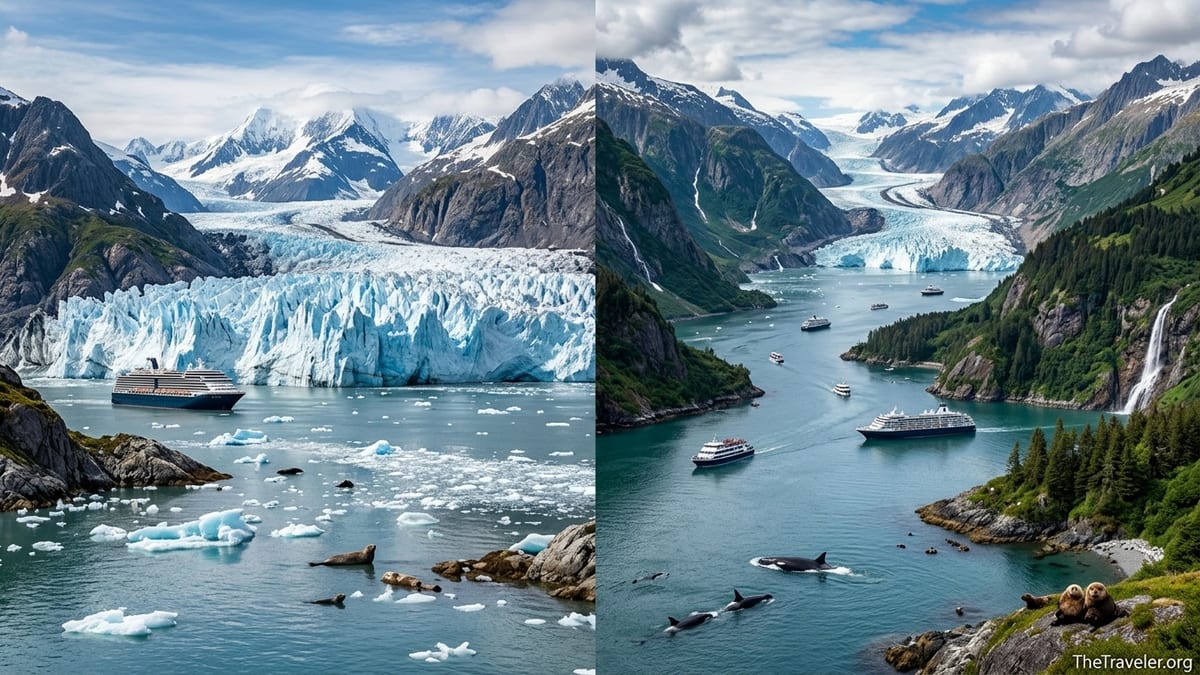
Hubbard Glacier and Glacier Bay: What They Actually Are
Hubbard Glacier is a single, massive tidewater glacier that flows more than 70 miles from the St. Elias Mountains into Disenchantment Bay near Yakutat. Glaciologists classify it as an advancing tidewater glacier, one of the few major Alaskan glaciers that has thickened and pushed forward over the past century instead of retreating. Its active calving face where cruise ships linger is roughly six miles across when measured along the irregular front, though the section most ships view head-on is narrower. From sea level, passengers see a jagged wall of blue ice rising roughly 200 to 250 feet above the water, with another similar thickness hidden below the surface.
Glacier Bay, by contrast, is not one glacier but a 65-mile-long national park fjord system with a dozen named tidewater and terrestrial glaciers, plus many more high on the surrounding peaks. The bay itself was almost completely filled with ice little more than 250 years ago, and has rapidly deglaciated, leaving dramatic valleys, hanging glaciers and open water. Margerie Glacier, Johns Hopkins Glacier and Lamplugh Glacier are among the most visited by cruise ships, with Margerie usually serving as the "hero" glacier at the head of Tarr Inlet. Margerie’s ice face is about one mile wide and roughly 250 to 350 feet high, including the submerged portion.
For travelers, this distinction matters. A Hubbard Glacier itinerary is fundamentally about one enormous ice wall in a relatively compact setting, while a Glacier Bay cruise day is about slowly moving through an evolving landscape of multiple glaciers, inlets and wildlife habitats. Understanding that difference helps set expectations: Hubbard is the show-stopper glacier; Glacier Bay is the immersive glacier ecosystem.
Scale, Ice Face, and Landscape: How Big Is Each Glacier Experience?
When cruise brochures talk about Hubbard’s size, they often highlight its enormous width and length. Scientific mapping shows a calving front that sweeps in a rough arc across Disenchantment Bay, with different studies and satellite measurements giving face widths in the range of several miles. Passengers rarely see that entire arc at once, but even a segment of the wall can fill the ship’s bow view from side to side. The ice here is heavily crevassed and frequently sheds house-sized chunks with rifle-crack sounds that echo off the surrounding peaks, especially in late spring and summer.
Margerie Glacier in Glacier Bay, while significantly smaller in width at about one mile across, still feels imposing. The visible height of its vertical face is similar to what you see at Hubbard, often described as a 200-plus-foot wall of ice above the waterline, with dark bands of rock and older ice marking its history. Because of a deep underwater drop-off at the terminus, ships can legally approach quite close, leading some passengers to feel Margerie seems nearly as large as Hubbard when you are right in front of it, even though the overall glacier is not as expansive.
The overall landscape scale is very different. At Hubbard, the glacier dominates most of your field of vision once the ship is positioned. In Glacier Bay, the glaciers share the stage with steep forested slopes, hanging valleys, waterfalls and distant snowfields. On a typical Glacier Bay day, you might start the morning passing retreating glaciers and recently exposed hillsides, then spend mid-day at Margerie, and possibly include a distant view of Johns Hopkins Glacier depending on seasonal restrictions. The sense is less about one overwhelming wall of ice and more about watching an entire glaciated world unfold.
Recent 2025 and 2026 passenger reports echo this contrast. Travelers who favor sheer spectacle often describe Hubbard as the more jaw-dropping single glacier, while those who value variety consistently rate Glacier Bay as the richer, more layered experience.
What the Cruise Day Feels Like On Board
One of the most practical differences for travelers is the length and structure of the scenic cruising day. Cruise-ship environmental monitoring data and park schedules show that ships entering Glacier Bay generally spend about 9 to 10 hours within the park boundary. Many itineraries list an early-morning arrival around 6 to 7 a.m., a mid-morning transit up the bay, several hours near Margerie and nearby glaciers, and an afternoon return toward Icy Strait. The ship is rarely stationary for long; instead, you enjoy an all-day moving panorama from multiple sides of the vessel.
Hubbard Glacier visits are usually shorter. Lines such as Celebrity, Royal Caribbean, Norwegian and Carnival typically show a half-day scenic call in Yakutat Bay and Disenchantment Bay. Based on current 2025–2026 schedules and passenger accounts, ships might enter the bay by mid-morning, spend one to three hours maneuvering near the face, and then depart back into the Gulf of Alaska. There is less variety in scenery once you reach the head of the bay, but much more focus on the main glacier itself.
Both destinations involve the bridge team slowly rotating the ship to give each side balcony and open deck time directly facing the ice. At Hubbard, captains may perform several slow 360-degree turns if ice, visibility and schedule allow, which lets you photograph different angles of the face and listen for calving. In Glacier Bay, rotations often occur at Margerie and occasionally near Johns Hopkins when conditions permit entry into that inlet. The long transit times in Glacier Bay also give ample opportunities to move between forward observation lounges, promenade decks and your own balcony.
Photography opportunities differ slightly. Hubbard often rewards telephoto lenses for capturing dramatic calving eruptions, seracs and blue crevasses in detail, while Glacier Bay benefits from both wide-angle shots of sweeping valleys and medium zooms for glaciers and wildlife. Many 2025–2026 travelers note that they took more varied photos in Glacier Bay, but their single most dramatic calving images came from Hubbard.
Wildlife Encounters and Conservation Constraints
Both Glacier Bay and Hubbard Glacier regions are rich marine and coastal ecosystems, but the type and likelihood of sightings vary. Humpback whales, sea otters, harbor seals, porpoises and seabirds such as puffins and kittiwakes are possible in either area. Bears and mountain goats are occasionally seen along shorelines and cliffs, particularly in Glacier Bay where the ship spends many hours close to land. Passengers’ 2025 and 2026 trip reports often mention humpbacks on the approach to Glacier Bay, rafts of sea otters near the mouth of the bay, and harbor seals hauled out on ice near Johns Hopkins and Margerie.
No wildlife sighting is guaranteed, but Glacier Bay generally offers more time in protected waters surrounded by varied coastline, and therefore more windows to spot animals. The National Park Service notes that Johns Hopkins Inlet is an important harbor seal pupping area in early summer, and often restricts large-vessel access during that period to reduce disturbance. In practice, this means that in May and June ships may not travel all the way into the inlet, trading a closer view of Johns Hopkins Glacier for seal protection.
Disenchantment Bay, where Hubbard Glacier meets the sea, is also a significant harbor seal habitat. NOAA Fisheries has spent decades studying how seals respond to vessel traffic in this area and has issued voluntary guidelines to reduce disturbance. Updated brochures and a 2025 reminder campaign advise all vessels, including cruise ships, to remain more than 1.5 miles from Hubbard’s face between May 15 and June 30 to protect mothers and pups on ice floes. They also recommend slow, predictable approaches and avoidance of sudden course changes that might startle resting seals.
For travelers, these guidelines have two consequences. First, ships may hold farther from Hubbard’s face in late May and June than in July or August, which can slightly reduce the sense of towering scale compared with close approaches earlier or later in the season. Second, you might see more seals spread across the ice field in front of the glacier, even if the glacier itself feels a bit more distant. This trade-off between close-up ice and wildlife protection is central to modern Hubbard itineraries and worth understanding before you book.
Ranger Programs, Permits and Onboard Interpretation
Glacier Bay is a U.S. national park and UNESCO World Heritage Site, and that status profoundly shapes the visitor experience. The National Park Service strictly limits the number of large cruise ships allowed into Glacier Bay each day, currently capped at two ships per summer day for the main cruise season. Permits are awarded to select cruise lines several years in advance, and each permitted visit follows an agreed route and operating conditions. This scarcity is one reason Glacier Bay itineraries can sometimes cost slightly more or sell out earlier than similar-length cruises visiting only other glacier areas.
On a Glacier Bay day, National Park Service rangers and often a Huna Tlingit cultural interpreter board the ship early in the morning, usually by pilot boat near the park entrance. Throughout the day they provide commentary over the public address system and host talks, Q&A sessions and junior ranger programs at an onboard desk or theater. Topics range from glaciology and climate change to Tlingit history and the bay’s rapid ecological transformation since the 18th century. Many families and first-time visitors later describe this interpretive layer as a highlight that helped them understand what they were seeing beyond the simple “big ice wall” impression.
Hubbard Glacier, by comparison, is not governed by a single on-board ranger program. Interpretation depends entirely on the cruise line and ship. Some companies, such as Holland America and Princess on their Gulf of Alaska runs, often carry onboard naturalists who provide commentary during the approach to Hubbard, explain NOAA harbor seal guidelines and point out geological features. Others rely on the cruise director’s staff or pre-recorded narration that focuses more on scenery than science. This can still be informative, but it generally lacks the depth and national park perspective you receive in Glacier Bay.
For travelers who value learning as much as sightseeing, Glacier Bay has a clear edge. If you are traveling with children who enjoy collecting junior ranger badges, or adults who appreciate context about Indigenous history and conservation, the in-person ranger presence adds tangible value to that cruise day.
Weather, Ice Conditions and Approach Limitations
Alaska’s coastal weather always introduces uncertainty, but the two destinations carry different risk profiles. Hubbard Glacier’s setting on the open Gulf of Alaska side makes it more exposed to ocean swells, fog banks and drifting ice. Scientific studies of Disenchantment Bay emphasize how rapidly ice coverage can shift with wind and tide, occasionally forcing ships to hold farther back from the face or, in rare cases, skip the final approach entirely if the captain judges it unsafe. In 2025 passenger reports, there were several accounts of ships turning around one to two miles short of the usual viewing spot due to dense brash ice, leaving guests with more distant views than they expected.
Glacier Bay, while hardly immune to rain or low clouds, is a sheltered fjord complex. Once inside Icy Strait and the park entrance, seas are usually calmer than on the open Gulf. Heavy fog can still obscure views at any time of year, and glaciers like Margerie can disappear into low cloud layers, but complete cancellations of Glacier Bay scenic days due to ice blockage are uncommon. Instead, the more typical compromise is that the ship might not be able to enter side inlets such as Johns Hopkins during early summer seal pupping season or if there is too much floating ice.
Both destinations are influenced by seasonal light and temperature. In May and early June, sun angles can paint the ice in soft pastel tones, and there may still be snow at lower elevations on surrounding mountains. July and August often bring more haze, more calving at some glaciers as air and water warm, and potentially busier ship schedules. September can be moodier, with more frequent rain but fewer crowds and a chance at crisp clear days. Passenger accounts from 2025 and 2026 show spectacular conditions and disappointing fog at both Glacier Bay and Hubbard in all these months, reinforcing that there is no “guaranteed clear” window.
When evaluating risk, it is fair to say that Hubbard carries a slightly higher chance that ice conditions will keep you at more of a distance from the glacier face, particularly in late spring when harbor seal guidelines and lingering winter ice overlap. Glacier Bay carries a slightly higher chance of overcast or rainy hours simply because you are there longer, but a lower chance of the entire experience being significantly curtailed by ice.
Cruise Lines, Itineraries and Value, Including Combined Visits
Because Glacier Bay access is limited by permit, only certain cruise lines and ships can visit in a given season. As of the 2025 and 2026 schedules, Holland America Line and Princess Cruises hold multiple Glacier Bay permits and feature the park on many of their 7-day one-way and roundtrip sailings from Vancouver, Seattle and Whittier. Some Norwegian Cruise Line and Cunard sailings also include Glacier Bay on select dates, while other major brands, including Royal Caribbean, Celebrity and Carnival, more often feature Hubbard Glacier or Endicott Arm instead.
Hubbard Glacier is a common highlight on Gulf of Alaska itineraries that sail between Vancouver or Seattle and Seward or Whittier. Celebrity’s northbound and southbound voyages, for instance, frequently list a “Hubbard Glacier scenic cruising” day. Norwegian and Royal Caribbean do the same on some 7- and 9-night runs. Because Hubbard is not capacity-constrained by a national park permit system in the same way, it appears on a broader range of itineraries, including some slightly lower-priced sailings compared with peak-season Glacier Bay cruises.
A small subset of longer itineraries, typically 10 nights or more, visit both Glacier Bay and Hubbard Glacier on the same trip. Recent examples include certain 10-day roundtrip Seattle sailings on Cunard and some extended Holland America voyages. Passengers reporting on these dual-glacier cruises in 2025 and 2026 often describe them as “the best of both worlds,” but it is important to note that these sailings usually command a premium fare and require more vacation time. For many first-time visitors with only seven days available, choosing one marquee glacier day and pairing it with strong port calls like Juneau, Skagway and Ketchikan is a more realistic and still satisfying plan.
In terms of value, Glacier Bay itineraries sometimes cost a bit more per night when comparing similar ships and cabin types, reflecting both demand and permit scarcity. However, the difference is not always large, especially on shoulder-season departures in May or September. Trip reports from 2025 include several travelers who deliberately chose a slightly older ship or less flashy onboard amenities in order to secure Glacier Bay access, and most later said they did not regret the trade.
Side by Side: How Hubbard Glacier and Glacier Bay Compare
For travelers weighing two specific cruises, it can help to see the differences condensed. While exact numbers vary by line and date, the following general comparison reflects current patterns:
Scenic cruising duration: Glacier Bay usually provides about 9 to 10 hours inside the park, much of it within sight of shore and multiple glaciers. Hubbard Glacier visits tend to offer a shorter window, around 2 to 4 hours focused on the single glacier and its approach.
Glacier size and scale: Hubbard Glacier is larger overall, with a calving front that extends several miles and a long, advancing tongue reaching deep into the mountains. Margerie Glacier in Glacier Bay is roughly one mile wide at its face, but the park features numerous other glaciers visible during the day, creating a broader sense of a glaciated landscape.
Wildlife potential and close-up viewing: Both destinations offer chances to see humpbacks, harbor seals, otters and seabirds. Glacier Bay generally provides more varied wildlife and shoreline viewing thanks to its long, protected transit. Close-up views of ice are excellent at both; Hubbard’s wall can feel higher and more imposing when the ship can approach closely, while Margerie allows very near approaches due to deep water at its base, and smaller tour boats in Glacier Bay can at times get even closer.
Calving, weather risks and onboard education: Travelers frequently report more frequent and dramatic calving at Hubbard on active days, though Margerie can also put on an impressive show. Hubbard carries slightly higher risks from dense ice and fog that may limit approach, whereas Glacier Bay’s main variables involve cloud cover and occasional restrictions on side inlets for wildlife protection. Glacier Bay stands out for in-depth ranger-led interpretation, while Hubbard’s educational quality depends on the cruise line’s own naturalist programming.
Recommendations for Different Types of Travelers
For first-time Alaska visitors choosing a single 7-night cruise, Glacier Bay is usually the stronger all-around choice. You spend an entire day in protected scenic waters, see multiple glaciers and evolving landscapes, and benefit from onboard rangers and cultural interpreters who put everything into context. This depth means that even if clouds hide part of one glacier, you still have hours of scenery and wildlife chances. Many 2025 and 2026 reviewers who experienced both now say that, if they had to pick only one for a first trip, they would lean toward Glacier Bay for its overall richness.
Glacier photography enthusiasts, especially those with telephoto lenses and a passion for capturing dramatic calving shots, might tilt toward Hubbard. The massive face, intricate ice patterns and frequent calving events can produce stunning images when visibility is good and the ship can approach closely. However, photographers who prefer variety and landscape compositions may still favor Glacier Bay, where you can capture sequences of different glaciers, wide fjord vistas and layered mountain backdrops all in one day.
Wildlife watchers who place animal encounters at the top of their wish list will often get more sustained opportunities in Glacier Bay, simply because the ship spends so many hours in relatively calm, wildlife-rich waters. The likelihood of seeing harbor seals on ice, distant bears on shore, and a mix of seabirds is generally higher when you are in the park all day. That said, some of the best humpback whale viewing on recent cruises has occurred in Icy Strait and the broader Inside Passage outside both Hubbard and Glacier Bay, so it is important to remember that many wildlife highlights happen on port days and approaches rather than at the glaciers alone.
Families and multi-generational groups often appreciate Glacier Bay’s structured programs. Junior ranger activities, talks suitable for school-aged children and clear narration that explains what you are seeing can keep everyone engaged, even on a chilly or rainy day. Hubbard Glacier days can be equally exciting, especially when calving is active, but the experience is more self-directed. For families traveling with mobility limitations, Glacier Bay’s long day also gives more flexibility to move between lounges and decks at an easy pace.
Repeat cruisers and those planning longer itineraries may deliberately choose Hubbard Glacier to complement a previous Glacier Bay visit. Travelers who saw Glacier Bay on a first 7-night cruise often look for a second trip that adds Hubbard, College Fjord or Dawes Glacier for contrast. In this context, Hubbard’s singular spectacle becomes a memorable counterpoint to the national park day they already know. For travelers limited to exactly seven days and deciding between two otherwise similar itineraries, giving priority to Glacier Bay still makes sense for most, unless the Hubbard sailing has clearly superior ports, pricing or travel dates for your situation.
Key FAQs: Which Is More Impressive, and Can You Do Both?
Is Hubbard Glacier or Glacier Bay more impressive overall? The consensus from recent scientific descriptions and 2025–2026 traveler feedback is that Hubbard Glacier is the more imposing individual glacier, with a wider, more massive face and often louder calving. Glacier Bay, however, is widely regarded as the more impressive overall day at sea, thanks to its multiple glaciers, varied landscapes and rich interpretation. If your dream is standing in front of the single biggest wall of ice possible from a large ship, Hubbard has the edge. If your dream is an all-day immersion into a glacial national park, Glacier Bay usually wins.
Can you visit both Hubbard Glacier and Glacier Bay on the same cruise? Yes, but only on a limited number of longer itineraries, typically 10 nights or more and often on select lines such as Holland America or Cunard in recent seasons. These sailings can be excellent choices for travelers with ample time and budget who want to compare the two experiences back-to-back. For most first-time visitors with one week available, it is more practical to pick one marquee glacier and potentially add a separate small-boat glacier excursion from Juneau, Seward or Whittier to increase your time with ice.
Which destination has more glaciers? Glacier Bay by a large margin. The park encompasses numerous named tidewater glaciers, plus many hanging and alpine glaciers visible from the ship during the long transit. Hubbard Glacier itineraries focus on a single main glacier, though the surrounding region also contains other icefields and glaciers that are not usually the focus of the cruise day.
Is Glacier Bay worth prioritizing when choosing a ship? For most travelers who care deeply about glacier scenery, wildlife and learning, the answer is yes. Glacier Bay access is limited, highly sought after and supported by robust ranger and cultural programs. If you are choosing between two comparable ships and one has Glacier Bay on the itinerary while the other does not, it is reasonable to give extra weight to the Glacier Bay option, particularly for a first Alaska cruise. The main reasons to choose a Hubbard-focused itinerary instead are if it offers significantly better dates, ports, pricing, or the chance to add land tours in interior Alaska that matter more to your trip.
Ultimately, there is no wrong decision. Travelers returning from both routes in 2025 and 2026 consistently emphasize that any day spent among Alaska’s tidewater glaciers feels extraordinary. Understanding the real differences between Hubbard Glacier and Glacier Bay simply helps you choose the version of extraordinary that best matches your priorities for this particular cruise.