


More news on this day
British travellers heading to or through the United States are being warned to expect major disruption after the US Federal Aviation Administration imposed a rare nationwide ground stop on all flights, citing “extraordinary circumstances” and sparking hours of chaos across global aviation networks.
Get the latest news straight to your inbox!
US ground stop triggers hours of disruption
The Federal Aviation Administration ordered all departures from US airports to be halted on Friday 13 November 2026 after communications systems at key air traffic control centres were hit by a significant outage. Publicly available flight tracking data and media coverage indicate that the order took effect in the late afternoon Eastern time and remained in place for around five hours, grounding nearly all aircraft scheduled to take off during that period.
The FAA described the move as being due to “extraordinary circumstances and for reasons of safety”, language that was repeated in messages circulated to airlines and pilots. According to aviation data cited in multiple reports, more than 30,000 departures and arrivals were scheduled for the remainder of the day, with well over one million passengers expected to be affected as delays and cancellations rippled through the system.
The nationwide halt is being widely described as the most significant interruption to US air travel since the aftermath of the 11 September 2001 attacks. Historical records show that only two comparable nationwide ground stops have been imposed in recent decades, one following those attacks and another in January 2023 during an outage of the FAA’s Notice to Air Missions system, which also briefly paused all domestic departures.
Initial indications from US agencies point to a telecommunications or data overload problem affecting communications between regional Air Route Traffic Control Centers and aircraft, rather than a deliberate attack. Public statements from senior US officials so far suggest there is no evidence of a cyber incident or wider security threat, although detailed technical investigations are expected to take days or weeks.
UK issues advisory as knock-on effects reach British travellers
The UK government’s official foreign travel advice for the United States was updated on Friday to highlight the disruption. The guidance notes that the FAA has ordered a nationwide grounding of flights at all US airports and warns travellers to expect delays and possible cancellations, advising them to check for messages from their airline and to contact their travel insurance provider about any changes to plans.
British media reports indicate that airlines operating between the UK and US moved quickly to adjust schedules. British Airways cancelled at least one evening departure from London Heathrow to New York that had been due to leave at 22:30, while services already in the air continued to their destinations but in some cases faced extended holding and delays on arrival. Virgin Atlantic stated that it was aware of the US ground stop and that flights departing the United States could be delayed while air traffic control issues were resolved.
Airports across the UK, including London Heathrow and Manchester, reported potential disruption to transatlantic services on Friday night and into Saturday 14 November. Statements from Manchester Airport referenced three Saturday morning flights to the US, all operated by Virgin Atlantic, which could face delays depending on how quickly US operations stabilise.
UK airport operations and domestic airspace remain unaffected, as the technical fault is confined to US systems. However, because the United States is a central hub for transatlantic and onward connections, cancellations and missed connections are likely to impact British travellers well beyond those on direct US routes.
What the ground stop means for current and upcoming journeys
While the FAA has now lifted the ground stop and gradually reopened US airspace to departing aircraft, published coverage from US outlets indicates that thousands of flights were delayed or cancelled on Friday, with disruption expected to continue over the weekend as airlines attempt to reposition aircraft and crews. Aviation experts quoted in open reporting warn that it could take at least several days for schedules to fully normalise.
For British travellers due to fly to, from or via the United States, airlines are urging passengers to monitor apps and email notifications closely and to verify the status of flights before travelling to the airport. Some long-haul departures from Europe and other regions were held at origin airports while the situation unfolded, while others continued to operate but faced uncertainty over available gates and connections on arrival in the US.
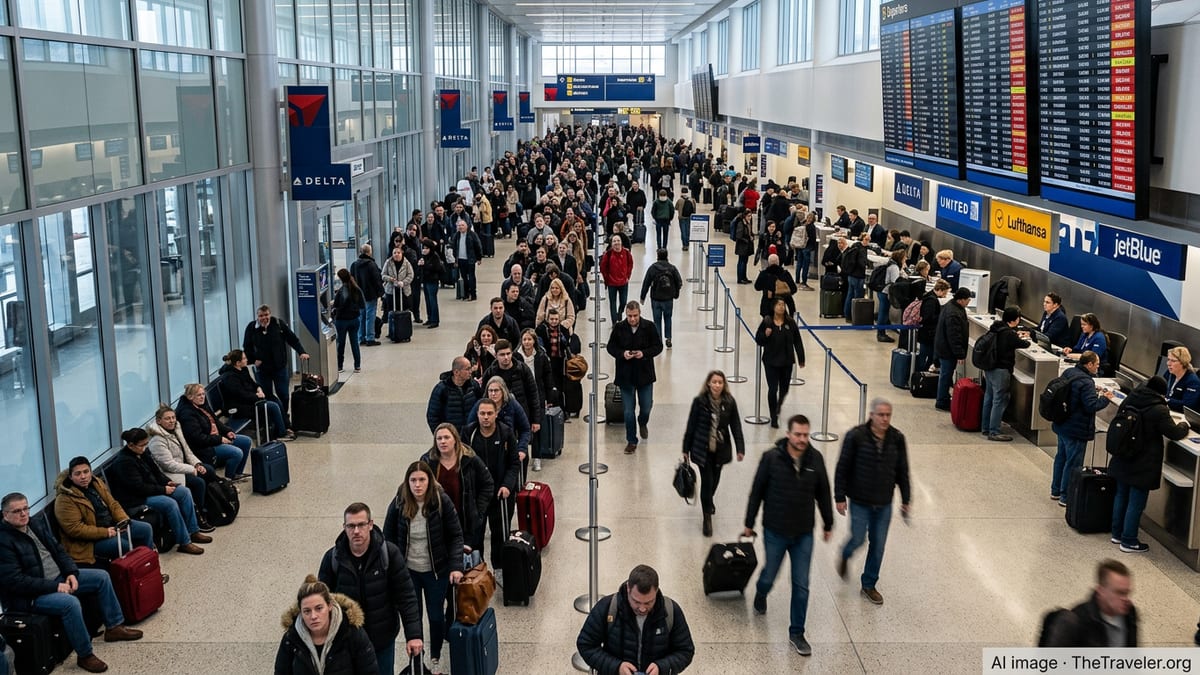
Passengers currently in the United States and waiting to return to the UK are among those most immediately affected. Crowded departure halls, long queues at airline service desks and limited hotel availability near major US hubs have been reported as airlines work through backlogs. Where flights have been cancelled, carriers are offering rebooking on the next available services or refunds, in line with their published policies.
Travellers with complex itineraries involving US domestic connections or onward flights to Latin America and the Caribbean may experience additional difficulties as missed connections cascade through multi-leg journeys. Travel agents and corporate travel managers are advising customers to keep receipts for meals, accommodation and ground transport in case these can be reclaimed through insurance or, where applicable, compensation schemes.
Guidance on passenger rights and compensation for Brits
Consumer protections for British passengers affected by the US ground stop depend on where their journey starts, which airline operates the flight and which legal regime applies. Guidance from the UK Civil Aviation Authority on similar air traffic control incidents explains that large-scale technical failures are usually classed as “extraordinary circumstances”, which can limit cash compensation under UK or EU rules. However, airlines may still be responsible for providing care such as meals and hotel accommodation when flights are significantly delayed or cancelled.
Under UK law, often referred to as UK261, travellers departing from a UK airport on any airline, or flying to the UK on a UK or EU carrier, can be entitled to assistance when flights are disrupted. In previous cases involving air traffic control failures, the CAA has indicated that while airlines might not owe fixed compensation, they should still arrange reasonable support and rerouting at the earliest opportunity. Travellers should check the specific conditions of carriage for their airline and retain documentation relating to extra expenses.
For flights originating in the United States or operated by US carriers, different rules apply. US regulations focus primarily on refunds when a flight is cancelled or significantly changed, along with the terms set out in each airline’s customer service plan. These documents, which are publicly available on airline websites, set out what passengers can expect in terms of rebooking, meal vouchers and hotel stays in the case of major operational disruptions.
Travel insurance can play an important role in closing gaps between legal entitlements and actual costs. The updated UK travel advice for the US urges travellers to check that their policy covers travel disruption, additional accommodation and missed connections arising from events such as air traffic control outages. Policy wordings vary and may treat technical failures differently from severe weather or industrial action, so passengers are being encouraged to read terms carefully or contact their insurer for clarification.
How long the fallout could last and what travellers should do next
US transportation officials have indicated that they expect core systems to be operating normally in time for the upcoming Thanksgiving travel peak, but acknowledge that the immediate fallout will be felt for several days as airlines clear backlogs and reposition aircraft. The complexity of the US network, with thousands of daily departures and interlinked hub operations, means that even a few hours of halted departures can create lingering operational challenges.
For British travellers scheduled to depart for the United States over the coming weekend and early next week, industry experts recommend assuming that flights will operate unless advised otherwise, while building in extra time at the airport and preparing for potential last minute schedule changes. Those with flexible plans may wish to consider voluntary rebooking where airlines allow it without fees, particularly if travelling for discretionary leisure rather than fixed events.
Travellers already in the US who face cancelled flights are being encouraged by airlines, travel companies and official advisories to make use of digital self-service tools where possible, as call centres are likely to remain busy. Rebooking through airline apps or websites can often secure alternative options more quickly than queuing at airport desks, especially when large numbers of passengers are affected at once.
With investigations into the exact technical cause of the outage still under way, both UK and US authorities are expected to face renewed scrutiny over the resilience of critical aviation systems. For now, the immediate priority for British travellers is to stay informed, keep documentation of any disruption and remain in close contact with airlines, travel agents and insurers as the transatlantic network gradually recovers.