


More news on this day
Passengers flying to and through Dubai face another unsettled weekend as airlines extend suspensions, selectively restore routes and warn that schedules across the Middle East remain vulnerable to sudden change.
Get the latest news straight to your inbox!
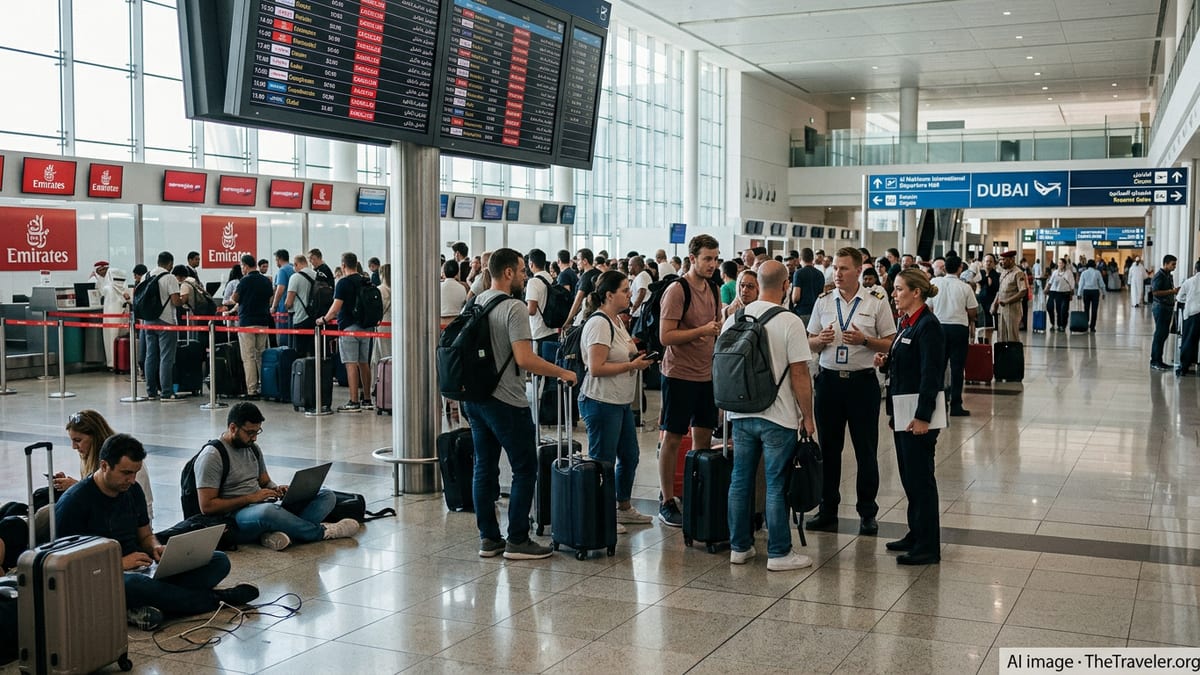
Airspace limits and regional tensions keep schedules in flux
Published updates from aviation trackers and regional media indicate that airspace capacity across parts of the Middle East remains constrained following months of heightened tensions involving Iran, Saudi Arabia and neighboring states. Restrictions affecting key corridors around the Strait of Hormuz and over parts of Saudi Arabia have led airlines to suspend some routes entirely and reroute others, adding time and complexity to journeys.
Travel disruption summaries compiled this week describe a patchwork of operating conditions rather than a uniform shutdown. Flights on some high-demand trunk routes are running close to normal, while others remain cancelled or operate only on limited frequencies. The result for travelers is an environment where services can be removed from schedules at short notice, even after tickets have been issued and seats assigned.
Regional reporting also notes that aviation authorities and security advisories continue to flag the potential for further disruption as long as conflict-related risks persist. This has prompted many airlines to adopt conservative schedules for destinations viewed as higher risk, particularly certain cities in Saudi Arabia, while maintaining more robust operations on lower-risk sectors.
Dubai hub operations: partial recovery with targeted suspensions
Dubai International Airport remains one of the busiest hubs in the region, and most long haul services to Europe, North America, Asia and Africa are operating. According to recent flight status round-ups, Emirates is now serving more than 160 destinations, equivalent to about 85 per cent of its pre-war network. However, the airline continues to adjust its Middle East schedule day by day in response to security assessments and airspace constraints.
Updates compiled on November 12 and 13 show that Emirates has partially restored flights between Dubai and Bahrain, currently operating one daily service on that route, after a period of suspension. By contrast, flights between Dubai and Kuwait remain suspended, with no confirmed restart date in the latest public disruption notices. Services to several Saudi Arabian cities, including Riyadh and Dammam, have seen repeated cancellations through the second week of November.
Flydubai, which operates a large network of regional routes from Dubai, is also continuing to revise its schedule. Publicly available summaries of its operations note that selected services to Saudi destinations such as Riyadh and Abha are suspended at least until mid November, while other Saudi routes continue with reduced frequencies. Flydubai’s services to Tel Aviv remain paused through at least late November.
Airport-focused reporting from the United Arab Emirates stresses that while Dubai’s terminals remain busy and broadly functional, travelers should not assume that previously booked regional connections will depart as planned. Same day checks using airline apps or departure boards are described as essential, particularly for flights touching Saudi airspace.
Saudi Arabia at the center of continuing cancellations
Saudi Arabia continues to feature prominently in disruption advisories for passengers starting their journey in Dubai or connecting through the emirate. Coverage from regional outlets in early and mid November highlights that services to Riyadh, Dammam, Jeddah and Madinah have been among the most affected, although the pattern differs by airline and route.
Etihad Airways, based in nearby Abu Dhabi, has cancelled flights to Riyadh and Dammam until at least November 19, according to security and industry briefings issued on November 13. The same material notes that Etihad’s Jeddah services resumed on November 6, illustrating how airlines are restoring some Saudi routes while keeping others off the schedule.
Low cost carrier Air Arabia, operating from Sharjah, continues to list suspensions on multiple Saudi routes. Recent travel updates state that flights between Sharjah and Riyadh, Abha, Dammam and Taif remain off sale, with no firm restart date. Additional reporting indicates that Sharjah services to other Saudi cities, including Jizan, have also been affected by cancellations in recent days.
International airlines outside the Gulf are also adjusting their Saudi operations in ways that affect itineraries routed through Dubai and other regional hubs. A detailed breakdown of Saudi flight suspensions published last week notes that KLM, Singapore Airlines and Air France have all extended their suspensions of selected flights touching Saudi airports. Cathay Pacific has cancelled passenger flights to and from Riyadh through January 31, 2027, while maintaining other routes in its network.
International carriers weigh return to Dubai routes
While Gulf-based airlines have focused their suspensions on specific Saudi and regional routes, some European and Asian carriers have taken a broader approach to Dubai and Middle East flying. The Lufthansa Group, which includes Lufthansa, Swiss and Austrian Airlines, has repeatedly postponed its restart of Dubai services amid the evolving security picture.
Travel and aviation monitoring sites tracking the group’s schedules report that Lufthansa’s Dubai flights remain suspended as of November 14, with a provisional restart date of November 25. Separate coverage from a major UAE-based news outlet on November 12 indicated that the group had already extended its Dubai suspension window once this month, underlining the tentative nature of current planning.
At the same time, some airlines are returning to Dubai after earlier pauses. According to recent travel industry reporting, British Airways resumed flights between London Heathrow and Dubai International Airport on November 3, with the first inbound arrival reaching Dubai on November 4. Those flights had been on hold for around eight months because of the regional conflict. However, British Airways services to Abu Dhabi remain suspended into future seasons, and the airline continues to publish warnings about potential airspace related disruption on routes across the Gulf.
Other carriers have opted for partial restrictions involving both Dubai and Saudi Arabia. Operational summaries from risk consultancies this week mention that Cathay Pacific has suspended both Riyadh and Dubai passenger flights until January 31, 2027, though the airline continues to operate to other destinations in the wider region. Oman Air, by contrast, allowed a previous temporary suspension of Riyadh flights to lapse in early November but has not yet publicly confirmed a full restart schedule.
What passengers should do before flying to or via Dubai
Passenger guidance emerging from airlines, airports and security advisors converges on a few key recommendations. Travelers are consistently urged to verify the status of their flight on the airline’s website or mobile app before leaving for the airport, rather than relying on earlier booking confirmations or third party itineraries. Because some cancellations are being announced within 24 hours of departure, same day checks are particularly important for routes involving Saudi cities or airspace known to be under restriction.
For those whose flights are cancelled, carriers are generally offering rebooking on later services or alternative routings, subject to seat availability. Public policy pages for major airlines covering the current disruption period outline options that may include free date changes, refunds for unused tickets, or rerouting via different hubs such as Doha, Istanbul or European gateways. However, the exact entitlements depend on the ticket type and the airline’s conditions of carriage, making it important for passengers to review the specific travel waiver that applies to their booking.
Travelers with tightly timed connections through Dubai are also being encouraged, in publicly available advisories, to allow greater buffer times where possible. With schedules under pressure, a missed or delayed inbound flight can easily cascade into a missed onward connection, especially on itineraries that combine different carriers. Booking longer layovers and ensuring that all segments are on a single ticket can reduce the risk of being stranded without support.
Security and risk briefings for the United Arab Emirates published on November 13 emphasize that the situation remains fluid. While Dubai itself continues to function as a major global hub and daily life in the city proceeds largely as normal, airspace and airline decisions are evolving in response to regional events rather than fixed timelines. For the moment, flexibility, close attention to airline communications and a willingness to adjust travel dates or routings remain essential for anyone planning to fly to, from or through Dubai.