


More news on this day
A nationwide ground stop that halted nearly all departing flights across the United States on Friday has been lifted, but publicly available data shows that tens of thousands of passengers remain stranded as airlines work through a massive backlog of delays and cancellations.
Get the latest news straight to your inbox!
Rare nationwide halt after air traffic communications failure
According to a statement published by the Federal Aviation Administration on November 13, a nationwide ground stop was ordered for all U.S. airports after “communication issues” affected multiple Air Route Traffic Control Centers. The order applied broadly to domestic departures, with only limited exceptions for certain international and overflight traffic.
Advisory text reproduced in industry and pilots’ forums describes the event as an “extraordinary circumstances” ground stop issued by the FAA Command Center. The order cited widespread air traffic control radio and equipment outages, prompting regulators to halt new departures while controllers verified that safety and flight information systems were functioning correctly.
Flight tracking platforms cited in major U.S. media outlets reported that more than 15,000 flights were affected in some way over the course of the day, with over 10,000 delays and several thousand cancellations across the domestic network. The disruption was concentrated in the afternoon and evening peak as the ground stop remained in place for several hours.
Public statements from administration officials in Washington indicated that, as of Friday night, there was no evidence that the outage resulted from a cyberattack or was connected to a separate global software problem that had affected other industries. At the same time, officials acknowledged that the precise technical chain of events leading to the communications failure remained under review.
Order lifted, but ripple effects spread across major hubs
The FAA began gradually easing the restriction in the early evening before fully lifting the nationwide ground stop a little after 8 p.m. Eastern time, according to timelines compiled by national broadcasters and aviation weather services. Some local outlets reported that departures resumed in phases, with early movements allowed at select airports around 5:30 p.m. as communications capacity was restored.
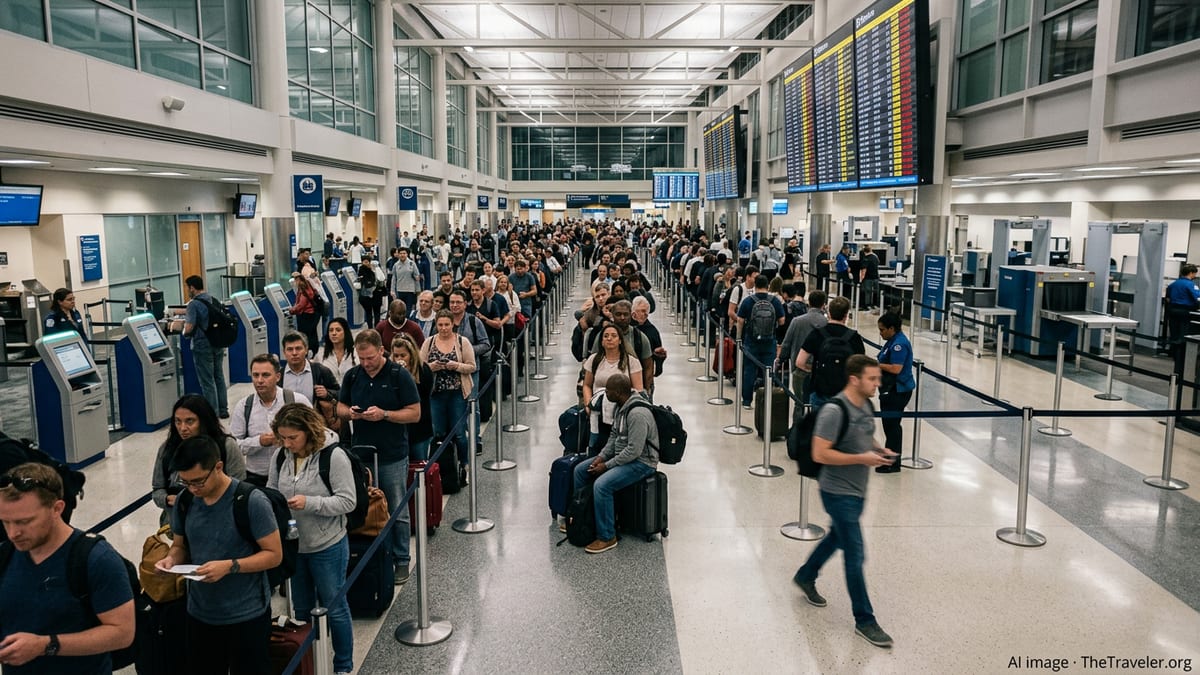
Despite the formal end of the order, the impact at major hubs was immediate and highly visible. Reports from airports such as Atlanta, Chicago O’Hare, Dallas Fort Worth, Los Angeles International, and New York’s JFK described departure boards dominated by red and orange delay notices, with long lines at rebooking counters and security checkpoints.
Airport authorities in several cities warned travelers that the evening’s disruptions were likely to cascade into the weekend. With aircraft and crews out of position across the country, airlines began preemptively cancelling late-night and early-Saturday departures, particularly on routes that rely on tight aircraft rotations or overnight positioning flights.
Regional airports also felt the strain. Local coverage in markets including Orlando, Miami, Seattle and Phoenix highlighted passengers held on aircraft waiting for release, as well as full gate areas where travelers struggled to find updated departure times. In some instances, ground stops and delay programs specific to individual airports remained in place even after the national order was withdrawn.
Technology transition and long-running infrastructure concerns
The outage arrived at a sensitive moment for U.S. airspace technology. Recent FAA updates describe an ongoing multiyear project to replace decades-old systems, including platforms that once relied on floppy disks, with a modern, centralized architecture capable of sharing alerts, restricted airspace schedules and pilot reports across hundreds of facilities.
Separate trade and technology publications recently noted that the agency is rolling out new tools for managing congestion, including the Strategic Management of Airspace, Routes and Trajectories system known as SMART. Following Friday’s disruption, the private company behind SMART issued a public statement asserting that the ground stop was not caused by its software or integration with FAA networks.
Early reporting from national outlets pointed to an attempted communications system update that may have overloaded key infrastructure and triggered the cascading failure that forced the shutdown. While detailed technical findings have not yet been released, analysts quoted in mainstream coverage drew parallels with previous aviation outages in the United States and abroad where modernization projects interacted with legacy systems in unexpected ways.
The incident also revived comparisons with the January 2023 stoppage linked to a failure in the FAA’s Notice to Air Missions system, as well as the unprecedented grounding that followed the September 11, 2001 attacks. Industry voices highlighted that, although nationwide orders remain extremely rare, the age and complexity of air traffic control technology leave limited margin for error when critical links fail.
Sports, business and holiday travel thrown off course
Because the ground stop unfolded on a November Friday, the disruption extended beyond routine business travel. Sports coverage from networks following college football, the NBA and NHL documented teams scrambling to adjust travel plans for weekend games as charter and commercial flights were delayed or cancelled.
One prominent college athletics conference publicly acknowledged that the ground stop could prevent teams, staff and fans from reaching scheduled matchups, and at least one athletic director voiced frustration about the competitive consequences in statements reported by national sports outlets. Leagues indicated that they were closely monitoring airport conditions and working with schools and franchises on contingency plans.
Leisure travelers were similarly affected. Photographs carried by major newspapers showed families at vacation gateways such as Orlando and Miami sitting on terminal floors surrounded by luggage as they waited for news of rebooked flights. At business hubs including New York and Washington, some travelers reportedly abandoned same-day trips altogether as it became clear that knock-on delays would stretch late into the night.
With the U.S. entering a busy season for conferences, sports fixtures and early holiday getaways, analysts noted that a systemwide shock of this scale can reverberate for several days, even once normal departure rates resume. The need to reposition aircraft and crews means some low-demand routes and late-night services are likely to face cancellations before schedules fully stabilize.
What stranded passengers are being advised to do
Consumer advocates and airline operations staff, speaking through public statements and travel advisories, emphasized that passengers dealing with the aftermath should rely on official airline channels such as mobile apps, text alerts and airport display boards for the most current information. Rebooking options can change rapidly as carriers adjust schedules to restore balance to their fleets.
Published guidance from major U.S. airlines indicates that many are waiving change fees and fare differences for affected passengers on specific dates and routes, allowing travelers to shift itineraries without penalty. The exact terms vary by carrier, and travelers are being encouraged to review each airline’s travel waiver page or contact customer service channels for route-specific rules.
Airport statements and federal travel information services are also advising passengers to build in extra time for check-in and security over the weekend, as terminals work through residual crowding from disrupted flights. In some locations, airport trains, parking facilities and concession stands are extending hours or redeploying staff to cope with surges in demand.
Observers of the aviation system note that the coming days will provide an important test of how quickly U.S. air travel can recover from a nationwide halt triggered by technological failure. For travelers whose Friday plans were upended, the focus now shifts from the dramatic stoppage itself to the practical challenge of finally reaching their destinations.