


More news on this day
Hundreds of flights at Phoenix Sky Harbor International Airport were delayed this week, creating long lines, missed connections and broad ripple effects across airline networks in the United States.
Get the latest news straight to your inbox!
Delays Stack Up Across Two Consecutive Days
Publicly available flight-tracking data and local media coverage indicate that more than 200 arrivals and departures were delayed at Phoenix Sky Harbor between Wednesday evening and Thursday evening, with only a small number of outright cancellations. Reports from June 4 and June 5 show delay counts climbing steadily through the afternoon and evening as airline schedules fell behind.
Average delays were reported at roughly an hour, with some flights waiting significantly longer for departure or arrival. The disruption affected a wide mix of domestic routes, including short regional hops and longer transcontinental services, as aircraft arriving late into Phoenix subsequently departed late for their next legs.
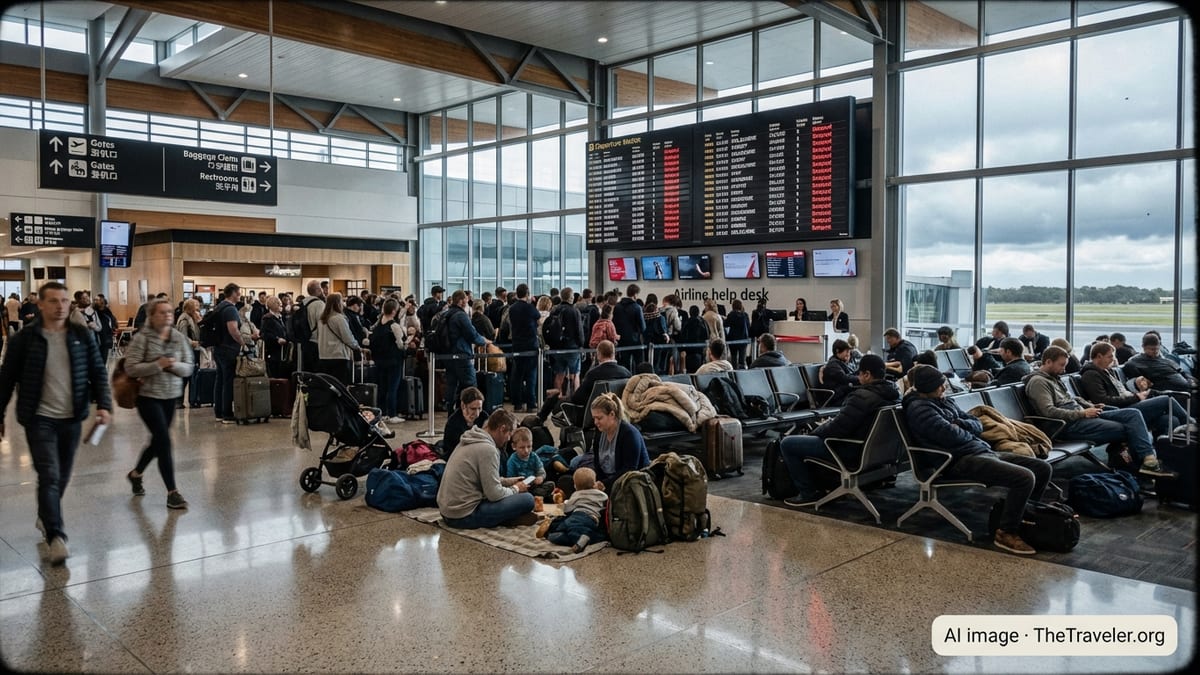
Travelers experienced the familiar cascade of modern air travel disruption: a departure pushed back by 45 to 60 minutes, a missed connection at Sky Harbor or another hub, and then rebooked itineraries that further stressed already crowded flights. Departure boards in Phoenix showed dense clusters of yellow “delayed” indicators rather than isolated problem flights.
While the worst of the disruption centered on a roughly 24-hour window, residual knock-on delays were still appearing in schedules into Friday, as airlines worked to reposition aircraft and crews and close the gap between planned and actual operations.
Weather, Low Clouds and National Air-Traffic Flow Limits
Local and national coverage attribute a major share of the disruption to weather-related air-traffic constraints. Storm systems and low clouds in parts of the northern Plains and Midwest reduced the throughput of already busy air corridors, while a blanket of lower cloud and reduced visibility around Phoenix itself periodically constrained runway capacity.
When airports operate under instrument-only conditions, controllers must space aircraft farther apart on approach and departure. Publicly available Federal Aviation Administration advisories show that, in such scenarios, national traffic managers often impose ground delay programs that meter flights into affected airports, including Phoenix, at a slower, more controlled rate.
These measures are designed to keep skies safe and avoid excessive holding patterns in the air, but they have the side effect of keeping many flights on the ground at their origin cities, waiting for assigned departure slots. Data compiled by flight-status services for this week’s disruption indicate that a significant share of delays involving Phoenix were tied to these systemwide flow restrictions rather than localized issues inside Sky Harbor alone.
The result for passengers was that even flights leaving from cities with clear weather could be held at the gate because their destination or onward routing crossed congested or storm-affected airspace. Phoenix, as a major connecting point in the Southwest, became one of several visible pinch points for this broader national slowdown.
Operational Strain at One of the Southwest’s Busiest Hubs
Phoenix Sky Harbor is among the busiest airports in the United States by passenger volume, serving as a key hub and focus city for multiple major carriers. Publicly available statistics from the City of Phoenix Aviation Department and the Federal Aviation Administration describe a facility that regularly handles dense banks of arrivals and departures during peak periods.
In that context, a reduction in effective runway capacity for even a few hours can quickly translate into hundreds of delayed flights. Structured connection banks, where large numbers of flights are scheduled to arrive and depart within tight windows, leave little slack when adverse weather or airspace restrictions reduce the rate at which aircraft can land and take off.
Ongoing airspace modernization work and construction-related capacity constraints at various airports in the national system, including projects noted in recent FAA construction impact reports, have further reduced the margin for error. When those long-term constraints coincide with short-term weather disruptions, airports such as Phoenix can see rapid swings from routine operations to widespread delay.
Observers of air-travel performance note that this week’s disruption fits a pattern seen at Sky Harbor over the past two years, where clusters of delays often follow regional storms, air-traffic control initiatives or infrastructure work that temporarily lowers the airport’s arrival and departure rate.
Nationwide Ripple Effects for Airlines and Travelers
Because many of the aircraft passing through Phoenix continue on to other destinations, the impact reached far beyond Arizona. Data compiled by flight-tracking platforms show delayed Phoenix-bound flights originating in multiple regions, including the West Coast, Midwest and East Coast, with late arrivals then propagating further delays into subsequent legs.
Airlines attempted to absorb the shock through schedule adjustments, aircraft swaps and crew reassignments, but limited spare capacity during a busy late-spring travel period left few easy fixes. Publicly available airline status tools showed rolling departure-time revisions through Thursday and into Friday, with some flights first pushed back modestly and then delayed again as congestion persisted.
The ripple effects extended to passengers whose journeys did not include Phoenix on their original itineraries. When aircraft that normally operate multi-segment rotations spent longer on the ground waiting for Phoenix-related slots, later flights elsewhere in the network occasionally departed late or were reassigned different equipment, adding complexity for operations teams and travelers alike.
Analysts note that such events illustrate how interconnected the U.S. air-travel system has become, with a bottleneck at one hub, combined with unfavorable weather several states away, capable of disrupting travel plans for passengers who never set foot in the affected airport.
Guidance for Passengers Facing Future Disruptions
Publicly available information from Phoenix Sky Harbor and major airlines emphasizes familiar but increasingly important steps for passengers when delays mount. Travelers are consistently encouraged to monitor flight status closely through airline apps, text alerts or online tools before leaving for the airport and again after check-in, even if a flight is already boarding.
Same-day rebooking options, standby lists and protection on alternative routings are typically managed through airline digital channels and call centers, and those tools often update before gate displays reflect the latest schedule changes. Travel industry guidance suggests that passengers with tight connections through Phoenix may benefit from selecting slightly longer layovers on days when storms or seasonal demand are likely to strain the system.
For those already at Sky Harbor during disruption, publicly available advice highlights the value of staying near departure gates to catch last-minute boarding announcements, as well as confirming that contact details are up to date in airline profiles so that automated notifications can reach passengers quickly. Some travelers also build extra flexibility into hotel and ground-transportation bookings when passing through hubs that have recently seen clusters of delays.
With summer travel demand building and ongoing weather and infrastructure challenges across the national airspace system, aviation analysts expect additional days of heightened disruption at Phoenix Sky Harbor and other major hubs in the coming months, even without headline-grabbing storms or major incidents on the airfield.