


Stockholm Arlanda is Sweden’s largest airport and the main gateway to the country, but its unusual layout can surprise first time visitors. Terminals have been reconfigured, domestic and international flights now share spaces, and some transfers require a bit of advance planning. With a little understanding of how the airport is organized and how its trains and buses work, you can turn what might feel confusing into a straightforward, even pleasant, experience.
Get the latest updates straight to your inbox!
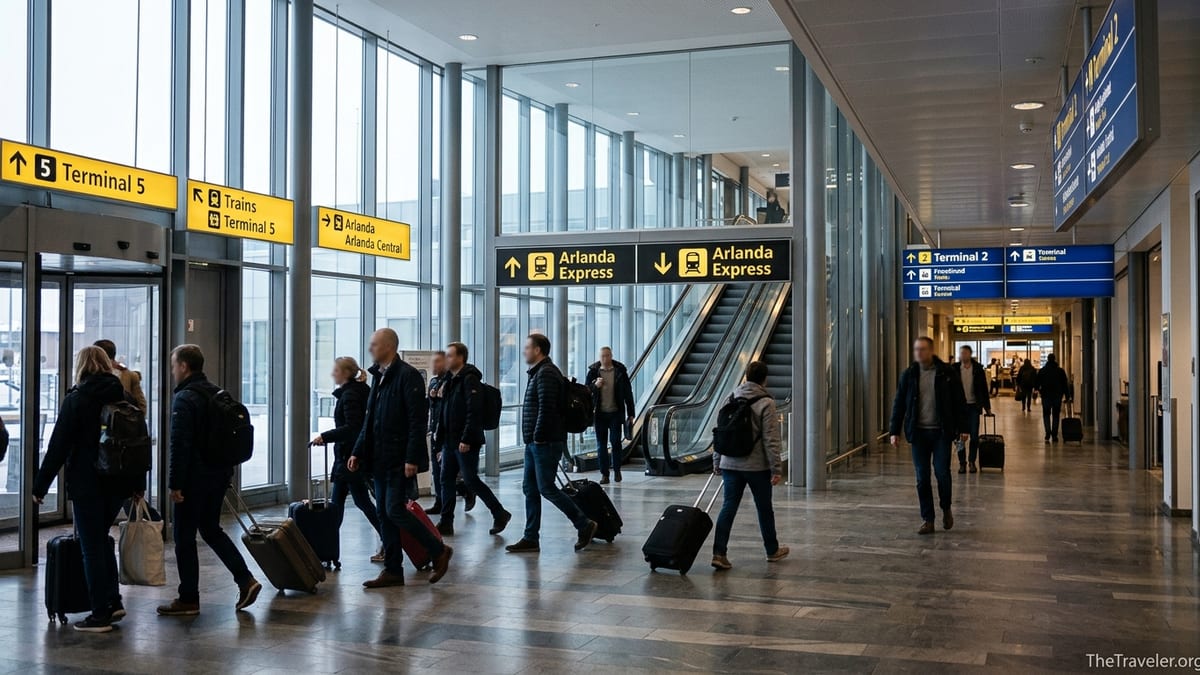
Understanding Arlanda’s Terminals and SkyCity
Arlanda is officially divided into Terminals 2, 3, 4 and 5, but in practice most travelers will only see Terminal 2 and Terminal 5. Terminal 5 is the main hub used by many large carriers and most long haul flights, while Terminal 2 is a smaller building used by several European and regional airlines. Terminal 3 is a small regional area that functions like an extension of Terminal 2, and the former Terminal 4 has been integrated into Terminal 5 as Gate Area C, linked by a long internal corridor. This means that if your boarding pass says Terminal 4 or a gate starting with C, you will actually be processed through Terminal 5.
Between Terminal 5 and the rest of the complex sits SkyCity, a central atrium that works as Arlanda’s landside heart. It is an indoor street of shops, cafes, money exchange desks and hotel entrances that also houses the Arlanda Central railway station at ground level. If you arrive by long distance train or commuter rail, you emerge straight into SkyCity. From there it is a short signed walk up escalators to Terminal 5 departures in one direction, or to the pedestrian walkway toward Terminals 2 and 3 in the other.
The most important distinction for transfers is the difference between airside and landside. Airside is everything after security and border control, while landside is the public area before you show your boarding pass. Terminal 5 and its C pier are fully connected airside, so once you clear security you can walk to any gate in that combined area. Terminal 2, however, is separate airside. That means if you are connecting from Terminal 2 to a flight that departs from Terminal 5, you usually have to move landside and then go through security again, unless your airline has arranged an airside bus for certain tight connections.
As a real world example, a traveler flying in from Copenhagen with SAS to Terminal 5 and connecting onward to Kiruna on a domestic flight will likely remain entirely in Terminal 5. They would follow transfer signs, go through passport control if needed, and then walk along the internal corridor to a C gate without ever entering SkyCity. By contrast, someone arriving on a low cost carrier into Terminal 2 and leaving on a US bound flight from Terminal 5 will typically walk landside through SkyCity, then clear security again in Terminal 5 for their long haul departure.
Moving Between Terminals: Walking, Bus and Free Airport Train
Despite Arlanda’s size, the distances between terminals are manageable when you understand the options. Many travelers are surprised to discover that you can walk indoors between Terminal 5 and Terminal 2 via SkyCity. From the Terminal 5 departures hall, you follow signs for SkyCity, pass cafés and the entrance to the airport hotels, and continue along the corridor toward Terminal 2. The walk is usually around 10 to 15 minutes at a normal pace with luggage, slightly longer if you have children or heavy bags.
For those who prefer not to walk, Arlanda offers free transport within the airport area before security. The most useful option for terminal to terminal movement is the Arlanda Express airport train, which normally requires a premium ticket for the fast ride to Stockholm Central but is free when used only between airport stations. If you board the train at Arlanda Norra station adjacent to Terminal 5 and get off at Arlanda Södra beneath Terminals 2 and 3, the journey takes just over a minute and costs nothing as long as you stay inside the airport. Staff and signs at the platform make it clear which side to use for the short transfer.
There are also complimentary Swedavia shuttle buses circulating around the airport roads, mainly serving long term parking areas and the car rental center, with stops at the terminals. For instance, a traveler collecting a rental car at the dedicated car hire hub would take a marked shuttle from outside Terminal 5 or Terminal 2. These buses are useful if you arrive at a distant car park or hotel shuttle area and need to get back to a different terminal, although they are generally slower than the free Arlanda Express hop between the main buildings.
If you have mobility issues or very short connection times, factor in the time to move between terminals carefully. A connection from a Schengen arrival at a C gate in the former Terminal 4 area to a non Schengen departure at a distant F gate within Terminal 5 may still involve a 10 to 20 minute indoor walk, especially at busy times. In contrast, a connection from a domestic arrival into Terminal 5 to another domestic departure in the same building can be as quick as a five minute stroll between neighboring gate areas.
Transfers and Minimum Connection Times
How much time you need for a transfer at Arlanda depends heavily on whether your flights are on a single ticket, whether you are staying inside the Schengen area, and whether you need to collect and recheck your luggage. When all flights are on one booking, airlines and ground handlers coordinate baggage transfer and typically choose realistic minimum connection times. For example, a 55 minute connection from a SAS flight arriving from Oslo into Terminal 5 to a SAS flight to Luleå, also from Terminal 5, is usually workable as long as the inbound flight is on time.
Situations become more complex when you have separate tickets or are switching between very different types of carriers. A common scenario is a traveler arriving from North America on a full service airline at Terminal 5, then connecting to a low cost carrier flight at Terminal 2 bought separately. In this case, you must clear Swedish border control, collect your bags from baggage claim, walk or take the free train to Terminal 2, check in again and clear security. In practical terms, many travelers find that three hours is a comfortable minimum for such a self made transfer, with more time providing extra margin if your first flight is delayed.
Schengen versus non Schengen status also affects your route through the building. If you arrive from another Schengen country such as Germany or Denmark and connect onward within Schengen, you do not normally pass passport control and simply follow transfer signs directly to your next gate. If you are connecting from a Schengen flight to a non Schengen destination, you will go through passport control at some point within the terminal, which can add several minutes in busy periods. Non Schengen arrivals, such as flights from the United Kingdom or the United States, enter a separate arrivals area in Terminal 5 where passport checks are carried out before you can access either the transfer corridor or baggage reclaim.
Real world schedules illustrate why cautious planning pays off. A traveler landing around 08:30 on a transatlantic flight may find that security queues for mid morning departures in Terminal 5 are long, especially during school holidays and peak summer. Adding an extra half hour to your planned connection time may be the difference between a calm stroll to your next gate and a stressful dash. Conversely, late evening connections after 21:00 often see shorter lines, but you must verify that any onward train or bus you plan to use after arrival still operates that late into the night.
Trains to Stockholm and Beyond: Arlanda Express, Commuters and Intercity
Arlanda is one of the few European airports with multiple train options directly underneath the terminals. For many travelers heading into central Stockholm, the Arlanda Express is the most convenient choice. It is a dedicated airport train that runs non stop between the airport and Stockholm Central Station, with a journey time of around 18 to 20 minutes. Trains typically depart every 15 minutes during daytime and early evening, less frequently late at night. Tickets are sold at machines in the terminal, on the platform and often through mobile apps, with prices varying by time, age and advance purchase.
Alongside the premium airport train are regular regional and long distance services operated by national rail companies. These use the Arlanda Central station in SkyCity, one level below the public concourse. Commuter trains, often referred to locally as pendeltåg, connect Arlanda with Stockholm Central in roughly 38 to 40 minutes and also run north to Uppsala. While the base fare is part of the wider public transport system, an extra station access charge is usually added for boarding or alighting at Arlanda, which means the final price can approach that of a lower cost airport coach if you are traveling alone.
For many itineraries, especially longer ones, the presence of intercity trains at Arlanda is a major advantage. Seasonal and regular services run directly from the airport toward destinations such as the ski regions of Åre and Duved, coastal cities like Sundsvall, or major inland hubs such as Östersund. A traveler flying into Arlanda for a winter sports trip, for instance, may step off a morning flight, walk into SkyCity, and board an afternoon northbound train without needing to detour via Stockholm Central at all. This can save both time and the cost of separate airport transfer tickets.
However, these trains do not run around the clock, and schedules can shift due to track works, especially early in the morning or late at night. Travelers aiming for very early departures, such as a 06:00 intercity train to the north, must check whether the specific service stops at Arlanda on their date of travel or only at Stockholm Central. If a schedule change means the train leaves from the city instead, you would need to allow time and budget to reach the main station first, either on a commuter train, the Arlanda Express, or a bus coach.
Airport Coaches, Local Buses and Nighttime Options
Not everyone needs or wants to take the train. Arlanda is also served by several airport coach companies operating between the terminals and Stockholm Cityterminalen, the main long distance bus station next to Stockholm Central. These coaches usually take 40 to 50 minutes depending on traffic and are often cheaper than the Arlanda Express, especially if you book a return ticket or travel outside peak commuter hours. Buses typically stop at Terminal 5 and also at other terminals, such as Terminal 2 and the integrated former Terminal 4 area.
In addition to the dedicated airport coaches, there are ordinary regional and local buses that connect Arlanda with nearby towns and transport hubs. One common budget route involves taking a local bus from the airport to the suburb of Märsta and then continuing by commuter train into Stockholm. This can significantly reduce costs for backpackers or long stay visitors who are less pressed for time, though it requires a bit more navigation and comfort with local ticketing systems.
Nighttime travel requires particular attention. While the Arlanda Express has departures into the late evening and, at times, shortly after midnight, the frequency is lower and there may be gaps in service. Some airport coaches adjust their schedules to match common flight arrival waves, but not every route is 24 hours. For example, a flight landing around 01:00 might leave you with a choice between a late running airport coach, a local bus and train combination, or a taxi. Regular taxis in Sweden are safe and regulated, with many companies offering fixed prices from Arlanda to central Stockholm that you can verify with the driver before departure.
For arrivals in the very early morning, such as 04:30 or 05:00, services are ramping up again but might not yet be at full daytime frequency. In such cases it is wise to check the first departure times of your preferred mode, whether that is a specific coach line, the commuter train, or the airport express, and consider waiting inside the terminal or SkyCity’s cafés until you are ready to travel onward.
Check In, Security and Using Your Time at the Airport
Arlanda’s check in experience varies depending on your airline and time of day. Most carriers encourage online or mobile check in, which can save significant time at the airport, especially if you are traveling with only hand luggage. In that case, you can often bypass the main check in halls and go directly to security in the correct terminal, scanning your digital boarding pass at the checkpoint. For instance, a traveler on a morning flight to Helsinki from Terminal 2 who checked in online and has no checked bag can walk straight to security from SkyCity or the Terminal 2 entrance.
If you have checked baggage, you should follow your airline’s guidance on when to arrive, which often aligns with Swedavia’s broader recommendations: generally at least two hours before departure for European flights and three hours for intercontinental flights. During peak holiday periods, such as July or Christmas, security queues can grow quickly, particularly in Terminal 5 where many long haul and charter flights depart within similar windows. Passengers with early morning flights around 06:00 to 08:00 are often advised to allow extra buffer time, as both bag drop and security can be busy.
Once through security, the airside area in Terminal 5 is large and modern, with duty free shops, cafés and restaurants stretching along the central concourse and into the former Terminal 4 gate area. Because Terminal 5 and Gate Area C are linked airside, a passenger departing from a C gate can still access the wider selection of food and shopping nearer the main F and G gate areas, as long as they keep an eye on walking times back to their gate. Travelers departing from Terminal 2 have a smaller but still adequate range of cafés and stores, with some passengers choosing to eat in SkyCity before going through security if they have a long wait.
Facilities for longer waits are reasonably good. SkyCity hosts hotels that can be booked for overnight stays or sometimes day rooms, along with seating areas, basic grocery style shops and currency exchange desks. After security, there are business lounges in both Terminal 5 and Terminal 2, accessible either through airline status or paid entry, where travelers can shower, work and rest. Families with children can find smaller play areas airside, and free Wi Fi is available throughout the airport, which makes it easier to keep an eye on real time gate and schedule updates through airline apps while you relax.
Practical Scenarios: From Tight Connections to City Break Layovers
To see how all of this comes together, imagine a traveler arriving from London to Arlanda at 11:10 on a weekday, landing at a non Schengen gate in Terminal 5, and connecting to a domestic flight to Umeå at 12:30, also from Terminal 5. After disembarking, they pass through passport control, follow the transfer signs, and reach the domestic gate area in roughly 20 to 30 minutes, leaving time for a brief stop at a café near their departure gate. Because both flights are on one ticket and use the same terminal, their checked bag is automatically transferred and they do not need to pass landside at all.
Contrast this with a traveler on separate tickets who lands on a long haul flight from New York at 09:00 in Terminal 5 and has booked a low cost flight to Berlin leaving from Terminal 2 at 11:15. They must clear passport control, collect baggage, exit into the arrivals hall, then either walk through SkyCity or take the free Arlanda Express hop to Terminal 2. Once there, they check in and drop their bag at the airline desk, then proceed through security for their Berlin flight. With any delays at passport control or baggage delivery, that two hour and fifteen minute window can become uncomfortably tight, illustrating why separate ticket connections usually call for at least three hours at Arlanda.
Layover passengers considering a quick city visit must weigh travel times carefully. A traveler with a 7 hour daytime layover, for example, arriving at 09:00 and leaving at 16:00, could realistically ride the Arlanda Express into central Stockholm in under 20 minutes, stroll through the old town or have lunch near the waterfront, and still be back at the airport by 14:00. That schedule builds in time for passport control on arrival, baggage recheck if needed, the ride back to the airport and security for the onward flight. Shorter layovers of 4 or 5 hours, especially on separate tickets or involving non Schengen border checks, usually make a city trip risky.
For travelers heading directly from the airport to other parts of Sweden by train, planning often revolves around buffer time and ticket flexibility. Someone flying in for a ski holiday might choose a late afternoon northbound train from Arlanda to Åre rather than the last possible departure of the day. That way, even if their inbound flight from Europe is an hour late or baggage claims are slow, they can still catch their train. Many tickets purchased for long distance trains include conditions for rebooking in case of missed connections, but when your plane and train tickets are purchased separately rather than in one combined itinerary, you carry more of the risk and should plan accordingly.
The Takeaway
Stockholm Arlanda is a busy and sometimes confusing hub, but with a little knowledge of how its terminals, trains and transfers fit together, it becomes much easier to navigate. The key is to identify early which terminals you will use, whether your flights are on one ticket or not, and how you plan to get to or from the city. Understanding that Terminal 5 and the former Terminal 4 gate area now form a single airside space, that Terminal 2 is separate after security, and that SkyCity is the central crossroads for trains and services can remove much of the uncertainty.
Practical decisions make a big difference. Giving yourself extra time when changing terminals, using the free Arlanda Express hop between airport stations, and choosing the right mix of airport train, commuter rail or coach based on your schedule and budget can turn a rushed transfer into a smooth transition. Whether you are racing to catch a domestic connection in winter, rolling your ski bag toward an overnight train in SkyCity, or simply riding into Stockholm for a few hours in the old town, Arlanda rewards travelers who plan a few steps ahead.
FAQ
Q1. How long does it take to transfer between Terminal 2 and Terminal 5 at Arlanda?
In normal conditions it takes about 10 to 15 minutes to walk indoors via SkyCity, or around a minute on the free Arlanda Express train between the airport stations, plus a few minutes for getting to and from the platforms.
Q2. Is there a free way to travel between Arlanda’s terminals?
Yes. You can ride the Arlanda Express train for free between the airport stations serving Terminal 5 and Terminals 2 and 3, and there are also complimentary Swedavia shuttle buses circulating between terminals, long term parking and the car rental center.
Q3. How much time should I allow for a self transfer from Terminal 5 to Terminal 2?
If you need to collect and recheck baggage on separate tickets, plan on at least three hours. This gives time for passport control, baggage claim, the walk or train ride between terminals, new check in and security.
Q4. Which train is best from Arlanda to central Stockholm?
The Arlanda Express is the fastest and most convenient, taking around 20 minutes non stop to Stockholm Central Station. Commuter trains and some coaches are slower but usually cheaper, especially for budget travelers or groups.
Q5. Can I catch long distance trains directly from Arlanda without going into Stockholm first?
Yes. Many regional and intercity trains stop at Arlanda Central station in SkyCity, allowing direct travel to destinations such as Uppsala, Sundsvall or the Åre ski region without detouring via Stockholm Central.
Q6. How early should I arrive at Arlanda for check in and security?
As a rule of thumb, arrive at least two hours before European departures and three hours before intercontinental flights. During peak holiday periods or early morning waves, adding extra buffer time is wise.
Q7. Are Terminal 4 gates still in a separate building?
No. The former Terminal 4 has been integrated into Terminal 5 as Gate Area C. After security in Terminal 5 you can walk to these gates along an internal corridor without going landside.
Q8. Is Arlanda easy to manage with children or heavy luggage?
Yes, but plan for extra time. Elevators, moving walkways and the free airport train help, yet walks between distant gates or terminals can still take 10 to 20 minutes, so do not schedule tight connections.
Q9. What are the options for getting into Stockholm late at night?
Depending on your arrival time, you may be able to use a late Arlanda Express departure, an airport coach or a combination of local bus and commuter train. Taxis with fixed prices to central Stockholm are the fallback if public transport options are limited.
Q10. Can I leave the airport on a layover to visit Stockholm?
It is realistic with a layover of about 6 to 7 hours or more, especially if both flights are on one ticket. You need to allow time for border control, travel into the city and back, and security before your onward flight.