


More news on this day
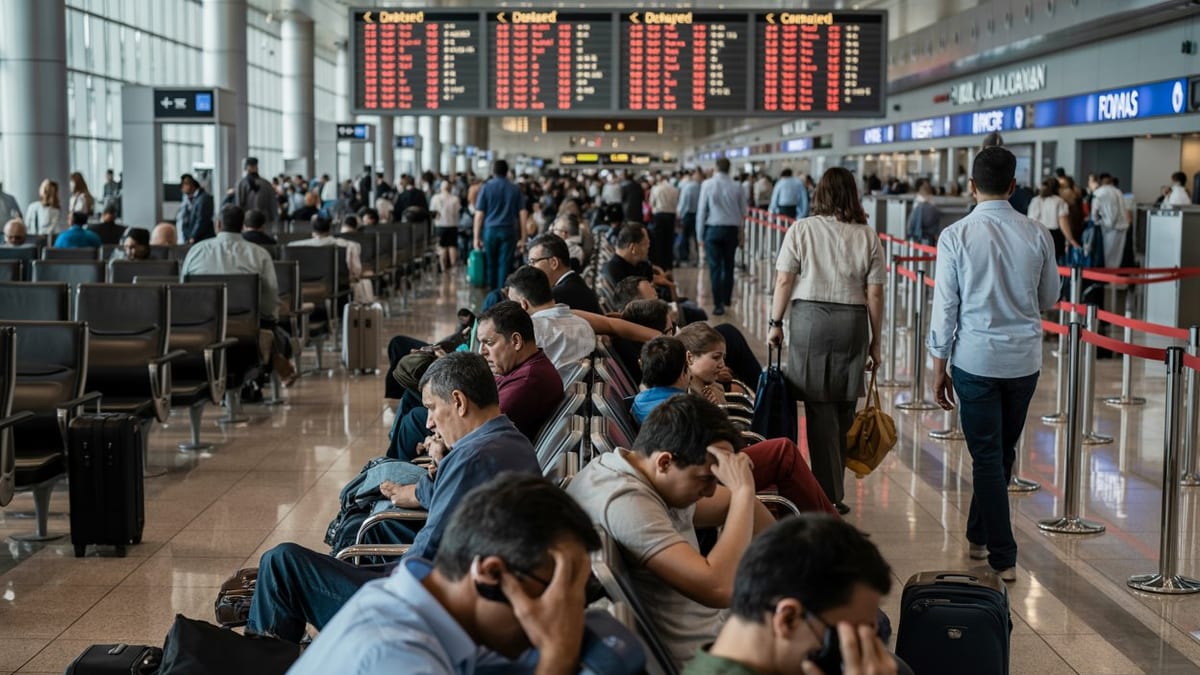
Hundreds of travelers across the Gulf have seen journeys abruptly halted as 166 flights were reportedly cancelled and 103 delayed at Bahrain International, Doha’s Hamad International, Dubai International and Riyadh’s King Khalid International Airport, creating long queues, missed connections and overnight backlogs at some of the region’s busiest transit hubs.
Get the latest news straight to your inbox!
Major Gulf Hubs Hit By Fresh Wave Of Disruptions
Publicly available flight-tracking snapshots and regional travel coverage indicate that the latest wave of cancellations and delays is concentrated at four of the Middle East’s most strategically important airports: Bahrain International (BAH), Hamad International in Doha (DOH), Dubai International (DXB) and King Khalid International in Riyadh (RUH). Combined tallies from these hubs point to at least 166 flights cancelled and 103 delayed over a short operational window, stranding point-to-point passengers and those using the Gulf as a long-haul connection corridor.
Operational data for recent weeks shows that these airports have already been operating under strain, with previous episodes of mass disruption linked to airspace restrictions and rolling schedule changes across the wider region. Recent reporting on Gulf aviation trends describes repeated instances in which a cluster of cancellations at one hub is quickly mirrored at others as airlines re-time or consolidate services, a pattern that appears to have resurfaced in the latest figures.
Dubai International and Hamad International, both heavily reliant on complex transfer traffic, are particularly exposed when schedules unravel. Even a limited number of grounded services can trigger long queues at rebooking desks and force passengers to wait hours for the next available seat on oversubscribed routes. Bahrain and Riyadh, meanwhile, function as important spokes and secondary hubs, so cancellations there can cut off feeder services into larger intercontinental networks.
Reports from regional and international media over recent months have repeatedly highlighted how quickly disruption in Gulf airspace can translate into genuine travel paralysis for passengers. The concentration of cancellations and delays at these four hubs underscores how dependent global connectivity has become on the smooth functioning of a relatively small cluster of Middle Eastern airports.
Operational Constraints And Regional Airspace Pressures
Published advisories from aviation and logistics firms show that the Gulf’s air traffic environment has been unusually volatile since late winter, with intermittent airspace restrictions and route adjustments affecting carriers based in the United Arab Emirates, Saudi Arabia, Bahrain and Qatar. In some periods, Bahrain International has been listed as operating on a highly curtailed basis, while Hamad International has been described as functioning under tight constraints and limited routing options for overflying traffic.
Analysts note that when airspace corridors are narrowed or temporarily closed, airlines often respond by cancelling rotations outright rather than attempting complex diversions that may not be sustainable across an entire schedule. This leads to concentrated bursts of cancellations and knock-on delays, especially at connecting hubs where aircraft and crew positioning must be precisely choreographed to keep banks of departures running.
In the case of Dubai International and King Khalid International, publicly available information indicates that carriers have, at various points this year, trimmed frequencies and consolidated flights in response to such constraints. These decisions can reduce exposure to sudden route changes, but they also mean that when disruptions occur, there is less spare capacity to accommodate displaced travelers.
Industry data referenced in recent coverage of Middle East aviation shows that across the region, several hundred flights have been scrapped in compressed timeframes during past episodes of tension, with delays frequently numbering in the high hundreds. The current figure of 166 cancellations and 103 delays across the four Gulf hubs fits into this broader pattern of vulnerability whenever operational conditions tighten.
Knock-On Impact For Passengers Across Continents
The immediate consequence of 166 cancelled flights and more than one hundred delays at major Gulf airports is a sharp spike in missed connections and unplanned stopovers. Many travelers use Bahrain, Doha, Dubai and Riyadh as midpoints on multi-leg itineraries connecting Europe, Asia, Africa and the Americas, meaning a grounded or late-running sector can leave passengers stuck far from both origin and destination.
Recent accounts collected in public forums and media reporting during earlier disruption cycles in 2026 describe crowded transfer halls, long lines for meal vouchers and hotel arrangements, and passengers sleeping in terminal seating when accommodation near the airport fills up. With the latest wave of cancellations and delays affecting such a high number of services in a compressed period, similar conditions are likely to have emerged once again.
For travelers, the complexity is often compounded by the need to rebook across multiple segments, especially where separate tickets or different airlines are involved. When a feeder flight into Dubai or Doha is cancelled, a long-haul departure on another carrier may be lost as well, with re-accommodation dependent on fare rules, available seats and how much flexibility airlines are willing to offer beyond their minimum obligations.
Given the scale of the disruption reported across Bahrain International, Hamad International, Dubai International and King Khalid International, travel specialists advise that passengers transiting these hubs build in extra buffer time where possible and remain prepared for last-minute changes to routings, including diversions to alternative regional gateways if capacity allows.
How Airlines And Airports Are Managing The Backlog
Airlines operating through the affected hubs are using a mix of consolidation, schedule thinning and aircraft swaps to manage the disruption, according to publicly available operational updates. When several rotations are cancelled, carriers sometimes deploy larger aircraft on remaining services to absorb part of the backlog, though this strategy is limited by crew availability and airport slot constraints.
At airport level, reports from previous disruption periods in 2026 at these same hubs describe temporary congestion management measures, including staging passengers away from the busiest gate areas, opening additional check-in counters for disrupted services and extending customer service hours inside the terminals. Such steps aim to prevent overcrowding while airlines work through rebookings.
However, aviation analysts point out that once cancellation numbers push into the triple digits across a small cluster of primary hubs, full recovery is rarely immediate. Even after schedules formally stabilize, displaced travelers can remain in the system for days as they are re-accommodated on flights that were already heavily booked. This means that the effects of the 166 cancellations and 103 delays now being reported are likely to ripple across the network beyond the initial period of disruption.
Some carriers have, in earlier waves of Gulf disruption this year, published waivers allowing affected passengers to change travel dates or reroute via alternative hubs without additional change fees. While the specific conditions vary by airline and ticket type, observers suggest that travelers impacted by the latest cancellations and delays should carefully review available options rather than accepting the first rebooking offer if it involves a significantly longer journey or extended layover.
What Travelers Should Watch In The Coming Days
With Bahrain International, Hamad International, Dubai International and King Khalid International all implicated in the current wave of disruption, travel experts expect lingering schedule instability across the Gulf in the near term. Even if no further large-scale airspace restrictions are introduced, airlines will need time to reposition aircraft and crews and to clear the backlog of stranded passengers built up during the period of 166 cancellations and 103 delays.
Public travel advisories and airline updates issued during recent disruption cycles in the region emphasize the importance of checking flight status repeatedly in the 24 hours before departure, as last-minute retimings and aircraft changes are common while networks are recalibrated. Travelers are also encouraged to monitor local airport channels for information on terminal changes, altered check-in windows and any temporary caps on arriving guests or visitors in the landside areas of terminals.
Passenger rights information from consumer organizations notes that entitlement to care, rebooking and possible compensation depends on a combination of airline policy, ticket type and jurisdiction, and that disruptions linked to wider security or airspace issues may limit compensatory claims. Nonetheless, many carriers in the region have, in previous episodes this year, offered meals, accommodation where available and complimentary date changes for those directly affected.
For now, the situation across Bahrain, Qatar, the United Arab Emirates and Saudi Arabia serves as another reminder of how sensitive global travel has become to operational shocks in the Gulf. With hundreds of travelers stranded and scores of services still out of position, those planning to pass through Bahrain International, Hamad International, Dubai International or King Khalid International in the coming days are being urged by published guidance to remain flexible, stay informed and be prepared for unexpected changes to even the most carefully arranged itineraries.