


More news on this day
HX Expeditions and the University of Tasmania have unveiled a new Alaska-focused Arctic course designed for expedition cruise passengers, marking the first phase of a broader university-backed education program for polar travel.
Get the latest news straight to your inbox!
From Antarctica Pilot to Arctic Rollout
The new Alaska course builds on an existing partnership between HX Expeditions and the University of Tasmania, which first took shape around Antarctica-focused learning. Publicly available information shows that the partners initially collaborated on a two-step Antarctic curriculum, including an introductory pre-cruise module and a more advanced post-voyage course that carries formal university recognition. Those programs were developed with the university’s Institute for Marine and Antarctic Studies and were designed to help travelers better understand the polar environments they were visiting.
Reports indicate that interest in the Antarctic offering has been strong, with thousands of travelers enrolling since launch and feedback pointing to higher awareness of environmental issues among participants. That reception appears to have encouraged HX and the university to expand their model into the Arctic, using Alaska as the starting point for a multi-region series of courses that will follow the company’s itineraries.
According to recent coverage of the initiative, the Alaska program is described as the first in a family of Arctic Introductory Courses that will later extend to Arctic Canada, Greenland, Iceland, the Northwest Passage and Svalbard. The move aligns with HX’s broader strategy of pairing small-ship expeditions with structured science content and citizen-science participation across its itineraries.
Alaska Becomes the Testbed for Arctic Learning
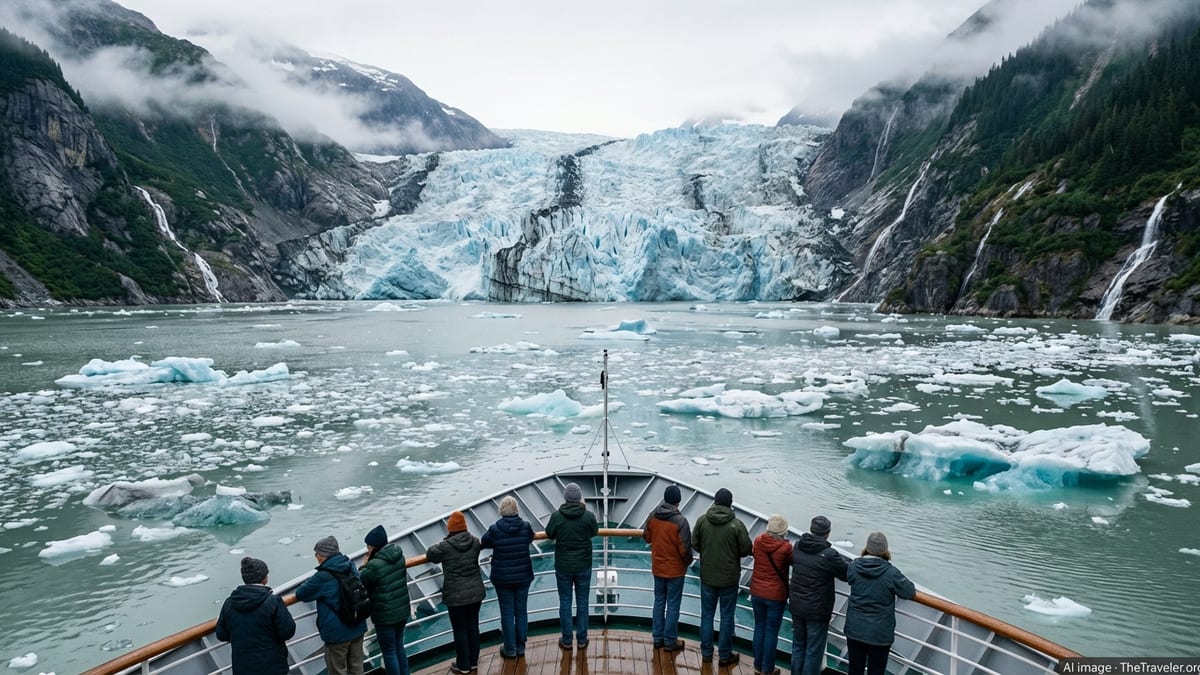
The Alaska course is framed as a pre-cruise learning experience aimed at booked HX passengers. Reports indicate that it is delivered online at no additional cost and is intended to be completed in the weeks leading up to an expedition. It offers a structured introduction to Alaska’s glaciated landscapes, coastal ecosystems, marine wildlife and Indigenous cultures, mirroring the themes travelers are likely to encounter on shore landings and small-boat excursions.
Information from industry coverage describes the program as a practical companion to the expedition itself, emphasizing how Alaska’s glaciers, coastline, marine systems, wildlife and communities are interconnected. The curriculum highlights how climate change is reshaping these systems and encourages participants to think about how responsible tourism can support more mindful exploration of one of the world’s most closely watched Arctic regions.
The decision to launch first in Alaska reflects the state’s central role in HX’s growing polar portfolio. The company has detailed expanded Alaska sailings for 2026, including new itineraries and inaugural calls in ports such as Klawock and Valdez, supported by hybrid-powered expedition ships. Embedding an educational component that matches this expanded footprint allows HX and the University of Tasmania to position Alaska as the pilot for their Arctic classroom at sea.
Course Structure: Short, Accessible and Certificate-Backed
According to trade press reports, the Alaska course is organized into four modules, each designed to take around 30 minutes to complete. This short-session structure is intended to fit around work and travel commitments while still giving participants enough time to engage with scientific and cultural content before departure. Topics span regional geology and glaciology, marine and coastal ecology, wildlife behavior and conservation, as well as historical and contemporary human presence in coastal Alaska.
Participants who complete all modules receive a Certificate of Attendance from the program, adding a tangible acknowledgment of their preparation. For members of HX’s loyalty scheme, the course also contributes reward points, which is intended to help integrate learning more deeply into the overall expedition experience. Publicly available information on the earlier Antarctic partnership suggests that such recognition has been a useful motivator, encouraging guests to start studying well ahead of embarkation.
The Alaska curriculum also appears to echo elements of the partners’ Antarctic materials, which combine video, expert commentary, reading material and reflection exercises. While the Arctic and Antarctic are distinct regions, HX and the University of Tasmania are positioning both programs as part of a continuous polar education pathway that can accompany travelers as they move from one hemisphere to the other.
Part of a Wider Arctic Education Network
The Alaska launch is not taking place in isolation. Recent announcements from HX Expeditions describe a broader Arctic education initiative that will roll out additional courses for destinations such as Arctic Canada, Greenland, Iceland, the Northwest Passage and Svalbard from 2026 onward. These courses are expected to follow a similar model to Alaska, pairing online modules with on-the-ground experiences during voyages.
The expansion comes as demand for Arctic expedition travel continues to grow and operators place more emphasis on science-based interpretation. Other programs, including community and classroom partnerships in Alaska and pan-Arctic education projects, have demonstrated a strong appetite for resources that connect scientific research with local knowledge. HX and the University of Tasmania’s initiative positions commercial expedition cruising as one more platform where that kind of learning can take place.
Industry observers note that the company’s recent program expansions in the Arctic, Antarctica and Norway are closely tied to its focus on extended time in the field and collaboration with researchers. The new Alaska course sits within that framework, aiming to send travelers into sensitive environments better prepared to understand what they see and to participate in data collection or citizen-science efforts where offered.
Implications for Future Polar Voyages
For travelers considering an Alaska expedition with HX, the new course represents an additional layer of value built into the fare. It also signals how expedition cruising is shifting toward more academically informed itineraries, where lectures and shore talks are supplemented by pre- and post-cruise study. If the Alaska launch proves as popular as the earlier Antarctic offerings, future guests heading to other Arctic regions may find similar courses waiting for them as the program scales up.
For the University of Tasmania and its polar research community, the initiative offers another route to bring current science to a wider public audience. By linking research themes such as climate impacts, marine ecosystems and glacial dynamics directly to specific voyage routes, the courses aim to bridge the gap between scientific papers and what travelers witness from a ship’s observation deck or during a landing.
As 2026 approaches, HX’s schedule includes a dense calendar of Arctic sailings, from Alaska and the Bering Strait to extended journeys through the Northwest Passage. With the Alaska course now live and more Arctic modules in development, the company is positioning its ships as moving classrooms, where the journey begins long before passengers step aboard and continues long after they return home.