


I used to think claiming flight compensation meant months of paperwork, legal jargon and being stonewalled by airlines. Like many travelers, I filed the ordeal under "not worth the stress" and moved on. That was before a badly delayed flight to Lisbon pushed me to test a service I had seen mentioned in countless airport ads and travel forums: AirHelp. What I discovered is that the process can be far simpler than most passengers imagine, especially if you understand your rights and know when an intermediary is worth the fee.
Get the latest updates straight to your inbox!
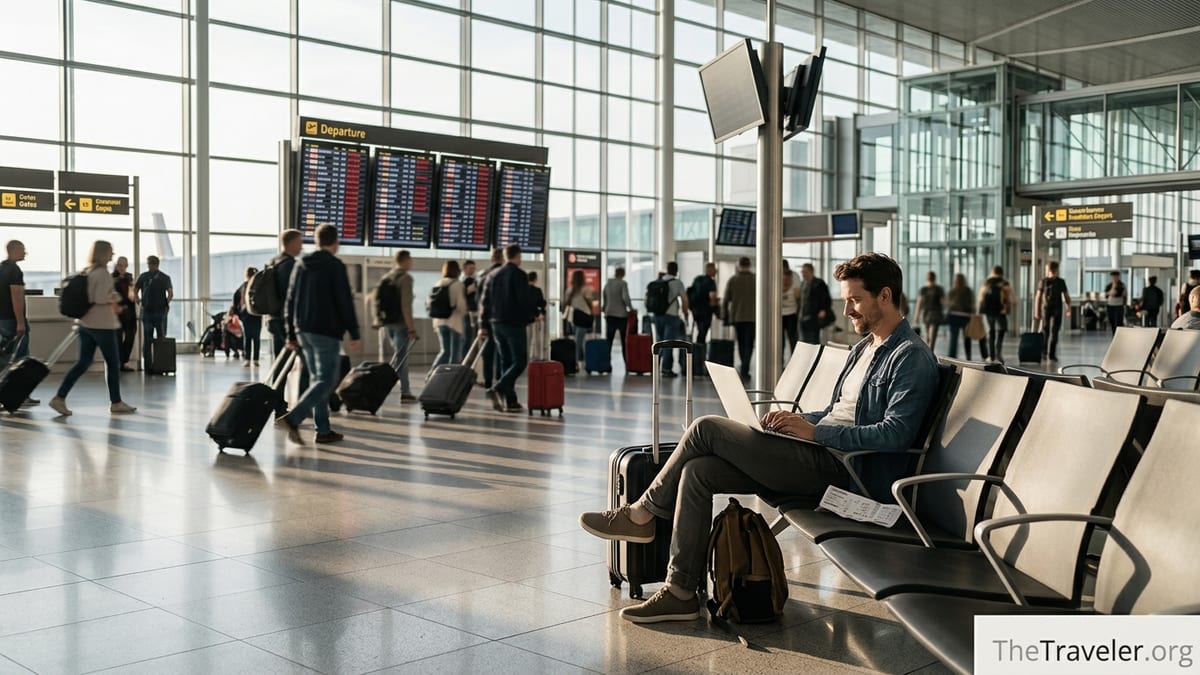
When a Disrupted Flight Turns Into Money You Did Not Know You Were Owed
My turning point came after a spring connection through Madrid went wrong. A technical issue grounded our aircraft for over four hours, turning a short hop to Lisbon into an all-day slog with airport-floor picnics and melted duty-free chocolate. The airline handed out stale sandwiches and vague apologies but never once mentioned compensation. Like most people, I assumed it was just bad luck.
A few weeks later, a friend casually asked whether I had claimed under EU261, the European regulation that protects air passengers when flights are significantly delayed, cancelled or overbooked. I had heard of it but never really believed it applied to ordinary travelers flying on low-cost carriers with bargain fares. In my mind, this was the sort of thing business-class passengers with corporate lawyers worried about.
That night I dug out my booking confirmation. The itinerary started in Madrid and ended in Lisbon, both within the European Union, on an EU carrier. The delay at arrival was more than three hours. On paper, that looked like a textbook EU261 situation, potentially worth around 250 euros per person on short routes. Suddenly, the hassle of that day had a potential cash value.
I tried reading the rules on my own, cross-checking the regulation with consumer articles and airline conditions of carriage. The legal language, references to "extraordinary circumstances" and flight distances made my eyes glaze over. That was when I finally clicked on an AirHelp ad I had always ignored. Within a few minutes I went from vague curiosity to realizing that claiming might be far more straightforward than I had imagined.
What EU261 Really Promises: From 250 to 600 Euros per Passenger
The heart of AirHelp’s business is EU Regulation 261/2004, usually shortened to EU261, and its UK equivalent. These rules set out standard lump-sum compensation for passengers when airlines cause major disruption and cannot blame it on extraordinary circumstances such as severe weather, volcanic ash, air traffic control strikes or security risks.
In practice, if your journey starts in the EU or UK, or you are flying into the region on a European or British carrier, the regulation often applies. The headline numbers are well known in consumer circles: about 250 euros for short flights up to 1,500 kilometers, 400 euros for medium-haul flights of 1,500 to 3,500 kilometers or longer intra-EU routes, and 600 euros for many long-haul services over roughly 3,500 kilometers. A New York to Paris flight that lands more than three hours late for reasons within the airline’s control can easily trigger that highest band.
Those amounts apply per passenger, not per booking. A family of four delayed on a Barcelona to Berlin flight might be entitled to roughly 1,000 euros in total. Crucially, the ticket price does not matter. A 29 euro sale fare on a budget carrier is treated exactly the same as a flexible business-class seat on a legacy airline. The law is designed to compensate lost time and inconvenience, not to refund what you paid.
There are nuances. If the airline re-routes you and still gets you to your destination with only a short delay, they may be allowed to reduce standard compensation, and every case turns on details like exact arrival delay and cause. That is where many travelers give up. The combination of distance bands, time thresholds and exceptions makes it easy for an airline to tell a tired passenger, "You are not eligible," and for that passenger to believe it without pushing back.
Why So Many Travelers Never Claim on Their Own
On paper, EU261 encourages passengers to submit a claim directly to the airline. In reality, many never try. When I started asking fellow travelers about their experiences, the same themes came up again and again: confusing forms, unanswered emails and months of silence. One friend who routinely flies between London and Warsaw had a six-hour delay but gave up after the carrier’s online claim form repeatedly crashed.
Others described airlines responding with generic denials that cited "operational reasons" or "extraordinary circumstances" without providing any evidence. Unless you already know that routine technical faults or crew scheduling issues are usually considered the airline’s responsibility, it is difficult to know whether to challenge those refusals. For a one-off leisure trip, many decide their time is worth more than a hypothetical payout.
Jurisdiction is another barrier. An American traveler delayed on a Rome to Copenhagen flight may technically have to bring a claim in an EU court if the airline will not pay up. For someone living in Chicago, that is both intimidating and impractical. Several US-based passengers who later turned to third-party services admitted that they had no realistic plan to pursue legal action abroad on their own.
The result is a large pool of unclaimed money. Airlines know this. Industry studies and consumer watchdogs have repeatedly suggested that a sizeable share of eligible passengers never claim at all. This is the gap that companies like AirHelp aim to fill, arguing that even after their fee, travelers end up ahead compared with receiving nothing.
How AirHelp Actually Works: From Flight Number to Payout
What surprised me most about AirHelp was how quickly a vague frustration could be turned into a structured claim. The process begins with a simple online check. You type in your flight number, date and the nature of the disruption, such as a cancellation, long delay or denied boarding. Behind the scenes, AirHelp’s systems compare the details against historical flight data and EU261 rules to estimate whether compensation is likely and which amount band might apply.
In my Madrid to Lisbon case, the checker flagged potential eligibility within seconds based on arrival delay and route distance. It suggested that each passenger could be owed around 250 euros. At that point, I created an account and uploaded my boarding pass and booking confirmation. That was essentially the core of my effort; from there, the claim became AirHelp’s problem rather than mine.
AirHelp operates on a "no win, no fee" model. If they conclude your case has merit, they submit a claim to the airline on your behalf. According to their published terms, they only charge a fee if they actually secure compensation, sometimes around a third of the payout, depending on the jurisdiction and whether legal action is required. If they lose, you pay nothing, which is what persuades many hesitant travelers to give them a try.
Behind that simple front end is a mix of automation and human staff. For straightforward cases where airlines cooperate, the process can be relatively quick, sometimes a few weeks from submission to payout, although slower carriers can drag this out. For tougher cases, AirHelp can escalate matters to legal partners in the airline’s home country, something that would be hard for an individual passenger to arrange cost effectively for a single disrupted trip.
Real-World Experiences: When AirHelp Shines and When It Frustrates
Browsing traveler forums reveals a spectrum of experiences with AirHelp, from glowing gratitude to exasperated complaints. One common success story involves passengers whose direct claims were repeatedly rejected. A traveler on a multi-leg itinerary from an EU city to the United States described being denied compensation by the airline, which argued that EU261 did not apply to the non-European segment. After AirHelp took over, the company pursued the claim for several months and ultimately obtained a payout that would have been difficult for that individual to win alone, even though roughly half of the compensation went to fees after court action.
Another positive example comes from passengers who simply lacked the time or energy to chase a stubborn carrier. A traveler whose connecting flight was cancelled en route to a family wedding said AirHelp’s cut felt like a fair trade for not having to wrestle with customer service scripts and legal terminology. For them, a reduced payout was preferable to letting the airline keep everything.
On the other side, not every story is happy. Some users describe long delays with limited updates, especially when cases become legally complex or when airlines appeal. A few report feeling blindsided by the final fee, not realizing that the percentage could be higher when court proceedings are involved. Others are skeptical about handing over a large share of what could be a 600 euro claim, especially when they discover that some airlines provide simple online forms that can be filled out in under half an hour.
The honest conclusion is that AirHelp is neither a magic bullet nor a scam by default. It is a commercial service operating in a gray area between consumer law and convenience. For travelers who value their time highly, who are based far from the airline’s jurisdiction or who have already hit a wall dealing with the carrier directly, its role can be genuinely helpful. For those comfortable drafting a basic claim letter and following up, handling EU261 cases alone remains a viable and cost-free option.
Direct Claim vs AirHelp: Doing the Math on Your Compensation
Deciding whether to use AirHelp often comes down to a trade-off between money and effort. Imagine your four-hour delay on a 2,000 kilometer route qualifies you for around 400 euros. If you claim directly and the airline pays without fuss, the entire amount goes to you. If you route that same claim through a third-party service that charges roughly 30 percent including tax, you might receive closer to 280 euros after fees.
For a solo backpacker with flexible time and a knack for paperwork, the extra 120 euros might justify a DIY approach. Many European consumer websites provide free template letters that reference EU261, and some airlines now maintain clear claim portals where you can submit documentation and bank details. In cases involving well-regulated carriers with a history of complying, this can be effective.
However, the calculation changes if you expect a fight. Long-haul delays worth around 600 euros per person, complex itineraries with multiple connections or cases where the airline has already rejected your claim may tilt the balance toward outsourcing. If a carrier refuses to engage or drags its feet for months, a company like AirHelp can escalate the pressure, sometimes filing in court or involving national enforcement bodies. While you give up a share of the money, you also move the burden of persistence away from your own inbox.
It is also worth considering geography. A traveler living outside Europe may struggle to navigate EU court systems or language barriers. For a family from Canada dealing with a cancelled flight between Frankfurt and Rome, hiring a specialized service may feel more realistic than corresponding with an overseas airline and regulator for months. In those circumstances, receiving even half of the theoretical compensation can feel like a win compared with collecting nothing.
How AirHelp Fits Into a Broader Ecosystem of Passenger Rights Tools
AirHelp is not alone in this space. Over the past decade, a small industry of passenger rights startups and legal-tech firms has emerged, many focused on EU261 claims. Some operate exclusively as online platforms, while others combine digital tools with traditional law offices in key aviation hubs like Berlin, Warsaw or Barcelona. Their models are similar: analyze disrupted flights using real-time and historical data, filter out weak cases, then pursue viable ones in bulk for a percentage fee.
This ecosystem has helped bring EU261 from obscure legal text into mainstream travel awareness. Press coverage in outlets such as CNN, USA Today and European newspapers frequently cites passenger rights experts explaining when compensation is owed and highlighting how often airlines fall short. Several companies now publish annual rankings of the most reliable carriers and routes based on on-time performance and compensation records, turning regulatory data into consumer-friendly guidance.
AirHelp itself has expanded beyond simple claims into membership products that bundle services like lounge access during delays or proactive monitoring of flights for potential payouts. Whether these extras are worth paying for depends on how often you fly and your appetite for insurance-like subscriptions. For frequent European travelers who routinely bounce between budget carriers and tight connections, the prospect of automatic claim handling can feel attractive.
At the same time, consumer advocates point out that the ultimate goal is not to outsource all enforcement to private intermediaries but to push airlines and regulators to make direct claiming simpler. Ongoing debates in Brussels and national capitals about updating EU261 focus heavily on clearer rules, stricter deadlines for airline responses and better information at airports. If those reforms succeed, the need for third-party services could gradually shrink, even if they remain useful for edge cases.
The Takeaway
Looking back, what truly surprised me was not that I had a right to compensation for my delayed Lisbon flight, but how close I came to never claiming it at all. Like many passengers, I was vaguely aware of EU261 but considered it too much work to pursue for a single trip. AirHelp changed that perception by turning a thicket of legal rules into a few simple questions about flight number and delay length.
In the end, my case took several months to resolve. The airline initially pushed back, arguing that the disruption stemmed from circumstances beyond its control, but AirHelp persisted and eventually secured compensation. After fees, the amount that landed in my bank account was smaller than the theoretical maximum yet still felt like a meaningful acknowledgment of the wasted day I had spent in a crowded terminal.
Would I use AirHelp again? That depends. For straightforward cases with cooperative airlines and smaller amounts, I would now be confident enough to file directly, armed with a basic understanding of distance bands and delay thresholds. For more complex itineraries or if my own attempts hit a wall, I would not hesitate to outsource the battle, accepting that the fee is the price of not spending my evenings drafting follow-up emails.
The broader lesson for travelers is simple: do not assume that a disrupted flight is just bad luck. Whether you choose to claim alone or through a service, knowing that EU261 and similar regulations exist can turn frustration into financial recovery. I thought claiming flight compensation would be hard until I looked at AirHelp. Now I know that the hardest part was simply realizing I had rights in the first place.
FAQ
Q1. What types of flight disruptions does AirHelp handle?
AirHelp typically focuses on delays of three hours or more at arrival, cancellations and denied boarding on flights covered by EU261 or similar regulations, especially when the airline is responsible for the disruption rather than extraordinary circumstances like severe weather or air traffic control restrictions.
Q2. How does AirHelp know if my flight is eligible for compensation?
When you enter your flight number, date and problem type, AirHelp compares that information with flight data and legal criteria such as route distance, delay length and applicable regulations to estimate eligibility before you decide whether to submit a claim.
Q3. How much of my compensation does AirHelp keep as a fee?
AirHelp works on a no win, no fee basis and only charges if they succeed. The exact percentage can vary by case and country, and may be higher when legal action is required, so it is important to review their current fee table before proceeding.
Q4. How long does it take to get money through AirHelp?
Timelines vary widely. Simple cases with cooperative airlines can be resolved in a few weeks, while disputes that involve appeals or court proceedings may take many months or even over a year, regardless of whether you claim directly or via AirHelp.
Q5. Can I claim flight compensation on my own instead of using AirHelp?
Yes. Under EU261 and similar rules, you can always submit a claim directly to the airline, often through online forms or by letter. Doing it yourself means keeping the full amount if you win, but you must be prepared to follow up and possibly escalate matters with regulators or courts if the airline resists.
Q6. Does the ticket price or cabin class affect how much I receive?
No. EU261 compensation is based on distance and delay, not on what you paid or whether you flew economy or business class. A budget ticket on a low-cost carrier and a full-fare ticket on a flagship airline are treated the same for compensation purposes.
Q7. Are US domestic flights covered by AirHelp’s services?
US domestic flights are not covered by EU261, but AirHelp may still review them under other regulations or airline policies. However, compensation rules for domestic flights within the United States are generally far more limited than in Europe.
Q8. What documents do I need to submit a claim through AirHelp?
In most cases you will need your booking confirmation, boarding pass if available, and any written communication from the airline about the delay or cancellation. The more complete your documentation, the easier it is for AirHelp or any claims service to build a strong case.
Q9. What happens if the airline says the disruption was due to extraordinary circumstances?
If an airline blames extraordinary circumstances such as extreme weather or airspace closures, compensation may not be owed. However, routine technical faults or staffing issues usually do not qualify as extraordinary, and AirHelp or a similar service can help challenge questionable denials when evidence supports your claim.
Q10. Can I still use AirHelp if I already tried and failed to claim directly?
Often yes. Many travelers turn to AirHelp after an airline has rejected or ignored their direct claim. While prior correspondence does not guarantee success, it can provide useful background for any renewed effort to secure compensation through a third-party specialist.