


I arrived at Topkapı Palace expecting a grand but predictable museum: velvet ropes, glass cases, a few famous artifacts, maybe a nice Bosphorus view. Instead, I walked into a place that felt strangely alive, where tiled courtyards still smell faintly of damp stone, the harem corridors seem to hold their breath, and modern Istanbul presses in just beyond the palace walls. Topkapı is not what many travelers imagine, and the surprises begin long before you step through the Imperial Gate.
Get the latest updates straight to your inbox!
First Surprise: The Scale Hits Before the History
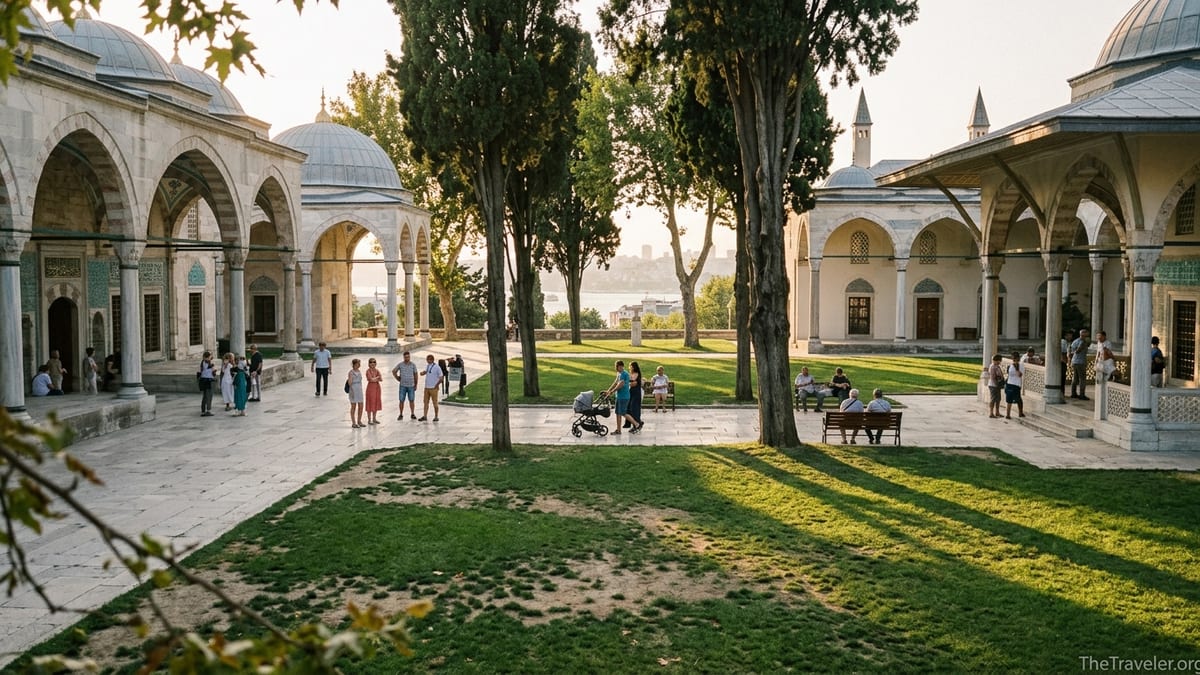
Most visitors picture a single ornate building when they think of a palace. At Topkapı, the first surprise is that there is no “one” palace at all. You walk through a series of vast courtyards and clusters of low, pavilion-like buildings spread across a headland that once controlled an empire. From the moment you pass security and emerge into the First Courtyard, it feels more like a walled city than a royal residence.
That sense of scale is heightened by sound and movement. On a typical morning around 9:15, just after opening, you might see a queue of group tours forming near the ticket control while school groups in matching caps stream in from buses parked outside the outer walls. Yet it is still possible to step to one side, under the shade of plane trees, and suddenly find yourself alone on a gravel path where gardeners push wheelbarrows and a cat stretches on a low wall. For a monument that welcomes well over a million visitors a year, those quiet pockets are disarming.
The geography is another surprise. On maps, Topkapı seems perched neatly above the Bosphorus, but in person you realize it commands three bodies of water at once: the Golden Horn, the Bosphorus, and the Sea of Marmara. Stand at the balustrade behind the Fourth Courtyard’s Baghdad Pavilion and ferries look like toy boats below, horn blasts drifting up from Karaköy and Eminönü. Many travellers report that they came for Ottoman history and left talking about the way Istanbul spreads out below the palace like a living relief map.
This physical layout matters for your visit. It is easy to underestimate how long it takes just to cross the grounds. Travelers who budget “an hour or two” for Topkapı are often surprised to find they have barely cleared the main palace kitchens and Audience Chamber when it is already time for lunch.
What the Ticket Really Buys You Now
Another unexpected twist: the ticketing structure has changed in recent years, and it is not always intuitive. As of early 2026, the standard foreign visitor ticket at the official gate is around 2,750 Turkish lira and now includes access to the Harem and the Imperial Treasury in one combined ticket. Hagia Irene, the echoing former church inside the outer grounds, is usually sold as a separate ticket, sometimes bundled in combination offers with the palace, depending on the reseller or pass you use.
For travelers arriving with out-of-date guidebooks that still treat the Harem as an add-on, this can cause a pleasant kind of confusion. One Canadian couple I spoke to in the Second Courtyard admitted they had skipped the Harem on their last visit years ago to save both money and time. This time, assuming it was still separate, they lined up at a smaller kiosk beside the Harem Gate only to discover their existing palace ticket already covered it. “We nearly walked past the best part without realizing it was included,” they said, clutching a free printed map that still made the ticketing sound more complicated than it now is.
The price itself is often an emotional surprise. At roughly the cost of a mid-range dinner for two in Istanbul, Topkapı has become one of the city’s most expensive single-site tickets for foreign visitors. On online forums, you can find exasperated travelers comparing the cost to the Vatican Museums or the Alhambra and wondering if it is “worth it.” But that same cost also nudges many people to slow down and use the ticket fully, lingering over the kitchens, the tulip-flecked tiles in the Circumcision Room, and the imperial portraits instead of treating the palace as a quick checklist stop between a Bosphorus cruise and a rooftop bar.
Another practical surprise: queues at the on-site ticket windows are not always as bad as their reputation. In low and shoulder seasons, arriving just before the 9:00 opening time can mean waiting only 10 or 15 minutes. In peak summer or on weekends, however, that line can stretch across the First Courtyard and cost you an hour you might rather spend in the gardens. That is where pre-booked guided tours or museum passes with line-access become less a luxury and more a way of buying back part of your day.
The Harem: More Intimate, Less Exotic Than Expected
The word “harem” encourages the wildest expectations, and Topkapı’s is no exception. Many visitors arrive expecting something between an Orientalist painting and a film set: velvet sofas, incense, perhaps a louche atmosphere. The reality is more human and more unsettling. Step through the Harem Gate and you discover a labyrinth of narrow corridors, modestly sized rooms, marble basins, and low, cushioned platforms framed by stained glass and Iznik tiles.
Recent restoration work has opened up new sections that were closed for decades, including parts of the concubines’ quarters that travelers are only now beginning to see. You move through courtyards where the sultan’s mother once managed the empire’s domestic politics, under ceilings painted with delicate tendrils of gold leaf and cobalt. In one room, the wall panels are so close to your face that you can see the uneven glaze puddled in the grooves of the tilework, reminding you that this was a handmade world, not a fantasy palace built from uniform, factory-made objects.
What most visitors do not expect is how cramped and controlled life here must have felt. In the Concubines’ Corridor, the windows are high and the light comes in at sharp angles. Some staircases are so steep and narrow that they force you to climb single file, touching the same smoothed stone that servants and royal women used for centuries. I watched a group of university students from Izmir go suddenly quiet as their guide explained that many of the women here would have arrived as teenagers from the Balkans or the Caucasus, their fate bound for years to these small, ornately decorated rooms.
It is in the harem that you feel the palace most as a lived space. The Second Courtyard, with its ceremonial fountain and grand kitchens, shows you the public face of the empire. The Harem shows you where those public decisions ended up in private: which children were born, which rivalries festered, which alliances were sealed behind carved wooden doors.
Unexpected Encounters With the Sacred and the Everyday
Beyond the Harem, another surprise awaits in the Pavilion of the Holy Mantle and Sacred Relics. Even secular visitors who came only for the architecture often find themselves moved here. The space is dim, hushed, and watched over by Quran recitations broadcast softly through hidden speakers. Here, relics associated with the Prophet Muhammad and early Islamic history are displayed in glass cases that draw a slower, more reverent crowd than the jewel-filled treasury next door.
There is also a contemporary surprise: the dress code. While the rest of Topkapı is relatively relaxed, the Holy Relics section enforces more conservative standards. Visitors in shorts or sleeveless tops are sometimes turned away or handed disposable cover-ups at the entrance. One summer afternoon, I watched a group of backpackers from Germany frantically knot scarves around their waists to comply. They had breezed through the palace gates in hiking shorts without issue but discovered only at this interior threshold that the rules changed.
In contrast, the old imperial kitchens offer a vivid sense of the everyday. This is where the palace’s 1,000-plus inhabitants once depended on a complex, almost industrial-scale cooking operation. Today, rows of giant copper cauldrons and rough brick domes stand in semi-darkness, lit by narrow slits high in the walls. Display cases show Chinese porcelain bowls ordered in bulk, Ottoman coffee cups, and sherbet vessels. It is an unexpected reminder that the sultans’ world, despite its silks and jewels, also ran on routine: stews simmering at dawn, bread baked by the hundreds, coffee poured late into the night.
Many travelers describe this sequence of spaces as a kind of emotional whiplash: one moment contemplating relics revered by millions, the next marveling at the logistics of feeding an imperial household, then stepping into courtyards where peacocks once strolled between tulip beds. Topkapı refuses to offer a single, tidy narrative. Instead, it offers overlapping worlds, each with its own textures and sounds.
Views, Gardens, and the Feeling That Istanbul Is Still the Capital
If you enter Topkapı thinking only about the Ottoman past, you may be caught off guard by how much the palace reframes present-day Istanbul. From the marble terrace near the Baghdad Pavilion, you can trace the ferry route from Karaköy to Üsküdar, watch container ships slip along the Sea of Marmara, and follow the tram lines as they slice through Sultanahmet’s hotel streets. The palace’s vantage points make it clear why this site was chosen as the seat of power: it is a 360-degree survey of the city and its waterways.
Gardens are another quiet surprise. Outside the busier exhibition halls, the Fourth Courtyard softens into a series of landscaped terraces with clipped hedges, small pools, and decorative pavilions. In April, tulip beds echo the sultans’ famous obsession with tulips, blooming in improbable shades of purple and near-black among the more familiar reds and yellows. In mid-summer, the lawns are less lush but the shade of old plane and cypress trees becomes precious. I watched an Istanbul family lay out simit and olives on a bench while their children chased each other along the gravel despite the “no running” signs.
The way visitors use these spaces today underscores a point many travelers miss: Topkapı is still woven into the city’s daily life. Locals meet friends in the First Courtyard, where entry is free and where you might see a bride and groom arriving for wedding photos, her gown trailing behind her on the stone. On a weekday afternoon, office workers from nearby Sirkeci duck in to eat takeaway köfte on a shaded wall before heading back to their desks. For them, the palace is not an isolated monument. It is a familiar backdrop, as present-tense as the tram bell clanging outside the gate.
All of this can shift your sense of Istanbul itself. After a few hours in Topkapı, the city ceases to be a blur of “East meets West” cliches and starts to look like what it always has been: a working capital, where container ships and tourists and local commuters all share the same narrow straits, overlooked by a hilltop complex that has been watching for half a millennium.
Practical Realities You Might Not Anticipate
On paper, visiting Topkapı seems straightforward: buy ticket, enter palace, wander through history. In practice, several aspects of the experience catch travelers by surprise. The first is the weekly closure. The palace is closed on Tuesdays, a detail that leaves a steady trickle of bewildered travelers standing outside the locked gate each week, peering through the bars at the lawns beyond while trying to reshuffle their itineraries.
The second is how exhausting the visit can be. Extensive walking, stone surfaces that radiate heat in summer, and a general lack of strong air conditioning in many historic rooms mean that three or four hours here can feel like a full day. In August, I met a couple from São Paulo leaning against a column in the Second Courtyard, sharing a bottle of water and laughing ruefully about their decision to do Hagia Sophia, the Basilica Cistern, and Topkapı in one continuous march, starting at 8 a.m. “We thought, three monuments, one neighborhood, easy,” they said. “By noon we were finished. And then realized we had not even seen the Harem yet.”
Another issue is signage. While recent improvements have added more English and Turkish information panels, some areas still feel under-explained, especially compared with major museums in Western Europe. That is one reason guided tours and audio guides remain popular. On a guided visit, a good guide can turn a nondescript doorway into the vivid story of a janissary patrol or a political crisis. Without that context, you may find yourself staring at a beautiful but baffling room, wondering why it matters. For independent travelers, downloadable audio apps and paper guidebooks picked up in Sultanahmet bookshops are a practical way to fill the gaps.
Security and crowd control can also surprise first-timers. Bag checks at the entrance are brisk but serious, and tripods or professional-looking camera gear are often refused without a special permit. Inside, stewards in navy jackets carefully funnel visitors through narrow rooms to avoid bottlenecks. At the Imperial Treasury, queues snake around display cases holding the Topkapı Dagger and the Spoonmaker’s Diamond. It can take 20 to 30 minutes just to shuffle past the most famous pieces at busy times, and photography is tightly restricted.
How to Time Your Visit for the Palace You Don’t Expect
Most first-timers arrive at Topkapı in the late morning, around 10:30 or 11:00, after a leisurely breakfast and a stroll past the Blue Mosque. That is exactly when the tour buses roll up and the ticket lines swell. To experience a different, more contemplative side of the palace, timing is everything. Arriving just before the 9:00 opening generally means cooler temperatures, shorter waits, and emptier courtyards. You can walk the length of the Second Courtyard while the dew is still lifting from the lawns and reach the Harem before it becomes a human bottleneck.
Late afternoon is the other sweet spot. The ticket office typically closes around 17:00 or 17:30 depending on the season, with the museum shutting an hour later. If you enter by about 15:30, you will still have time to see the key sections, and many large tour groups will already be gone. Light slants through the lattice windows of the harem in warmer tones, and the terraces take on a softer glow as ferries flash in the low sun on the Bosphorus. You may not have the place to yourself, but the atmosphere is noticeably less frantic.
Your route also shapes what you discover. Many visitors head straight for the Treasury or the Harem. Consider beginning instead with the outer courtyards and kitchens, then working inward to the sultan’s private rooms, the Baghdad Pavilion, and finally the terraces and gardens. This sequence gradually peels back the layers of ceremony and power, making the last lookout over the Bosphorus feel like the final reveal of what the palace’s location meant.
Finally, allow more time than you think. Three hours is a bare minimum if you want to see the Harem, treasury, sacred relics, and a few gardens without rushing. Four or even five hours, with breaks for tea at one of the modest palace cafes, will give you room to absorb the details: the way a corridor tilts slightly underfoot, the faint smell of old wood in the harem ceilings, the everyday scuffs on stone thresholds that no restoration can quite erase.
The Takeaway
Topkapı Palace resists easy comparison. It is not as architecturally unified as Versailles, nor as tightly curated as the Vatican Museums, nor as fortress-like as the Tower of London. Instead, it is something messier and more revealing: a stitched-together world of courtyards, pavilions, kitchens, relic rooms, and private chambers that together tell the story of an empire from the inside out.
What most surprises visitors is not a single highlight but a mood. It is the moment you find yourself alone for a few seconds in a tiled side room, hearing only distant footsteps and the faint horn of a ferry across the water. It is realizing that the harem is less about fantasy than about power and confinement. It is stepping out onto a terrace and seeing modern Istanbul spread below, suddenly understanding why this hill mattered so much to so many rulers.
If you arrive expecting a quick, photogenic stop between more famous sites, Topkapı will probably overturn that plan. The palace asks for time, context, and a willingness to wander, but it gives back something rare in return: the sense that you have stepped not just into a royal residence or a museum, but into the living idea of a capital city that still orbits around this hill. That, more than any individual jewel or tile, is the surprise that lingers after you walk back through the Imperial Gate and rejoin the noise of Istanbul outside.
FAQ
Q1. How long do I need to visit Topkapı Palace properly?
Most travelers find that three to four hours is the minimum to see the main courtyards, the Harem, the Treasury, and the Sacred Relics without rushing. If you like to linger over details, plan for closer to five hours with a break for tea or a light snack inside the grounds.
Q2. Is the Harem included in the standard ticket?
As of 2026, the standard foreign visitor ticket sold at the official ticket windows includes access to both the main palace and the Harem, along with key exhibition areas such as the Treasury. Hagia Irene, within the outer precinct, generally requires a separate ticket or a specific combination ticket.
Q3. Which day is Topkapı Palace closed?
Topkapı Palace is closed to visitors on Tuesdays. If you are planning a short stay in Istanbul, make sure to avoid scheduling your visit for that day, as the gates will be shut and the ticket offices closed.
Q4. What is the best time of day to visit to avoid crowds?
Early morning just after the 9:00 opening and late afternoon a couple of hours before closing are usually the calmest times. Mid-morning to early afternoon, especially in high season and on weekends, tends to be the busiest, with longer queues and more congestion in narrow areas such as the Harem and Treasury.
Q5. Do I need a guide, or can I explore on my own?
You can absolutely explore on your own, and many visitors do. However, because signage can feel sparse in places, a good licensed guide or a comprehensive audio guide can add a lot of context and help you understand why particular rooms and courtyards matter in Ottoman history.
Q6. Is there a dress code inside Topkapı Palace?
There is no strict dress code in most palace areas beyond standard respect for a historic site, but the Pavilion of the Holy Mantle and Sacred Relics expects more conservative clothing. Shorts above the knee and sleeveless tops may not be accepted there, and staff sometimes provide or request cover-ups at the entrance.
Q7. Can I take photos everywhere inside the palace?
Photography is allowed in many outdoor courtyards and some interior rooms, but restrictions apply in sensitive areas such as the Treasury and the Holy Relics section, where photography may be banned or tightly controlled. Tripods and professional-looking gear generally require prior permission and are often refused at the security check.
Q8. Are there places to eat or drink inside Topkapı Palace?
Yes, there are small cafes and kiosks inside the grounds where you can buy tea, soft drinks, and light snacks or simple meals. Prices are higher than on nearby streets in Sultanahmet, but the trade-off is the convenience of staying inside the palace and the views from some seating areas.
Q9. Is Topkapı Palace suitable for children and strollers?
Families visit regularly, and many children enjoy the open courtyards, gardens, and stories of sultans and palaces. However, the harem and some interior routes involve stairs, uneven stone floors, and narrow passages, which make them awkward for strollers. A lightweight, foldable stroller and a willingness to carry small children on some staircases are helpful.
Q10. Is Topkapı Palace worth the high ticket price?
For most visitors with an interest in history, architecture, or simply understanding Istanbul beyond its postcard views, the answer is yes. The combination of imperial courtyards, intimate harem spaces, sacred relics, and sweeping views over the city offers an experience that is hard to replicate elsewhere, especially if you allow enough time to explore beyond the main highlights.