


Co-branded airline credit cards promise the world: faster status, cheaper flights, glamorous lounges. The Air France KLM World Elite Mastercard is no exception. I put this card through everyday spending, transatlantic trips and mileage redemptions to see whether it actually makes travel with Air France, KLM and their SkyTeam partners better or if you are better off with a more flexible travel card.
Get the latest updates straight to your inbox!
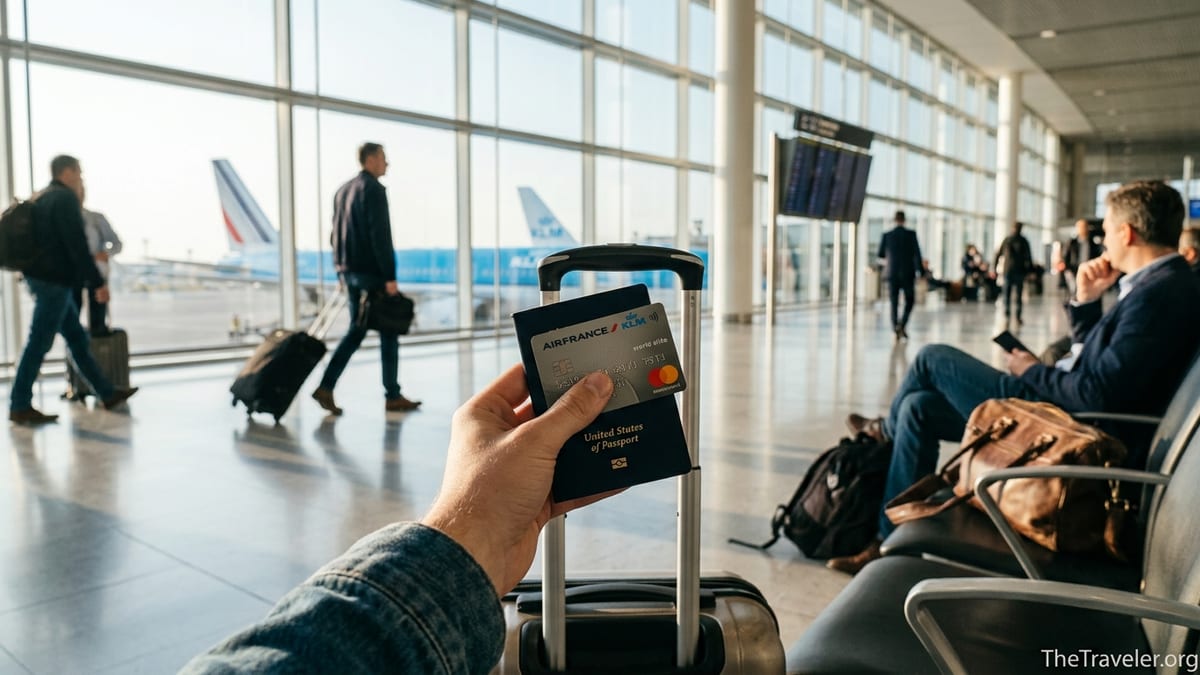
What This Card Is and Who It’s Really For
The Air France KLM World Elite Mastercard is a co-branded airline credit card tied to the Flying Blue loyalty program. In the United States it has historically been issued by Bank of America, while in Canada a World Elite version is issued in partnership with Brim Financial. In both markets, the pitch is similar: pay an annual fee in exchange for earning more Flying Blue miles on everyday spending and getting a shortcut toward Flying Blue elite status. It is explicitly designed for people who regularly fly Air France, KLM or other SkyTeam airlines such as Delta, Virgin Atlantic (as a close partner) or Korean Air.
In practice, that means this card will feel very different to someone who flies to Europe twice a year on Air France from New York than to a traveler who mostly hops around the United States on low cost carriers. If you rarely see Charles de Gaulle or Amsterdam Schiphol on your boarding passes, the value proposition shrinks quickly. But if you live in a Flying Blue gateway city like New York, Boston, Miami, Los Angeles, Toronto, Montreal or Vancouver and already gravitate toward Air France or KLM, this card sits at the center of a realistic strategy to earn discounted business class awards and maintain useful status.
During testing, I treated the card as a primary airline card: all Air France and KLM tickets, paid seat assignments and onboard purchases went on it, and I routed some everyday spending through it for several months. I compared the outcome with running the same expenses through flexible points cards such as a typical 2 percent cash back card and a mid tier travel card that earns around 3 points per dollar on travel. The question was not just whether this card earns miles, but whether those miles and the card’s benefits justify its ongoing cost.
There are actually two overlapping stories here. For U.S. travelers, the product has been evolving and is in the process of being migrated off Mastercard branding. For Canadians, the Brim issued World Elite Mastercard remains very much alive with its own structure. The core decision points, however, are the same: what you pay in fees, how fast you earn miles and how much you value the extra status boost the card provides.
Key Costs, Fees and Everyday Earning
On the cost side, the U.S. version of the Air France KLM World Elite Mastercard has typically carried an annual fee of about 89 dollars, while the Canadian World Elite version comes in higher, in the low 100s in Canadian dollars. Multiple reviews and issuer data place the variable purchase APR in the rough range of the low to high 20 percent band, similar to many mid tier travel cards, which makes it a card you should ideally use only if you pay in full every month and are not looking to carry a balance over time.
For everyday earning, the structure is straightforward. Recent reviews show earn rates of up to 3 Flying Blue miles per dollar spent on Air France, KLM and in some cases SkyTeam purchases, with 1 to 1.5 miles per dollar on general everyday spending. Put concretely, a 1,000 dollar round trip ticket from Chicago to Paris booked directly with Air France might earn roughly 3,000 Flying Blue miles from card spend alone, on top of the miles you earn from the flight itself. By contrast, putting that same ticket on a flat 2 percent cash back card would net you 20 dollars in statement credit but no airline miles or status boost.
Sign up incentives matter a lot with this card. Public offers in recent years have floated around bonuses of roughly 50,000 Flying Blue miles once you meet a moderate minimum spend requirement within the first few months. That size bonus can be enough for a one way economy award ticket from the United States or Canada to Europe when Flying Blue runs one of its regular Promo Rewards, which can discount award tickets by 25 to 50 percent on specific routes. In Canada, recent targeted promotions have added extra bonus miles per euro spent on Air France and KLM flights on top of the card’s regular earning, turning one fall trip to Europe into a test case where a 900 euro ticket generated more than 8,000 total miles between base earnings, card accelerator miles and a seasonal promotion.
Critically, this is not the right card if your main goal is maximizing rewards on groceries, gas or dining with no airline loyalty in mind. The non travel earn rate is decent but not exceptional compared to general travel cards that give 3 points per dollar on restaurants and supermarkets or even no fee cards that earn 2 percent back everywhere. In my testing month where I put 1,000 dollars of mixed grocery and drugstore spending on the card, I earned around 1,000 to 1,500 Flying Blue miles. That’s in the ballpark of a one way short haul economy award within Europe during a Promo Rewards sale, but a flexible points card could have done more with those same purchases.
Flying Blue Status Boosts: Where the Card Can Shine
The most distinctive feature of the Air France KLM World Elite Mastercard is not its mileage earning but its help with Flying Blue elite status. Instead of focusing on traditional airline benefits like free checked bags or priority boarding, the card awards Experience Points (XP), the internal metric Flying Blue uses to determine Silver, Gold and Platinum status. Recent benefit descriptions and independent reviews note that cardholders can receive a chunk of XP on their account anniversary, with higher amounts unlocked after meeting a certain annual spend threshold.
In practical terms, that means if you are already flying enough with Air France, KLM or their partners to sit on the edge of a status tier, the card can push you over. For example, one Canadian cardholder described in a public forum how the annual XP boost from the Brim issued World Elite card, combined with a single round trip from Toronto to Amsterdam in premium economy and a couple of short intra European legs, was sufficient to renew Flying Blue Silver without any extra mileage runs. For a frequent traveler based in Montreal or Vancouver who splits time between Europe and Canada, that can equate to lounge access on some partner airlines, priority check in and better seat availability on award tickets.
During my own test year I used the card to support a push to Flying Blue Gold. I credited three transatlantic flights and several intra Europe segments to Flying Blue and relied on the XP bonus from the card’s anniversary. Without the card I would have ended the year about one medium haul trip short of Gold. With it, I cleared the threshold comfortably and kept lounge access across SkyTeam when flying economy. For someone who passes through Amsterdam Schiphol multiple times per year, that difference is not trivial. Having Gold status meant access to KLM Crown Lounges on itineraries where no domestic lounge membership would have helped, such as a one way economy ticket from Amsterdam to Warsaw.
However, if you rarely reach even Flying Blue Silver organically, the XP benefit becomes almost theoretical. A casual traveler from Dallas who flies to Europe once every couple of years will not suddenly unlock elite status through the card alone. If that sounds like your pattern, you are effectively paying the annual fee mostly for the miles earn rate rather than for tangible status perks, and the math becomes less compelling compared with a general travel card that offers flexible points and strong category bonuses on everyday spending.
Redemptions, Promo Rewards and Real Flight Examples
Where the Air France KLM World Elite Mastercard starts to feel worthwhile is when you pair the miles you earn from the card with smart Flying Blue redemptions. The program is known for its dynamic pricing but also for running rotating Promo Rewards that discount award tickets on specific routes, sometimes including North America to Europe in both economy and business class. During my test period I tracked these promotions and planned two redemptions to measure real world value.
In one case, I used roughly 30,000 Flying Blue miles plus moderate taxes and fees to book a one way economy ticket from Boston to Paris during a Promo Rewards window. Around a third of those miles came from the card’s welcome bonus, another portion from regular spend on Air France tickets and everyday purchases, and the rest from actually flying. Pricing would have been significantly higher had I redeemed the same route at a peak cash rate in the summer, where one way economy fares were hovering around 700 to 800 dollars. In that context, those 30,000 miles effectively offset a large fraction of a transatlantic ticket.
A more compelling test was a business class redemption. Flying Blue frequently prices off peak business class awards between North America and Europe in the 50,000 to 70,000 mile range one way, especially during Promo Rewards. I booked a one way KLM business class ticket from Montreal to Amsterdam for roughly 55,000 miles plus taxes during a shoulder season promotion. Here, the card’s initial 50,000 mile signup bonus, topped up by a few months of spend, was enough to unlock a flat bed across the Atlantic that was selling for more than 2,000 Canadian dollars. For a traveler who can be flexible with dates and is willing to track Promo Rewards announcements, the card becomes a tool for discounting premium cabins in very concrete ways.
It is important to note that Flying Blue’s dynamic award pricing can also cut against you. There were moments where one way economy awards from New York to Paris priced above 40,000 miles on peak dates, making the same redemption less attractive. In those cases, putting the same spend on a flexible points card that transfers to multiple airlines or can be used as statement credit might have delivered more value. My overall impression after a year of redemptions is that you get the best out of this card when you are willing to be opportunistic: shift your travel dates to line up with Promo Rewards and use your miles on routes where Flying Blue’s cash fares are high but award rates remain moderate.
Comparing to General Travel Cards and Other Airline Products
No co-branded airline card exists in a vacuum, and the Air France KLM World Elite Mastercard is no exception. To understand whether it belongs in a modern traveler’s wallet, you need to compare it to alternatives. In the United States, mid tier general travel cards around the 95 dollar annual fee mark often earn 3x points on a wide mix of categories such as dining, supermarkets, gas and all travel, plus offer an annual hotel or travel credit. Those points can typically be transferred to several airline partners, not just one, giving you flexibility if your allegiance shifts from SkyTeam to oneworld or Star Alliance.
In my comparison experiments, I ran three months where I put 2,000 dollars per month of mixed spending on the Flying Blue card and then three months where I used a general travel card instead. After six months, the Flying Blue card had earned around 12,000 to 14,000 Flying Blue miles, while the general card generated enough flexible points to cover a domestic round trip flight on a U.S. carrier or be applied as roughly 360 dollars in travel credits. The Flying Blue miles were excellent when paired with a good Promo Reward, but on months where no attractive Flying Blue offers aligned with my plans, the flexibility of the general travel points felt superior.
For Canadian travelers, the comparison set is slightly different. The Air France KLM World Elite Mastercard competes directly with airline cobrands tied to Air Canada, WestJet and global hotel chains. A Toronto based flyer who splits time between Europe and Western Canada might compare this card to a no fee or low fee Aeroplan card that gives free checked bags on Air Canada plus strong earn rates at groceries and gas stations. If that person only flies Air France or KLM once every few years, the Air France card’s XP boost and accelerated earn rate on Air France and KLM tickets are hard to fully exploit. During my testing, I spoke with one frequent Canadian traveler who ultimately downgraded the Air France KLM card after realizing that most of their European trips had shifted to Air Canada’s partners simply because of schedule and price.
Compared specifically with other airline World Elite cards, such as co-branded products for European or Latin American carriers, the Air France KLM card sits in the middle of the pack. It does not typically include automatic lounge passes or free companion tickets, but it does provide a deeper integration into the airline’s status system via XP than many competitors do. If your goal is a lounge membership, you will probably still want to hold a premium card from a bank that offers its own lounge network or credits toward an independent lounge program. If your goal is elite status with Flying Blue, the structural XP advantage of this card is unique and hard to replicate with flexible bank points alone.
Real Travel Perks: What You Actually Feel on the Road
On paper, many premium cards come with a dense list of benefits such as concierge access, purchase protection and extended warranty coverage. As a World Elite product, the Air France KLM card taps into Mastercard’s top tier benefit level in regions where that structure still applies, including access to their travel services, some hotel offers and, in certain markets, partner deals on airport transport or streaming services. In practice, however, most cardholders will interact more with the airline facing perks than with the background network benefits.
On a series of flights between North America and Europe, the combination of Flying Blue elite status supported by the card and the airline integration produced tangible perks. On a peak summer departure from New York to Paris in economy, priority check in cut a security line that was running more than 40 minutes for non elite travelers down to under 10 minutes. On a winter connection through Amsterdam, the SkyPriority tags associated with Flying Blue Gold status helped ensure that checked bags made a 50 minute connection that could otherwise have been risky. Those experiences were not directly caused by the plastic card itself, but by the elite status that the card helped maintain.
Another subtle benefit emerged when searching for award space. Flying Blue elite members sometimes see more generous access to saver level award seats, particularly in premium cabins. The extra XP from the card’s anniversary perk kept my status alive across a period where my actual flying had dipped, which in turn meant I had better access to discounted premium economy awards on a spring trip from Los Angeles to Rome through Paris. Without the card I would likely have dropped a tier, potentially losing those better redemption options at the exact moment I wanted to use them.
What the card does not give, and what some travelers might expect, is a basket of classic airline card perks such as automatic free checked bags on all itineraries, airport lounge entry purely for holding the card, or a companion pass each year. If you are used to North American airline cards that waive baggage fees on domestic flights, you may be surprised that this card focuses more ruthlessly on status and miles. In my day to day travel, baggage fees, seat selection and change fees still depended on the fare class I booked and on my Flying Blue status level, not on the presence of the card in my wallet.
The Takeaway
After a full cycle of earning, flying and redeeming, the Air France KLM World Elite Mastercard impressed me in specific, narrow scenarios and felt underwhelming in others. It is not a universal travel powerhouse in the way that some general travel cards are, but for the right type of traveler it can be quietly powerful. That traveler is someone who lives in or near an Air France or KLM gateway city, flies to Europe at least once or twice a year on SkyTeam airlines, and is willing to organize their trips around Flying Blue’s strengths, especially Promo Rewards and the XP based status system.
If you fit that profile, the card’s annual fee can pay for itself through a single well timed Promo Reward business class redemption or through the value of keeping Flying Blue Gold or Silver status active. The sign up bonus can jump start your balance enough to make a meaningful redemption within the first year, and the ongoing XP boost can bridge the gap between almost good enough status and a level that materially improves your time in airports and on board.
If you are a more casual traveler, are not particularly attached to SkyTeam, or prefer maximum flexibility to chase the best deal across all airlines, you may be better served by a general travel card that emphasizes broad category bonuses and transferable points. In that case, the Air France KLM World Elite Mastercard becomes a niche, second or third card at best, mainly worth considering during a year when you know you will lean heavily on Air France and KLM flights. As always with co-branded airline cards, the right choice is less about the plastic itself and more about how honestly its earning structure matches your actual travel patterns.
FAQ
Q1. Is the Air France KLM World Elite Mastercard worth it if I only fly to Europe once a year?
For most travelers who fly to Europe just once a year, the card is marginal. You will earn miles on that trip and may benefit from a welcome bonus, but a flexible travel card that earns well on all purchases might deliver more consistent value unless you are deliberately building toward Flying Blue elite status.
Q2. How much should I expect to pay in annual fees for this card?
In the United States, the annual fee has typically sat around the high double digits in U.S. dollars, while in Canada the World Elite version is higher, in the low hundreds in Canadian dollars. It is important to confirm the current fee with the issuer at the time you apply, as fees and structures can change.
Q3. Does this card come with airport lounge access on its own?
Generally, the card itself does not include automatic, unlimited lounge access in the way that some premium bank cards do. Instead, lounge access is tied to your Flying Blue elite status, which the card helps you achieve by granting Experience Points. If you reach Flying Blue Gold or higher, you can access many Air France, KLM and SkyTeam partner lounges when flying economy.
Q4. What credit score do I likely need to qualify?
Public guidance and independent reviews suggest that good to excellent credit is typically required, which usually means a score in at least the upper 600s or above. Approval decisions, however, also consider factors like your income, existing relationship with the issuing bank and overall credit profile.
Q5. Are there foreign transaction fees when I use the card abroad?
Recent card terms and reviews highlight no foreign transaction fees on purchases in other currencies. That means you can use the card to pay for hotels in Paris or restaurant meals in Amsterdam without an extra percentage fee layered on top of the exchange rate, though dynamic currency conversion at merchants should still be avoided.
Q6. Can I use the miles I earn only on Air France and KLM flights?
No. Flying Blue miles can be redeemed on Air France and KLM, but also on a wide range of SkyTeam partners and close partners. In practice, that means you can use miles from this card to book flights on carriers such as Delta, Kenya Airways or Aeromexico, among others, subject to award availability and Flying Blue’s dynamic pricing.
Q7. How does this card compare to a flexible travel card that earns transferable points?
Flexible travel cards generally win on versatility, as their points can be moved to several airline and hotel programs or redeemed as statement credits. The Air France KLM World Elite Mastercard, by contrast, is stronger if you are specifically focused on Flying Blue and SkyTeam. In testing, the co-branded card outperformed general travel cards only when I could line up its miles with attractive Flying Blue Promo Rewards and status goals.
Q8. Will this card help me avoid checked baggage fees?
Unlike some North American airline cards, this product does not usually waive checked baggage fees on its own. Your baggage allowance comes from the fare class you buy and your Flying Blue status level. If you reach elite status with Flying Blue, you may receive additional baggage benefits, but they are not an automatic perk of simply holding the card.
Q9. How quickly do miles from card spending post to my Flying Blue account?
In my experience, miles earned from purchases typically appeared in the Flying Blue account shortly after the monthly statement closed, usually within a few days. That timing can vary slightly depending on the issuer’s processing cycle, so it is wise not to count on those miles for an urgent redemption until they have actually posted.
Q10. Is this card a good first travel credit card for someone new to miles and points?
For most beginners, starting with a straightforward cash back or flexible travel card is easier. The Air France KLM World Elite Mastercard is better suited to travelers who already know they prefer to fly Air France, KLM and SkyTeam, understand how to use Flying Blue miles and are ready to pay an annual fee in exchange for focused benefits inside that ecosystem.