


The Lufthansa Miles & More World Elite Mastercard is a niche credit card that often flies under the radar in the United States. Marketed as the primary way for U.S.-based travelers to earn Lufthansa Miles & More miles without stepping on a plane, it promises a big welcome bonus, annual companion ticket and lounge vouchers. I put the card through real-world tests on transatlantic trips, everyday spending and mileage management to see whether it actually deserves space in a traveler’s wallet.
Get the latest updates straight to your inbox!
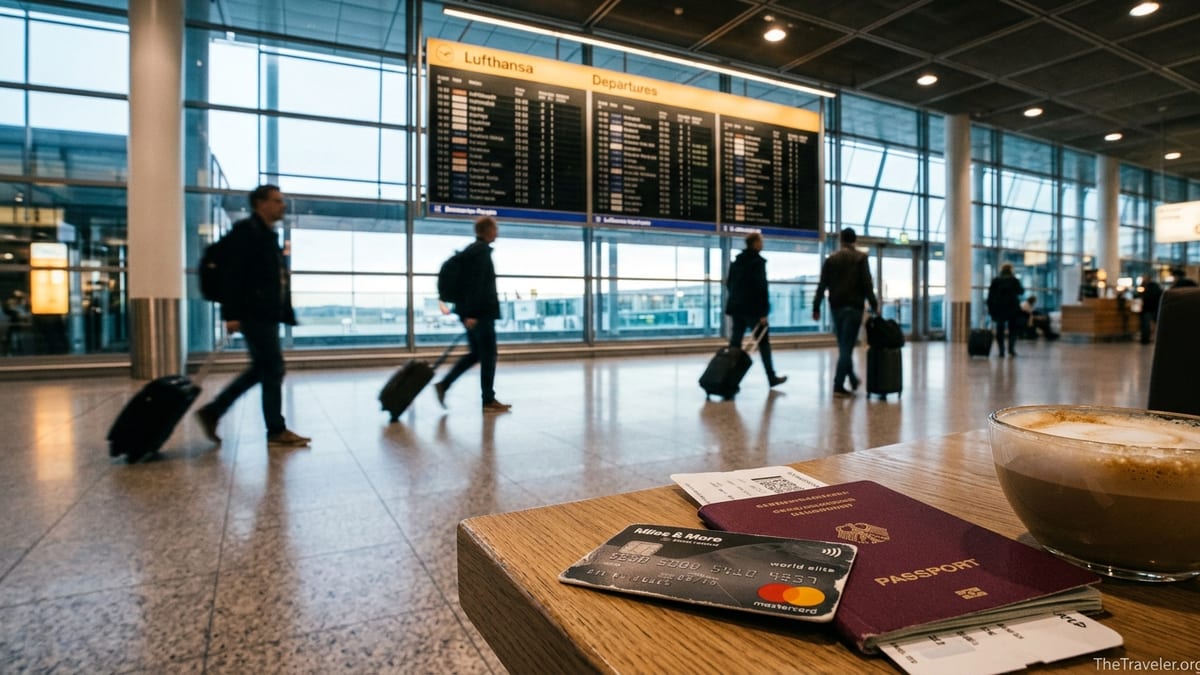
Card Basics: What You Actually Get
The Lufthansa Miles & More World Elite Mastercard, issued in the U.S. by Barclays, is a co-branded airline card tied directly to Lufthansa’s Miles & More program. The annual fee sits around the 90 dollar mark and is not waived in the first year for most cardholders. However, travelers with high Miles & More elite status, such as Senator or HON Circle members, may have the annual fee waived as long as they maintain that status, which can be valuable for very frequent Lufthansa flyers.
The main headline feature is the welcome offer. At the time of testing, the public offer was in the range of 60,000 Miles & More miles after meeting a minimum spend of roughly 3,000 dollars in the first 90 days and paying the annual fee. Exact bonuses change over time and targeted offers can be higher, but this ballpark is typical. For a U.S. traveler, that amount of Miles & More miles is enough for a one way business class ticket on Lufthansa between the U.S. East Coast and much of Europe during off peak pricing, plus taxes and surcharges, or a round trip in economy on many partner routes if you find saver space.
Day to day earnings are straightforward. You earn 2 miles per dollar spent on ticket purchases directly from Miles & More integrated airlines such as Lufthansa, SWISS, Austrian Airlines, Brussels Airlines and Eurowings, and 1 mile per dollar on all other purchases. There are no broad bonus categories like dining or groceries, which makes the card weaker as a general everyday spender compared with popular U.S. travel cards that earn three or more points per dollar in multiple categories.
One positive for international travelers is that the card charges no foreign transaction fees. That means you can use it in Germany for a hotel bill in Munich, a restaurant in Vienna or a train ticket in Zurich and pay only the currency conversion rate, not an extra 3 percent fee that many non-travel cards still impose. For anyone who travels to Europe even once a year, avoiding those charges can easily offset a chunk of the annual fee.
Real-World Earn & Burn: What My Test Trips Revealed
I tested the card on a typical U.S. to Europe itinerary: a round trip in economy from New York to Frankfurt on Lufthansa during shoulder season, booked directly with the airline at about 900 dollars all in. Charging the ticket to the Miles & More Mastercard generated roughly 1,800 miles from the 2x earning on Lufthansa purchases. The same flight itself, credited to Miles & More, earned around 3,000 to 4,000 miles depending on fare class, so the card’s contribution was a meaningful but not life changing boost.
For comparison, putting the same 900 dollar airfare on a general travel card that earns 5x points on flights booked through a bank’s portal or 3x on airfare could generate 2,700 to 4,500 flexible points that transfer to multiple airlines. In that scenario, the Lufthansa card’s 1,800 miles looks less impressive. The key difference is that Miles & More miles are difficult to earn in the U.S. through any other channel, as major cards like Chase Sapphire, Amex Membership Rewards and Capital One do not transfer directly into the program. If you specifically want Miles & More miles, this card is effectively your main tool.
I also used the card for a month of mixed everyday spending in the U.S.: groceries, gas, rideshare trips, streaming subscriptions and a few restaurant meals, totaling about 2,000 dollars. That spend generated just 2,000 Miles & More miles at the flat 1x rate. By contrast, a popular mid-tier travel card that earns 2x on everything would have produced 4,000 transferrable points for the same purchases. After a few billing cycles, the pattern was clear: this card is a targeted earning tool for Miles & More, not a general workhorse for all travel spend.
On the redemption side, I tested booking a one way business class award from Chicago to Frankfurt. Saver level pricing for a Miles & More business award on Lufthansa metal often hovers around 56,000 to 70,000 miles one way, plus several hundred dollars in taxes and carrier surcharges. In my case, I was quoted roughly 56,000 miles plus around 650 dollars in taxes and fees. Using most of the welcome bonus for a lie flat business seat across the Atlantic felt rewarding, but the high surcharges meant I had to value the experience, not pure cash savings. Someone who primarily wants to minimize out of pocket costs might find better value redeeming flexible points for partner airlines with lower fees.
The Companion Ticket & Lounge Vouchers: Perks or Window Dressing?
One of the most eye catching features on the marketing materials is the annual companion ticket you receive on each account anniversary. In practice, this is a paper or electronic voucher that lets you bring a second passenger on a paid itinerary on Lufthansa Group airlines, with the base fare for the companion waived. You still pay all taxes, airport charges and fuel surcharges for the second passenger, which can be substantial on transatlantic flights.
To see whether it is actually valuable, I priced a summer trip from Newark to Munich for two adults in economy. A sample fare search for July showed a round trip price of about 1,200 dollars per ticket, so 2,400 dollars total without a companion voucher. Using the companion certificate, the primary passenger still pays the full 1,200 dollar fare, while the companion’s base fare is dropped but taxes and fees remain. On these routes, taxes and surcharges can easily run 300 to 400 dollars per ticket. The actual savings on the second passenger came out closer to 700 to 800 dollars instead of the full 1,200 dollars. That is still a solid discount, but not a free ticket.
There are also important restrictions. Companion tickets often require round trip travel on Lufthansa operated flights, certain fare classes and departures from specific countries. They may not be useable on the lowest promotional fares you see during flash sales. In my testing, the tool occasionally defaulted to higher fare buckets when overlaying the companion pass, which could eat into the apparent savings. For a couple that flies Lufthansa once a year at predictable times, the benefit can more than offset the annual fee. For infrequent or highly price sensitive travelers who chase the absolute cheapest fare, the value is far less reliable.
The card also grants two complimentary Lufthansa Business Lounge vouchers each year. I used one in Frankfurt on a layover between an early morning arrival from the U.S. and a midday connection within Europe. At the entrance, I presented the lounge voucher and a same day Lufthansa boarding pass. Inside, there were hot breakfast options, self service drinks, workspaces and showers. Regular access to this lounge would normally require a business class ticket or elite status, so getting two passes per year is a pleasant extra, particularly on long connection days. However, if you already hold a premium card like an American Express Platinum that can grant access to many Lufthansa lounges in certain circumstances, the incremental value of these two vouchers drops.
Mileage Expiration: The Hidden Reason This Card Matters
Lufthansa’s Miles & More program is notorious for relatively strict mileage expiration rules. For non status members who do not hold a qualifying Miles & More credit card, miles typically expire 36 months after they are earned, on a rolling schedule, regardless of account activity. That means a batch of miles earned from a 2023 flight can quietly vanish in 2026 even if you continue flying occasionally, unless you meet specific criteria.
The U.S. Miles & More Mastercard has a powerful but often misunderstood benefit: as long as you have held the card for at least three months and make at least one qualifying purchase each month, your award miles in the Miles & More account are protected from expiring. In practical terms, a simple recurring charge, such as a streaming subscription or mobile phone bill, posted to the card every month can safeguard a large mileage balance that might otherwise start disappearing.
In my testing, I set up a small recurring payment of around 10 dollars on the card and monitored my upcoming miles expiration notices in the Miles & More account dashboard. After a few months of continuous card activity, the previously listed expiration dates for older miles disappeared and were replaced with messages noting that miles were protected due to the co-branded credit card. That peace of mind is particularly useful for travelers who accumulate miles sporadically from occasional European trips and do not always redeem quickly.
For comparison, some U.S. programs have moved to no expiration policies for active members or have more flexible “24 months of activity” rules. With Miles & More, the credit card or elite status is often the only practical way for U.S. based travelers to keep a large balance alive long term. If you have 100,000 or more miles from past flights or promotions, the card can function as inexpensive insurance against losing that value.
Status Boosting & Who Actually Benefits
Another feature that looks intriguing on paper is the ability to convert some of your earned miles from purchases into status qualifying points once per calendar year. In the current structure, you can convert between 5,000 and 25,000 Miles & More award miles into a combination of points and qualifying points that count toward elite status. For example, converting 5,000 miles might yield 20 points plus 20 qualifying points, with larger conversions scaling up the total.
In practice, this is most attractive for travelers who are already flying Lufthansa Group carriers regularly and are on the cusp of qualifying for or requalifying for a tier such as Frequent Traveller or Senator. Imagine a consultant based in Chicago who flies to Frankfurt or Zurich on client work six to eight times per year and ends the year a few dozen points short of the next status level. Converting 20,000 miles from card purchases into status points could push them over the line, granting lounge access, priority services and extra baggage on future trips.
For the average leisure traveler who flies to Europe once every year or two, this benefit is far less useful. You would need to charge significant spending to the card to accumulate enough miles to convert, and even then you might remain well below the thresholds required for meaningful status. In my tests as an occasional Lufthansa flyer, the numbers did not justify using the card as a primary spending tool purely for status chasing; a couple of extra flights or a targeted mileage promotion would move the needle much more.
Still, for a narrow segment of high value, Lufthansa loyal travelers who do not have access to strong corporate contracts or premium cabin tickets, the status conversion feature is a unique lever that U.S. bank cards generally do not offer with other foreign airline partners.
How It Stacks Up Against Popular U.S. Travel Cards
To understand whether the Lufthansa Miles & More Mastercard belongs in a U.S. wallet, it helps to compare it directly against mainstream alternatives. Consider a traveler who spends around 20,000 dollars per year on a mix of travel and everyday expenses and takes one or two trips to Europe annually. Putting all of that spending on the Lufthansa card would generate about 22,000 Miles & More miles in a year, assuming a blend of some airline tickets at 2x and the rest at 1x.
By contrast, a flexible travel rewards card with a similar or slightly higher annual fee might earn 3x points on flights, 3x on dining and 1x or 2x on other purchases. The same 20,000 dollars in spend could easily produce 30,000 to 40,000 transferrable points that can be redeemed across multiple airline partners, often with lower taxes and fees on award tickets. Those transferable points might also be used for domestic trips on U.S. carriers, hotel stays or even statement credits, options that simply do not exist within the more limited Miles & More ecosystem.
Where the Lufthansa card becomes compelling is precisely where these flexible cards fall short: direct, concentrated access to Miles & More miles. If your dream trip is a First Class experience on Lufthansa from the U.S. to Frankfurt with a visit to the famed First Class Terminal, or if you frequently fly niche routes within Europe on smaller Lufthansa Group carriers, collecting Miles & More miles can unlock award space that partner programs rarely see. In that situation, the card’s welcome bonus plus some targeted spend can be worth the tradeoff of lower earning rates elsewhere.
Another comparison point is foreign transaction fees. Many no annual fee cards in the U.S. still charge around 3 percent on foreign purchases. On a 3,000 dollar vacation in Europe, that is about 90 dollars in extra fees, almost equivalent to the Lufthansa card’s annual fee. If your alternative card lineup consists mainly of such products, consolidating foreign purchases on the Miles & More Mastercard could make financial sense, while also building a specialized mileage balance.
Who Should Get This Card & Who Should Skip It
After several months of use, a few clear profiles emerged where the Lufthansa Miles & More Mastercard genuinely fits. First, there are the committed Lufthansa and Star Alliance travelers whose flights often involve Lufthansa Group carriers and who want deep access to Miles & More award space, especially in premium cabins. For these travelers, the card is almost a prerequisite, as bank transfer partners do not fill the gap. The combination of a sizeable welcome bonus, annual companion ticket, lounge vouchers and mileage protection can easily justify the fee.
Second, the card makes sense for U.S. based travelers who already hold large stashes of Miles & More miles from previous flying, European residence or prior co branded cards. Without elite status, those miles are at risk of expiring after 36 months. In this situation, the card functions as a safeguard: a modest recurring charge each month can save tens of thousands of miles from disappearing. If you value your miles at even one cent each, protecting 50,000 miles is akin to shielding 500 dollars worth of travel.
On the flip side, casual travelers who simply want to visit Europe once in a while and do not care which airline they fly are usually better off with a broad U.S. travel card. Flexible currencies offer more partners, fewer constraints on award space and often richer earning structures on common spending categories. Someone who primarily travels domestically or across North America, with only occasional Lufthansa flights, will struggle to get more value from this card than from a solid, no foreign transaction fee competitor.
The card also may not be ideal for hardcore points enthusiasts who constantly chase the highest possible return on every dollar. The flat 1x on most purchases and 2x on Lufthansa tickets cannot compete with occasional 4x or 5x category bonuses offered by many popular U.S. banks. For this group, the Lufthansa card is best seen as a temporary tool: open it when the welcome bonus is attractive, meet the minimum spend, use the miles for a specific aspirational redemption and then downgrade or cancel if long term value is lacking.
The Takeaway
Testing the Lufthansa Miles & More World Elite Mastercard in real travel scenarios confirmed what its fine print suggests: this is a specialized instrument, not a universal solution. It shines most brightly for travelers who are already tied to the Lufthansa ecosystem or who place a premium on accessing Miles & More specific award space, particularly in business or first class on Lufthansa Group airlines.
The welcome bonus can fund a memorable transatlantic trip, the companion ticket can meaningfully reduce the cost of annual Europe flights for couples, and the lounge passes smooth the rough edges of long connection days. Hidden beneath those headline perks, the mileage expiration protection quietly delivers some of the most practical value, especially for U.S. based members with older balances approaching the 36 month deadline.
Yet the card’s weak everyday earning structure, limited bonus categories and relatively high surcharges on many award tickets mean it is not the best first travel card for most U.S. consumers. Flexible bank points, paired with a card that also waives foreign transaction fees, will better serve the majority of occasional international travelers.
If you are deeply invested in Lufthansa and Miles & More, or if you have a specific plan to use a large chunk of miles in the next couple of years, the Lufthansa Miles & More Mastercard can be a savvy, focused addition to your wallet. If not, your travel budget and reward strategy will likely go further with a more versatile card. In that sense, I tested it so you do not have to, and the verdict is clear: powerful in the right hands, but unnecessary for most.
FAQ
Q1. Is the Lufthansa Miles & More Mastercard worth it for a first time travel card?
For most U.S. travelers, no. It is a niche card designed for people who specifically want Lufthansa Miles & More miles. A flexible travel card that earns points transferable to multiple airlines is usually a better choice as a first travel rewards card.
Q2. How big is the typical welcome bonus on the Lufthansa Miles & More Mastercard?
Public offers often hover around 60,000 miles after meeting a minimum spending requirement in the first 90 days, though promotions can change over time. Targeted offers to specific customers may occasionally be higher.
Q3. Does the Lufthansa Miles & More Mastercard charge foreign transaction fees?
No. The card does not charge foreign transaction fees, so purchases made abroad in euros or other currencies will not incur the typical 3 percent surcharge many non travel cards still add.
Q4. How does the companion ticket from the card actually work?
Each year after your account anniversary, you receive a companion voucher valid on certain paid round trip Lufthansa Group flights. The primary passenger pays the full fare, while the companion’s base fare is waived but taxes, airport charges and carrier surcharges still apply.
Q5. Can this card really stop my Miles & More miles from expiring?
Yes, if you have held the card for at least three months and make at least one qualifying purchase each month, your Miles & More award miles are generally protected from expiring under standard rules. If you stop using the card, normal expiration terms can return.
Q6. Is the card good for everyday spending in the United States?
It works, but there are stronger options. The card earns 1 mile per dollar on most purchases and 2 miles per dollar on tickets from Miles & More airlines, which is less generous than many U.S. cards that offer higher multipliers on dining, groceries, gas and general travel.
Q7. How valuable are the two Lufthansa lounge vouchers that come with the card?
They can be very useful if you have one or two long layovers per year in airports like Frankfurt, Munich or Zurich. Each voucher grants access to a Lufthansa Business Lounge when you hold an eligible same day boarding pass, providing food, drinks and a quieter place to wait.
Q8. Who gets the annual fee waived on the Lufthansa Miles & More Mastercard?
Certain top tier Miles & More elite members, such as Senator or HON Circle members, can have the annual fee waived as long as they maintain their status. Most everyday travelers will still pay the standard annual fee.
Q9. Is this card a good way to earn status with Lufthansa?
It can help at the margins. You can convert some earned miles from purchases into status qualifying points once per year, which is useful if you are already close to a status threshold. For most travelers, however, flying more or taking advantage of promotions is a more effective path.
Q10. Should I keep this card long term or just for the bonus?
It depends on your travel profile. If you regularly fly Lufthansa, value the companion ticket and need mileage protection, holding the card long term can make sense. If you rarely fly Lufthansa and mainly wanted the welcome bonus, you may find better ongoing value in other travel cards after redeeming your miles.