


More news on this day
Europe’s new biometric border regime is colliding with peak travel demand, prompting a flurry of last-minute measures from EU institutions and airports to prevent the Entry/Exit System from turning summer holidays into hours-long queues at passport control.
Get the latest news straight to your inbox!
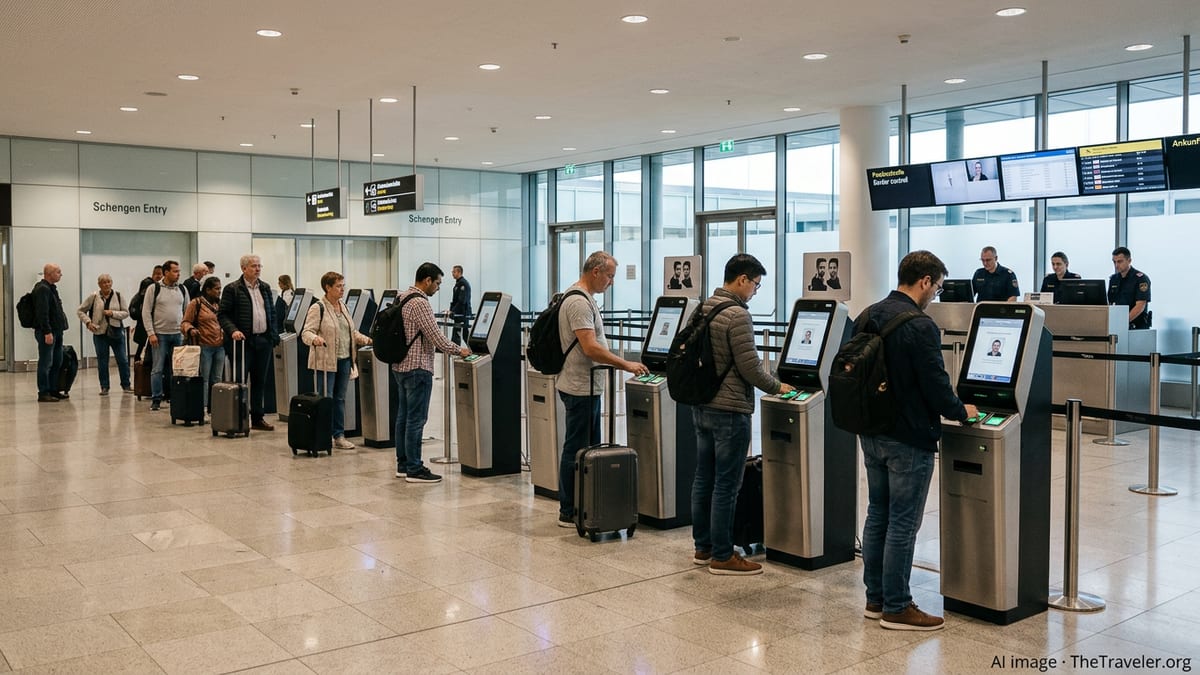
Biometric border system now fully active across Schengen
The EU’s Entry/Exit System, a long-planned biometric database for non-EU nationals, is now live at all external Schengen border crossings and has moved from pilot to full-scale operation in time for the 2026 summer season. The system replaces manual passport stamping with automated registration of each entry and exit, including facial images and fingerprints for most third-country travelers.
According to publicly available information from the European Commission and Schengen states, the system reached full operational status in April 2026 after a phased rollout that began in late 2025. The aim is to strengthen external border management, tackle overstays and identity fraud, and standardize checks across 29 participating European countries.
While the long-term goal is to make border checks both more secure and ultimately faster, early implementation has highlighted practical challenges. Airports report that first-time registrations for visitors can take significantly longer than the simple passport stamp procedure that EES has replaced, particularly when biometric kiosks are unfamiliar to passengers or staff.
For frequent visitors, EES is intended to streamline repeat crossings by reusing stored biometric data for up to three years. However, as the system settles in, travel industry groups say the immediate reality at many gateways is slower processing and unpredictable queues.
Reports of delays spur calls for EU action
Industry associations representing European airports and airlines have been warning for months that the new biometric checks risk straining already busy border lanes. Published analyses referencing internal monitoring suggest that passport control processing times at some airports have increased by up to 70 percent during peak periods since EES was introduced, with waiting times stretching to multiple hours when traffic is heavy.
Travelers have reported bottlenecks at major hubs and tourist gateways, particularly where large numbers of non-EU passengers arrive simultaneously and must complete their EES registration from scratch. Accounts from Italy, France, Portugal and the Netherlands describe long queues at biometric kiosks, missed flights and confusion over which lines travelers should join for the new system.
These pressures have intensified as airlines rebuild schedules and seat capacity closer to pre-pandemic levels. Aviation stakeholders argue that the combination of fuller planes and slower border processing is a risky mix at the height of the summer season, when even small delays can ripple across tightly timed connection banks.
The pushback has reached Brussels, where members of the European Parliament and national transport ministries have questioned whether the rollout calendar has given front-line border posts enough time and resources to adapt. Written questions and public commentary have highlighted concerns about both passenger experience and the reputational impact on Europe as a long-haul tourism destination.
Temporary flexibilities and partial suspensions
In response to mounting concern, the EU has built flexibility into the way EES is applied during its first full year of operation. Official documents and specialist legal commentary indicate that member states can, in exceptional circumstances, partially suspend use of the system at specific border points for limited periods, particularly during peaks such as the summer holiday rush.
This option does not remove EES altogether but allows border authorities to prioritise fluid passenger flows where infrastructure or staffing cannot keep pace with demand. In practice, it may mean that some travelers are processed using traditional passport checks at selected airports or seaports, while biometric registration is emphasised at quieter times or locations.
National decisions vary. Some countries have signalled that they intend to rely fully on EES from the outset, arguing that early consistency will shorten the bedding-in period. Others have already used the flexibility provisions to ease congestion, especially at busy leisure gateways serving large numbers of arrivals from the United Kingdom and other non-Schengen markets.
Travel industry observers note that this patchwork approach can create uncertainty for passengers who may not know in advance whether they will face full biometric enrolment, a simplified check, or a temporary reversion to manual procedures. However, proponents argue that a degree of local discretion is necessary to prevent the system from seizing up under peak loads.
Operational fixes: staffing, lanes and digital tools
Alongside legal flexibilities, the EU and national authorities are focusing on practical fixes to keep border queues in check. Publicly available planning documents and technical notices show that airports and border agencies have been urged to increase staffing at control points, open more lanes that can handle biometric checks and expand the number of self-service kiosks.
The EU’s IT agency for large-scale justice and home affairs systems has introduced a dedicated carrier interface that allows airlines, ferry companies and coach operators to verify passenger data against EES before departure. The tool, which became available in early 2026, is designed to help carriers identify issues in advance so that fewer travellers reach the border with incomplete information or documentation.
Digital support for passengers is also being ramped up. A mobile application and related web tools promoted by EU institutions allow some non-EU travellers to pre-enter passport details and other data shortly before travel, reducing the number of steps needed at the kiosk. Communication campaigns at airports, ports and on airline channels aim to explain the new procedure and encourage passengers to have documents ready when they reach border control.
For many travelers, however, the most visible change remains the physical layout of border areas. New signage, separate queues for first-time and repeat EES users, and staff deployed to direct passengers toward kiosks or manned booths are gradually reshaping the arrival experience across Europe’s main gateways.
What non-EU travellers should expect this summer
With the summer peak under way, publicly available guidance from EU channels and national border services converges on a clear message for visitors: plan for extra time at external Schengen border crossings, especially on the first trip since EES went live. First-time registrations still tend to take longer than traditional passport stamping, and lines can grow quickly when multiple wide-body flights land in close succession.
Travelers are advised to check which airports or ports they are using to enter the Schengen area, since EES checks apply only at the external border. Passengers connecting within the zone after their initial arrival will not usually repeat biometric procedures, but they may face longer queues on their first entry as officials capture the necessary data.
Families and groups may be asked to approach kiosks one by one, which can slow movement through the area. Reports from early adopters suggest that cooperating with staff instructions, removing hats and glasses for facial capture and having travel documentation to hand can help keep lines moving.
Despite present frustrations, EU institutions present EES as a long-term investment in border security and efficiency. If the current mix of flexibilities, staffing boosts and digital tools succeeds in easing pressure over the coming months, the system could gradually shift from being seen as a source of airport delays to a largely invisible layer of Europe’s travel infrastructure.