


More news on this day
European institutions are scrambling to ease long queues and missed flights linked to the rollout of the European Union’s new biometric border system, as pressure mounts from airports and airlines ahead of the peak summer travel season.
Get the latest news straight to your inbox!
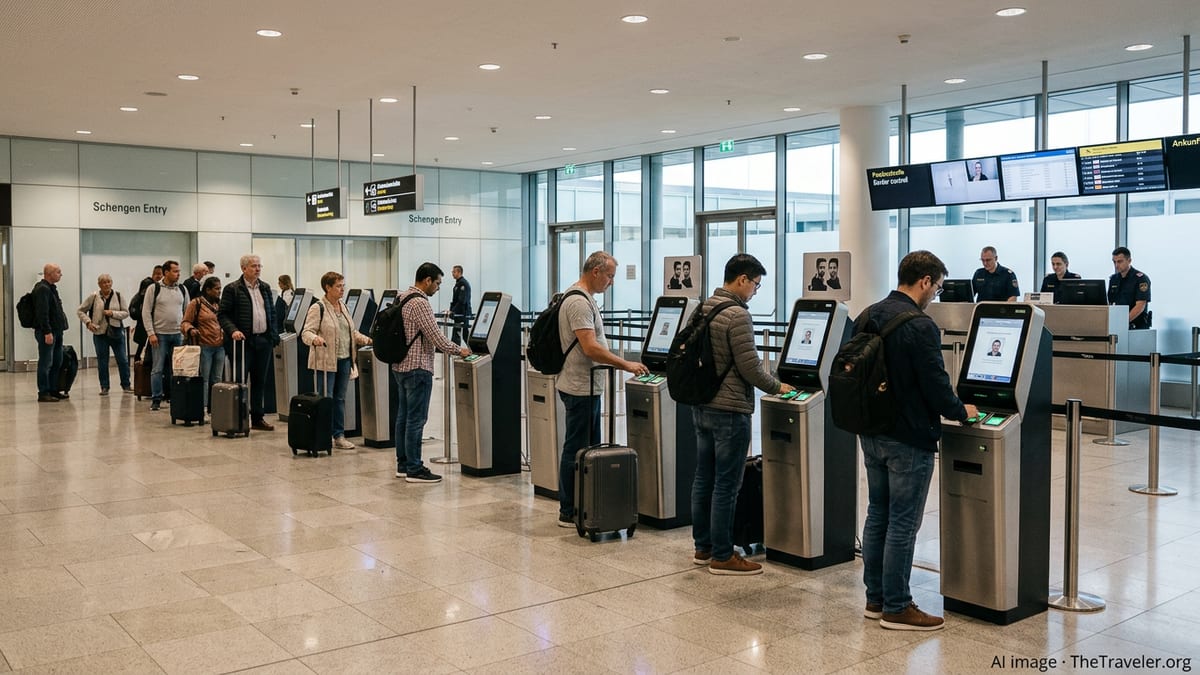
New biometric system reshapes border checks across Europe
The Entry/Exit System, or EES, became fully operational across Schengen external borders in April 2026, following a phased introduction that began in October 2025. The system replaces passport stamping for most non-EU visitors with a centralised database that records entries and exits along with biometric information such as facial images and fingerprints.
According to publicly available information from EU institutions, EES is designed to tighten border management, curb overstays and identity fraud, and provide real-time data on who is entering and leaving the Schengen area. It applies to travellers from countries outside the EU and Schengen who do not hold long-term residence permits, including visitors from the United States, the United Kingdom and many other popular origin markets.
In practice, the system has introduced a new step at many airports, ports and land crossings, where first-time EES users must register biometric data before proceeding through border control. While individual processes differ by country and airport, travellers typically encounter self-service kiosks or special lanes where face scans and fingerprints are captured and linked to passport details.
Once registered, a traveller’s biometric profile is intended to speed up subsequent crossings, as details can be verified electronically without re-enrolment. However, early reports indicate that technical glitches, inconsistent procedures and variable staffing levels have limited these benefits in the first months of full operation.
Queues, missed flights and calls for flexibility
From April onward, media coverage and industry reports have highlighted lengthy queues at several major European gateways, particularly where high passenger volumes met early-stage EES deployment. Accounts from airports such as Amsterdam Schiphol, Rome Fiumicino, Lisbon and regional hubs in Italy and France describe non-EU passengers waiting up to three hours at border control during busy periods.
Airport trade bodies and airline associations have warned in public statements that, without additional flexibility, queues could stretch to five or six hours on peak days this summer. Some carriers have reported passengers missing flights or departing planes leaving with empty seats because travellers were still stuck in border lines, even after clearing security and check-in.
Industry analyses point to a combination of challenges, including hardware outages at biometric kiosks, mismatches between local infrastructure and passenger volumes, and uneven integration between automated systems and manual passport booths. At certain locations, border staff have reportedly suspended use of EES equipment during rush periods and reverted temporarily to conventional checks in an effort to keep lines moving.
The difficulties have particularly affected first-time visitors who must complete a full biometric registration, as well as travellers connecting between non-Schengen and Schengen flights within tight connection windows. Transport groups argue that even modest delays at immigration can undermine carefully timed transfer banks that underpin long-haul networks into major European hubs.
Brussels responds with phased rollouts and temporary pauses
In response to mounting concern, EU institutions have moved to adjust how EES is applied at the border. A legislative agreement between the Council and European Parliament, finalised in 2025, already allowed for a progressive start to the system over several months, enabling member states to ramp up the use of biometrics gradually rather than in a single cutover.
As operational problems became more visible in 2026, publicly available documents show that the European Union authorised additional flexibilities. Member states were given scope to delay certain biometric obligations at the height of the summer season and to prioritise manual processing when congestion risks became unacceptable. In early May, the EU endorsed temporary pauses on biometric enrolment at particularly busy border points, aimed at preventing gridlock during peak traffic surges.
National authorities have used these tools in different ways. Reports indicate that some airports, including Lisbon, temporarily suspended EES processing during earlier trial phases and then reintroduced it with revised procedures. Others have directed only a portion of passengers through biometric registration on the busiest days or opened extra staffed booths to relieve pressure on automated kiosks.
At the same time, the European Commission and home affairs bodies continue to stress the long-term benefits of the new system, arguing in official communications that EES is central to modernising border management and that short-term disruption must be balanced against future gains in security and efficiency.
Digital pre-registration and local workarounds for travellers
Against this backdrop, authorities have promoted digital tools intended to shorten queues by shifting part of the process away from the border. A dedicated “Travel to Europe” mobile application, highlighted in recent public information campaigns, allows many third-country travellers to pre-register their passport data and facial images up to 72 hours before arrival. The aim is to reduce the time required at kiosks and help border staff verify travellers more quickly.
Some airports are experimenting with separate lanes for passengers who have already completed EES enrolment on a previous trip, directing them to e-gates or fast-track lines where identity can be confirmed with a quick face scan. However, recent traveller accounts suggest that implementation is inconsistent; at several airports, returning visitors report being funnelled back into full registration queues, sometimes because earlier biometric records could not be located or verified.
Airports and airlines are also adjusting operations on their own initiative. Measures reported in local media include announcing departure gates earlier to encourage passengers to clear border control well ahead of boarding, adding staff to manage queues and signage, and revising minimum connection time guidance for itineraries involving Schengen border crossings.
Travel advisers and tourism boards increasingly recommend that non-EU visitors allow significantly more time at European arrival points than they might have needed in previous years, particularly when connecting onward within the Schengen area. For now, the experience appears to vary widely between airports, with some hubs reporting relatively smooth processing and others still grappling with heavy backlogs at peak hours.
What the changes mean for upcoming trips to Europe
For travellers planning visits to the Schengen area in the coming months, the evolving situation around EES has several practical implications. First-time visitors from visa-exempt countries can expect a one-off biometric enrolment at their first point of entry, which will typically involve both fingerprints and a facial image as well as electronic capture of passport details.
Subsequent trips within a three-year window should in theory be faster, as existing EES records can be re-used, reducing the need for repeat biometric capture. However, given the technical and organisational issues reported at certain airports, travellers should be prepared for occasional repeat checks until systems and staff are fully aligned.
Tourism organisations advise allowing extra buffer time before departures from European airports, particularly for flights back to non-Schengen destinations where outbound border checks apply. Longer queues are still most common at peak travel times, such as weekend mornings and afternoons in July and August, when summer holiday traffic overlaps with business travel.
While the EU’s new system aims to streamline border management in the long term, the immediate priority for European institutions is to ensure that biometric controls do not undermine the continent’s appeal as a convenient and reliable destination. The coming summer season is widely viewed as a critical test of whether the combination of temporary flexibilities, digital tools and operational fine-tuning can keep queues manageable as millions of visitors arrive at Europe’s airports.