


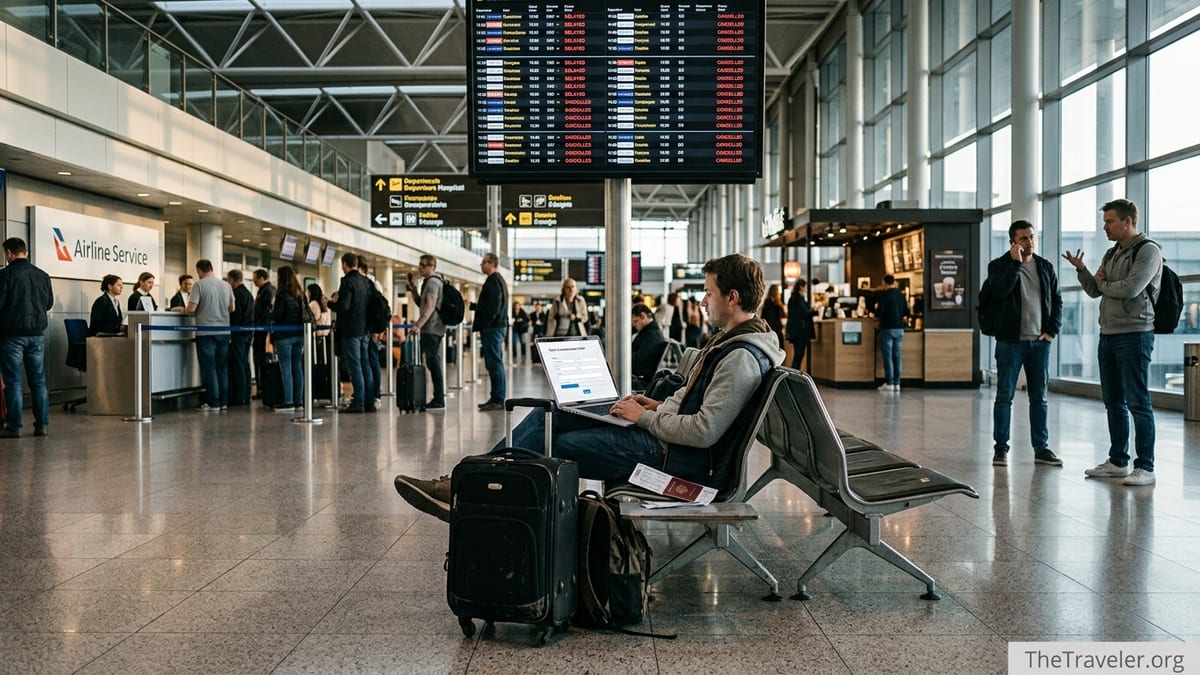
Few moments are as frustrating for travelers as watching a long-awaited trip unravel on an airport departure board. Under rules such as EU Regulation 261/2004 and similar laws in the UK and elsewhere, many passengers are entitled to cash compensation when flights are significantly delayed, cancelled, or overbooked. The challenge is actually getting that money. Services like Compensair promise to fight the airline on your behalf in exchange for a cut of whatever you receive. But is it better to hand over your claim to Compensair or roll up your sleeves and pursue compensation yourself?
Get the latest updates straight to your inbox!
How Flight Compensation Works in Practice
Most commercial flight compensation claims that Compensair handles are based on European-style passenger rights frameworks, above all EU Regulation 261/2004 and its UK equivalent. These rules give fixed cash amounts when certain conditions are met, regardless of what you paid for the ticket. For example, if your Paris to Rome flight is cancelled at short notice for a technical issue that is considered within the airline’s control, you may be owed around 250 euros in cash even if your one-way ticket cost only 79 euros. For longer flights such as Frankfurt to New York, successful claims can reach roughly 600 euros per person when delays exceed four hours on arrival.
In day-to-day travel, this plays out in recognisable scenarios. A family flying Madrid to Berlin on a European carrier might arrive more than three hours late after a last-minute aircraft swap that the airline struggles to explain. A couple on a London to Istanbul holiday flight could see their service cancelled due to a staffing shortage, be rebooked a day later, and spend the night in an airport hotel. In both examples, there is a realistic chance they qualify for compensation in addition to basic assistance like meals and accommodation.
However, airlines frequently push back. Real-world travelers report receiving template rejection emails that blame “extraordinary circumstances” such as air traffic restrictions, security staffing problems, or vague “operational reasons” without supplying detailed evidence. Others find that their online claim forms disappear from airline portals after a few months, or that messages go unanswered for weeks at a time. This pattern is what has created demand for specialist companies like Compensair that step in to manage the process.
Understanding how these regulations work in broad terms is essential before deciding whether to outsource the claim. Compensation is usually tied to distance and delay thresholds, not ticket price, and time limits to claim can run to several years for flights departing from or arriving in Europe. That long window means you do not need to decide at the airport whether to hire a third party, but you do need to keep boarding passes, booking confirmations, and any written communication from the airline.
What Compensair Actually Does
Compensair operates as a no-win, no-fee intermediary between you and the airline. A typical journey starts on its website, where you enter your disrupted flight details into an eligibility checker. For example, a traveler from Chicago to London on a European airline who arrived over four hours late can submit their flight number, travel date, and reason for delay if known. Compensair’s system cross-references that with historical delay and cancellation data and the relevant passenger rights rules to estimate whether there is a viable claim and how much might be owed.
If the case appears promising, you upload supporting documents such as your e-ticket, boarding pass, and any written messages from the airline. You then sign a digital agreement authorising Compensair to act in your name. From that point forward, the company drafts formal demand letters, submits claims through airline portals or email channels, and follows up when airlines stall or issue partial offers. In some cases, Compensair escalates disputes to national enforcement bodies or initiates legal action through partner law firms when carriers continue to refuse payment.
Travelers who have written publicly about their experience with Compensair describe both smooth and bumpy journeys. In a positive example, a passenger whose Lisbon to Copenhagen flight was cancelled reported being awarded around 600 euros in compensation after Compensair took the airline to task over several months. Once the airline finally transferred the funds, Compensair deducted its fee and passed the remainder to the traveler, who had spent little personal time on the process aside from the initial sign-up.
Less happy accounts mention long waits for payouts after the airline had already sent money to Compensair, or confusion about the company creating dedicated email aliases and payment channels in the passenger’s name to manage correspondence and funds. Some users complain that they were not given copies of messages exchanged with airlines or that they struggled to understand the basis for certain fee deductions in complex cases. These experiences underline how important it is to read Compensair’s terms carefully, especially around communication, data handling, and payment timelines.
How Compensair Charges Compared to DIY
Compensair generally charges a success-based commission: you pay nothing up front, but if the claim is successful the company keeps a percentage of the compensation before forwarding the rest. The exact percentage can vary over time and by case type, but it is broadly comparable to other European claim services. To put this into real numbers, imagine you are owed 400 euros after a delayed Barcelona to Stockholm flight. If Compensair’s commission were around one-third, you might receive something in the region of 260 to 270 euros after fees and any applicable taxes, while the service keeps the remainder as its income.
This model appeals to travelers who would not otherwise pursue compensation at all. A passenger who lost two days of a weekend trip to a cancelled Milan to Prague flight might reasonably decide that filling out forms, chasing replies, and potentially arguing technicalities is not worth their time. For them, receiving a portion of 250 or 400 euros via Compensair for fifteen minutes of effort can feel like found money, especially when the original trip is already in the past.
On the other hand, the commission significantly reduces the value of the claim compared with a successful do-it-yourself effort. For a family of four flying a disrupted London to New York itinerary, a valid claim could total roughly 2,400 euros in compensation. Handled through Compensair, that might become something closer to 1,600 euros in the traveler’s pocket, depending on fee levels. If one family member is organised and comfortable with bureaucracy, they may understandably prefer to invest a few hours to try to keep the full amount.
There is also the question of who gets paid when the airline quietly credits compensation without acknowledging the intermediary. Some travelers have reported situations in which an airline processed a payment directly to the passenger after they had already signed an agreement with Compensair. In such cases, Compensair may still demand its commission, arguing that it did work that contributed to the outcome. That can come as a surprise to passengers who do not fully appreciate that they are committing to share a portion of any eventual payout, whether it passes through Compensair or not.
What It Involves to Claim Compensation Yourself
Filing a compensation claim yourself is not especially complicated from a technical standpoint, but it does require persistence, attention to detail, and some willingness to learn the basics of passenger rights. The do-it-yourself route usually starts with gathering evidence: your booking confirmation or e-ticket, boarding passes, photos of airport departure boards, and any vouchers or written notices the airline gave you on the day of disruption. If you had to pay for a hotel, meals, or alternative transport, you should also keep those receipts, as some may be reimbursable even outside the fixed compensation scheme.
Next, you identify under which rule your case falls. For many disruptions involving flights departing from or arriving in the EU, UK, or certain associated territories, that will be EU Regulation 261/2004 or its UK equivalent. For a Montreal Convention claim involving lost luggage on a Toronto to Paris flight, a different framework applies. You then go to the airline’s customer relations or claims portal and locate the specific form for flight irregularities. For example, a German flag carrier may have an online form where you select “Delay over three hours” and enter your flight, booking code, and description of events.
In the narrative section of the form or in a separate email, you should clearly state what you are claiming and on what legal basis. A typical paragraph might read along the lines of: “I am requesting 400 euros in cash compensation under EU Regulation 261/2004 for flight AB1234 from Rome to Berlin on 14 March, which arrived at our final destination 3 hours and 45 minutes late due to a technical issue within the airline’s control.” Enclosing screenshots of the scheduled and actual arrival times, as well as any internal delay codes you can obtain from staff on the day, can strengthen your position.
Once submitted, responses range from generous to obstructive. Some airlines approve clear-cut cases within a few weeks, paying compensation via bank transfer or voucher and even adding bonus miles as an apology. Others reply with stock phrases about adverse weather, air traffic control restrictions, or “extraordinary circumstances” without offering evidence. If you disagree, you can push back by asking for documentation or citing case law summaries from national enforcement bodies. Where that goes nowhere, your next escalation step is usually a formal complaint to the relevant regulator or an alternative dispute resolution scheme if the airline belongs to one. Each of these stages takes time, often months.
When Compensair Makes the Most Sense
Compensair tends to be most attractive in situations where the potential compensation is modest, your patience is limited, or the legal issues are finely balanced. Suppose you are a solo traveler on a short-haul flight from Brussels to Geneva who arrives just over three hours late due to a prolonged aircraft repair. The full compensation amount in that distance band is relatively low compared with a long-haul disruption, and your life may be busy enough that you will simply never get around to chasing the airline yourself. In that case, accepting that perhaps a third of 250 euros will go to Compensair can feel like a fair trade for the convenience.
The service also appeals if you are uncomfortable dealing with formal correspondence in a foreign language. A Brazilian passenger connecting via Paris to Athens on a European carrier may be put off by the idea of debating regulatory language in French or Greek, especially when airlines route communication through local offices. Compensair and similar services routinely handle multi-lingual claims, understand which national enforcement bodies are effective, and know when to call an airline’s bluff on “extraordinary circumstances.” For someone unfamiliar with these systems, that expertise can be valuable.
Another common scenario is collective travel. For a group of friends whose Prague to Dublin weekend flight was cancelled, a four-figure claim can quickly become complex when different people booked through separate online agencies or used frequent flyer miles. Coordinating a single DIY claim may be more challenging than it first appears. Using Compensair as a central point of contact, even at the cost of a commission, can simplify the process and reduce the risk that someone forgets to submit a part of the claim or omits a required document.
Finally, Compensair can be helpful in older or borderline cases that require legal pressure. Airlines are more likely to contest flights that happened several years ago or that sit near the edge of eligibility rules. While a determined traveler can still pursue these claims alone, having an intermediary that is prepared to escalate to legal partners if needed may increase the odds of success, albeit on a slower timetable.
When You Are Better Off Claiming on Your Own
Despite the convenience of Compensair, there are many situations where handling a claim yourself is the stronger option. The first is any disruption involving multiple passengers on the same booking where total compensation could easily exceed a thousand euros. Think of a family of five whose Amsterdam to Tenerife holiday flight arrived nearly six hours late because the airline scheduled a replacement aircraft from another base. If that claim is clearly eligible under EU rules, surrendering a large slice of several thousand euros to a third party purely for form filling is a significant cost.
DIY also makes sense when the airline has an established track record of honouring valid claims with minimal pushback. Some European full-service carriers and even a few low-cost operators now have streamlined systems that automatically assess delay data and issue payments once you submit a simple online form. In those cases, Compensair would likely be going through the same portal you might use yourself, which undermines the value of paying an intermediary at all.
Your own comfort level with bureaucracy is another decisive factor. Travelers who already manage their own visa applications, tax filings, or complex insurance paperwork are usually well positioned to tackle a compensation claim. Many report success with nothing more than a clear initial letter and one firm follow-up email when the airline delays. For them, the process is an annoyance rather than an obstacle, and keeping the full 250 to 600 euros per head becomes the obvious choice.
Finally, a do-it-yourself claim gives you complete transparency and control. You decide whether to accept a partial offer, such as a mixture of cash and voucher, or to hold out for the full statutory amount. You also keep all correspondence between you and the airline, which can be helpful if similar issues arise in future or if you need to demonstrate patterns of behaviour for travel insurance or frequent flyer complaints. When using Compensair, much of this communication happens out of sight, and the company’s contract usually grants it discretion over negotiation tactics that you might or might not agree with.
Practical Tips if You Choose Compensair
If you decide that Compensair is the right fit for a particular disruption, take a few simple steps to protect your interests. Start by reading the current terms and conditions carefully, focusing on the commission rate, any additional charges if court proceedings become necessary, and the exact moment when the fee becomes payable. Understanding whether the fee still applies if the airline pays you directly can prevent unpleasant surprises months later.
Next, keep your own archive of all key documents, even if you upload them to Compensair’s portal. Save your booking confirmations, boarding passes, and any airline notifications as PDF files in a cloud folder or email them to yourself with descriptive subject lines. If Compensair creates a special email address or virtual account to interact with the airline on your behalf, make sure you understand how and when you can access information linked to those credentials, or at least how you will be updated on progress.
It is also worth setting realistic expectations about timelines. While some travelers receive compensation via Compensair in a matter of weeks, more complex or contested claims can take many months. Airlines often hope that delays will cause claimants to abandon the process. Compensair can shield you from some of that frustration by handling the chasing, but it cannot force carriers to pay more quickly than the legal and administrative systems allow.
Finally, if you are unhappy with how a case is handled, raise concerns in writing. If you believe Compensair has withheld funds for too long, miscommunicated with you, or misused your personal data, document specific dates and events. While online reviews and forum posts are one outlet, you may also have recourse through local consumer protection authorities or data regulators depending on your country of residence and how your information was processed.
The Takeaway
Choosing between Compensair and a do-it-yourself claim is ultimately a trade-off between time, control, and money. Compensair offers a relatively effortless way to pursue flight compensation that you might otherwise never claim, with no upfront cost and a reasonably high success rate in straightforward cases. For solo travelers on modest short-haul claims or passengers who dislike paperwork, that convenience can easily justify surrendering a portion of the payout.
At the same time, passengers willing to invest a few hours reading basic guidance and following up with airlines can often secure the full statutory amounts themselves, especially for clear-cut long-haul disruptions involving several people on one booking. In those scenarios, giving away hundreds of euros in commission simply to avoid some emails and forms may not make financial sense. The key is to assess each incident separately, weighing the size of the potential compensation, the complexity of the facts, and your own appetite for administrative work.
In the end, neither route is universally better. Compensair is a useful tool in the modern traveler’s kit, best reserved for cases you lack the time, language skills, or energy to tackle alone. For larger or more straightforward claims, going directly to the airline remains the most rewarding option, provided you are prepared to be patient and persistent.
FAQ
Q1. Is it always better to use Compensair instead of claiming myself?
Not necessarily. Compensair is useful if you lack time or confidence, but if your case is straightforward and the potential payout is large, claiming directly with the airline usually leaves you with more money.
Q2. How long does it usually take Compensair to get compensation paid out?
Timelines vary widely. Simple, uncontested cases can resolve in a few weeks, while disputed or older claims may take many months, especially if regulators or courts become involved.
Q3. How much of my compensation will Compensair keep in fees?
Compensair works on a success-based commission, typically keeping a significant percentage of whatever the airline pays. The exact amount can change, so you should always check the current rate before signing.
Q4. Can I switch to Compensair after first trying to claim by myself?
Yes, many travelers first contact the airline directly and only turn to Compensair if their claim is rejected or ignored. However, once you sign with Compensair, you may still owe them a fee even if the airline later pays you directly.
Q5. What if the airline sends compensation straight to my bank account?
If you have already authorised Compensair to handle the claim, the company may still be entitled to its commission, arguing that its work contributed to the outcome. This is why it is vital to understand the contract terms before using the service.
Q6. Is claiming flight compensation myself legally risky?
For most travelers, no. You are simply asserting rights that passenger regulations already grant you. The main cost is your time and effort, not legal exposure, especially if you stick to factual descriptions and reputable guidance from regulators.
Q7. What documents should I keep if I want to claim on my own?
Keep your booking confirmation, boarding passes, any delay or cancellation notices, photos of airport departure boards, and receipts for hotels, meals, and alternative transport related to the disruption.
Q8. Can Compensair help with non-European flights?
Compensair focuses heavily on European-style rules but also works with other passenger rights regimes, such as those in Turkey and Canada, for certain routes. Whether your particular non-European flight is covered depends on the airline, route, and local laws.
Q9. What happens if Compensair loses my case?
If the claim is unsuccessful, you generally do not pay Compensair a fee. The company absorbs the cost of its time and any basic legal work, though you still will not receive compensation for your disrupted flight.
Q10. How do I decide quickly at the airport whether to contact Compensair?
You do not have to decide on the spot. As long as you keep your documents, you can use Compensair’s eligibility checker or start a DIY claim days or even years later, depending on the time limits in the relevant rules.