


Minčeta Tower rises over Dubrovnik’s terracotta rooftops like a stone crown, the highest point on the city’s famous medieval walls and the viewpoint you will see on almost every postcard. The real question for many travelers standing at the base of those stairs is simple: is the final climb up Minčeta actually worth the time, money, and effort, or are the views from the rest of the walls and nearby viewpoints enough?
Get the latest updates straight to your inbox!
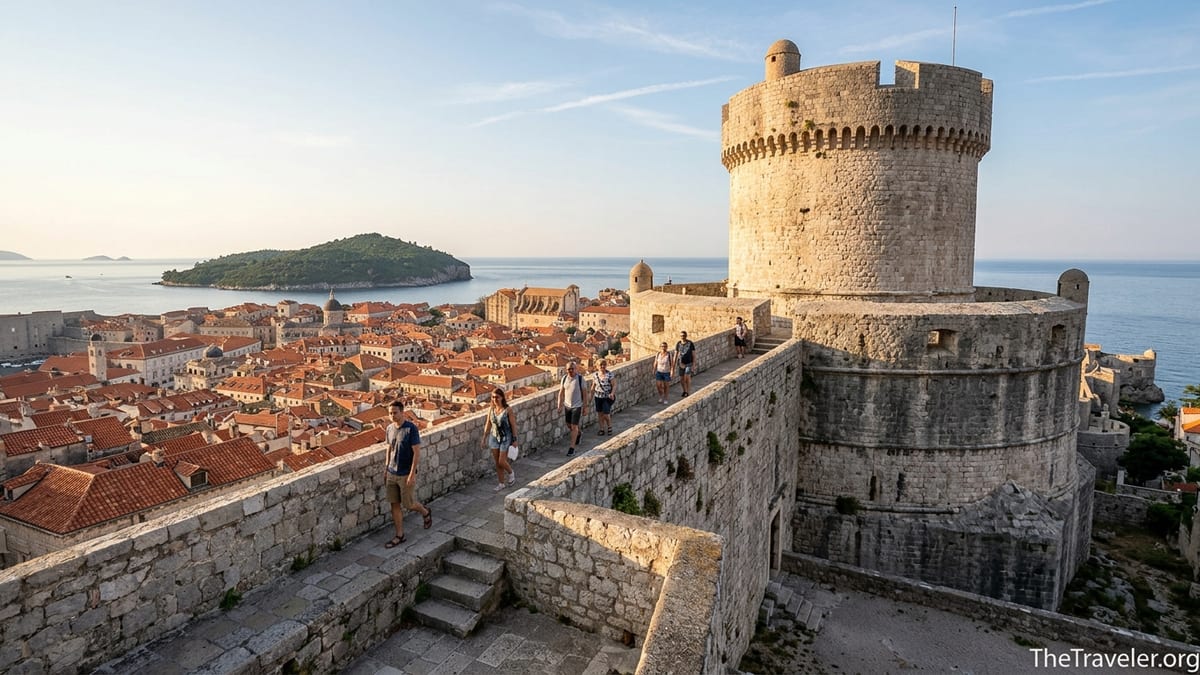
What Exactly Is Minčeta Tower?
Minčeta Tower is the large circular fortress at the northwestern corner of Dubrovnik’s Old Town walls, and it is the single highest point in the entire fortification circuit. Rising to around 25 meters above the walls, it once served as a key defensive stronghold guarding approaches from the land side. Today it doubles as a history lesson in stone and one of the most dramatic viewpoints anywhere on the Adriatic coast.
The tower’s current form dates largely from the mid‑15th century, when architects such as Michelozzo di Bartolomeo and Juraj Dalmatinac strengthened Dubrovnik’s defenses with thicker walls and gun ports. Walking the circular terrace at the top, you can still see how the tower’s design allowed defenders to watch both the inland hills and the approaches to the harbor, with the entire 1.9‑kilometer circuit of walls visible below.
For modern visitors the attraction is less about military strategy and more about perspective. From the crown of Minčeta, Dubrovnik’s famous red roofs, narrow streets, and tiny squares form a dense pattern that is hard to grasp at ground level. You also see how the city is wedged between the slopes of Mount Srđ and the deep blue Adriatic, with the island of Lokrum sitting just offshore. That sense of the city’s overall layout is something even the best street‑level wanderings cannot fully provide.
Minčeta is also woven into contemporary culture. It appeared prominently as a filming location in Game of Thrones, which has only increased its popularity. On busy summer days you can watch fans recreating scenes on the ramparts, a reminder that this medieval fortress now lives a second life as a global pop‑culture icon.
How Hard Is the Climb Really?
Most travelers encounter Minčeta as part of the full city walls walk rather than as a standalone destination. The walls themselves involve a lot of stairs and short, steep ramps. Traveler reports commonly estimate around 1,000 or more steps for the full circuit, with roughly three‑quarters of that effort coming before or around Minčeta, depending on where you start. The final staircase inside the tower is steeper and narrower than most sections of the walls, and in high season it can become a slow, one‑way shuffle.
If you begin your walk at Pile Gate and move counterclockwise, you will reach Minčeta roughly a third of the way into the circuit. Many visitors say this is the point where the effort starts to feel serious, particularly in July and August when temperatures on the stone can feel far hotter than the forecast suggests. People who are moderately fit usually manage it in comfortable fashion, but if you have knee issues, cardiovascular limitations, or significant vertigo, you may find the final internal staircase challenging.
That said, the climb itself is fairly short. The steps up through the interior of the tower typically take only a few minutes of actual climbing, even at a conservative pace. The bigger strain often comes from the cumulative effect of walking the walls beforehand in strong sun, carrying a backpack, and stopping frequently to take photos. Many travelers who describe the walls as “tough” still single out Minčeta as a highlight they are glad they pushed themselves to reach.
For families, the decision is more nuanced. Older children who enjoy castles and fortresses usually love the sense of height and adventure. Parents of toddlers, however, often decide to skip the very top, as the stairways can be cramped and there is limited space to manage strollers or hold the hands of two small children at once. If your group is mixed, one practical approach is to designate a meeting point on the wall walkway below while more energetic members make the quick up‑and‑down detour.
Ticket Prices, Opening Hours, and How Minčeta Fits Into Your Day
There is no separate ticket for Minčeta Tower. Access is included with the standard Dubrovnik City Walls ticket, which in 2026 costs around 35 euros per adult. This ticket allows you to walk the entire length of the fortifications, including Minčeta and other towers and bastions. Children and students typically benefit from reduced pricing, and many visitors from the United States and elsewhere also consider the Dubrovnik Pass, which costs slightly more but includes museum entries and local bus rides along with the walls.
Seasonal hours change, but in recent years the walls have generally opened around 8:00 in the morning, closing in the early evening, with the last entry usually allowed an hour or so before closing time. Minčeta itself does not have different hours; when the walls are open, the tower is accessible. On holidays such as Christmas Day the walls may be closed entirely, so it is worth checking local information during winter visits.
In practical terms, the climb to Minčeta usually fits into a half‑day Old Town plan. Many travelers start the walls between 8:00 and 9:00, finish the full loop by late morning, then descend into the streets below for a late breakfast or early lunch at one of the cafes near Stradun. Others combine the walls in the late afternoon with a sunset cable‑car ride to Mount Srđ, using Minčeta for a closer, more immersive city view and the mountain top for a sweeping wide‑angle panorama.
Because the walls ticket is one of the larger single expenses in Dubrovnik, many visitors weigh it carefully. Some online reviewers describe the walls as overpriced, especially in peak season. Yet even critics often concede that if you are going to pay for the ticket at all, it makes sense to climb up to Minčeta, since you are already there and it offers the absolute best views included in the price.
The Views from the Top: What You Actually See
Standing on Minčeta’s upper terrace, you are surrounded by a full 360‑degree panorama. To the south, the red‑tiled rooftops of Dubrovnik’s Old Town tumble down toward the harbor, broken by the bell towers of churches and the long white ribbon of Stradun, the main street. On clear days you can follow the line of the walls almost continuously, tracing how they snake around the city and drop toward the sea.
To the east, the island of Lokrum sits just offshore, its green slopes rising behind the harbor entrance. Boats come and go from the marina and cruise ships anchor farther out, giving a sense of motion against the still backdrop of stone and water. Turning north, you see the rugged hillside of Mount Srđ, with the cable‑car line clearly visible when it is in operation. This inland view helps you understand how precariously Dubrovnik occupies its narrow strip of flat ground between mountain and sea.
Many travelers say that photos taken from Minčeta are the ones that finally capture what they imagined when they first booked a trip to Dubrovnik. The textures are particularly striking: rough stone, weathered terracotta, and the sheen of the Adriatic all appear in the same frame. In softer early‑morning light, the city glows in gentle oranges and golds; by late afternoon, the shadows lengthen along the streets and the sea deepens to a darker blue.
In practical terms, photographers often bring a mid‑range zoom lens or use a smartphone with optical zoom. From Minčeta you can frame close‑up shots of individual towers, courtyards, or church domes, or pull back for classic sweeping cityscapes. Tripods are generally impractical because of space and foot traffic, but a small travel monopod or simple image stabilization is usually enough. Even casual photographers using a basic phone camera are likely to come away with some of their favorite images of the trip from this spot.
Best Time to Climb and How to Avoid the Crowds
The difference between climbing Minčeta at 8:15 in the morning and at 11:30 on a busy summer day is dramatic. Early arrivals often find the tower almost empty, with just a few other visitors scattered around the terrace. You can move freely, linger at the viewpoints, and take photos without needing to wait for people to clear out of your frame. By late morning, especially when multiple cruise ships are in port, the steps inside the tower can slow to a stop‑start queue.
Local guides and frequent visitors consistently recommend starting the walls as close to opening time as possible in July, August, and early September. Temperatures are lower, sea breezes are more likely, and the stone underfoot has not yet absorbed hours of direct sun. In shoulder seasons such as May or October, the mid‑morning period can still be comfortable, but even then, the early start is your best bet for a quieter experience at Minčeta.
The direction you walk also matters. Starting at the less busy Ploče Gate on the eastern side of the Old Town and walking clockwise brings you to the seaward sections first, with Minčeta coming later in the circuit. Starting at Pile Gate near the main tourist drop‑off brings you to Minčeta sooner, which some travelers prefer because they are still fresh. If Minčeta is your priority and you are not sure how your energy will hold, entering at Pile Gate and focusing on the northern section first is a sensible strategy.
Weather plays a role too. On days of intense heat forecasts, consider shifting your visit to a slightly overcast morning or a cooler day if your schedule allows. Light cloud cover softens the light for photography and makes the climb feel noticeably less punishing. In strong wind and heavy rain the walls can sometimes be closed for safety; if you are visiting in the off‑season and see rough weather on the horizon, it is worth checking conditions locally before planning your day around the climb.
Who Will Find Minčeta Worth the Effort (and Who Might Not)
For many travelers, Minčeta is one of those rare viewpoints that lives up to and even exceeds its reputation. If you are the kind of person who seeks out towers, hilltop castles, and high terraces in other European cities, you are very likely to feel that the climb is justified. Visitors with an interest in medieval architecture, defensive history, or urban planning also tend to appreciate how much the tower reveals about Dubrovnik’s layout and past.
Photographers, whether serious hobbyists or casual smartphone shooters, usually rank Minčeta as a must. The combination of height, proximity, and variety means you can capture both detailed street scenes and broad skyline panoramas without needing a drone or special equipment. Couples on honeymoon or marking a special trip often cite their time on the tower as one of the most memorable shared moments in the city.
On the other hand, there are travelers for whom Minčeta, and even the city walls in general, are less compelling. If you strongly dislike heights or feel anxious on narrow walkways with drop‑offs, you may find that the views are not worth the discomfort. Ground‑level alternatives such as walking along the harbor, sitting at a cliffside bar outside the walls, or taking the cable car to Mount Srđ for a broader but less enclosed perspective might suit you better.
Budget‑conscious visitors who are already unsure about paying for the city walls sometimes decide to skip them altogether, preferring free or low‑cost viewpoints. From spots like the small park above the Pile Gate or various terraces in the Lapad and Gruž districts, you can still enjoy fine views of the Old Town without the ticket price. For these travelers, the specific climb to Minčeta may feel like an unnecessary extra cost in a city where expenses already add up quickly.
Alternatives and Complements to the Minčeta Experience
The most obvious alternative to Minčeta for panoramic views is the cable car to Mount Srđ, which rises to 412 meters above the city. From the viewing platforms near the top station you see Dubrovnik, Lokrum, and the surrounding coastline laid out like a map. The scale is grander than from Minčeta, but you are further removed from the texture and detail of the Old Town, and the cable‑car ticket is an additional expense.
Within the walls, other towers and bastions also offer excellent perspectives. Bokar Fortress on the seaward side gives photogenic views across to the freestanding Fort Lovrijenac, creating a classic composition of fortresses facing each other across the small bay. The sections of wall near the harbor offer striking angles over the old port, with fishing boats and kayaks adding color below. Some visitors who find Minčeta too crowded end up lingering longer at these quieter spots and still feel satisfied with the overall wall walk.
At street level, viewpoints from outside the walls provide another angle on the city’s form. Walking the path toward the popular cliffside bars near Buža Gate lets you see the fortifications rising straight out of the rock, especially beautiful in the late afternoon when the stone glows warm against the sea. Farther out, staying at a hotel on the Lapad Peninsula or along the coastal road toward Babin Kuk gives you sunrise or sunset vistas of the Old Town from a distance, with the walls and Minčeta silhouetted against the sky.
Seen in this wider context, Minčeta is best thought of not as the only way to appreciate Dubrovnik, but as the point on the walls where all of the city’s other views make the most sense. If you plan to explore both street‑level corners and higher lookouts during your stay, the tower becomes a central reference point that ties them all together.
The Takeaway
So, is Minčeta Tower in Dubrovnik worth the climb? For most visitors who have already decided to buy a ticket for the city walls, the answer is yes. The additional physical effort required for the tower itself is relatively modest compared to the overall walk, and the reward is a uniquely complete view of one of Europe’s most photogenic historic cities. You see the Old Town’s shapes and patterns in a way that no ground‑level stroll or distant hillside viewpoint can fully match.
That said, worth is always personal. If you have serious mobility issues, an intense fear of heights, or very young children in tow, you may decide that the stress outweighs the benefits, and Dubrovnik still offers many beautiful alternatives. Likewise, if the cost of the walls ticket feels uncomfortably high within your travel budget, you can find impressive free or low‑cost vistas elsewhere around the city.
For many travelers, though, the memory that lingers after leaving Dubrovnik is standing on Minčeta’s stone terrace, sea breeze in their face, looking down over the rooftops and out toward Lokrum. If that image appeals to you and you are able to handle a set of stairs in warm weather, then planning your day so you can climb Minčeta early, with time to enjoy the summit, is likely to be one of the most rewarding choices of your trip.
FAQ
Q1. Is Minčeta Tower included in the Dubrovnik city walls ticket, or do I pay extra?
The climb to Minčeta Tower is included in the standard Dubrovnik City Walls ticket, so there is no separate fee for the tower itself.
Q2. How many steps are there to reach the top of Minčeta Tower?
Exact counts vary, but traveler estimates suggest several hundred steps from street level to the summit, with most of the effort coming during the overall walls walk rather than in the tower alone.
Q3. How long does it take to climb Minčeta Tower once I am on the walls?
From the point where you reach the base of the tower, the internal staircase to the top usually takes just a few minutes, even at a relaxed pace, though it can be slower during busy periods.
Q4. What is the best time of day to climb Minčeta for views and comfort?
Early morning soon after the walls open is generally best, offering cooler temperatures, softer light for photos, and fewer crowds on the narrow stairways.
Q5. Is Minčeta Tower suitable for people with vertigo or fear of heights?
The tower’s parapets feel reasonably secure, but the height and open views can be unsettling if you are sensitive to exposure, so cautious visitors may prefer to enjoy the views from lower sections of the walls.
Q6. Can I visit Minčeta Tower without walking the entire city walls circuit?
You must enter via one of the city walls gates and use the same ticket, but you can choose to walk only part of the circuit and turn back after visiting Minčeta if you wish.
Q7. Are there railings and safety barriers at the top of Minčeta?
The top terrace has solid stone parapets and feels secure for most visitors, but parents still need to supervise children closely and there are no modern railings like you might find at newer attractions.
Q8. Is the climb to Minčeta manageable in summer heat?
It can be challenging in peak summer, but starting early, wearing a hat, bringing water, and taking breaks in shaded sections usually make it manageable for reasonably fit visitors.
Q9. How does the view from Minčeta compare to the view from the Mount Srđ cable car?
Minčeta offers a closer, more detailed view of the Old Town rooftops and walls, while Mount Srđ provides a much higher, more distant panorama that includes the wider coastline.
Q10. Is Minčeta Tower worth it if I am visiting Dubrovnik only for a day?
If you have limited time but want one unforgettable perspective on the city, prioritizing the city walls and the climb to Minčeta is often one of the most rewarding uses of a half‑day visit.