


For an airport that handles tens of millions of passengers a year, Tokyo’s Haneda Airport hardly feels like a global mega-hub when you arrive. It feels, instead, like a well-run neighborhood station that just happens to have wide-body jets parked outside. My latest trip through Haneda started with low expectations and a late-night landing. Ninety minutes later, I was checked into a hotel in Shimbashi, wondering how one of the world’s busiest airports had just given me the smoothest arrival of my travel life.
Get the latest updates straight to your inbox!
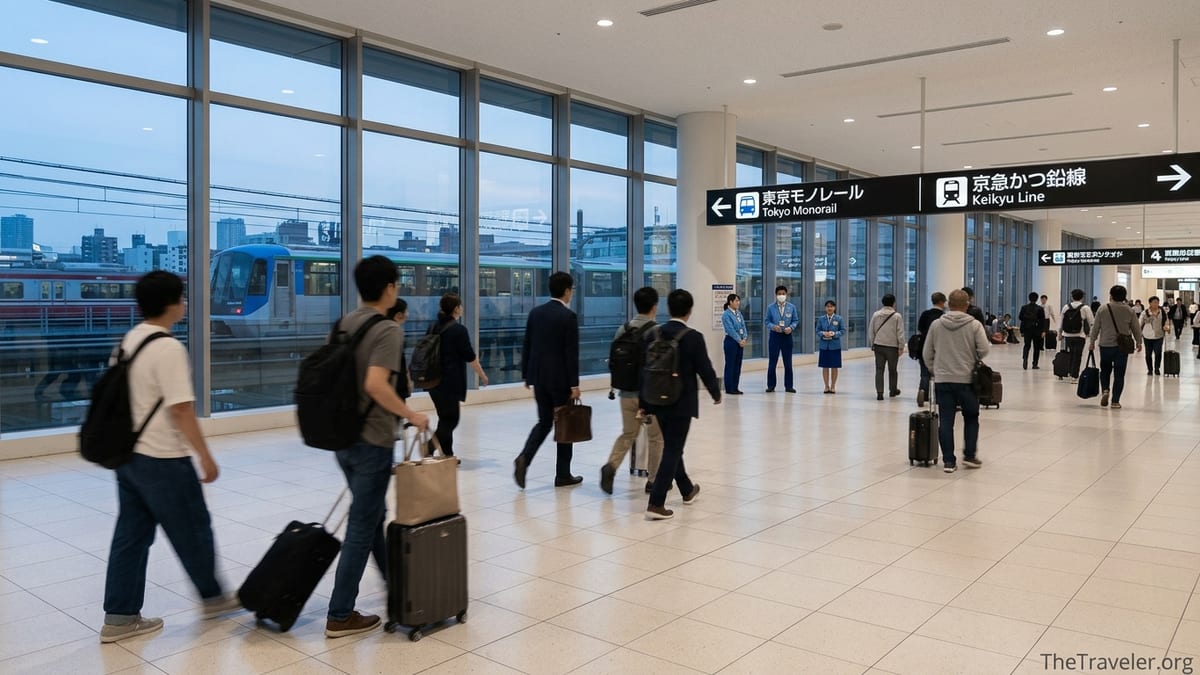
First Impressions: Quiet Order at One of the World’s Busiest Hubs
Haneda is officially one of the busiest airports on the planet by passenger numbers, yet the experience on the ground rarely reflects that raw volume. Instead of echoing announcements and snaking lines, the first impression in Terminal 3 is of calm order: polished floors, precise signage in multiple languages, and staff who seem to appear exactly where you might have a question. The overall effect is striking for anyone used to landing at large hubs in North America or Europe, where congestion often feels built into the design.
Part of that smoothness comes from how compact everything is. Haneda sits only about 14 kilometers from central Tokyo, with three main terminals: Terminal 1 for domestic flights, Terminal 2 for both domestic and some international, and Terminal 3 as the primary international gateway. The terminals are linked by a free airside shuttle and simple landside connections, so you are not forced into long bus rides or labyrinthine walks just to change buildings. You can go from a jet bridge in Terminal 3 to a train platform in under ten minutes if you walk with purpose.
That compactness would not matter if processes broke down under pressure, but the airport’s operating style is distinctly Japanese: small efficiencies add up. You notice it in the way queue lanes are laid out, the way announcements are kept clear and minimal, and the way staff quietly guide flow instead of barking instructions. Even before you reach immigration, Haneda communicates a message: we know you are tired, and we are not going to waste your time.
It helps that Haneda has been steadily modernized over the past decade. Terminal names were unified in 2020 to make navigation easier, and ongoing works include a new dedicated rail access line toward Tokyo Station targeted for the early 2030s. Yet even today, without that future upgrade, the experience already feels like a preview of what efficient urban air travel can be.
Immigration and Customs: Visit Japan Web and the Rise of the E-Gate
The real revelation at Haneda begins the moment you step off the plane and follow the signs for immigration. Japan has invested heavily in automation, and Haneda is one of the airports where those investments are most visible. As you descend into the arrivals area, you are funneled toward a set of clearly marked lanes: one for passengers who have pre-registered with the Visit Japan Web system, and another for those filling in paper forms on arrival.
Visit Japan Web is essentially a digital pre-clearance platform that lets you complete immigration and customs information before you fly. Instead of juggling a blue and white paper form midair, you upload your details in advance and generate QR codes that can be scanned on arrival. In early 2024, Japan unified these QR codes for immigration and customs, which means that a single digital record now follows you through both checkpoints. At Haneda, dedicated staff stand before the queues with tablets and signage, gently steering those with QR codes to the right lanes and helping late adopters complete the process on the spot.
Once you reach the immigration area itself, the efficiency becomes physical reality. At peak times there can still be a wait, but the presence of automated immigration gates for eligible travelers takes pressure off the manned counters. You place your passport on a reader, look into a camera, and wait a brief moment while the system cross-checks your biometric data. For repeat visitors and long-stay residents who have registered to use automated gates, the entire process can take less than a minute, often with no need to interact with an officer unless you are randomly selected.
Customs is similarly streamlined. Japan Customs has rolled out electronic customs declaration gates at major airports, including Haneda. Instead of queuing for a traditional red or green channel, you stop at a kiosk, scan your QR code and passport, answer a short confirmation of your declarations, and then glide through a set of automated gates. Staff stand nearby to pull aside anyone requiring a bag check, but most travelers simply pass through. On a recent midday arrival, I timed the journey from aircraft door to the public arrivals hall at just under 25 minutes, with almost half of that spent waiting for the baggage carousel to start moving.
Baggage, Bathrooms and the Little Things That Add Up
Airports often reveal their true character not at immigration, but at the baggage claim and in the bathrooms. Here too, Haneda’s efficiency is evident in understated details. Luggage belts start moving quickly after arrival, and carousels are clearly labeled with both airline and flight number, reducing the familiar dance of passengers looping around the wrong belt. Overhead screens give real-time updates in English and Japanese about which luggage is being unloaded and how long it is expected to take.
One of the subtle advantages of Haneda’s design is that the distance from gate to carousel is not excessive. You do not march for 20 minutes before even seeing the baggage hall. That means ground handlers are not trying to deliver luggage across vast distances either. On several recent flights, my checked bag appeared within 10 to 15 minutes of reaching the carousel, which matched what fellow travelers were quietly noting as they checked their watches. It is not that other airports cannot do this occasionally; at Haneda, it feels consistent.
Bathrooms and baby-care facilities are another quiet indicator of how seriously an airport takes efficiency and comfort. At Haneda, restrooms are plentiful, clearly signed, and almost uncannily clean even during high-traffic periods. Family rooms offer changing tables, sinks, and in many cases small private booths for nursing. You will also find automated toilet fixtures and contactless taps, which reduce queues by speeding up each individual user’s time inside. It is the sort of detail you might not consciously appreciate until you land somewhere else and spend ten minutes in line just to wash your hands.
Currency exchange and SIM card counters are clustered sensibly near the exits, with clear posted rates and multilingual staff. While using an ATM or pre-arranged eSIM is usually cheaper, the presence of well-organized counters right where jet-lagged travelers need them keeps foot traffic flowing. You are not forced to circle the terminal trying to locate basic services; they are tucked just off the main passenger path, so you can decide in seconds whether you need them or want to walk straight to the trains.
Getting Into Tokyo: Monorail, Keikyu and a 30-Minute City Transfer
Where Haneda truly outperforms many global airports is in the transfer from terminal to city. Tokyo feels startlingly close. Two competing rail lines serve the airport today: the Tokyo Monorail and the Keikyu Airport Line. Both have stations directly under or next to the terminals. From Terminal 3’s arrivals level, you follow the signs: monorail to the left, Keikyu to the right. Within minutes you are standing on a platform with trains leaving every few minutes for central Tokyo.
The Tokyo Monorail runs from Haneda to Hamamatsucho Station on the edge of central Tokyo in around 13 to 18 minutes, depending on the service. Fares are in the low hundreds of yen, roughly the equivalent of a few US dollars, and you can tap in with common IC cards like Suica or Pasmo. From Hamamatsucho, you can transfer seamlessly to the JR Yamanote Line, the green ring that loops through major districts like Shibuya and Shinjuku. For first-time visitors, the monorail ride is an experience in itself, gliding over Tokyo Bay with views of container ships, office towers, and the glittering skyline sliding into view.
The Keikyu Airport Line, meanwhile, runs from Haneda to Shinagawa Station in as little as about 14 minutes, with a base fare that is typically a bit cheaper than the monorail. Some Keikyu trains continue directly onto the Toei Asakusa Line, meaning you can travel from the airport to neighborhoods like Asakusa without changing trains. This is a small but powerful efficiency: with one ticket and one seat, you go from an international terminal to the doorstep of a historic temple district, usually in under an hour total.
For those who prefer not to deal with train transfers after a long flight, Haneda’s location keeps taxi fares and times relatively reasonable by big-city standards. A metered ride into central areas like Ginza or Shimbashi can take about 20 to 30 minutes in light traffic. Limousine buses add another option, especially late at night when some train services wind down. Yet what stands out is not just the number of choices, but their simplicity. Fares are clearly posted, machines offer English-language menus, and staff stationed at the ticket halls are quick to guide confused passengers toward the right platform or bus stop.
Domestic Connections: Tight Transfers That Actually Work
For travelers connecting from an international arrival to a domestic flight, Haneda’s layout shines again. Unlike Narita, which typically requires a trek into Tokyo before you can connect further within Japan, Haneda concentrates both international and domestic operations in a single airport complex. Terminals 1 and 2 handle the bulk of domestic flights on carriers like ANA and JAL, and a free shuttle bus connects them with Terminal 3.
A typical international-to-domestic connection might look like this: you land in Terminal 3, breeze through immigration and customs using Visit Japan Web, and emerge into the arrivals hall. From there, clearly labeled shuttle buses outside the terminal whisk you to Terminal 1 or 2 in around 5 to 10 minutes. In many cases, airlines will tag your luggage through to your final domestic destination, which means you simply collect a new boarding pass and clear domestic security. Because outbound immigration is automated and domestic formalities are light, a connection of around two and a half to three hours can feel comfortable rather than risky.
Travelers report that even when schedules are tight, staff at Haneda are proactive about helping them make connections. Ground agents meet tight inbound flights with signs and instructions, and they can sometimes fast-track passengers through security or direct them to earlier domestic departures if seats are available. It is not guaranteed, of course, but the underlying sense is that the airport and its airlines are working together rather than at cross-purposes. That collaboration is another dimension of efficiency that passengers may not consciously perceive but definitely benefit from.
Even if you are not connecting, the domestic terminals can be a pleasant part of your journey. They host an array of cafes, bookstores, and regional food counters that showcase specialties from across Japan, from Hokkaido dairy sweets to Kyushu ramen. It is perfectly possible to land from abroad, drop bags at a hotel, and return later just to wander the public areas of Terminals 1 and 2 for a low-stress dose of Japanese airport culture.
Design, Signage and the Culture of Politeness
Efficiency is not just about speed. It is about how easy something feels. At Haneda, a great deal of that ease comes from design and signage. Wayfinding is exceptionally clear: color-coded lines on the floor, trilingual signs in Japanese, English and often Chinese or Korean, and simple iconography make it hard to get seriously lost. Transfer passengers are given their own routes, with overhead boards continuously confirming terminal names and transport options.
The design language is minimalist but warm. Terminal 3 in particular has wide glass walls that let in natural light, wooden accents that soften the steel and glass, and a curated set of shops and eateries that avoid the frantic, discount-mall aesthetic common at many airports. Instead of being bombarded with flashing promotions, you are guided past a mix of Japanese confectioners, convenience stores, and elegant sit-down restaurants. This reduces visual noise and subconscious stress, which is its own form of efficiency.
Cultural norms also play a role. Japanese airport staff are typically unfailingly polite, and that politeness has operational benefits. Passengers are more willing to follow instructions when they are delivered calmly and respectfully; queues form neatly because the expectation is that everyone will respect shared space. On trains from Haneda, commuters instinctively move down the carriage and clear the doors without being told. The result is that the entire system runs smoother without an army of security guards shouting directions.
Even security screening, often the chokepoint of any airport, feels relatively humane. Trays are plentiful, signage explains the process clearly, and staff move quickly but do not rush passengers in a way that creates confusion. The absence of performative security theater makes the experience feel both faster and less intrusive, while still maintaining strict control over prohibited items.
What Still Surprised Me: When Efficient Does Not Mean Sterile
The greatest surprise about Haneda is that its efficiency does not come at the expense of character. Many ultra-functional transport hubs can feel sterile, stripped of anything uniquely local. Haneda strikes a different balance. Once you are through the formalities, you find a miniature version of Tokyo inside the terminal walls: small izakaya-style bars serving yakitori and highballs, souvenir shops selling regional snacks in beautifully wrapped boxes, and quiet corners where business travelers tap away at laptops while overlooking the runways.
The Edo Koji area in Terminal 3, for example, is designed to evoke an old Tokyo streetscape, with lanterns, wood facades, and specialty shops. It could easily be kitsch, just another airport theme zone, but the attention to detail and the quality of the restaurants gives it authenticity. You can sit down for a bowl of ramen or a plate of tempura that would hold its own in many city neighborhoods, which transforms what might be wasted layover time into a final or first taste of Japan.
Even mundane errands feel less like chores here. Buying a train ticket is made easier by touch-screen machines that default to multiple languages, clearly show the fare to major destinations like Shibuya or Ueno, and accept both cash and IC cards. Convenience stores stock not just bottled water and snacks but also travel adapters, neck pillows, stationery, and a surprisingly comprehensive selection of ready-meals. If you arrive late at night and realize you forgot a toothbrush or phone charger, you can solve the problem in minutes without hiking across the terminal.
Ultimately, I left Haneda with the sense that the airport is built not just for throughput, but for the lived realities of travelers: jet lag, tight connections, anxious first-timers, and frequent flyers who just want everything to work without fuss. That sensitivity is what makes its efficiency feel welcoming rather than clinical.
The Takeaway
I was not expecting much from Haneda beyond proximity to central Tokyo. What I found was a case study in how an airport can be both high-volume and humane. Streamlined immigration backed by digital pre-clearance, fast-moving baggage systems, intuitive train links into the city, and a culture of clear signage and quiet politeness all combine to create an experience that feels almost frictionless.
No airport is perfect, and at the busiest holiday peaks even Haneda can see lines grow longer and trains more crowded. Yet the baseline is remarkably high. For most travelers, especially those arriving from farther afield, the journey from aircraft door to hotel room can be measured in well under an hour if connections line up. In an era when many airports seem to be getting more chaotic, Haneda’s quiet competence is disarming.
If you are planning a trip to Tokyo and have the choice, routing through Haneda rather than Narita can reshape your first hours in Japan. Instead of an extended commute and a maze of transfers, you are swept through a compact, well-organized gateway that deposits you in the city with minimal drama. Efficiency at Haneda is not an abstract buzzword; it is a series of small, very real advantages that you feel in your body when you step into your hotel lobby and realize you are far less exhausted than usual.
FAQ
Q1. How long does it usually take to clear immigration and customs at Haneda?
In typical conditions, many travelers report being through immigration, baggage claim and customs in about 30 to 45 minutes, though this can be longer at peak holiday times.
Q2. Is Visit Japan Web really worth setting up before I arrive?
Yes. Completing Visit Japan Web in advance and having your QR code ready usually speeds up both immigration and customs, letting you use designated lanes and automated kiosks more efficiently.
Q3. Which train should I take from Haneda into central Tokyo, the monorail or Keikyu?
Both are good options. The Tokyo Monorail is ideal if you are heading toward areas served by JR lines like Shinjuku or Shibuya, while Keikyu is often cheaper and more convenient for reaching Shinagawa or Asakusa.
Q4. How much does the train from Haneda to central Tokyo cost?
Expect to pay only a few hundred yen, roughly equivalent to a few US dollars, for either the Tokyo Monorail to Hamamatsucho or the Keikyu Line to Shinagawa, with IC card fares clearly shown on ticket machines.
Q5. Are late-night arrivals at Haneda still easy to manage?
Generally yes. While train frequency reduces after midnight, there are usually still services for a while, along with airport buses and taxis. The compact layout and clear signage also make it manageable even when you are tired.
Q6. How easy is it to connect from an international flight to a domestic one at Haneda?
Connections are relatively straightforward. After clearing immigration and customs in Terminal 3, you use the free shuttle to reach Terminals 1 or 2. A connection window of about three hours is usually comfortable.
Q7. Can I use my Suica or Pasmo card immediately at Haneda?
Yes. If you already have a Suica or Pasmo card, you can tap straight into the monorail or Keikyu gates. New arrivals can buy or recharge IC cards at machines in the station areas.
Q8. Is Haneda a better option than Narita for first-time visitors to Tokyo?
For most first-time visitors, yes. Haneda’s closer location, shorter city transfer times, and generally smoother procedures make arrivals less stressful compared with the longer journey in from Narita.
Q9. Are English signs and assistance readily available?
Very much so. Signage throughout the terminals and train stations is in English as well as Japanese, and many staff members can provide at least basic guidance in English.
Q10. How early should I arrive at Haneda for an international departure?
Airlines typically recommend arriving about three hours before departure for international flights. Thanks to automated check-in and outbound immigration, the process is usually smooth, but it is still wise to allow that buffer.