


Tokyo Haneda Airport is one of the most efficient hubs in the world, but its three-terminal layout can still confuse first-time visitors. Airline websites, booking engines, and even boarding passes do not always spell out clearly where you need to go. This guide explains in practical, real-world terms how Haneda’s terminals work today, which one you need for your airline and route, and how to move between them without stress.
Get the latest updates straight to your inbox!
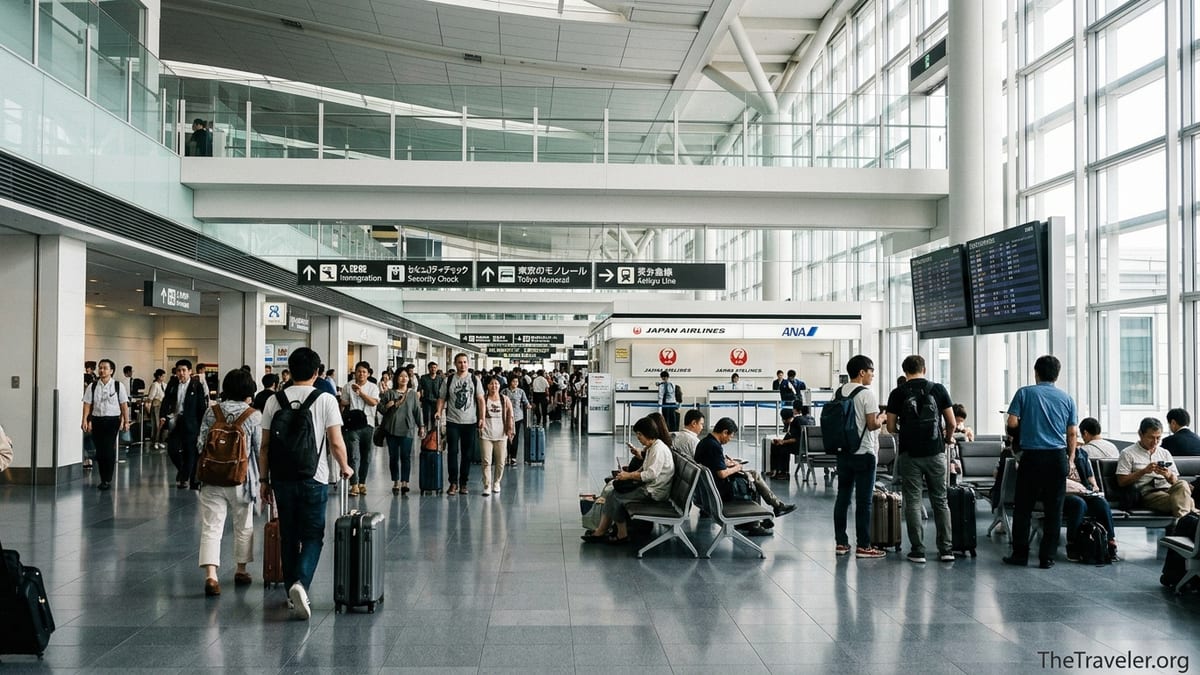
Haneda in a nutshell: how the three terminals are organized
Haneda Airport (HND) has three passenger terminals: Terminal 1 and Terminal 2 for domestic flights within Japan, and Terminal 3 as the main international terminal. Think of it this way: if your ticket is entirely within Japan, you will almost always use Terminal 1 or 2; if you are arriving from or departing to another country, you will almost always use Terminal 3.
Terminal 1 is historically the Japan Airlines side of the airport. Most JAL domestic flights, along with carriers such as Skymark Airlines and StarFlyer on some domestic routes, depart and arrive here. Terminal 2 is the All Nippon Airways base, handling most ANA domestic flights plus a growing number of ANA-operated international services on specific routes since 2024. Terminal 3 handles the bulk of international traffic, including JAL and ANA international flights, and many foreign airlines serving Tokyo.
The terminals sit relatively close together on the same side of Tokyo Bay. Passengers can move between them using a free airside shuttle bus, an underground walkway between Terminals 1 and 2, or the Keikyu Line and Tokyo Monorail stations that serve the airport landside. Because of immigration and security rules, you cannot simply walk from an international gate in Terminal 3 to a domestic gate in Terminal 1 or 2 without exiting, clearing formalities, and re-entering.
For most trips, the terminal shown on your booking will be accurate, but codeshares and last-minute operational changes can shift flights between terminals. Always re-check your terminal on your airline’s app or Haneda’s official website the day before and again on the day of travel, especially if you are on ANA or JAL using both domestic and international segments.
Terminal 1: Japan Airlines domestic hub and classic Haneda experience
If you are flying Japan Airlines (JAL) or its domestic partners on routes such as Tokyo Haneda to Sapporo (CTS), Fukuoka (FUK), or Okinawa (OKA), there is a high chance you will be using Terminal 1. This terminal is dedicated to domestic flights and is sometimes called the “JAL side” of Haneda. Smaller carriers like Skymark also operate many domestic flights from here, so it is not exclusively JAL, but JAL is the anchor tenant.
Terminal 1 is laid out for fast domestic turnarounds: check-in counters and automated baggage machines on the departure level, security lanes feeding into a ring of boarding gates, and straightforward connections to the Tokyo Monorail and Keikyu Line via the basement level. For example, a traveler arriving from central Tokyo on the Tokyo Monorail can ride to Haneda Airport Terminal 1 Station, take the escalator up two levels, and be at the JAL baggage drop in a couple of minutes.
For many travelers, Terminal 1 is also where they get their first taste of Japanese airport food. Before security, you will find branches of mainstream Japanese chains and bento shops selling packed meals for onboard snacking on short hops to regional cities. After security there are additional snack stands and convenience stores, but because this is a domestic-only terminal, there is no duty-free shopping. If you want regional souvenirs such as Hokkaido cookies or Kyoto sweets before flying out, Terminal 1 has numerous specialty shops selling pre-boxed omiyage that locals routinely bring on family visits.
Practical example: if you are flying from Los Angeles to Tokyo Haneda on JAL and connecting the same day to Sapporo, your itinerary will usually show LAX to HND international into Terminal 3, then a domestic JAL segment from Terminal 1. You must clear immigration and customs in Terminal 3, then follow the signs to the free inter-terminal shuttle or rail connections, and allow at least two hours between flights to be safe.
Terminal 2: ANA domestic flights and selected international routes
Terminal 2 is the home of All Nippon Airways (ANA) domestic operations. If you are flying ANA within Japan, for example from Haneda to Hiroshima, Kagoshima, or Komatsu, you will almost always be in Terminal 2. Several smaller domestic airlines such as Solaseed Air and Air Do also use this terminal, especially on routes to Kyushu and Hokkaido.
In recent years, part of Terminal 2 has been adapted to handle some ANA international flights. As of 2024, ANA operates a limited number of long-haul and regional international departures from Terminal 2, while most international services, including codeshares operated by partner airlines, still use Terminal 3. This can be confusing: a traveler booked on an ANA-operated Haneda to Shanghai or Haneda to Honolulu flight might depart from Terminal 2, while another ANA-branded flight to Europe or North America might depart from Terminal 3.
The key is to check whether your boarding pass or e-ticket specifically lists “HND Terminal 2” for an international flight. If it does, you will check in at the international area of Terminal 2, which is separated from the domestic side and has its own dedicated security and immigration facilities. If your ticket simply says “Terminal 3” or does not mention Terminal 2 at all, you should assume you are using Terminal 3 for an international departure.
Terminal 2 also tends to feel newer and brighter than Terminal 1, with a large glass-roofed central plaza and direct indoor connection to the Haneda Airport Garden complex that opened recently, offering a hotel, hot spring spa, and a collection of restaurants and shops. It is a good choice for travelers who plan to arrive early, freshen up, and perhaps have a sit-down meal before a late-evening domestic or international departure on ANA.
Terminal 3: main international gateway for Tokyo Haneda
Terminal 3 is the primary international terminal at Haneda and the one most foreign visitors will see first. This is where you arrive if you are flying non-stop from many major gateways such as New York, London, Singapore, Seoul, or Sydney on airlines including JAL, ANA, Delta Air Lines, Air France, British Airways, Qatar Airways, and numerous others. It is also where most Haneda international departures take place, except for select ANA flights from Terminal 2.
Upon arrival at Terminal 3, the flow is straightforward: disembark the aircraft, follow signs to quarantine and immigration, pass through passport control, collect luggage at baggage claim, clear customs, and then exit into the arrivals hall. From there you can walk directly to transport options: the Tokyo Monorail and Keikyu Line stations are connected by covered walkways, and limousine buses and taxis depart from curbside bays just outside.
For departures, Terminal 3 offers the most extensive range of services in the airport, including international duty-free stores, luxury brands, electronics shops, and a wide selection of restaurants. Travelers with long layovers often spend their time exploring the Edo-themed shopping street area, sampling ramen or tempura, or relaxing at airline lounges operated by JAL, ANA, and several alliance partners, depending on status and cabin class.
Consider a common scenario: a traveler from San Francisco lands in Terminal 3 on ANA at around 16:00 and has a separate low-cost carrier ticket from Narita the next morning. In this case, they will fully enter Japan at Terminal 3, collect their luggage, and then head for ground transport to central Tokyo or straight to Narita. Terminal 3’s layout makes it easy to find information counters, currency exchange counters in the public area, and transit desks for passengers continuing on same-ticket connections.
Moving between terminals: shuttle, train, and walking options
Because Haneda’s terminals are physically separated, understanding how to transfer between them is crucial, especially if you have a domestic-to-international connection on one ticket. The airport operates a free shuttle bus that circulates between Terminals 1, 2, and 3. Buses typically run every few minutes during daytime and evening hours, and the ride between Terminal 3 and the domestic terminals usually takes around 10 minutes under normal traffic conditions.
There is an underground passageway that connects Terminals 1 and 2. Travelers with time to spare can walk between the two domestic terminals in about 10 to 15 minutes without going outside. This can be handy if you arrive by monorail under Terminal 1 but discover that your low-cost domestic flight leaves from Terminal 2, or if you simply prefer walking to waiting for the shuttle.
Another option is to use the Tokyo Monorail or Keikyu Line trains that serve the airport. Each has stations at both the domestic complex (Terminals 1 and 2) and Terminal 3. For example, the Tokyo Monorail connects Monorail Hamamatsucho Station in central Tokyo to “Haneda Airport Terminal 1 Station,” “Haneda Airport Terminal 2 Station,” and “Haneda Airport Terminal 3 Station.” With a transit boarding ticket provided by airlines or information counters for eligible connections, you can ride between terminals at no extra charge on these trains.
Importantly, all transfers between Terminal 3 and the domestic terminals involve exiting into the public area, going through immigration and customs if you have just arrived from abroad, moving to the new terminal, and then re-clearing security. There is no airside transit passage that lets you go straight from an international gate in Terminal 3 to a domestic gate in Terminal 1 or 2. Travelers connecting from an international to a domestic flight should generally allow at least two to three hours, especially at busy times or if they need to re-check baggage.
Choosing the right terminal for your airline and itinerary
The simplest rule at Haneda is to match your airline and route type to the likely terminal, then confirm on your booking. JAL domestic flights usually mean Terminal 1. ANA domestic flights usually mean Terminal 2. Most international flights, whether on Japanese or foreign carriers, use Terminal 3, except for selected ANA-operated international routes that depart and arrive from Terminal 2.
For instance, a traveler flying Osaka Itami to Haneda on ANA and then connecting onward to Okayama on a separate domestic ANA ticket will most likely use Terminal 2 for both segments. In contrast, a traveler flying Seoul Gimpo to Haneda on JAL and then continuing to Fukuoka on JAL will arrive at Terminal 3 on the international leg, clear immigration and customs, transfer to Terminal 1 via shuttle or rail, and then depart domestically from there.
Codeshare flights add another layer. You might be booked on a ticket that shows “American Airlines” or “British Airways” but the flight itself is operated by JAL. In such cases, the terminal is determined by the operating carrier at Haneda, not the marketing airline. If your confirmation says “Operated by Japan Airlines” and the route is international, your departure will almost always be from Terminal 3, not from a hypothetical American Airlines or British Airways terminal area.
When in doubt, check three places: the airline’s official website or app under “flight status,” your e-ticket’s “departing terminal” field, and the Haneda Airport terminal information page on the day of travel. If two of the three agree, that is almost always correct. If you see conflicting information, assume Terminal 3 for international flights and arrive a bit earlier to allow time for a last-minute terminal change if needed.
Ground transport: how terminal choice affects your trip into Tokyo
Your arrival terminal at Haneda has minor but practical implications for how you head into Tokyo. The Tokyo Monorail and Keikyu Line each have stations serving all terminals, but they are labeled slightly differently and located at different levels. From Terminal 3, you can follow signs in English for “Tokyo Monorail” or “Keikyu Line” and reach the station concourse in roughly five minutes on foot.
The Tokyo Monorail runs from Haneda to Monorail Hamamatsucho Station on the edge of central Tokyo, usually in under 20 minutes, with trains departing every few minutes during the day. From Hamamatsucho, many travelers transfer to the JR Yamanote Line for destinations like Shinjuku, Shibuya, and Ueno. A typical one-way adult fare on the monorail is in the vicinity of a few hundred yen, which can be paid using IC cards such as Suica or PASMO or with a paper ticket from the vending machines.
The Keikyu Line connects Haneda to Shinagawa Station in about 15 minutes on fast services, where travelers can transfer to JR lines including the Tokaido Shinkansen for cities like Nagoya, Kyoto, and Osaka. Keikyu also offers through services via the Toei Asakusa Line, so some trains from Haneda run directly to hubs like Asakusa and into Chiba Prefecture without a transfer. Limousine buses link all terminals to major hotel districts including Shinjuku, Shibuya, Tokyo Station, and Yokohama, with typical fares to central Tokyo often in the range of around 1,000 to 1,500 yen.
Taxi stands are located outside each terminal’s arrivals hall. Because Haneda is relatively close to downtown, a taxi into central Tokyo is much cheaper and faster than from Narita, especially late at night when trains are limited. Metered fares into areas like Ginza or Shinjuku can vary widely depending on time and traffic, but are generally manageable for small groups with large luggage who value a door-to-door ride. Regardless of the terminal you arrive at, you can easily follow multilingual signs to your choice of train, bus, or taxi within minutes of clearing customs.
The Takeaway
Haneda’s three-terminal layout seems complicated at first, but it follows a consistent logic once you understand the roles of each building. Terminal 1 is primarily the domain of JAL and its domestic partners, Terminal 2 belongs mainly to ANA with added international capability, and Terminal 3 is the main international gateway for most foreign visitors and airlines.
The most important practical step is to confirm your terminal before you travel and again on the day of departure. Airline apps and Haneda’s official information pages are updated frequently and will reflect recent changes, such as new ANA international routes using Terminal 2 or seasonal schedule shifts. With your terminal known, you can plan your arrival time, choose the best transport into or out of Tokyo, and build in enough margin for transfers between terminals if you are connecting.
For travelers on complex itineraries that mix domestic and international flights or involve different airlines on separate tickets, the combination of a free shuttle bus, underground walkways, and trains linking the terminals means that even last-minute terminal confusion is usually solvable with a short ride. By approaching Haneda with a clear sense of which terminal you need and how to move between them, you can turn one of the world’s busiest airports into a surprisingly calm and efficient starting or ending point for your journey in Japan.
FAQ
Q1. How do I know which Haneda terminal my flight uses?
Check the “departing terminal” or “arrival terminal” field on your e-ticket, then confirm it on your airline’s website or app and on Haneda Airport’s official terminal information page on the day of travel.
Q2. Is Terminal 3 always the international terminal at Haneda?
Terminal 3 is the main international terminal and handles most international flights, but some ANA-operated international routes now use Terminal 2, so always verify your terminal in advance.
Q3. Do I need to clear immigration at Terminal 3 before connecting to a domestic flight?
Yes. If you arrive from abroad into Terminal 3 and are connecting to a domestic flight, you must pass through immigration, collect your bags, clear customs, then transfer to Terminal 1 or 2 and re-check in or proceed to security.
Q4. How much transfer time should I allow between an international and domestic flight at Haneda?
Plan for at least two to three hours between scheduled arrival and your onward domestic departure to allow for immigration, baggage claim, customs, moving terminals, and security.
Q5. Is the shuttle bus between Haneda terminals free?
Yes. Haneda operates a free shuttle bus linking Terminals 1, 2, and 3. It usually runs every few minutes, and the ride between Terminal 3 and the domestic terminals takes roughly 10 minutes.
Q6. Can I walk between Terminals 1 and 2?
Yes. There is an underground passageway connecting Terminals 1 and 2, and the walk typically takes about 10 to 15 minutes. This route is entirely within the landside public area.
Q7. Are there direct train connections from all terminals into central Tokyo?
Yes. Both the Tokyo Monorail and Keikyu Line have stations serving all terminals, with frequent trains to central hubs like Hamamatsucho and Shinagawa where you can transfer to JR lines.
Q8. Where can I find duty-free shops at Haneda?
Duty-free shops are concentrated in Terminal 3 after security and immigration in the international departures area. Terminal 2 also has international duty-free shops for flights using its international facilities.
Q9. What if my airline changes the terminal at short notice?
Terminal changes are announced on airline apps, airport displays, and websites. If this happens, follow signage to the new terminal using the free shuttle or trains, and speak to airline staff if you are worried about missing your flight.
Q10. Is Haneda or Narita better if I want a quick trip into central Tokyo?
Haneda is usually the faster choice, regardless of terminal, because it is much closer to central Tokyo. Trains, buses, and taxis from Haneda typically reach major districts in around 20 to 60 minutes depending on the mode and traffic.