


More news on this day
Iberia has extended the suspension of its historic Madrid–Havana route until at least June 30, 2027, as Cuba’s protracted energy crisis continues to disrupt fuel supplies and undermine the reliability of long-haul operations to the island.
Get the latest news straight to your inbox!
Suspension Stretched From Seasonal Pause to Multi‑Year Halt
What began as a limited summer suspension of Iberia’s flights between Madrid and Havana has evolved into a long-term interruption to one of Europe’s key air links with Cuba. Earlier this year, Iberia announced it would halt the route from June 1 to October 24, 2026, in response to operational difficulties on the island. Published schedules and travel notices outlined a full cancellation of services during that period, replacing what had been three and then two weekly frequencies. ([aeroroutes.com](https://www.aeroroutes.com/eng/260511-ibns26cu?utm_source=openai))
New notices released in mid-August 2026 show that the airline now plans to keep the route suspended until June 30, 2027, extending the disruption well beyond the current northern summer season. Iberia’s agency bulletin on the Cuba market details an updated flexibility policy for tickets issued up to August 18, 2026, covering travel dates from June 1, 2026, through June 30, 2027, and allowing changes to other destinations or full refunds for affected customers. ([agencias.iberia.com](https://agencias.iberia.com/content/iberia-agencias/language-masters/en/flexibilizaciones/listado/suspension-flight-cuba.html?utm_source=openai))
According to published coverage in Spanish media, the carrier links the continued suspension directly to the worsening energy situation in Cuba, which has made it difficult to guarantee predictable operations and fuel availability. Reports emphasize that the measure remains officially temporary, but the new timeline effectively removes direct Iberia flights from the island’s long-haul offering for at least 13 consecutive months. ([elpais.com](https://elpais.com/economia/2026-08-19/iberia-mantendra-la-suspension-de-vuelos-a-cuba-hasta-junio-de-2027-por-la-crisis-energetica-de-la-isla.html?utm_source=openai))
Energy Crisis in Cuba Drives Airline Retrenchment
The extended suspension is closely tied to Cuba’s deepening energy crisis, which has resulted in recurring fuel shortages, rolling power cuts and nationwide blackouts. International reporting describes multiple island-wide outages in recent months as the National Electric System has struggled to maintain generation, contributing to a broader economic downturn and disruptions to basic services. ([apnews.com](https://apnews.com/article/44f447bb5da48391c1199627ab11cc08?utm_source=openai))
For airlines, the fuel constraints have had direct operational consequences. Before announcing the full suspension, Iberia had already been routing its return flights via Santo Domingo in the Dominican Republic in order to refuel, adding time and complexity to the Madrid–Havana journey. Spanish outlets note that the carrier cited both the difficulty of refueling in Havana and a fall in demand linked to the crisis in justifying the decision to pull back. ([elpais.com](https://elpais.com/economia/2026-04-13/iberia-suspendera-en-junio-su-vuelos-a-cuba-por-la-falta-de-combustible-en-el-pais-y-la-caida-de-la-demanda.html?utm_source=openai))
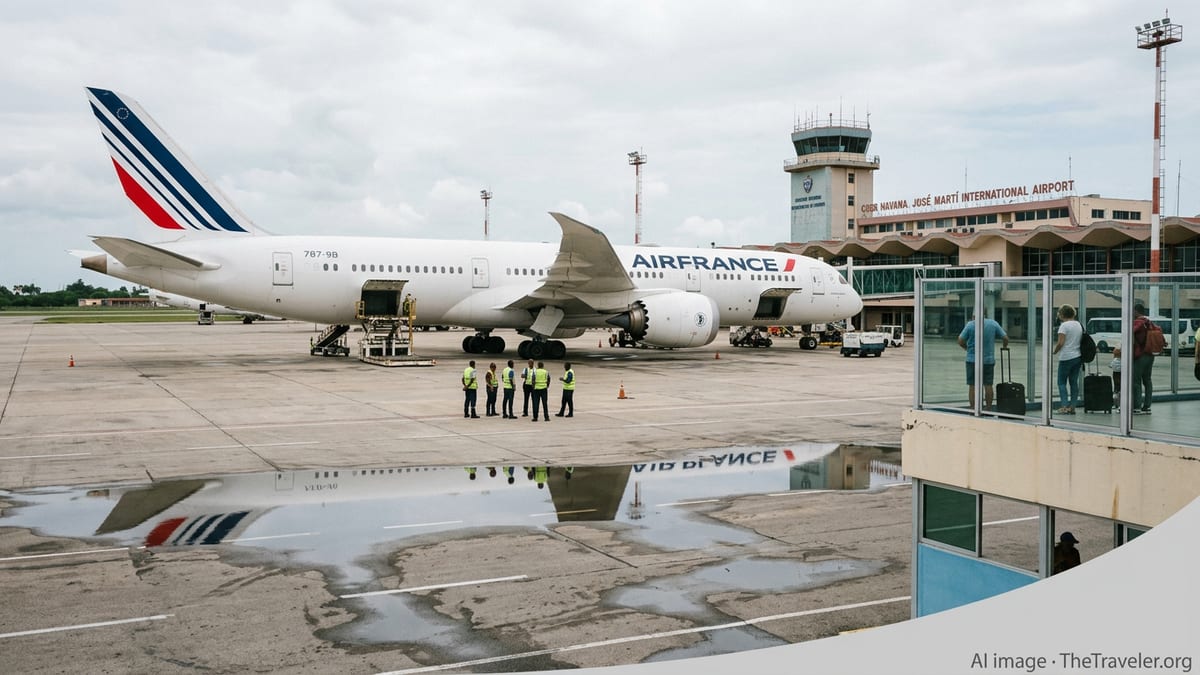
Cuba’s energy problems have also affected other international operators. Coverage from European and North American media highlights that Air France, Air Canada and charter specialist World2Fly have all cut or restructured their services to the island in recent months, and that several airlines now avoid refueling there entirely. The trend underscores how energy supply has become a central factor in route planning for long-haul links to Havana. ([euronews.com](https://www.euronews.com/travel/2026/06/02/fresh-blow-for-cuba-iberia-halts-direct-madridhavana-flights-until-november?utm_source=openai))
Passenger Options Shift to Connections and Codeshares
With Iberia’s direct Madrid–Havana service offline until at least mid‑2027, travelers are being redirected to alternative routings. The airline’s travel notices and public statements describe a strategy centered on its partnership with Copa Airlines, which operates a hub in Panama City. Passengers holding Iberia tickets can be rebooked via Madrid–Panama and then continue to Havana under a codeshare arrangement. ([aviationweek.com](https://aviationweek.com/air-transport/airports-networks/iberia-suspending-havana-flights-cuba-energy-crisis-worsens?utm_source=openai))
The updated flexibility policy allows affected customers to change their bookings to other destinations within approximately 2,300 kilometers of Havana, a radius that includes major gateways such as Miami, Panama City, Santo Domingo and Mexico City. Travelers can rebook into the same cabin, in the original or lowest available fare class, or request a full refund if they prefer not to travel under the revised conditions. These provisions apply both to cancelled flights and, in certain cases, to itineraries that remain technically scheduled but are impacted by the suspension. ([agencias.iberia.com](https://agencias.iberia.com/content/iberia-agencias/language-masters/en/flexibilizaciones/listado/suspension-flight-cuba.html?utm_source=openai))
Industry analysis points out that the growing reliance on connections is reshaping how European leisure and diaspora travelers reach Cuba. With nonstops reduced, more itineraries now route through hubs in Panama, Mexico or the Dominican Republic, increasing travel times and potentially raising costs. At the same time, some competing carriers, notably Air Europa on the Spanish side, continue to operate direct services, positioning themselves to capture demand left on the table by Iberia’s withdrawal. ([elpais.com](https://elpais.com/economia/2026-04-13/iberia-suspendera-en-junio-su-vuelos-a-cuba-por-la-falta-de-combustible-en-el-pais-y-la-caida-de-la-demanda.html?utm_source=openai))
Tourism and Connectivity Hit as Havana Loses Capacity
The loss of Iberia’s Madrid–Havana route removes one of the island’s longstanding European connections at a time when tourism receipts are already under pressure. Aviation data cited by regional outlets show that, before the pandemic, the Havana–Madrid link handled several hundred thousand passengers annually and ranked among the principal long-haul routes for Cuba’s main international gateway. ([aviacionline.com](https://www.aviacionline.com/english/commercial-aviation/latin-america-and-caribbean/central-america-and-caribbean/world2fly-suspends-its-operations-to-cuba_a6a0e29c20a3ce39269948c7c?utm_source=openai))
With multiple carriers scaling back, Cuba faces a thinner network of direct flights from Europe and North America, limiting options for both holidaymakers and Cuban residents who rely on long-haul links for family visits and business travel. Hotel operators with a large footprint on the island have acknowledged that reduced air capacity, alongside domestic economic challenges, is weighing on occupancy and delaying a full tourism recovery. ([cincodias.elpais.com](https://cincodias.elpais.com/companias/2026-02-26/escarrer-melia-no-vamos-a-salir-de-cuba-y-nos-sentimos-muy-comodos-con-la-posicion-de-liderazgo.html?utm_source=openai))
Travel industry observers note that the pattern in Havana mirrors a wider fragility in Caribbean connectivity, where single-route suspensions can quickly affect entire markets. In Cuba’s case, prolonged energy shortages and uncertainty over fuel supply have added a structural layer of risk, complicating planning for airlines and tour operators that might otherwise seek to restore capacity ahead of future high seasons.
Outlook for Madrid–Havana Travel Through 2027
While Iberia’s suspension is described as temporary, the extension through June 30, 2027 sets a clear medium‑term horizon for travelers and the tourism industry. Timetables and public notices state that tickets for travel on the Madrid–Havana route through that date will not be operated by Iberia, and rebooking windows on alternative routes now run until late October 2027, reflecting the scale of the adjustment. ([agencias.iberia.com](https://agencias.iberia.com/content/iberia-agencias/language-masters/en/flexibilizaciones/listado/suspension-flight-cuba.html?utm_source=openai))
According to specialist aviation coverage, any eventual restoration of direct flights will likely depend on a sustained improvement in Cuba’s fuel supply and power-generation capacity, together with a rebound in demand from key source markets. For now, analysts portray Iberia’s move as part of a cautious approach to the island, prioritizing network stability and operational predictability over the prestige of maintaining a historic long-haul route at any cost. ([aviationweek.com](https://aviationweek.com/air-transport/airports-networks/iberia-suspending-havana-flights-cuba-energy-crisis-worsens?utm_source=openai))
Until conditions change, passengers traveling between Madrid and Havana will need to rely on other carriers’ nonstops or on itineraries built around regional hubs in the Americas. The prolonged gap in Iberia’s schedule underscores how an energy crisis on the ground can reverberate thousands of kilometers away, reshaping long-haul travel patterns between Europe and the Caribbean well into the second half of this decade.
Sources: Iberia travel notice on Cuba flight suspension; El País coverage of Iberia’s extended suspension; Euronews report on the Madrid–Havana route halt; Aviation Week analysis of the Cuba energy crisis impact