


Lapland in winter offers the kind of experiences that people plan entire bucket lists around. Two of the most iconic are sailing through pack ice on the legendary Icebreaker Sampo in Kemi and hunting the aurora borealis on a Northern Lights tour from resorts like Rovaniemi, Levi or Saariselkä. Both are unforgettable, both take place in deep winter, and both require some planning and a realistic budget. If you only have time or money for one, which should you choose? This guide compares them head to head so you can match the right Arctic adventure to your travel style, expectations and timing.
Get the latest updates straight to your inbox!
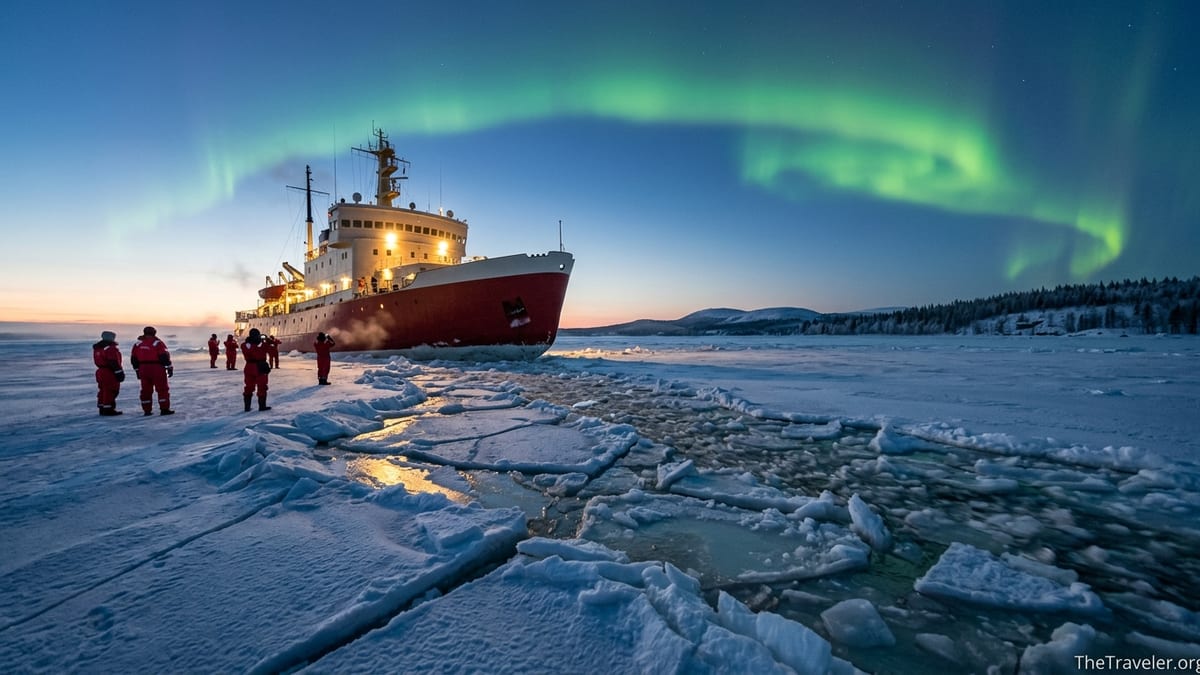
What the Icebreaker Sampo Experience Really Feels Like
The Icebreaker Sampo cruise is one of the most distinctive winter activities in Finland. The ship itself is an old state icebreaker from 1960 that spent decades keeping sea lanes open before being retired to tourism and permanently stationed in Kemi, on the Bothnian Bay in the Gulf of Bothnia. Today it runs winter cruises on the frozen sea outside Kemi, typically from mid-December through early April, when the ice is thick enough to support both the vessel and passengers walking on the ice.
A standard Sampo cruise, such as the popular morning departure, lasts around 3.5 hours. After leaving Kemi’s port, the ship pushes steadily into the sea ice, carving a channel through meter-thick slabs. You can move between indoor lounges and outside decks, feeling the vibration as the bow rides up on the ice and crushes it. Many visitors say the sound of the hull cracking through the ice and the sight of huge floes tilting and breaking is the most memorable part of the day.
Midway through the trip, the ship usually stops, turns around and creates an ice-free pool in the channel. Passengers are invited to change into thick, bright red survival suits and climb down to the sea for a supervised “ice floating” session in the freezing water. You bob between blocks of ice, kept perfectly dry by the suit, with crew watching closely and photographers taking pictures. Those who prefer to stay dry can instead step down onto the broken ice and walk around on the frozen sea, taking in the scale of the landscape.
The cruise generally includes a guided tour of the vessel, where you walk through the engine room, bridge and working areas, and a hot drink on board. Some packages booked through Kemi’s local providers or tour companies from Rovaniemi also bundle in entrance to the SnowCastle area in Kemi or lunch at a nearby restaurant. For many families and cruise passengers visiting Northern Finland, the Sampo day trip becomes the fixed centerpiece of their entire itinerary.
What a Lapland Northern Lights Tour Is Actually Like
In contrast to the structured, daytime nature of the Sampo cruise, Northern Lights tours are nighttime excursions that center on a natural phenomenon you cannot control. In most of Finnish Lapland, from Rovaniemi to Inari, the aurora season runs roughly from late August to mid-April, but the most popular period for visitors is from about November to March, when the nights are long and the landscapes are fully snow-covered.
Aurora tours come in several formats, each giving a different feel to the evening. In Rovaniemi, for example, you will see options like a minibus “aurora chase” where a guide follows real-time cloud maps to find clearer skies, a snowmobile safari across frozen rivers and fells to a wilderness hut, or a quieter reindeer or husky sleigh ride that ends with hot juice around a campfire. In Saariselkä, Levi and Ylläs you will also find photography-focused tours that help you set up your camera and tripod to capture the lights over open fells and frozen lakes.
Most tours last 3 to 5 hours and run between about 8 pm and 1 am, targeting the hours when local tourism boards and the Finnish Meteorological Institute say auroras are most often visible. A typical evening might start with hotel pickup around 20:00, a 30 to 60 minute drive out of town to avoid light pollution, and then a mix of waiting, warming up in a kota hut or laavu shelter, drinking hot berry juice, grilling sausages and stepping outside whenever the sky brightens. If the aurora appears, the sky can shift from faint green arcs to fast-moving curtains or even reddish and purple streaks when solar activity is high.
Crucially, there is never a guarantee. Even in northern Lapland, where statistics suggest auroras appear on roughly every second clear night in winter, clouds can block the show or solar activity can be quiet. That is why many operators encourage staying at least three or four nights. Some, including a few small Rovaniemi companies, have started offering partial refunds or rebooking if there is no display, but this is not universal, so you need to read conditions carefully when you book.
Costs, Logistics and Time Commitment Compared
For many travelers trying to choose, the decision comes down to practicalities: price, timing and how complicated it is to fit each experience into a short Lapland itinerary. The Icebreaker Sampo is a fixed, high-value purchase: recent season prices for the core cruise, including ice floating and ship tour, often fall in the range of roughly 300 to 400 euros per adult, with somewhat lower rates for children. If you add bus transportation from Rovaniemi, which is common for visitors staying there, expect the total to reach or exceed the higher end of that range per person once transfers and any meal packages are included.
The Sampo cruise also requires a whole day. From Rovaniemi, shuttle transfers to Kemi and back take about 1.5 to 2 hours each way depending on conditions, and the cruise itself is several hours, so you can easily be out for 8 to 10 hours. If you are already staying in Kemi, the logistics are simpler, but many visitors are basing themselves in Santa Claus Village or Rovaniemi city, which means accepting a long day on the road in mid-winter darkness.
Northern Lights tours, on the other hand, are generally less expensive and more flexible. In Rovaniemi, Levi or Saariselkä, a small-group aurora chase by minibus typically costs in the region of 100 to 150 euros per adult, depending on the operator, group size and whether a full camp dinner or additional activities like snowshoeing are included. Premium, very small-group or private tours can cost substantially more, while basic big-bus tours can be a little cheaper but may feel less personal.
Transport logistics for aurora tours are usually lighter because operators pick you up directly from major hotels and cabin areas and return you later that night. You can spend your daylight hours on other activities such as skiing at Levi, visiting Santa Claus Village in Rovaniemi or touring the Arktikum museum before heading out after dark. For travelers on a short 3 or 4 night stay, it is quite common to book two different Northern Lights tours, increasing the chance of success while still staying under the cost of a single Sampo cruise for a couple.
Seasonality and Weather: When Each Experience Works Best
Both experiences depend heavily on the Arctic winter calendar, but in different ways. The Icebreaker Sampo can only operate once the sea ice in the Bothnian Bay is thick enough. For the current and upcoming seasons, cruises are generally scheduled from around mid-December until early April, with exact dates set based on ice conditions. Early winter sailings in December often feel atmospheric because of the polar night, while late season trips in March and early April can offer brighter days and sometimes milder temperatures.
Because Kemi lies near the sea and slightly south of the most consistently cold parts of Lapland, weather can be variable. February and early March are often considered a sweet spot: deep winter conditions, strong ice and more daylight than the very dark weeks around Christmas. Travelers who are sensitive to extreme cold may appreciate that coastal temperatures, while still sub-zero, are often a few degrees milder than inland northern Lapland on the same day.
Northern Lights viewing is mostly about three variables: darkness, cloud cover and solar activity. Darkness is predictable: from late August to mid-April, nights are dark enough somewhere in Lapland to make aurora watching possible. The heart of the season is roughly September to March, with many Finnish tourism sources pointing to March and early April as particularly favorable because skies often clear up and snow still reflects ambient light. In northern Lapland regions such as Inari or Utsjoki, the number of nights with potential aurora visibility can be higher than around the coast.
Cloud cover and solar activity are not predictable long in advance, so the best strategy is to build flexibility into your schedule. Booking at least three nights in a northern destination like Rovaniemi, Saariselkä or Nellim and planning to go out multiple evenings improves your chances. During the current solar cycle, activity is relatively strong, which means bright auroras are more frequent, but you still need clear skies. This is where guided tours that are willing to drive an hour or more to find a gap in the clouds can be a real advantage over staying put at your hotel.
Who Should Choose Sampo and Who Should Choose the Aurora Tour
Thinking about your own expectations is key. The Icebreaker Sampo is best for travelers who value a guaranteed, tangible experience over a potentially transcendent but uncertain one. If you want to come home knowing you will float in icy water in a survival suit, stand on the frozen sea and tour an authentic icebreaker, Sampo delivers with near-total reliability as long as the cruise operates. It is especially well suited to families with older children and teens, cruise ship passengers docking in Kemi, engineering and maritime enthusiasts, and anyone building a “once in a lifetime” winter itinerary who prefers bold, physical experiences.
It is also a good match for those who have already seen the Northern Lights elsewhere or who are visiting in a period when aurora chances are decent but not their highest, such as early December when snow cover and darkness are great but cloud cover can be frequent. For some visitors, just the novelty of walking on the open sea and hearing the ice crack under a 3,500-ton ship is more compelling than a night of waiting under cold skies that may stay stubbornly grey.
Northern Lights tours are ideal for travelers who feel that the aurora itself is the main reason to visit the Arctic. If you are the type of person who is willing to stay up late, dress in layers, accept uncertainty and potentially go out two or three nights in a row, the payoff can be extraordinary. Couples on romantic trips, serious photographers, nature lovers and repeat visitors to Lapland often put aurora hunting at the center of their plans, building days around the need to be rested and ready to go out when forecasts look good.
Aurora tours also scale better to different budgets. A backpacker staying in a simple cabin can join a group tour from Rovaniemi or Levi for around what a single fancy dinner might cost in Helsinki, while luxury travelers can arrange private aurora chases by van, snowmobile or even reindeer sleigh, combined with stays in glass-roofed igloo cabins where you can watch the sky without leaving your bed. If you are unsure, one strategy is to book at least one guided aurora night and leave another evening free so you can add a second tour if the forecast looks promising once you are on the ground.
Sample Itineraries: How Each Choice Shapes Your Lapland Trip
To understand the practical impact of each choice, it helps to look at sample trips. Consider a four-night stay based in Rovaniemi in late February. If you prioritize the Icebreaker Sampo, you might dedicate one full day to the cruise with transfers to Kemi, another to Santa Claus Village and local reindeer or husky activities, one to snowmobiling or skiing on Ounasvaara, and leave only one evening free for a single Northern Lights tour. You would return home with a guaranteed highlight in the form of the icebreaker day but only a modest chance of having seen a strong aurora display.
If you instead prioritize Northern Lights hunting on the same four-night schedule, you might skip the long Sampo transfer and arrange two different aurora experiences, such as one minibus chase and one snowmobile or snowshoe tour, on separate nights. Your days would still be full: you could visit Arktikum and the science center one day, cross the Arctic Circle at Santa Claus Village the next and book a daytime husky safari on another. The financial outlay could end up similar to one Sampo day for two people, but you would have maximized your odds of a dramatic aurora encounter.
For a longer itinerary that includes northern Lapland, such as a week split between Rovaniemi and Saariselkä, some travelers try to do both. You could spend three nights in Rovaniemi, including a day trip to Kemi for Sampo, then take a domestic flight or coach north to Saariselkä for three more nights focused on aurora hunting on the fells and cross-country skiing by day. Because domestic travel and extra nights add cost, this combination works best for those with some flexibility in budget and at least a week to spare.
If you are on a very short schedule, such as a 2-night stopover around Helsinki with only one full day in Lapland, trying to squeeze in Sampo plus a serious aurora hunt is often unrealistic. In that scenario, visitors usually choose a single base like Rovaniemi and focus either on Northern Lights by joining a tour that first evening, or on activities like Santa-themed visits, snowmobiling and huskies. Kemi and the icebreaker are simply too far and time-consuming to justify for a one-night Arctic dash.
How to Decide: Key Questions to Ask Yourself
Once you know what each experience involves, a few simple questions can clarify your choice. First, ask how you personally handle uncertainty. If you are comfortable with the possibility that you might spend several cold evenings without a real aurora show, but that the reward could be one of the most beautiful things you ever see, then investing in Northern Lights tours makes sense. If you are the type who would feel disappointed and resentful if the sky stays cloudy all week, a concrete experience like Sampo might better align with your expectations.
Second, look at your base and routes. If your itinerary already brings you near Kemi, for example on a coastal road trip or a winter ferry route, Sampo suddenly becomes logistically easier. Conversely, if all your nights are planned in more northern destinations like Levi, Ylläs or Inari, where the aurora statistics are particularly strong, it may feel counterintuitive to spend a full day heading south to the coast for a ship excursion.
Third, think about your companions. Families with younger children often find that the structure of the Sampo day, with clear schedules, indoor warm spaces and a definite highlight in the form of ice floating, works well. Parents can manage naps on the bus and enjoy the cruise without pushing kids to stay up until midnight. Couples or groups of friends, by contrast, may prefer the late-night camaraderie and sense of adventure that comes with sitting around a campfire at 1 am waiting for the sky to turn green.
Finally, consider your budget and how you value time. A Sampo cruise is typically a one-off, premium expenditure. A Northern Lights tour, at roughly a third to half the per-person cost of Sampo, leaves space for multiple attempts or for adding other activities like a visit to a glass igloo resort near Rovaniemi or Ivalo. If you are on a tighter budget but still want something unique, focusing on aurora experiences and skipping the icebreaker can free up funds for extra nights in Lapland, which arguably matter more than any single day tour when it comes to overall satisfaction.
The Takeaway
If you are choosing between the Icebreaker Sampo and a Northern Lights tour in Lapland, you are deciding between a guaranteed, engineered Arctic spectacle and a wild, elusive natural one. Sampo offers a fixed set of experiences that almost no other destination can match: walking and floating on the frozen sea, exploring a historic icebreaker and witnessing the raw force of a ship crushing thick pack ice. It costs more and requires a full day, but you can count on coming home with epic photographs and stories.
Northern Lights tours demand more patience and flexibility, but they put you in the path of one of the planet’s great light shows. With a few nights in Lapland, a well-chosen tour operator and cooperative weather, the aurora can easily become the defining memory of your trip. The key is to treat the lights as a possibility, not a promise, and to choose a base and time of year that maximize your odds.
For many travelers, the most balanced strategy is to decide which of these experiences speaks most strongly to you and build the rest of your itinerary around it. If your heart is set on the dream of green curtains dancing over silent forests, focus your budget on multiple aurora nights and stay in darker, northern resorts. If the idea of crunching through sea ice on a legendary vessel excites you more, anchor your plans on a Sampo cruise and fill the surrounding days with easier evening activities that do not depend on clear skies. Either way, Lapland’s winter landscapes, huskies, reindeer and snow-covered forests will ensure that your journey to the Arctic Circle is far from ordinary.
FAQ
Q1. Can I realistically do both the Icebreaker Sampo and a Northern Lights tour on one trip?
Yes, if you have at least three or four nights in Lapland and are willing to commit one full day to traveling to Kemi for the Sampo cruise and one or more evenings to aurora tours. Travelers on tight two-night schedules usually find it more practical to focus on just one of the two.
Q2. Which is better for children: Sampo or a Northern Lights tour?
For younger children, Sampo is often easier because it happens during the day, offers warm indoor spaces and has a clear structure, including the ice floating session. Northern Lights tours run late at night in very cold conditions and can involve long periods of waiting, which some kids find tiring.
Q3. How far in advance should I book the Icebreaker Sampo?
Because sailing dates are limited to the winter season and capacity per cruise is fixed, it is wise to book several months ahead if you plan to travel during peak times like Christmas, New Year or February school holidays. Outside peak weeks, you may find more flexibility, but last-minute spots are never guaranteed.
Q4. Are Northern Lights tours worth it if I am staying in a dark area anyway?
Guided tours add value by monitoring cloud cover and aurora forecasts, choosing good viewing spots and providing transport, clothing and photography help. Even if you have a dark sky near your accommodation, a tour can significantly improve your chances on marginal nights, especially if you do not have a rental car.
Q5. What should I wear for ice floating on the Sampo?
You will be given a professional survival suit to wear over your clothes, but you should still dress in warm, layered winter clothing, including thermal base layers, thick socks and a hat and gloves. The suit keeps you dry and afloat, but the surrounding air and ice can still feel extremely cold when you are waiting on deck.
Q6. What are my chances of seeing the Northern Lights on a single tour night?
No operator can guarantee a sighting. In parts of Lapland the aurora appears on many clear nights in winter, but cloud cover, timing and solar activity vary. Booking at least two separate nights increases your overall chances far more than spending extra money on a single, ultra-premium tour.
Q7. Is Kemi a good place to see the Northern Lights if I go for the Sampo cruise?
Kemi does see auroras, but it is somewhat farther south and closer to the coast than major aurora hotspots like Inari or Saariselkä. If the Northern Lights are your main goal, it usually makes more sense to base yourself farther north and treat Sampo as an additional experience rather than the centerpiece of your aurora strategy.
Q8. Can seasickness be a problem on the Icebreaker Sampo?
Because the sea surface is largely frozen and the ship moves relatively slowly through the ice, many passengers experience less motion than on open-water cruises. However, some vibration and movement are inevitable, so those very prone to seasickness may still want to take normal precautions.
Q9. Do I need a professional camera to enjoy a Northern Lights tour?
A professional camera is not essential. Modern smartphones can capture reasonable aurora images with night modes or long exposure apps, and many tour guides help guests adjust settings. That said, a camera with manual controls and a tripod will give the best results if photography is a major priority.
Q10. If I have to choose only one, which offers better value for money?
Value depends on what you personally cherish more: a guaranteed, rare activity or the chance of witnessing a natural wonder. The Sampo cruise is more expensive but delivers a unique, tangible experience every time it runs. Northern Lights tours cost less per night, allow multiple attempts and can yield spectacular memories, but there is always a real possibility that clouds or low activity will limit what you see.