


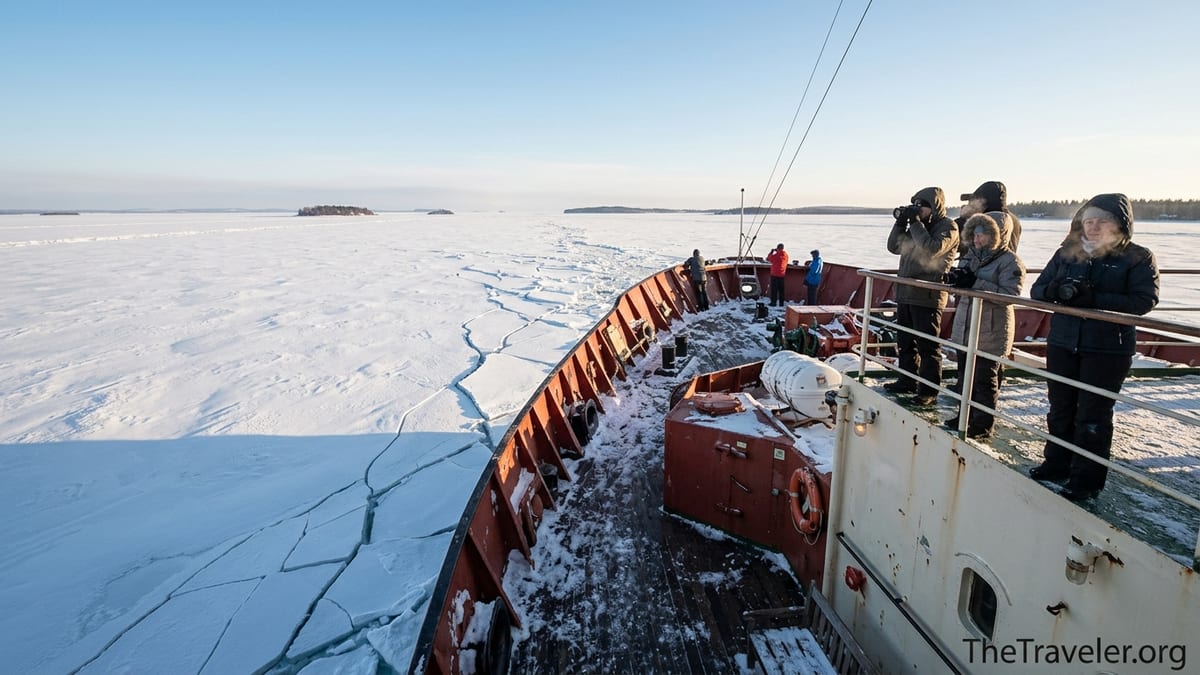
Few travel experiences capture the Arctic spirit as vividly as standing on the deck of Icebreaker Sampo while the ship crushes through thick sea ice on the frozen Gulf of Bothnia. Operating out of Kemi in Finnish Lapland, this former working icebreaker has become a legend among winter travelers, offering a rare chance to feel, hear and literally walk on the Arctic sea in complete safety. For many visitors, it becomes the defining memory of a trip to Finland.
Get the latest updates straight to your inbox!
A Working Icebreaker Turned Arctic Icon
Sampo is not a purpose-built tourist vessel but a genuine Finnish icebreaker launched in 1960 and stationed for most of its working life in the northern reaches of the Baltic Sea. After nearly three decades of service opening shipping lanes, it was purchased by the city of Kemi and, from the late 1980s onward, repurposed for passenger cruises. That industrial past is still written into every steel plate and rivet, and it is a big part of what makes a cruise on Sampo feel so authentic.
Unlike many sightseeing boats that only mimic a polar atmosphere, Sampo retains the heavy-duty profile, reinforced hull and towering superstructure of a real icebreaking workhorse. When you step aboard at the port of Kemi, you are not boarding a sleek yacht but a 75-meter-long, 3,500-ton icebreaker built to slam its weight onto sea ice and smash it apart. The ship’s bright hull stands out against the white expanse of the Bay of Bothnia, and the industrial setting of the port adds to the sense that you are joining a serious Arctic operation rather than a simple pleasure cruise.
Inside, the vessel is a fascinating blend of functional maritime spaces and visitor-friendly comforts. Corridors are narrow and purposeful, engine room ladders are steep, and control panels still have their original analog feel. At the same time, public salons are warm and welcoming, with large windows, simple seating and a shipboard café-bar where guests can warm up with coffee, hot chocolate or a glass of wine between excursions onto the ice.
This preserved character makes Sampo feel less like an attraction and more like a living museum. During the guided tour, you typically visit the bridge, engine room and crew quarters, hearing stories from its working days and from the crew who now split their time between maritime duties and hosting travelers. The result is an experience that feels uniquely grounded in Finland’s maritime history.
Crunching Through the Ice: What the Cruise Is Really Like
A standard Sampo cruise from Kemi usually lasts around three and a half hours on the ice, with extra time on land for check-in and transfers. Morning departures from the SnowCastle of Kemi area are especially popular. Guests check in, perhaps add an optional breakfast buffet, then board a shuttle bus that drives through the port’s restricted zone to the icebreaker’s berth. The industrial cranes, stacks of timber and container piles that you pass along the way remind you that this is an active cargo port, not a theme park.
Once aboard, the cruise begins with a safety briefing and welcome drink, followed by time on deck as Sampo heads out through the harbor and begins its work. The first moment the hull leans onto solid ice is unforgettable: a low, grinding vibration rises from below, the ship shudders, and then thick ice sheets fracture into jagged plates that slide away in the wake. The sound is somewhere between thunder and glass breaking, and the rhythm of the ship climbing, dropping and crushing becomes almost hypnotic.
Travelers quickly find their favorite viewing spots. Many cluster along the bow railings to look straight down at the ice as it cracks open, while others prefer the side decks to watch the broken floes swirl and refreeze behind the ship. On calm days with clear winter light, the combination of pale blue sky, distant islands and white expanse makes the whole scene feel otherworldly. On rougher, more overcast days, the conditions are harsher and more dramatic, offering a different but equally powerful experience.
Throughout the cruise, announcements invite passengers to join a guided tour through the ship. You might move from the engine room, where the deep metallic thrum of the machinery fills the air, to the navigation bridge, where officers explain how they read the ice and choose a route. Many visitors are struck by how manual much of the work still is, with real people making judgment calls rather than everything being left to automated systems. It underlines that this is real seamanship in a demanding environment.
Walking on the Frozen Sea and Floating in Ice Water
For most people, the true highlight of a Sampo cruise is the chance to step off the ship and onto the frozen sea. After the captain has created a stable opening in the ice, Sampo comes to a controlled stop and lowers a gangway. Guests are then invited to walk directly on the sea ice, surrounded by nothing but frozen water as far as the eye can see. The realization that there is several meters of water under your boots, and perhaps kilometers to the nearest open sea, is both humbling and exhilarating.
The crew mark a safe area with flags and keep a close eye on everyone, but travelers are generally free to wander, take photos, kneel down to touch the rough surface or listen to the subtle creaks and pops within the ice. Families often bring children, who dash ahead with red cheeks, while photographers experiment with low angles and wide shots to capture the ship towering against the horizon. On sunny days, sunglasses are essential because the ice reflects light almost like a mirror.
Then there is the ice-floating session, which is unlike anything most visitors have ever done. Those who want to participate are fitted with bright orange survival suits that cover everything except the face. These suits are similar to what professional mariners use in emergencies and are designed to keep you warm and buoyant in freezing water. One by one, guests step down a ladder into the dark opening alongside the ship and ease themselves into the sea, where the water temperature is typically just below zero in winter.
Once you are floating, the experience is surprisingly calm. The suits are so buoyant that you can lie back, spread your arms and simply drift among small chunks of ice, looking up at Sampo’s hull, the frozen landscape and the winter sky. Many travelers describe this as the moment when they truly grasp the power and beauty of the Arctic environment. After about 10 to 15 minutes, participants climb out, often grinning and flushed, and head back inside for something hot to drink. It is a safe but viscerally memorable way to feel the sea in deep winter.
Season, Logistics and What It Really Costs
Sampo does not operate year-round; its cruises depend on the sea freezing solid, which typically happens in mid-winter. Recent schedules indicate that the season usually begins in December and runs until early April, with the exact dates adjusted each year according to ice conditions and demand. The busiest period tends to be from late January through March, when daylight hours are longer and ice conditions are at their most impressive.
Prices reflect the specialized nature of the experience. Recent seasons have seen adult cruise tickets commonly priced in the low hundreds of euros per person for the full 3.5-hour package, which includes the icebreaking cruise, guided tour of the ship, time walking on the ice, ice-floating in survival suits and entrance to the SnowCastle exhibition area. Children’s tickets are typically cheaper, and family packages or group rates may be available, especially for tour operators bundling Sampo with hotel stays or other Lapland activities.
To reach Kemi, many international travelers first fly into Helsinki and then continue either by domestic flight to Kemi-Tornio Airport or by train. Finnair has in recent years operated a roughly 1 hour 40 minute flight between Helsinki and Kemi-Tornio, providing a quick link to the northern coast for those with tight itineraries. Others opt for the overnight VR night train from Helsinki to the north, which allows travelers to combine sleeping in a private cabin with watching Finland’s snowy forests and frozen lakes slide by in the evening or early morning.
From Kemi’s center, transfer to the SnowCastle area and port is straightforward. During cruise days, shuttle buses collect guests from central hotels and the railway station before taking them to the SnowCastle of Kemi complex for check-in, then on to the port’s secured area. Travelers who self-drive can park near the SnowCastle and follow the same check-in procedure. The emphasis on centralized check-in ensures that even first-time visitors navigating Finnish Lapland in winter conditions feel guided through the process.
How Sampo Compares to Other Ice Experiences in Finland
Finland offers several winter experiences on ice, from snowmobile safaris across frozen lakes to short cruises on smaller vessels that push through ice along sheltered coasts. Yet Sampo remains distinctive. While there are other ice-strengthened ships around the Baltic, Sampo is widely promoted as one of the only dedicated tourist icebreakers in the world, operating almost exclusively for visitors during the winter season rather than as an occasional side activity of a working fleet.
Compared with short harbor ice cruises elsewhere in Finland, Sampo’s location in Kemi means it sails directly onto the open Bay of Bothnia, where the sea can freeze into a thick, solid sheet. This gives the icebreaking action a more dramatic quality than what you might find on inner archipelagos, where currents and narrower channels often keep ice conditions more varied. The opportunity to walk on sea ice far from land and float in a carved-out basin of open water beside a full-sized icebreaker is difficult to replicate elsewhere.
Many visitors combine Sampo with visits to the SnowCastle of Kemi, which is rebuilt each winter with newly designed snow suites, ice sculptures and a snowy courtyard. Others pair the cruise with northern lights excursions based around Rovaniemi, Levi or Ylläs, traveling to or from Kemi by train or car. In practice, Sampo becomes a centerpiece of a wider Lapland itinerary, offering a different type of Arctic story to tell alongside husky safaris, reindeer visits and aurora hunting.
Some travelers also compare Sampo to Russian or Scandinavian expedition cruises in the high Arctic. The difference is scale and accessibility. Those longer voyages, sometimes lasting more than a week, can cost several thousand euros and require extensive planning. Sampo, by contrast, offers a concentrated, half-day taste of the same sensations at a more accessible price point and with far simpler logistics, yet still retains the authenticity of a true icebreaker operating in real winter conditions.
Practical Tips for Making the Most of Your Cruise
Because Sampo cruises are popular and the season is relatively short, advance booking is strongly recommended, particularly for February and March departures or for travelers tying the cruise to a fixed-length Lapland trip. Tour operators based in Helsinki, Rovaniemi and Kemi often package Sampo tickets with accommodations and transfers, but it is also common for independent travelers to book directly and then arrange their own flights or trains.
Clothing is another crucial consideration. Even though survival suits are supplied for the ice-floating segment, you will spend extended periods standing on open decks and on the sea ice itself. A practical outfit usually includes thermal base layers, a warm mid-layer such as fleece or wool, a windproof and insulated outer jacket, snow pants, thick socks, insulated winter boots, a warm hat that covers the ears, and good gloves or mittens. On cold, windy days, temperatures can feel much lower than what the forecast suggests, especially with windchill over open ice.
Photographers may want to prepare for challenging but rewarding conditions. Batteries drain faster in the cold, so spare batteries carried close to the body can be helpful. Wide-angle lenses capture the dramatic scale of the ship against the ice, while a moderate zoom is valuable for details of broken floes, crew at work or fellow travelers in survival suits. A simple lens cloth is useful for clearing condensation when moving between warm interiors and the frigid deck.
Finally, build some flexibility into your broader itinerary. Winter travel in the north can be affected by snowstorms, rail delays or changing road conditions. Arriving in Kemi at least the day before your scheduled cruise and staying the night after the cruise gives you a buffer against minor disruptions and allows time to enjoy the town’s restaurants, local museums or evening saunas without rushing.
The Takeaway
Icebreaker Sampo delivers one of the most distinctive and memorable experiences in Finland because it combines industrial heritage, raw Arctic nature and hands-on participation in a way few other attractions can match. You are not simply looking at the ice from a distance; you are hearing it shatter under a real icebreaker, walking across frozen sea far from shore and floating in sub-zero water encased in professional survival gear.
Set against the backdrop of Kemi and the wider Lapland region, a Sampo cruise can be the centerpiece of a winter journey that also takes in snow hotels, northern lights, husky trails and peaceful train rides through frozen forests. It appeals equally to families seeking a once-in-a-lifetime adventure, photographers chasing unusual images and seasoned travelers looking for an experience that feels genuinely different rather than just another scenic tour.
For those willing to travel north in winter and embrace the cold, Sampo offers a rare privilege: to step safely and comfortably into an environment that, for much of history, was the domain of working mariners and icebreakers alone. That blend of accessibility and authenticity is what makes it one of the most unique experiences in Finland today.
FAQ
Q1. Where does Icebreaker Sampo depart from?
The cruise departs from the port of Kemi in northern Finland, with guest check-in and transfers usually organized from the SnowCastle of Kemi area in town.
Q2. How long does a typical Sampo cruise last?
The on-ice portion of the cruise is usually around three and a half hours, with additional time needed for check-in, transfers to the port and post-cruise activities.
Q3. Can children join the Icebreaker Sampo cruise?
Yes, families with children regularly join the cruises. Age and height limits may apply for specific activities like ice-floating, but children can usually participate in the main cruise and ice walk.
Q4. Do I need to know how to swim to try the ice-floating?
No, swimming skills are not essential for the ice-floating segment. Guests wear fully buoyant survival suits and are closely supervised by crew members while in the water.
Q5. What should I wear on board and on the ice?
Dress in warm winter layers, including thermal underwear, insulated jacket and pants, winter boots, hat and gloves. Survival suits are provided for ice-floating, but you need your own warm clothing for the decks and ice walk.
Q6. How far in advance should I book the cruise?
It is wise to book several weeks or even months ahead for peak season dates between late January and March, especially if your visit to Kemi is tied to fixed travel or accommodation plans.
Q7. Is the cruise suitable for people with limited mobility?
The ship is a historic icebreaker with steep stairs and narrow corridors, which can be challenging. Some guests with limited mobility can still enjoy parts of the experience, but full access to all areas and activities is not guaranteed.
Q8. What happens if the weather is very bad on the day of the cruise?
Winter conditions are expected, and the ship is designed for ice and cold. In cases of severe weather or safety concerns, schedules or activities may be adjusted, and guests are informed by the operator.
Q9. Can I see the northern lights during a Sampo cruise?
Most Sampo cruises run in daylight hours, so aurora sightings from the ship are uncommon. However, Kemi and the surrounding region offer good opportunities to see the northern lights at night on land-based excursions.
Q10. Is Icebreaker Sampo open in summer?
In summer, when the sea is not frozen, Sampo does not run icebreaking cruises. At times, the vessel has been available as a static attraction, but the signature experience is strictly a winter activity.