


More news on this day
India has been thrust deeper into the global aviation turmoil triggered by the Iran war and wider Middle East conflict, as Air India pushes through sweeping cuts to its Middle East schedule while major international carriers from Europe, the Gulf and Asia race to reroute around closed airspace and absorb a sudden surge in fuel costs.
Get the latest news straight to your inbox!
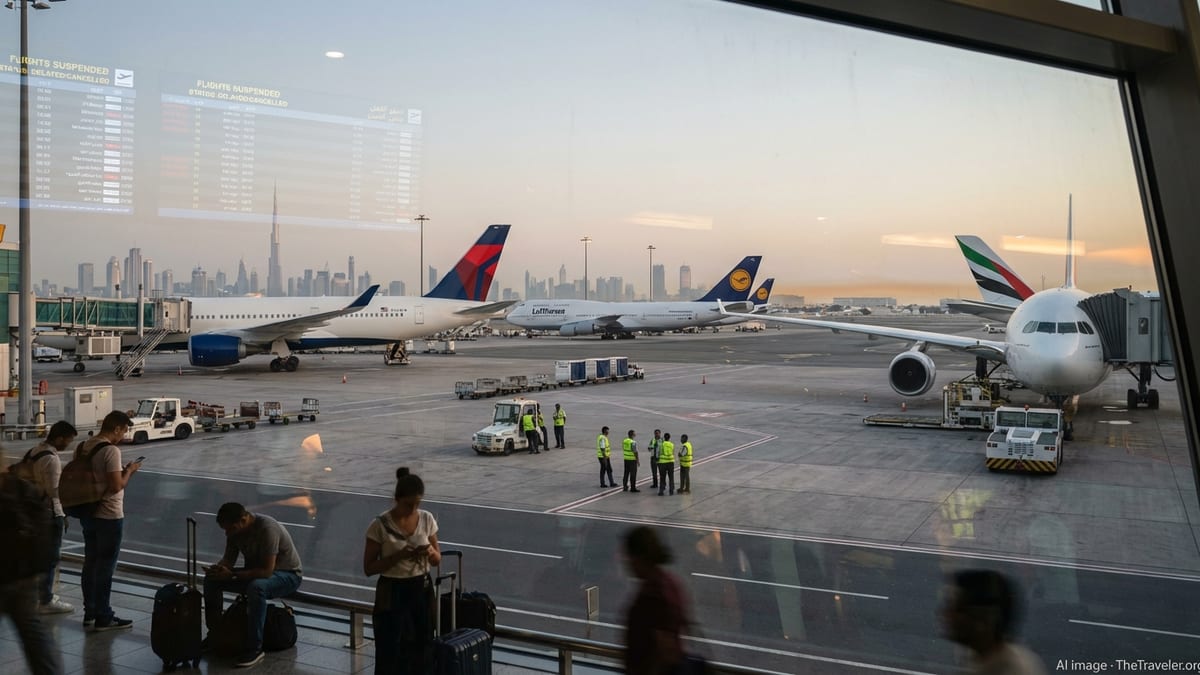
India’s Flight Network Shrinks as War Closes Regional Skies
Publicly available information shows that Indian carriers were among the first outside the immediate conflict zone to feel the impact when the United States and Israel launched airstrikes on Iran on February 28, 2026, followed by retaliatory attacks and widespread airspace closures across West Asia. Within hours, aviation notices shut or restricted skies over Iran, Israel, Iraq, Jordan, Qatar, Bahrain, Kuwait, the United Arab Emirates and other states, instantly severing key corridors that connect India with the Gulf and onward to Europe and North America.
Reports indicate that Air India responded by suspending all flights to destinations across the UAE, Saudi Arabia, Israel and Qatar for several days in late February and early March. Government data cited in Indian media later showed that daily departures between India and the Middle East fell from roughly 300–350 flights to fewer than 100 as carriers cancelled or sharply curtailed services while waiting for clarity on which airports and routes remained viable.
Budget operators IndiGo and SpiceJet also cancelled and rerouted services to Dubai and other Gulf cities as airports and airspace in the region cycled through partial closures and temporary reopenings. Even when some hubs resumed limited operations, carriers faced pressure to avoid overflying conflict-affected zones, stretching flying times on routes that remained technically open and further eroding already thin margins.
Passengers traveling between India and the Gulf reported rolling disruptions, with flights shifted to last-minute routings, extended layovers at alternative hubs, and frequent delays as aircraft and crews fell out of position. Public guidance from carriers and regulators consistently urged travelers to monitor airline apps and airport boards closely and to be prepared for same-day schedule changes.
Air India’s “Drastic” Cuts and Cost Squeeze
According to recent corporate updates, Air India has moved beyond short-term suspensions and into structural reductions of its Middle East network. The airline disclosed in March that it had already cancelled around 2,500 flights to the wider region over a three-week span, leaving it with roughly 30 percent of its usual Middle East schedule as war-related closures and safety advisories persisted.
Subsequent operational notices in early April outlined a heavily pared-down pattern of flights to Gulf destinations. Schedules showed no regular Air India or Air India Express services to several key airports, including Doha, Kuwait, Bahrain, Dammam and Tel Aviv, while operations to hubs such as Dubai, Abu Dhabi, Muscat and Jeddah were restricted to a limited mix of scheduled and ad hoc sectors. Industry analysts describe the shift as one of the most significant contractions of India–Gulf capacity in more than a decade.
Rising aviation turbine fuel prices have intensified the pressure. Data compiled by industry researchers indicate that the share of fuel in Indian carriers’ operating costs has climbed toward 55 to 60 percent, up from a prewar baseline of around 30 to 40 percent. Air India has announced phased fuel surcharges on international routes, including West Asia, in a bid to pass a portion of those costs to passengers while warning staff internally that further capacity cuts may be required if demand weakens or jet fuel prices climb higher.
Domestic trade groups have cautioned that India’s airlines, many of which only recently began to stabilize after the pandemic, face a “double bind”: reduced access to some of their most profitable international markets just as energy prices soar and currency volatility complicates hedging strategies. Executives across the sector are now pushing for tax relief on fuel and more flexible slot and routing rules to preserve connectivity without tipping weaker carriers into insolvency.
Emirates, KLM, Swiss and Others Navigate Airspace Maze
India’s difficulties mirror a wider shock that has rippled through aviation networks spanning Europe, the Gulf, North America and East Asia. Travel advisories from major European carriers show that KLM has halted flights to Tel Aviv, Dubai, Riyadh and Dammam into mid-May while avoiding the airspace of Iran, Iraq and Israel, as well as sections of several Gulf states. Similar restrictions apply across the Air France–KLM group, forcing long-haul flights between Europe and Asia to divert north over the Caucasus and Central Asia.
Swiss, Singapore Airlines, Gulf Air and other global carriers have pursued comparable strategies, trimming frequencies and threading aircraft through narrower safe corridors that add hours to traditional routes linking Europe with India, Southeast Asia and Australia. Aviation safety regulators in Europe have extended formal advisories against overflying much of the conflict zone well into April 2026, a move that effectively locks in higher operating costs and longer schedules for the upcoming summer season.
Middle Eastern giants such as Emirates and Qatar Airways have also been hit hard. Studies by aviation consultancies show that Gulf super-connectors, which previously relied on unrestricted access to regional flight information regions around Iran and the Arabian Peninsula, now face complex rerouting that cuts into the time and cost advantages of their hub-and-spoke models. Some services have been suspended outright as carriers weigh the economics of flying lengthened routes with uncertain demand against parking aircraft and redeploying capacity elsewhere.
Even when airlines keep routes open, the cumulative effect of avoiding multiple conflict-adjacent airspaces has produced a patchwork of circuitous flight paths. Schedules that once involved a single overnight leg now often require extended flight times, additional crew, and tighter fuel management, putting strain on both operations centers and front-line crews coordinating disrupted connections.
Fuel Shock and the Global Aviation Fallout
The Middle East war has not only scrambled air routes but also disrupted global energy flows, driving an unprecedented spike in the cost of jet fuel. Industry research cited by European and international media places the current price of jet fuel at more than double prewar averages, with crude oil supply curtailed and refining capacity in parts of the Gulf damaged or reduced.
For airlines in India, the United States, China, France, Italy and other major markets, the result is a rapid escalation in fuel as a share of total operating costs. Trade bodies in Europe report that fuel has risen from approximately one quarter of expenses to around 45 percent, while similar or higher ratios are now reported in India and several emerging markets. These shifts are compressing margins even for large, well-capitalized carriers, while pushing smaller or heavily indebted airlines toward critical financial thresholds.
The fuel shock is feeding through to passengers in the form of higher fares, fuel surcharges and reduced seat availability on popular routes. Analysts tracking schedules note that airlines on both sides of the Atlantic have cut capacity plans for the rest of 2026, citing jet fuel prices and route instability linked to the Middle East conflict. In North America, at least one ultra-low-cost carrier has ceased operations after failing to absorb the jump in fuel bills, highlighting the vulnerability of budget models that depend on high utilization and minimal pricing power.
In Asia and Europe, premium-focused carriers are using loyalty programs and high-yield business cabins to cushion the blow, but there is growing concern that a prolonged period of elevated fuel costs could reshape global networks, with thinner point-to-point routes and secondary city links most exposed to cancellation.
Travelers Face Longer Journeys and Persistent Uncertainty
For travelers, the crisis has translated into longer journeys, fewer nonstops and persistent uncertainty over whether booked itineraries will operate as planned. With many Middle East hubs operating below normal capacity or subject to sudden restrictions, passengers from India, Europe and North America increasingly find themselves funneled through alternative gateways in Central Asia, Southern Europe or East Asia.
Public advice from regulators and consumer groups consistently emphasizes the importance of flexibility. Travelers are being urged to allow extra connection time, monitor airline and airport notifications closely, and be prepared for rapid schedule changes as airlines adjust to shifting airspace permissions and fuel economics. In some cases, governments have temporarily relaxed slot rules or allowed cargo-only operations on passenger aircraft to maintain critical supply chains, further complicating passenger schedules.
The broader picture is one of a global aviation system grappling simultaneously with security risks, energy shocks and fragile balance sheets. India’s experience, from Air India’s abrupt cuts and surcharges to the wider retrenchment of Gulf and European carriers, illustrates how quickly a regional conflict can cascade through interconnected air networks.
With no clear timeline for a political resolution in the Middle East and fuel markets still volatile, industry observers warn that volatility in routes and pricing is likely to persist well into the year. Travelers and airlines alike are settling into a new phase of crisis management, where contingency planning and real-time route adjustments are becoming part of daily operations rather than exceptional responses.