


Few climbing destinations are as mythic as Indian Creek, the sweeping red sandstone canyon that forms the northern portion of Bears Ears National Monument in southeastern Utah. Renowned for its laser-straight splitter cracks, quiet desert camps, and big skies, it is both a performance arena for elite trad climbers and a rite of passage for anyone who loves sandstone. This guide brings together current information on routes, camping, regulations, and logistics so you can plan a safe and respectful trip to the Creek.
Get the latest updates straight to your inbox!
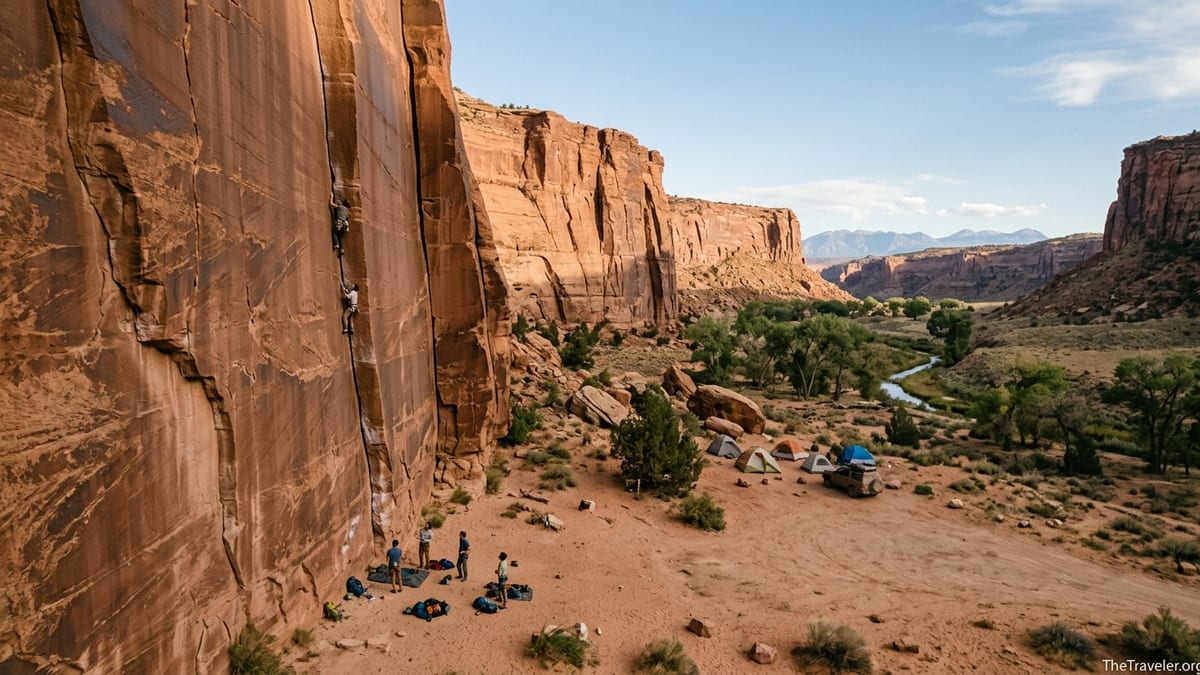
Where You Are: Indian Creek in Bears Ears National Monument
Indian Creek sits along Utah Highway 211 between the town of Monticello and the Needles District of Canyonlands National Park. The cliffs you see from the road are primarily Wingate sandstone, cut by parallel cracks that have made this canyon one of the world capitals of crack climbing. The area is managed by the Bureau of Land Management as part of Bears Ears National Monument, with a patchwork of private ranch lands along the valley floor.
From Moab, it is roughly a 1.5-hour drive, often combined with a stop at Newspaper Rock State Historical Monument, where petroglyphs hint at thousands of years of human presence in the canyon. Climbers usually base themselves either in the corridor’s BLM campgrounds, in dispersed sites on surrounding public land, or in motels and rentals in Monticello or Moab, driving in daily to climb.
Because the corridor is now firmly within a high-profile national monument, Indian Creek is managed more actively than it was a decade ago. That means more clear rules on camping, group sizes, and fixed anchors, along with seasonal raptor closures. Before you arrive, it is worth checking the BLM’s Monticello Field Office information for any fresh restrictions.
The climbing itself is almost entirely traditional crack climbing. There is virtually no sport climbing and very little easy terrain. For many visitors, even those comfortable leading 5.10 in other areas, the Creek can feel like starting from scratch. Planning your trip with realistic expectations and good information is essential.
Best Seasons, Weather, and How Long to Stay
The prime seasons for Indian Creek mirror the broader Moab area: spring and fall. March through May and late September through early November typically offer daytime highs in the 60s and 70s Fahrenheit, which is ideal for sandstone crack climbing. In those shoulder seasons, expect cold nights that dip near or below freezing, so four-season sleeping bags or at least high-quality three-season bags and warm layers are standard camp gear.
Summer in Indian Creek is extremely hot, with temperatures often pushing well above 90 degrees Fahrenheit and almost no shade at the base of many cliffs. A few locals will chase early morning or evening sessions, but for most travelers, June through August is considered off-season. Winter can be surprisingly viable, with sunny days on south-facing walls, but snow and ice on the road shoulders and bitterly cold nights make it more of an advanced, self-reliant mission.
A common first trip is about one week: two days to let your hands and technique adapt, two to three “big” climbing days, and a rest or sightseeing day in the Needles District or Arches National Park. Many repeat visitors plan longer stays of 10 days to three weeks, often combining the Creek with towers near Moab or desert bouldering at places like Big Bend or Big Bend Boulders.
Whatever your season, it is critical to factor in weather-related rock ethics. Local guidance is to avoid climbing for at least 24 to 48 hours after significant rain. Wet sandstone is fragile and gear placements can blow out, so on stormy spring weeks you may find yourself shifting plans to nearby hiking or road trips instead of climbing.
Classic Climbing Areas and Sample Routes
Indian Creek has thousands of crack routes, and new lines still appear each year. Modern guidebooks and apps group these into walls and canyons: Supercrack Buttress, Donnelly Canyon, Battle of the Bulge, Reservoir Wall, the Cat Wall, Optimator, and many more. For a new visitor, it is helpful to think in terms of a few high-profile sectors and then branch out.
Supercrack Buttress, visible from Highway 211 and only a short hike from the road, is the most famous crag. Here you will find routes like Supercrack of the Desert, a long, perfect hand crack that many climbers have seen in photos long before they arrive. Nearby, Incredible Hand Crack, Twin Cracks, and Coyne Crack showcase different sizes from tight hands to wider pods. On a peak October weekend, every line may have a rope on it, which is why experienced Creek climbers often push farther up canyon to less crowded walls.
Donnelly Canyon, a few minutes away, offers a dense collection of moderates and harder lines in the 5.10 to 5.11 range, including popular first-Creek routes with relatively short approaches. Battle of the Bulge and Reservoir Wall feature stunning corners and splitter cracks at grades that can feel demanding even for seasoned trad leaders. At Optimator Wall, routes like Annunaki have become modern testpieces, frequently featured in climbing media as examples of aesthetic desert crack climbing.
For those who climb primarily in the 5.9 to 5.10 range, recommendations often include avoiding the most crowded “zoo” crags and instead exploring satellite walls and lesser-known buttresses. Even then, expect each route to be a sustained lesson in one crack size. A single line might require six or more cams of the same number, which is unusual compared with most granite trad areas. It is very common to see parties pooling gear to make up adequate racks for a day’s objectives.
Gear, Skills, and Safety for Indian Creek
Climbing at Indian Creek is gear-intensive. Most standard Creek racks include multiple cams in each size from small hands through wide hands and often into offwidth. Experienced visitors commonly arrive with doubles or triples from small finger sizes through large hands, plus extra pieces in the specific size of the day’s project. For instance, a classic hands route might feel most comfortable with six or more identical cams in that size.
If you do not own a huge rack, there are a few practical strategies. Many traveling climbers coordinate with partners via online forums or local notice boards in Moab to combine gear. Guiding services based in Moab also provide equipment on courses that focus on crack technique and desert safety, which can be an efficient way to experience the area if you are new to trad climbing. However you approach it, count on bringing tape for your hands, a helmet, and enough warm layers for long belays in the wind.
Technical skills matter as much as equipment. True crack technique is essential: jamming hands, fingers, fists, and even arms instead of relying on face holds. Many strong sport climbers find that their usual grade does not transfer directly. It is wise to start at least a full number grade below your normal onsight level until you understand how your body and headspace react to long, sustained cracks with gear well below your feet.
Safety in the Creek also extends beyond the climb. Loose sand on ledges, sudden wind gusts, and long walks back to the car demand attention. Communication at the cliff can be tricky when multiple parties shout similar commands in a tight canyon. Consider using names instead of generic calls and confirm systems carefully. At the camp, plan for self-sufficiency: there are no services like water or trash pickup at most sites, and cell coverage is spotty or nonexistent along much of the corridor.
Camping Options: Campgrounds and Dispersed Sites
Overnight options in Indian Creek fall into two main categories: established BLM campgrounds and dispersed camping on surrounding public lands where allowed. Within the corridor, the three flagship campgrounds are Hamburger Rock, Superbowl, and Creek Pasture. Sites at these campgrounds are primarily first-come, first-served and, as of recent BLM guidance, typically cost around 15 US dollars per night for standard sites with a 14-day stay limit. Payment is often handled via self-pay envelopes or mobile app scan-and-pay systems, so arriving with a bit of cash and a charged phone is wise.
Each of these campgrounds offers basic amenities like vault toilets and defined tent or vehicle pads, but you should not expect hookups, showers, or potable water. Tanks or large jugs filled in Moab or Monticello are the norm. During busy fall and spring weekends, these campgrounds routinely fill by late afternoon. Many Creek regulars time their arrival for midweek or early morning to secure a site, especially if they are driving in from farther afield like Denver, Salt Lake City, or Flagstaff.
Group campsites are available at places such as Indian Creek Falls Group Site, Superbowl Group Site, and Creek Pasture Group Site. These are designed for organized groups and can generally accommodate larger gatherings. They must be reserved in advance through the national reservation system, and their nightly cost is significantly higher than individual sites, reflecting both the extra capacity and the impact larger groups can have.
Dispersed camping is permitted on many BLM lands around the corridor, subject to current Bears Ears management rules. Typically, this means camping in already-disturbed sites at least a short distance off designated roads, packing out all trash, and staying well away from water sources to protect scarce desert springs. Some riparian areas along Indian Creek itself are closed to camping to protect vegetation and cultural sites, so it is important to respect posted “No Camping” signs and to avoid creating new fire rings or vehicle tracks.
Regulations, Closures, and How to Minimize Your Impact
Because Indian Creek is part of Bears Ears National Monument, regulations are designed to protect both natural ecosystems and a dense concentration of cultural resources. Archeological sites, including ancient dwellings, rock art, and artifact scatters, are widespread. The overarching rule is simple: look, do not touch. It is illegal to remove artifacts, carve into rock, or build new structures. Climbers should avoid establishing new routes that would pass directly through cultural features or require cleaning on fragile patina near petroglyphs.
Raptor nesting closures are another key feature of the modern Creek season. Golden eagles and peregrine falcons often nest on the same cliffs that climbers prize. Each spring, biologists survey the canyon and designate temporary avoidance zones, usually in effect from March into late summer. Popular cliffs like The Wall, the Meat Walls, Reservoir Wall, Cat Wall, and others may have temporary restrictions on certain routes or sectors. Signs at trailheads and information from the Monticello Field Office outline which areas to avoid in a given year, and these closures can change as nesting patterns shift.
Day-to-day, low-impact behavior is what keeps Indian Creek special. Practical examples include using human waste bags or portable toilets instead of burying waste in desert soils that lack the microorganisms to break it down, keeping vehicles on established tracks rather than creating new shortcuts, and walking on durable surfaces such as rock or packed sand instead of cryptobiotic soil crusts. That dark, lumpy crust is alive and can take decades to recover from a single footprint.
Noise and crowding are also part of the human footprint. Quiet hours in campgrounds are not just formalities but a courtesy that helps climbers rest for big days on the wall. At crowded crags, sharing routes, communicating respectfully with other parties about plans, and avoiding monopolizing classic lines all contribute to a healthier culture in the canyon. None of these rules are complicated, but collectively they determine whether Indian Creek can absorb heavy visitation without losing its character.
Getting There, Supplies, and Practical Logistics
Most visitors arrive by car. From Moab, you drive south on US 191, then turn west onto Highway 211 at the signed junction for Canyonlands National Park and Newspaper Rock. From Monticello, it is a shorter drive north on US 191 to the same turnoff. The paved road follows Indian Creek for more than 20 miles before reaching the Needles District entrance, with trailheads and campgrounds branching off along the way. Passenger cars usually have no trouble in dry weather, but side roads to some walls and camps can become muddy and rutted after storms.
There are no services in the Indian Creek corridor itself. The nearest gas stations, groceries, and gear shops are in Moab or Monticello. A common strategy is to stock up on water, food, and firewood in town before heading into the canyon for several days at a time. For specialized gear like large cams, crack gloves, or replacement ropes, Moab’s climbing shops are the most reliable source, while general supermarkets there and in Monticello cover basic groceries and ice.
Digital maps and guide apps are extremely useful, but reception can be unreliable. Many climbers rely on a combination of printed guidebooks, offline digital topos, and screenshots of approach maps taken before leaving town. For emergency communication, some parties carry satellite messengers or GPS devices, especially in shoulder seasons when fewer people are at the cliffs.
Water management is perhaps the single most important logistical issue. For a pair of climbers camping and climbing full days, it is common to haul 10 to 15 gallons of water per car for a long weekend, covering drinking, cooking, and minimal washing. There are no public taps in the corridor, and natural water sources are both unreliable and ecologically sensitive, so you should not plan to filter directly from the creek for your main supply.
The Takeaway
Indian Creek is not a casual roadside crag. It is a remote, gear-hungry, ethically complex landscape that demands preparation and respect. For those who make the effort, though, it offers some of the most memorable days of climbing on earth: long, pure crack pitches against a backdrop of red walls, blue skies, and distant mesas. The experience of jamming up a clean Wingate splitter as the afternoon light turns the canyon gold is what keeps visitors returning season after season.
Planning your visit around the best seasons, arriving with appropriate gear and skills, and choosing camping options that fit current regulations all make a huge difference. Just as importantly, learning the nuances of desert etiquette, from waiting for rock to dry after rain to treating cultural sites with care, ensures that Indian Creek remains a place future climbers can experience in the same condition.
Whether you are ticking a life-list route like Supercrack of the Desert, learning to tape your hands on your first 5.9 crack, or simply soaking up the quiet of a star-filled desert night, Indian Creek rewards intention. Travel light on the land, prepare thoroughly, and the canyon will repay you with an unforgettable climbing pilgrimage.
FAQ
Q1. Do I need a permit to climb in Indian Creek?
In most cases individual climbers do not need a specific permit just to climb, but group campsites and certain organized activities may require reservations or permits. It is wise to confirm the latest requirements with the managing agencies before your trip.
Q2. What is the best time of year to visit Indian Creek for climbing?
The most reliable seasons are spring and fall, typically March through May and late September through early November, when daytime temperatures are cool enough for sandstone and nights are cold but manageable for camping.
Q3. Is Indian Creek suitable for beginner climbers?
Indian Creek has very few true beginner routes. Most climbs are steep, sustained cracks that can feel difficult even for experienced leaders. Newer climbers are better off gaining basic trad and crack skills at friendlier areas before treating the Creek as a progression trip.
Q4. How much climbing gear do I need for a typical day?
Compared with other areas, you will likely need more cams of the same size. Many parties bring doubles or triples from thin hands through wide hands and add extra pieces in the dominant size of their chosen route, often pooling racks among partners.
Q5. Are there water sources or stores in the Indian Creek corridor?
No. There are no reliable public water sources, grocery stores, or fuel stations in the corridor itself. Most visitors haul water and supplies from Moab or Monticello and plan to be fully self-sufficient while camped in the canyon.
Q6. Can I camp anywhere along Indian Creek?
No. Camping is allowed only in designated campgrounds or in certain previously disturbed dispersed sites on public land. Some riparian zones and stretches near the creek are closed to camping, and all visitors must follow posted signs and current BLM guidance.
Q7. What should I do about human waste while camping and climbing?
The recommended practice is to use pack-out systems such as waste bags or portable toilets. Desert soils do not break down waste effectively, and burying it is discouraged in heavily used areas like Indian Creek.
Q8. How do raptor nesting closures affect climbing plans?
Each spring, some cliffs are temporarily closed or restricted to protect nesting birds of prey. These closures can impact specific routes or entire walls, so climbers should check current maps and signs and be prepared to choose alternative crags.
Q9. Is four-wheel drive necessary to access the climbing areas?
In dry conditions, most main parking areas and campgrounds are accessible by standard passenger cars. However, side roads can become muddy or deeply rutted after storms, and in those conditions high-clearance or four-wheel drive vehicles are safer.
Q10. How crowded is Indian Creek, and can I still find solitude?
On peak-season weekends, classic crags like Supercrack Buttress can be very busy, with queues on famous routes. By visiting midweek, exploring less-publicized walls, and walking a little farther from the road, many climbers still find quiet corners of the canyon.