


More news on this day
Iranian missile and drone attacks on Kuwait, described in official Gulf statements as “heinous” and part of repeated aggression, have prompted temporary airspace closures, diversions and mounting disruption for passengers flying through Dubai and the wider Middle East.
Get the latest news straight to your inbox!
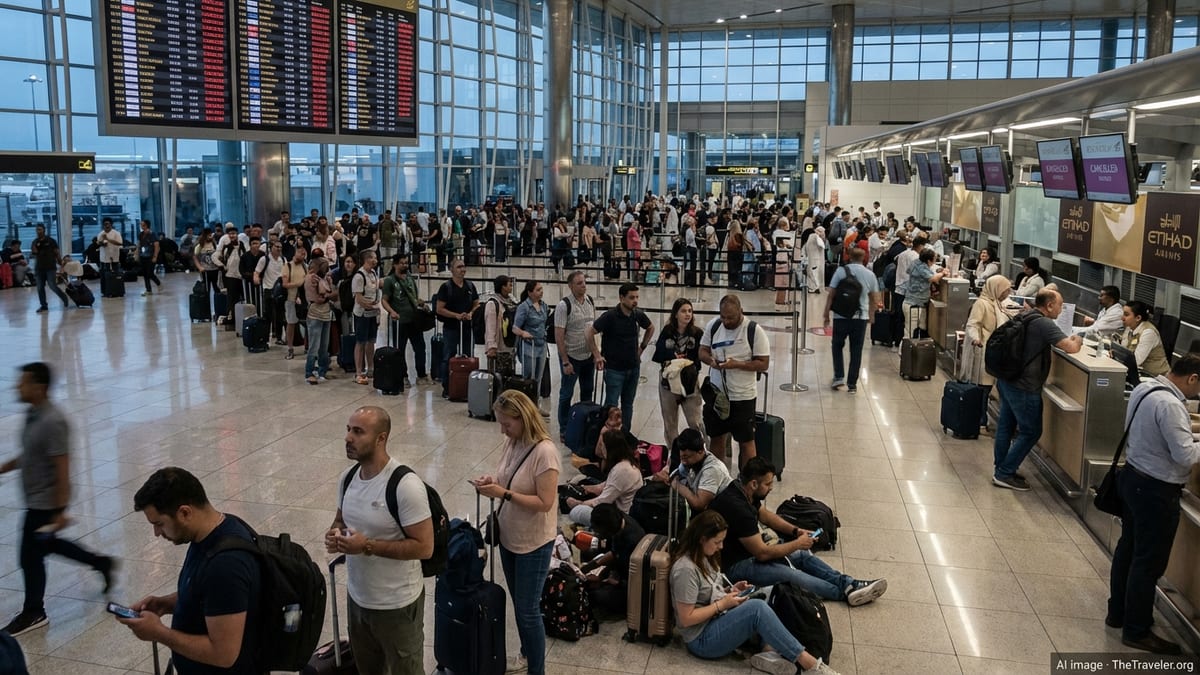
Fresh Iranian strikes deepen regional aviation turmoil
Publicly available information from Gulf and international media indicates that Kuwait came under renewed Iranian missile and drone fire early on Thursday, September 3, 2026, as part of a wider escalation between Tehran and Washington. Kuwait’s military reported that its air defenses were engaging what it called hostile projectiles launched from Iran, following similar attacks earlier in the week.
Coverage in regional outlets describes the latest barrage as part of repeated aggression, with Kuwait’s foreign ministry characterizing the strikes as heinous and a direct threat to the country’s security, stability and residents. The attacks follow days of cross-border fire that began when the United States resumed strikes on Iranian targets after a brief lull in hostilities.
In this context, aviation has again become one of the first sectors to feel the impact. Kuwait’s airports and surrounding airspace sit on a busy corridor linking the Indian subcontinent, the Gulf and Europe, so any shutdown or risk assessment immediately ripples across airline schedules and routings throughout the region.
Kuwait airspace closures and rerouted traffic
The Directorate General of Civil Aviation in Kuwait has previously confirmed that it temporarily closed the country’s airspace as a precaution when confronted with Iranian missile and drone activity, diverting multiple flights to neighboring airports. Official notices cited risk to civil aviation and emphasized that safety of passengers, crews and infrastructure was the primary concern while air defenses responded.
According to aviation statements reviewed in Arabic and English, earlier shutdowns of Kuwaiti airspace lasted around two hours, during which at least 11 flights operated by Kuwait Airways and Jazeera Airways were redirected to alternative airports such as Dammam and Riyadh. Once authorities assessed that conditions had stabilized and the immediate threat had subsided, airspace was reopened and diverted flights were progressively brought back to Kuwait International Airport.
The renewed attacks reported on September 3 are occurring against a backdrop of similar incidents in recent months, including prior strikes that damaged facilities at Kuwait International Airport. Analysts quoted in open sources note that repeated interruptions have forced carriers to plan around intermittent closures and the possibility of sudden diversions, which can create significant knock-on effects for aircraft rotations and crew scheduling.
Dubai and Gulf hubs brace for cascading delays
Major hubs in the United Arab Emirates, particularly Dubai International Airport and Abu Dhabi’s Zayed International Airport, are once again managing waves of disruption linked to heightened tensions and changing airspace conditions. Travel advisories and local reporting from September 2 and 3 show that dozens of flights to and from the UAE have been delayed, rerouted or cancelled as airlines react to evolving security assessments and route restrictions.
Public flight-status data compiled by regional media indicates that airlines including Emirates, Etihad and low-cost carriers serving South Asia and the wider Middle East have adjusted services, with some long-haul departures from Dubai cancelled and others subject to extended delays. Carriers have warned that timings remain subject to change at short notice as they work around temporary airspace constraints over Kuwait and areas closer to Iran.
Industry guidance issued during earlier phases of the current conflict suggested that airlines might increasingly avoid routings over or near Iranian territory and affected Gulf corridors, adding flight time and fuel burn on key links between Europe, the Gulf and Asia. While many services remain operational, the combination of tactical rerouting, slot constraints at busy hubs and crew duty limits is producing irregular operations that travelers are experiencing as rolling delays across multiple days.
What travelers transiting Dubai and the region should expect
For travelers booked through Dubai and other Gulf hubs, the latest attacks on Kuwait reinforce the need for flexibility. Travel media and airline advisories reviewed on Thursday urge passengers to check their flight status repeatedly in the hours before departure and to allow extra time for connections, especially on itineraries involving multiple stops in the region.
Some international airlines have already suspended or adjusted services into parts of the Gulf in response to the broader conflict, including temporary pauses on select routes to Dubai and Riyadh cited in recent travel advisories. Others are operating but with warnings that further changes are possible as the security situation evolves and as authorities in Kuwait and neighboring states reassess risk to civil aviation.
Travel-industry analysis highlights that even short airspace closures, such as the two-hour shutdowns reported around Kuwait’s earlier interceptions, can disrupt the tightly choreographed schedules of hub-and-spoke carriers. Aircraft and crews arriving late from one leg can cause knock-on delays to onward flights, a pattern that is already apparent in the departure boards at Dubai and Abu Dhabi.
Outlook for regional air travel amid continuing hostilities
As the conflict between Iran and the United States grinds into its sixth month, with missile and drone exchanges increasingly touching the territory of Gulf states, aviation planners face a shifting risk map. Commentaries from logistics specialists suggest that wider closures or persistent rerouting across multiple Gulf airspaces could lengthen standard flight times between Asia and Europe and reduce available capacity on peak corridors.
For now, published schedules show that Gulf mega-hubs remain open and operational, albeit with elevated disruption. Kuwait’s strong condemnation of what it describes as repeated heinous attacks, and its stated right to take measures to defend its sovereignty and vital facilities, underscores the possibility that further military activity could intersect with civil aviation in the coming days.
Travelers with upcoming itineraries through Kuwait, Dubai, Abu Dhabi, Doha or other regional hubs are therefore likely to see a period of heightened uncertainty, with last-minute adjustments more common than in calmer times. Airlines are continuing to update passengers through their websites and apps, while airports across the Gulf work to keep operations running as smoothly as possible under rapidly changing circumstances.
Condé Nast Traveller Middle East: Dubai and Middle East flight disruption
The National: UAE flights delayed and cancelled amid regional tensions
Emirates News Agency: Kuwait condemns repeated Iranian attacks
Kuwait DGCA: Statement on temporary airspace closure and flight diversions